
DOI:
https://doi.org/10.14483/22487638.22943Publicado:
31-12-2025Número:
Vol. 29 Núm. 86 (2025): Octubre - DiciembreSección:
RevisiónEmerging Trends in Business Intelligence: A systemic Mapping Study
Tendencias emergentes en Inteligencia de Negocios: un mapeo sistémico
Palabras clave:
business intelligence, emerging trends, systematic mapping, VOSViewer (en).Palabras clave:
inteligencia de negocios, tendencias emergentes, mapeo sistémico, VOSViewer (es).Descargas
Resumen (en)
Objective: The study aims to conduct a systematic mapping of emerging trends in business intelligence (BI) by analyzing research published between 2017 and 2024, in order to identify patterns, influential authors, key sectors, and future research opportunities.
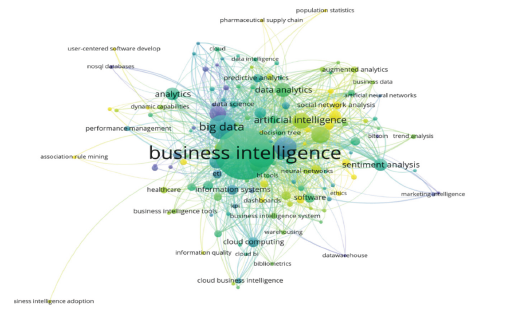
Methodology: We used the systematic mapping methodology described by Kitchenham, including two iterations of searches in academic databases such as Scopus, IEEE Xplore, and Web of Science. The collected data (1504 studies) were analyzed using tools such as VOSviewer and Microsoft Excel, focusing on network maps, overlays, and density visualizations to interpret key patterns and relationships.
Results: The analysis revealed dominant trends such as the use of big data, machine learning, predictive analytics, and real-time BI. Geographically, Asia and the Middle East lead in publications, with strong BI adoption in sectors such as healthcare, education, and retail. Less explored areas were also identified, such as the integration of BI with the Internet of Things, advanced social network analytics, and data ethics.
Conclusions: This study concludes that BI continues to evolve towards more advanced and ethically responsible technologies, with a focus on personalization and real-time decision-making. Less explored areas represent opportunities for future research, particularly regarding data governance and the integration of BI in specific sectors. This work provides a comprehensive overview of the current state of BI research and suggests strategic directions for its development.
Resumen (es)
Objetivo: este estudio tiene como objetivo realizar un mapeo sistemático de las tendencias emergentes en inteligencia de negocios (BI), analizando investigaciones publicadas entre 2017 y 2024, para identificar patrones, autores influyentes, sectores principales y oportunidades futuras de investigación.
Metodología: se utilizó la metodología de mapeo sistemático descrita por Kitchenham, incluyendo dos iteraciones de búsqueda en bases de datos académicas como Scopus, IEEE Xplore y Web of Science. Los datos recopilados (1504 estudios) fueron analizados mediante herramientas como VOSviewer y Microsoft Excel, con énfasis en mapas de red, superposición y densidad para interpretar patrones y relaciones clave.
Resultados: el análisis reveló tendencias predominantes, como el uso de big data, machine learning, análisis predictivo y BI en tiempo real. En términos geográficos, Asia y Medio Oriente lideran en publicaciones, con una fuerte adopción de BI en sectores como salud, educación y comercio minorista. También se identificaron áreas menos exploradas, como la integración de BI con el Internet de las Cosas, la analítica avanzada de redes sociales y la ética en el manejo de datos.
Conclusiones: El estudio concluye que BI sigue evolucionando hacia tecnologías más avanzadas y éticamente responsables, con un enfoque en la personalización y la toma de decisiones en tiempo real. Las áreas menos investigadas representan oportunidades para futuras investigaciones, particularmente en la gobernanza de datos y la integración de BI en sectores específicos. Este trabajo ofrece una visión integral del estado actual de la investigación en BI y sugiere direcciones estratégicas para su desarrollo.
Referencias
[1] F. Fernandes, J. Correia, and A. Pontes, “Business intelligence: Trends and the impact of emerging technologies,” presented at the Iberian Conf. Infor. Syst. Tech., 2023. https://doi.org/10.23919/CISTI58278.2023.10211645
[2] F. Gurcan, A. Ayaz, G. Dalveren, and M. Derawi, “Business Intelligence strategies, best practices, and latest trends: Analysis of scientometric data from 2003 to 2023 using machine learning,” Sustainability, vol. 15, no. 13, art. 9854, jul. 2023. https://doi.org/10.3390/su15139854
[3] B. Kitchenham, O. Pearl Brereton, D. Budgen, M. Turner, J. Bailey, and S. Linkman, “Systematic literature reviews in software engineering – A systematic literature review,” Inf. Softw. Technol., vol. 51, no. 1, pp. 7–15, ene. 2009. https://doi.org/10.1016/j.infsof.2008.09.009.
[4] B. Kitchenham and S. Charters, “Guidelines for performing systematic literature reviews in software engineering,” vol. 2, ene. 2007.
[5] A. Chandel and A. Sharma, “VUCA - A bibliometric and content analysis discourse using VOSviewer and Biblioshiny,” in VUCA and Other Analytics in Business Resilience, Part B, D. Singh, K. Sood, S. Kautish, and S. Grima, Eds. Leeds, UK: Emerald Insight, 2024, pp. 153–182. https://doi.org/10.1108/978-1-83753-198-120241010
[6] Z. Tang, T. Zhang, L. Wu, S. Ren, and S. Cai, “Knowledge mapping for fire risk assessment: A scientometric analysis based on VOSviewer and CiteSpace,” Fire, vol. 7, no. 1, art. 23, 2024. https://doi.org/10.3390/fire7010023
[7] M. Robot, “Discourse analysis and communication strategy of sport learning: A systematic review assisted with VOSviewer,” Retos, vol. 61, pp. 430–439, 2024. https://doi.org/10.47197/retos.v61.108864
[8] A. Hou, L. Yang, J. Lü, L. Yang, H. Kuang, and H. Jiang, “A bibliometrics visualization analysis and hotspots prediction for natural product on osteoporosis research from 2000 to 2021,” J. Future Foods, vol. 2, no. 4, pp. 326–337, 2022. https://doi.org/10.1016/j.jfutfo.2022.08.004.
[9] N. Ashal and A. Morshed, “Balancing data-driven insights and human judgment in supply chain management: The role of business intelligence, big data analytics, and artificial intelligence,” J. Infrastruct. Policy Dev., vol. 8, no. 6, art. 3941, 2024. https://doi.org/10.24294/jipd.v8i6.3941
[10] Y. Chen, C. Li, and H. Wang, “Big data and predictive analytics for business intelligence: A bibliographic study (2000–2021). | EBSCOhost.” [Online]. Available: https://openurl.ebsco.com/contentitem/doi:10.3390%2Fforecast4040042?sid=ebsco:plink:crawler&id=ebsco:doi:10.3390%2Fforecast4040042
[11] F. Wang, M. S. Raisinghani, M. Mora, and J. Forrest, “Effective decision support in the big data era: Optimize organizational performance via BI&A,” Int. J. Decis. Support Syst. Technol., vol. 14, no. 1, pp. 1–16, 2022. https://doi.org/10.4018/IJDSST.286683
[12] F. V. Calderon Pineda, D. S. Castro Loor, W. Nunez, and M. Serrano, “Applying Business Intelligence (BI) and Big Data Analytics techniques in virtual learning environments,” Rev. Cienc. Pedagog. Innov., vol. 9, no. 2, pp. 7–19, may 2021. https://doi.org/10.26423/rcpi.v9i2.463
[13] H. Ahmad et al., “The effects of big data, artificial intelligence, and business intelligence on e-learning and business performance: Evidence from Jordanian telecommunication firms,” Int. J. Data Netw. Sci., vol. 7, no. 1, pp. 35–40, 2023. https://doi.org/10.5267/j.ijdns.2022.12.009
[14] C. Barroso-Moreno, L. Rayon-Rumayor, and A. B. García-Vera, “Big data and business intelligence on twitter and instagram for digital inclusion,” Comunicar, vol. 30, no. 74, pp. 45–56, 2023. https://doi.org/10.3916/C74-2023-04
[15] S. K. Panda, V. Mishra, R. Balamurali, and A. A. Elngar, Artificial intelligence and machine learning in business management: Concepts, challenges, and case studies. Boca Raton, FL, USA: CRC Press, 2021. https://doi.org/doi: 10.1201/9781003125129
[16] T. V. Ramana, G. S. P. Ghantasala, R. Sathiyaraj, and M. Khan, Artificial intelligence and machine learning for smart community: Concepts and applications. Boca Raton, FL, USA: CRC Press, 2024. https://doi.org/ doi: 10.1201/9781003409502
[17] R. Abellera and L. Bulusu, Oracle business intelligence with machine learning: Artificial intelligence techniques in OBIEE for actionable BI. London, UK: Springer, 2017. https://doi.org/ doi: 10.1007/978-1-4842-3255-2
[18] A. Spadaccini, M. Di Pierro, P. Nadalutti, L. Cestari, and G. Pellegrini, “Data-driven prediction models at Acciaierie bertoli safau meltshop,” presented at ICS - Int. Congr. Sci. Technol. Steelmak.: Chall. Ind., 2018. [Online]. Available: https://www.scopus.com/inward/record.uri?eid=2-s2.0-85062074159&partnerID=40&md5=45b3241b8a5cec80523526aec59a01a3
[19] G. Ramesh and J. Praveen, “Artificial intelligence (AI) framework for multi-modal learning and decision making towards autonomous and electric vehicles,” presented at E3S Web Conf., 2021. https://doi.org/10.1051/e3sconf/202130901167
[20] F. Sánchez-Torres, I. González, and C. Dobrescu, “Machine learning in business intelligence 4.0: Cost Control in a destination hotel,” Int. J. Interact. Multimed. Artif. Intell., vol. 7, no. 3, pp. 86–95, mar. 2022. https://doi.org/10.9781/ijimai.2022.02.008
[21] M. Razali, S. Manaf, R. Hanapi, M. Salji, L. Chiat, and K. Nisar, “Enhancing minority sentiment classification in gastronomy tourism: A hybrid sentiment analysis framework with data augmentation, feature engineering and business intelligence,” IEEE ACCESS, vol. 12, pp. 49387–49407, 2024. https://doi.org/10.1109/ACCESS.2024.3362730
[22] T. Soussan and M. Trovati, “Sentiment urgency emotion conversion over time for business intelligence
” Int. J. WEB Inf. Syst., vol. 16, no. 5, pp. 519–528, nov. 2020. https://doi.org/10.1108/IJWIS-08-2020-0049
[23] H. El Ghalbzouri and J. El Bouhdidi, “Integrating business intelligence with cloud computing: State of the art and fundamental concepts,” in Networking, Intelligent Systems and Security, M. Ben Ahmed, H.-N. L. Teodorescu, T. Mazri, P. Subashini, and A. A. Boudhir, Eds., Singapore: Springer, 2022, pp. 197–213. https://doi.org/10.1007/978-981-16-3637-0_14
[24] E. Indriasari, S. Wayan, F. L. Gaol, A. Trisetyarso, B. Saleh Abbas, and C. Ho Kang, “Adoption of cloud business intelligence in indonesia’s financial services sector,” in Intelligent Information and Database Systems. ACIIDS 2019, T.-P. Hong, F.L. Gaol, N.T. Nguyen, and B. Trawiński, Eds., London, UK: Springer, 2019, pp. 520-529. https://doi.org/10.1007/978-3-030-14799-0_45
[25] C.-H. Huang, K.-C. Yang, and H.-Y. Kao, “A cloud business intelligence system for visual analytics with big data,” Lect. Notes Eng. Comput. Sci., vol. 2239, pp. 262–266, 2019. https://www.scopus.com/inward/record.uri?eid=2-s2.0-85065778778&partnerID=40&md5=4facc5b20a98075999497cefc41c621e
[26] F. Hamidinava, A. Ebrahimy, R. Samiee, and H. Didehkhani, “A model of business intelligence on cloud for managing SMEs in COVID-19 pandemic (Case: Iranian SMEs),” Kybernetes, vol. 52, no. 1, pp. 207–234, 2023. https://doi.org/10.1108/K-05-2021-0375
[27] P. A. Sakhnyuk, T. I. Sakhnyuk, and M. V. Korshikova, “The use of intelligent technologies of business intelligence platforms and data science and machine learning platforms for monitoring the socio-economic indicators of the administrative districts of Moscow,” IOP Conf. Ser. Mater. Sci. Eng., vol. 873, art. 012015, 2020. https://doi.org/10.1088/1757-899X/873/1/012015
[28] S. Ganesan and S. Gopalsamy, “Business intelligence and advanced analytics: Impact and behavior of business decision making process,” Int. J. Recent Technol. Eng., vol. 8, no. 3 (Special Issue), pp. 375–379, 2019. https://doi.org/10.35940/ijrte.C1080.1083S19
[29] S. Liu, H. Zhang, Z. Yang, J. Kong, L. Zhang, and C. Gao, “UXBIV: An evaluation framework for business intelligence visualization,” IEEE ACCESS, vol. 11, pp. 92391–92415, 2023. https://doi.org/10.1109/ACCESS.2023.3300418
[30] K. Weber et al., “Using business intelligence and data visualization to understand the characteristics of failed appointments in dental school clinics,” J. Dent. Educ., vol. 85, no. 4, pp. 521–530, abr. 2021. https://doi.org/10.1002/jdd.12538
[31] V. Biagi, R. Patriarca, and G. Di Gravio, “Business intelligence for IT governance of a technology company,” Data, vol. 7, no. 1, art. 2, 2022. https://doi.org/10.3390/data7010002
[32] M. del C. Becerra, A. Aballay, M. R. Romagnano, and A. Toral Sarmiento, “Análisis de nuevos problemas éticos and legales al aplicar business intelligence en los sistemas de información organizacionales,” presentado en XXI Simposio Argentino de Informática and Derecho (SID 2021) - JAIIO 50 (Modalidad virtual), 2021. [Online]. Available: http://sedici.unlp.edu.ar/handle/10915/141295
[33] H. A. Combita Niño, J. P. Cómbita Niño, and R. Morales Ortega, “Business intelligence governance framework in a university: Universidad de la Costa case study,” Int. J. Inf. Manag., vol. 50, pp. 405–412, 2020. https://doi.org/10.1016/j.ijinfomgt.2018.11.012
[34] J. M. Enríquez Herrera, “Análisis jurídico de la aplicación del business intelligence mediante un observatorio del delito en el Carchi para generar nuevas políticas públicas,” bachelor's thesis, Universidad de los Andes, Colombia, 2022. [Online]. Available: https://dspace.uniandes.edu.ec/handle/123456789/14497
[35] S. Attar-Khorasani and R. Chalmeta, “Internet of Things Data Visualization for Business Intelligence,” Big Data, vol. 12, no. 6, Feb. 2022. https://doi.org/10.1089/big.2021.0200
[36] M. Covaci and B. Covaci, “Data science, business intelligence, and the Internet of Everything: A scientometric education perspective with a mountain focus,” Rev. Romaneasca Pentru Educ. Multidimens., vol. 16, no. 2, pp. 56–70, jun. 2024. https://doi.org/10.18662/rrem/16.2/846
[37] H. Hu, M. Yin, and J. Li, “Evolution of business intelligence: An analysis from the perspective of social network,” Teh. Vjesn.-Tech. Gaz., vol. 29, no. 2, pp. 497–503, feb. 2022. https://doi.org/10.17559/TV-20210819071232
[38] I. Lanza-Cruz, R. Berlanga, and M. Jose Aramburu, “Modeling analytical streams for social business intelligence,” Inform., vol. 5, no. 3, art. 33, 2018. https://doi.org/10.3390/informatics5030033
[39] P. C. Latane, P. A. Dhakate, V. S. Ubale, and D. S. Mantri, “Real-Time data visualization for the IOT application using Tableau Platform,” presented at Int. Conf. Emerg. Smart Comput. Informatics, ESCI, 2024. https://doi.org/10.1109/ESCI59607.2024.10497376
[40] L. Butgereit, “Using GeoHashes to combine IOT and GIS to provide business intelligence to the informal sector in South Africa,” presented at EPiC Series in Computing, 2020, pp. 90-97. https://doi.org/ 10.29007/rssv
[41] I. Garcia-Magarino, M. M. Nasralla, and S. Nazir, “Real-time analysis of online sources for supporting business intelligence illustrated with bitcoin investments and iot smart-meter sensors in smart cities,” Electronics, vol. 9, no. 7, art. 1101, jul. 2020. https://doi.org/10.3390/electronics9071101
[42] T. M. Godinho, R. Lebre, J. R. Almeida, and C. Costa, “ETL framework for real-time business intelligence over medical imaging repositories,” J. Digit. Imaging, vol. 32, no. 5, pp. 870–879, 2019. https://doi.org/10.1007/s10278-019-00184-5
[43] E. Davcheva and A. Benlian, “Visual decision-making in real-time business intelligence: A social media marketing example,” in Proc. Annu. Hawaii Int. Conf. Syst. Sci., 2018, pp. 1319–1328. https://www.scopus.com/inward/record.uri?eid=2-s2.0-85106467036&partnerID=40&md5=ddcc0bfed9df7841a9d992d0414fad1a
[44] D. Delen, G. Moscato, and I. L. Toma, “The impact of real-time business intelligence and advanced analytics on the behaviour of business decision makers,” in Int. Conf. Inf. Manag. Process., 2018, pp. 49–53. https://doi.org/ 10.1109/ICIMP1.2018.8325840
[45] J. Bhuvana, M. Balamurugan, M. Aadil, and K. Hemachandran, “AI and real-time business intelligence,” in Artificial Intelligence and Knowledge Processing: Improved Decision-Making and Prediction. Boca Raton, FL, USA: CRC Press, 2023, pp. 208-222. https://doi.org/10.1201/9781003328414-18
[46] G. V. Machado, Í. Cunha, A. C. M. Pereira, and L. B. Oliveira, “DOD-ETL: distributed on-demand ETL for near real-time business intelligence,” J. Internet Serv. Appl., vol. 10, no. 1, art. 21, 2019. https://doi.org/10.1186/s13174-019-0121-z
[47] T. Guarda and I. Lopes, “Augmented analytics an innovative paradigm,” in Innovations in Bio-Inspired Computing and Applications, A. Abraham, N. Gandhi, A. Bajaj, A. M. Madureira, and C. Kahraman, Eds., Berlin, Heidelberg: Springer Science and Business Media Deutschland GmbH, 2023, pp. 725-733. https://doi.org/10.1007/978-3-031-27499-2_67
[48] R. Cherinka, J. Prezzama, and D. Edwards, “From business intelligence to augmented analytics, how organizations cope with the big data influx,” in WMSCI - World Multi-Conf. Syst., Cybern. Informatics, Proc., 2019, pp. 56-60. https://www.scopus.com/inward/record.uri?eid=2-s2.0-85074151270&partnerID=40&md5=909461e31c98ae123fc26a8a8a5eb38d
[49] P. Ukhalkar, M. Bhate, S. Hingane, and S. Hingane, “Augmented analytics: Modern business intelligence and data analytics,” presented at Int. Conf. Comput., Commun., Control Autom., ICCUBEA, 2023. https://doi.org/10.1109/ICCUBEA58933.2023.10392077
[50] N. A. Alghamdi and H. H. Al-Baity, “Augmented analytics driven by AI: A digital transformation beyond business intelligence,” Sensors, vol. 22, no. 20, art. 8071, 2022. https://doi.org/10.3390/s22208071
[51] G. M. Fernandez-Nieto, R. Martinez-Maldonado, V. Echeverria, K. Kitto, D. Gašević, and S. Buckingham Shum, “Data storytelling editor: A teacher-centred tool for customising learning analytics dashboard narratives,” presented at ACM Int. Conf. Proc. Ser., 2024, pp. 678–689. https://doi.org/10.1145/3636555.3636930
[52] H. Shao, R. Martinez-Maldonado, V. Echeverria, L. Yan, and D. Gašević, “Data storytelling in data visualisation: Does it enhance the eficiency and efectiveness of information retrieval and insights comprehension?” presented at Conf. Human Fact. Comp Syst., 2024. https://doi.org/10.1145/3613904.3643022.
[53] C. Jia and H. Mustafa, “A bibliometric analysis and review of nudge research using VOSviewer,” Behav. Sci., vol. 13, no. 1, art. 19, 2023. https://doi.org/10.3390/bs13010019
[54] J. Lopes, M. Faria, and M. Santos, “Exploring trends and autonomy levels of adaptive business intelligence in healthcare: A systematic review,” PLOS ONE, vol. 19, no. 5, art. 0302697, 2024. https://doi.org/10.1371/journal.pone.0302697
[55] A. Shollo, “Using Business Intelligence in IT Governance Decision Making” IFIP Adv. Inf. Commun. Technol., vol. 366, pp. 3–15, 2011. https://doi.org/10.1007/978-3-642-24148-2_1
[56] I. García-Magariño, M. M. Nasralla, and S. Nazir, “Real-time analysis of online sources for supporting business intelligence illustrated with bitcoin investments and IoT smart-meter sensors in smart cities,” Electron., vol. 9, no. 7, pp. 1–18, 2020. https://doi.org/10.3390/electronics9071101
[57] “7 tendencias de inteligencia de negocios en 2021,” Zoho Blog. [Online]. Available: https://www.zoho.com/blog/es-xl/analytics/7-tendencias-inteligencia-negocios.html
[58] Dataly, “Perspectivas de mercado and estadísticas de la inteligencia de negocios para 2022.” [Online]. Available: https://dataly.mx/perspectivas-de-mercado-inteligencia-de-negocios-2022/
[59] B. Kitchenham, O. Pearl Brereton, D. Budgen, M. Turner, J. Bailey, and S. Linkman, “Systematic literature reviews in software engineering – A systematic literature review,” Inf. Softw. Technol., vol. 51, no. 1, pp. 7–15, ene. 2009. https://doi.org/10.1016/j.infsof.2008.09.009.
[60] “Business Intelligence [BI] Market Size & Share | Outlook, 2032.” [Online]. Available: https://www.fortunebusinessinsights.com/business-intelligence-bi-market-103742
Cómo citar
APA
ACM
ACS
ABNT
Chicago
Harvard
IEEE
MLA
Turabian
Vancouver
Descargar cita
Licencia
Derechos de autor 2025 Jhon Fredy Hernández Castro, Gustavo Cáceres Castellanos, Juan Sebastián González Sanabria

Esta obra está bajo una licencia internacional Creative Commons Atribución-CompartirIgual 4.0.
Esta licencia permite a otros remezclar, adaptar y desarrollar su trabajo incluso con fines comerciales, siempre que le den crédito y concedan licencias para sus nuevas creaciones bajo los mismos términos. Esta licencia a menudo se compara con las licencias de software libre y de código abierto “copyleft”. Todos los trabajos nuevos basados en el tuyo tendrán la misma licencia, por lo que cualquier derivado también permitirá el uso comercial. Esta es la licencia utilizada por Wikipedia y se recomienda para materiales que se beneficiarían al incorporar contenido de Wikipedia y proyectos con licencias similares.