
DOI:
https://doi.org/10.14483/22487638.23211Publicado:
23-11-2026Número:
Vol. 30 Núm. 90 (2026): Octubre - DiciembreSección:
InvestigaciónPicking up Recycled Paper and Package Delivery System Indoors using a Mobile Robot
Sistema de Recogida de Papel de Reciclaje y Despacho de Paquetes en Interiores usando un Robot Móvil
Palabras clave:
Pickup and delivery, mobile robot, travel salesman problem (en).Palabras clave:
Recogida y entrega, robot móvil, problema del agente viajero (es).Descargas
Resumen (en)
Context: To produce 1-kg paper, 324 L of water is needed [1], so recycling paper is a better option.
Objective: This work describes the development of a system for picking up recycled paper and a package delivery system indoors.
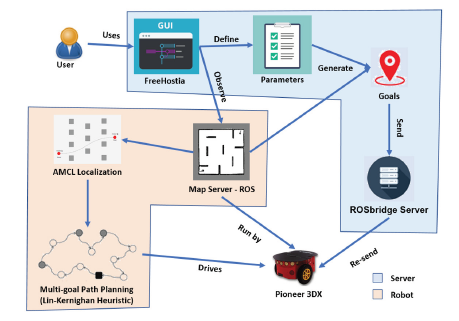
Methodology: The system includes a web page to request recycled paper pick-up and package delivery, a SQL database to track these requests, a mobile robot with ROS to execute the requests, and a multi-goal path planning system that heuristically solves the traveling salesman problem (TSP).
Results: To validate this work, integration and field tests were performed. Integration tests confirmed that the functional requirements were satisfied, and field tests observed that the system responds linearly with respect to time to user requests with an average correlation coefficient of 0.9591.
Conclusions: The REM software tool presented in this work is a valid option for implementing a recycled paper pickup or package delivery service system using mobile robots that consider the Lin-Kernighan heuristic to solve the multi-goal path planning problem.
Resumen (es)
Contexto: Para producir 1kg de papel se necesitan 324 L de agua [1], por lo tanto reciclarlo es una mejor opción.
Objetivo: Este trabajo describe el desarrollo de un sistema para la recogida de papel y el despacho de paquetes en interiores.
Metodología: El sistema incluye una página web para la solicitud de recogida de papel de reciclaje y despacho de paquetes, una base de datos SQL para su seguimiento, un robot móvil con ROS para la ejecución de las peticiones y un sistema de planificación de trayectorias multiobjetivo que resuelve heurísticamente el problema del agente viajero (TSP).
Resultados: La validación de este trabajo se realizó con pruebas de integración y de campo. Las pruebas de integración validan el cumplimiento de los requerimientos funcionales; y en las pruebas de campo se observó que el sistema responde linealmente con respecto al tiempo ante la demanda de peticiones con un coeficiente de correlación promedio de 0.9591.
Conclusiones: La herramienta de software REM presentada en este trabajo es una opción válida para implementar un sistema de servicio de recogida de papel reciclado/entrega de paquetes mediante robots móviles que considera la heurística de Lin-Kernighan para resolver el problema de planificación de rutas multiobjetivo.
Referencias
[1] Cartly, “The Impacts of Paper on The Environment.” [Online]. Available: https://cartlyapp.com/en/the-impacts-of-paper-on-the-environment/. Accessed: Feb. 27, 2024.
[2] Environmental-Paper-Network, “The Paper Calculator.” [Online]. Available: https://c.environmentalpaper.org/. Accessed: Mar. 04, 2024.
[3] A. Pérez, Sistema de gestión integral de residuos sólidos ordinarios (SGIRS). Cali, Colombia, 2020
[4] Open-Robotics, “ROS: Home.” [Online]. Available: https://www.ros.org/. Accessed: Sep. 06, 2022.
[5] K. Helsgaun, “An effective implementation of the Lin-Kernighan traveling salesman heuristic,” Eur. J. Oper. Res., vol. 126, no. 1, pp. 106–130, 2000, doi: https://doi.org/10.1016/S0377-2217(99)00284-2
[6] B. Coltin, Multi-Agent Pickup And Delivery Planning With Transfers. Dissertations, no. May, 2014, doi: https://doi.org/10.1109/ICRA.2014.6907709
[7] A. Gawel et al., “Aerial picking and delivery of magnetic objects with MAVs,” Proc. - IEEE Int. Conf. Robot. Autom., pp. 5746–5752, 2017, doi: https://doi.org/10.1109/ICRA.2017.7989675
[8] R. Hahnemann, D. Schindler, M. Kamel, R. Siegwart, and J. Nieto, “A decentralized multi-agent unmanned aerial system to search, pick up, and relocate objects,” in SSRR 2017 - 15th IEEE Int. Symp. Saf. Secur. Rescue Robot. Conf., 2017, pp. 123–128, doi: https://doi.org/10.1109/SSRR.2017.8088150
[9] B. Araki, J. Strang, S. Pohorecky, C. Qiu, T. Naegeli, and D. Rus, “Multi-robot path planning for a swarm of robots that can both fly and drive,” Proc. - IEEE Int. Conf. Robot. Autom., pp. 5575–5582, 2017, doi: https://doi.org/10.1109/ICRA.2017.7989657.
[10] P. Oettershagen, J. Förster, L. Wirth, J. Ambühl, and R. Siegwart, “Meteorology-Aware Multi-Goal Path Planning for Large-Scale Inspection Missions with Long-Endurance Solar-Powered Aircraft,” Nov. 2017
[11] K. Hernandez, B. Bacca, and B. Posso, “Multi-goal Path Planning Autonomous System for Picking up and Delivery Tasks in Mobile Robotics,” IEEE Lat. Am. Trans., vol. 15, no. 2, pp. 232–238, Feb. 2017, doi: https://doi.org/10.1109/TLA.2017.7854617.
[12] M. Liu, H. Ma, J. Li, and S. Koenig, “Task and Path Planning for Multi-Agent Pickup and Delivery,” in Proc. 18th Int. Conf. Auton. Agents MultiAgent Syst. AAMAS, 2019, doi: https://doi.org/10.65109/QTKR1570
[13] A. Koubâa, O. Cheikhrouhou, H. Bennaceur, M. F. Sriti, Y. Javed, and A. Ammar, “Move and Improve: a Market-Based Mechanism for the Multiple Depot Multiple Travelling Salesmen Problem,” J. Intell. Robot. Syst. Theory Appl., vol. 85, no. 2, pp. 307–330, 2017, doi: https://doi.org/10.1007/s10846-016-0400-x
[14] M. Ulrich, G. Lux, L. Jürgensen, and G. Reinhart, “Automated and Cycle Time Optimized Path Planning for Robot-Based Inspection Systems,” Procedia CIRP, vol. 44, pp. 377–382, 2016, doi: https://doi.org/10.1016/j.procir.2016.02.021
[15] J. Bae and W. Chung, “Efficient path planning for multiple transportation robots under various loading conditions,” Int. J. Adv. Robot. Syst., vol. 16, no. 2, p. 172988141983511, Mar. 2019, doi: https://doi.org/10.1177/1729881419835110
[16] C. A. Acosta Calderon, E. R. Mohan, and B. S. Ng, “Development of a hospital mobile platform for logistics tasks,” Digit. Commun. Netw., vol. 1, no. 2, pp. 102–111, Apr. 2015, doi: https://doi.org/10.1016/j.dcan.2015.03.001
[17] A. Oliinyk, I. Fedorchenko, A. Stepanenko, M. Rud, and D. Goncharenko, “Implementation of Evolutionary Methods of Solving the Travelling Salesman Problem in a Robotic Warehouse,” in Springer, Cham, 2021, pp. 263–292, doi: https://doi.org/10.1007/978-3-030-43070-2_13
[18] A. Tkachev, Multi-Goal Path Planning for Spray Writing with Unmanned Aerial Vehicle. Czech Technical University in Prague, 2020
[19] B. Zhang, W. Jin, X. Gao, and W. Chen, “A Multi-Goal Global Dynamic Path Planning Method for Indoor Mobile Robot,” in 2021 3rd International Symposium on Robotics & Intelligent Manufacturing Technology (ISRIMT), IEEE, Sep. 2021, pp. 97–103, doi: https://doi.org/10.1109/ISRIMT53730.2021.9597044
[20] Q. Xu, J. Li, S. Koenig, and H. Ma, “Multi-Goal Multi-Agent Pickup and Delivery,” in 2022 IEEE/RSJ International Conference on Intelligent Robots and Systems (IROS), IEEE, Oct. 2022, pp. 9964–9971, doi: https://doi.org/10.1109/IROS47612.2022.9981785
[21] A. A. H. Qizilbash, A. K. Yadav, K. Bregler, and W. Kraus, “Ant Colony Optimization for Retail Based Capacitated Vehicle Routing Problem with Pickup and Delivery for Mobile Robots,” in 2023 European Conference on Mobile Robots (ECMR), IEEE, Sep. 2023, pp. 1–6, doi: https://doi.org/10.1109/ECMR59166.2023.10256346
[22] F. Gao, X. Guo, X. Zheng, and S. Ning, “Research on AGV Path Planning of Simultaneous Pickup and Delivery with Time Window,” in 2023 26th International Conference on Computer Supported Cooperative Work in Design (CSCWD), IEEE, May 2023, pp. 1778–1782, doi: https://doi.org/10.1109/CSCWD57460.2023.10152796
[23] L. Huang et al., “Path Planning for Delivery Robots Based on an Improved Ant Colony Optimization Algorithm Combined with Dynamic Window Approach,” Sensors, vol. 26, no. 72, pp. 1–30, 2026, doi: https://doi.org/10.3390/s26010072
[24] Taryana Suryana, “Rational Unified Process (RUP),” Ration. Unified Process RUP, vol. 3, no. September, pp. 1–6, 2007
[25] J. Mace, J. Lee, R. Toris, B. Alexander, D. Bertram, and M. Gruhler, “RosBridge Protocol Specification,” GitHub. [Online]. Available: https://github.com/RobotWebTools/rosbridge_suite/blob/groovy-devel/ROSBRIDGE_PROTOCOL.md. Accessed: Sep. 01, 2018
[26] C. H. Wurll, D. O. Henrich, and H. E. Wörn, “MULTI-GOAL PATH PLANNING FOR INDUSTRIAL ROBOTS,” in International Conference on Robotics and Application (RA'99), Santa Barbara, USA, 1999, pp. 1–7
[27] J. Janos, V. Vonasek, and R. Penicka, “Multi-Goal Path Planning Using Multiple Random Trees,” IEEE Robot. Autom. Lett., vol. 6, no. 2, pp. 4201–4208, Apr. 2021, doi: https://doi.org/10.1109/LRA.2021.3068679
[28] L. Hu and Z. Kong, “Multi-target point path planning algorithm for mobile robot based on probabilistic roadmap,” Intell. Serv. Robot., vol. 19, no. 1, p. 9, Jan. 2026, doi: https://doi.org/10.1007/s11370-025-00670-6
Cómo citar
APA
ACM
ACS
ABNT
Chicago
Harvard
IEEE
MLA
Turabian
Vancouver
Descargar cita
Licencia
Derechos de autor 2026 Jorge Enrique Caicedo Martínez, Eval Bladimir Bacca Cortes

Esta obra está bajo una licencia internacional Creative Commons Atribución-CompartirIgual 4.0.
Esta licencia permite a otros remezclar, adaptar y desarrollar su trabajo incluso con fines comerciales, siempre que le den crédito y concedan licencias para sus nuevas creaciones bajo los mismos términos. Esta licencia a menudo se compara con las licencias de software libre y de código abierto “copyleft”. Todos los trabajos nuevos basados en el tuyo tendrán la misma licencia, por lo que cualquier derivado también permitirá el uso comercial. Esta es la licencia utilizada por Wikipedia y se recomienda para materiales que se beneficiarían al incorporar contenido de Wikipedia y proyectos con licencias similares.