
DOI:
https://doi.org/10.14483/22487638.23671Published:
2026-11-25Issue:
Vol. 30 No. 90 (2026): Octubre - DiciembreSection:
ReviewAdvances in the security of embedded systems in electronics: a systematic review of techniques and trends
Avances en la seguridad de los sistemas embebidos en electrónica: una revisión sistemática de técnicas y tendencias
Keywords:
Embedded systems, architectures, energy efficiency, industrial applications, development tools, hardware-software integration (en).Keywords:
Sistemas embebidos, arquitecturas, eficiencia energética, aplicaciones industriales, herramientas de desarrollo, integración hardware-software (es).Downloads
Abstract (en)
Introduction: Security in embedded systems has become increasingly important owing to their integration into critical applications such as the Internet of Things (IoT), cyber-physical systems (CPS), and industrial infrastructures like smart grids.
Objectives: This systematic review aims to provide a comprehensive analysis of recent literature on the security of embedded electronic systems, focusing on the evolution of security techniques, emerging trends in vulnerability mitigation, persistent vulnerabilities, and the impact of resource constraints on the implementation of security mechanisms in domains such as IoT, CPS, automotive systems, medical devices, and telecommunications.
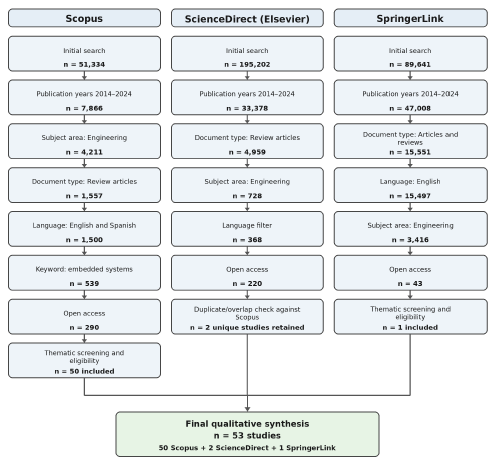
Methodology: A primary search was conducted in Scopus and supplemented by searches in ScienceDirect (Elsevier) and SpringerLink, with inclusion and exclusion criteria applied in accordance with the PRISMA guidelines. After screening, eligibility assessment, and removal of cross-database duplicates, 53 studies were included in the review: 50 from Scopus, 2 from ScienceDirect, and 1 from SpringerLink.
Results: The findings reveal significant growth in the development of defensive methods that balance energy efficiency and resilience against attacks, particularly in resource-constrained environments such as IoT devices and CPS. Furthermore, advances in lightweight cryptography, authentication techniques, and hardware-assisted protection measures, including Physically Unclonable Functions (PUFs) and the integration of Trusted Platform Modules (TPMs), are highlighted.
Conclusions: These findings underscore the critical need for continued innovation in this field to address both cyber and physical threats in increasingly complex applications.
Abstract (es)
Introducción: La seguridad en los sistemas embebidos ha cobrado creciente importancia debido a su integración en aplicaciones críticas, como el Internet de las Cosas (IoT), los sistemas ciberfísicos (CPS) y las infraestructuras industriales como las redes inteligentes.
Objetivos: Esta revisión sistemática analiza de manera integral la literatura reciente sobre la seguridad en sistemas electrónicos embebidos, con énfasis en la evolución de las técnicas de seguridad, las tendencias emergentes en la mitigación de vulnerabilidades, las vulnerabilidades persistentes y la influencia de las limitaciones de recursos en la implementación de mecanismos de protección en ámbitos como IoT, sistemas automotrices, dispositivos médicos y telecomunicaciones.
Metodología: Se condujo una búsqueda principal en Scopus y búsquedas complementarias en ScienceDirect (Elsevier) y SpringerLink, aplicando criterios de inclusión y exclusión conforme a las directrices metodológicas PRISMA. Tras el cribado, la evaluación de elegibilidad y la depuración de duplicados, se seleccionaron estudios ( de Scopus, de ScienceDirect y de SpringerLink).
Resultados: Los hallazgos revelan un crecimiento significativo en el desarrollo de métodos defensivos que equilibran la eficiencia energética y la resiliencia frente a ataques, en particular en entornos con restricciones de recursos como dispositivos IoT y CPS. Asimismo, se destacan los avances en criptografía ligera, técnicas de autenticación y medidas de protección asistidas por hardware, tales como las Funciones Físicamente No Clonables (PUF) y la integración de Módulos de Plataforma Confiable (TPM).
Conclusiones: Lo anterior subraya la necesidad crítica de una innovación continua en este campo para mitigar de manera integral las amenazas cibernéticas y físicas en escenarios de aplicación cada vez más complejos.
References
[1] M. J. Page et al., “Declaración PRISMA 2020: una guía actualizada para la publicación de revisiones sistemáticas,” Rev Esp Cardiol, vol. 74, no. 9, pp. 790–799, Sep. 2021, doi: https://doi.org/10.1016/j.recesp.2021.06.016.
[2] C. Burgos-Mellado et al., “Reinforcement Learning-Based Method to Exploit Vulnerabilities of False Data Injection Attack Detectors in Modular Multilevel Converters,” IEEE Trans. Power Electron., vol. 38, no. 7, pp. 8907–8921, Jul. 2023, doi: https://doi.org/10.1109/TPEL.2023.3263728.
[3] Z. An, W. Wang, W. Li, S. Li, and D. Zhang, “Securing Embedded System from Code Reuse Attacks: A Lightweight Scheme with Hardware Assistance,” Micromachines (Basel), vol. 14, no. 8, p. 1525, Jul. 2023, doi: https://doi.org/10.3390/mi14081525
[4] A. H. Karode, S. R. Suralkar, and V. B. Patil, “Performance Evaluation of Light Weight Cryptographic CLEFIA Algorithm,” International Journal of Electronics and Communication Engineering, vol. 10, no. 8, pp. 48–58, Sep. 2023, doi: https://doi.org/10.14445/23488549/IJECE-V10I8P105
[5] Y. Sun, G. Li, H. Luo, Y. Xing, S. Dang, and A. Hu, “Location-Invariant Radio Frequency Fingerprint for Base Station Recognition,” IEEE Wireless Communications Letters, vol. 12, no. 9, pp. 1583–1587, Sep. 2023, doi: https://doi.org/10.1109/LWC.2023.3283800.
[6] M. Boeding, M. Hempel, H. Sharif, J. Lopez, and K. Perumalla, “A flexible OT testbed for evaluating on-device implementations of IEC-61850 GOOSE,” International Journal of Critical Infrastructure Protection, vol. 42, p. 100618, Sep. 2023, doi: https://doi.org/10.1016/j.ijcip.2023.100618
[7] G. Sharma, A. M. Joshi, and S. P. Mohanty, “Fortified-Grid: Fortifying Smart Grids through the Integration of the Trusted Platform Module in Internet of Things Devices,” Information, vol. 14, no. 9, p. 491, Sep. 2023, doi: https://doi.org/10.3390/info14090491
[8] M. Brohet and F. Regazzoni, “A Survey on Thwarting Memory Corruption in RISC-V,” ACM Comput Surv, vol. 56, no. 2, pp. 1–29, Feb. 2024, doi: https://doi.org/10.1145/3604906
[9] T. Zoppi et al., “Safe Maintenance of Railways using COTS Mobile Devices: The Remote Worker Dashboard,” ACM Transactions on Cyber-Physical Systems, vol. 7, no. 4, pp. 1–20, Oct. 2023, doi: https://doi.org/10.1145/3607193
[10] M. El-Hadedy et al., “RECO-ASCON: Reconfigurable ASCON hash functions for IoT applications,” Integration, vol. 93, p. 102061, Nov. 2023, doi: https://doi.org/10.1016/j.vlsi.2023.102061
[11] T. Cultice and H. Thapliyal, “Vulnerabilities and Attacks on CAN-Based 3D Printing/Additive Manufacturing,” IEEE Consumer Electronics Magazine, vol. 13, no. 1, pp. 54–61, Jan. 2024, doi: https://doi.org/10.1109/MCE.2023.3240849
[12] A. Akbarzadeh, L. Erdodi, S. H. Houmb, and T. G. Soltvedt, “Two-stage advanced persistent threat (APT) attack on an IEC 61850 power grid substation,” Int J Inf Secur, vol. 23, no. 4, pp. 2739–2758, Aug. 2024, doi: https://doi.org/10.1007/s10207-024-00856-6
[13] M. Ebrahimabadi et al., “DELFINES: Detecting Laser Fault Injection Attacks via Digital Sensors,” IEEE Transactions on Computer-Aided Design of Integrated Circuits and Systems, vol. 43, no. 3, pp. 774–787, Mar. 2024, doi: https://doi.org/10.1109/TCAD.2023.3322623.
[14] M. Schink et al., “Unlock the Door to my Secrets, but don’t Forget to Glitch,” IACR Transactions on Cryptographic Hardware and Embedded Systems, vol. 2024, no. 2, pp. 88–129, Mar. 2024, doi: https://doi.org/10.46586/tches.v2024.i2.88-129
[15] A. Baird, A. Panda, H. Pearce, S. Pinisetty, and P. Roop, “Scalable Security Enforcement for Cyber Physical Systems,” IEEE Access, vol. 12, pp. 14385–14410, 2024, doi: https://doi.org/10.1109/ACCESS.2024.3357714
[16] T. Hutzelmann, D. Mauksch, A. Petrovska, and A. Pretschner, “Generation of Tailored and Confined Datasets for IDS Evaluation in Cyber-Physical Systems,” IEEE Trans Dependable Secure Comput, vol. 21, no. 4, pp. 3948–3962, Jul. 2024, doi: https://doi.org/10.1109/TDSC.2023.3341211
[17] P. Kietzmann, T. C. Schmidt, and M. Wählisch, “PUF for the Commons: Enhancing Embedded Security on the OS Level,” IEEE Trans Dependable Secure Comput, vol. 21, no. 4, pp. 2194–2210, Jul. 2024, doi: https://doi.org/10.1109/TDSC.2023.3300368
[18] M. S. Islam, I. Alouani, and K. N. Khasawneh, “SecureVolt: Enhancing Deep Neural Networks Security via Undervolting,” IEEE Transactions on Computer-Aided Design of Integrated Circuits and Systems, vol. 42, no. 12, pp. 4922–4933, Dec. 2023, doi: https://doi.org/10.1109/TCAD.2023.3296379
[19] A. Ussa et al., “A Hybrid Neuromorphic Object Tracking and Classification Framework for Real-Time Systems,” IEEE Trans Neural Netw Learn Syst, vol. 35, no. 8, pp. 10726–10735, Aug. 2024, doi: https://doi.org/10.1109/TNNLS.2023.3243679
[20] W. Alsabbagh, C. Kim, and P. Langendörfer, “Investigating the Security of OpenPLC: Vulnerabilities, Attacks, and Mitigation Solutions,” IEEE Access, vol. 12, pp. 11561–11583, 2024, doi: https://doi.org/10.1109/ACCESS.2024.3356051
[21] D. G. Mahmoud, B. Shokry, V. Lenders, W. Hu, and M. Stojilović, “X-Attack 2.0: The Risk of Power Wasters and Satisfiability Don’t-Care Hardware Trojans to Shared Cloud FPGAs,” IEEE Access, vol. 12, pp. 8983–9011, 2024, doi: https://doi.org/10.1109/ACCESS.2024.3353134
[22] M. F. Elrawy, C. Fioravanti, G. Oliva, M. K. Michael, and R. Setola, “A Geometrical Approach to Enhance Security Against Cyber Attacks in Digital Substations,” IEEE Access, vol. 12, pp. 18724–18738, 2024, doi: https://doi.org/10.1109/ACCESS.2024.3361753
[23] N. Jacobs et al., “Leveraging graph clustering techniques for cyber‐physical system analysis to enhance disturbance characterisation,” IET Cyber-Physical Systems: Theory & Applications, Feb. 2024, doi: https://doi.org/10.1049/cps2.12087.
[24] G. Sorrentino, M. Venere, D. Conficconi, E. D’Arnese, and M. D. Santambrogio, “Hephaestus : Codesigning and Automating 3D Image Registration on Reconfigurable Architectures,” ACM Transactions on Embedded Computing Systems, vol. 22, no. 5s, pp. 1–24, Oct. 2023, doi: https://doi.org/10.1145/3607928
[25] V. Fischer, F. Bernard, Q. Dallison, and M. Skórski, “Enhancing Quality and Security of the PLL-TRNG,” IACR Transactions on Cryptographic Hardware and Embedded Systems, pp. 211–237, Aug. 2023, doi: https://doi.org/10.46586/tches.v2023.i4.211-237
[26] D. Natarajan and W. Dai, “SEAL-Embedded: A Homomorphic Encryption Library for the Internet of Things,” IACR Transactions on Cryptographic Hardware and Embedded Systems, pp. 756–779, Jul. 2021, doi: https://doi.org/10.46586/tches.v2021.i3.756-779
[27] J. Ktari, T. Frikha, M. Hamdi, and H. Hamam, “Enhancing Blockchain Consensus With FPGA: Accelerating Implementation for Efficiency,” IEEE Access, vol. 12, pp. 44773–44785, 2024, doi: https://doi.org/10.1109/ACCESS.2024.3379374
[28] E. Krahmer, P. Pessl, G. Land, and T. Güneysu, “Correction Fault Attacks on Randomized CRYSTALS-Dilithium,” IACR Transactions on Cryptographic Hardware and Embedded Systems, vol. 2024, no. 3, pp. 174–199, Jul. 2024, doi: https://doi.org/10.46586/tches.v2024.i3.174-199
[29] J. W. Bos, O. Bronchain, F. Custers, J. Renes, D. Verbakel, and C. Van Vredendaal, “Enabling FrodoKEM on Embedded Devices,” IACR Transactions on Cryptographic Hardware and Embedded Systems, pp. 74–96, Jun. 2023, doi: https://doi.org/10.46586/tches.v2023.i3.74-96
[30] T. Nakai, D. Suzuki, and T. Fujino, “Timing Black-Box Attacks: Crafting Adversarial Examples through Timing Leaks against DNNs on Embedded Devices,” IACR Transactions on Cryptographic Hardware and Embedded Systems, pp. 149–175, Jul. 2021, doi: https://doi.org/10.46586/tches.v2021.i3.149-175
[31] M. Yamni, A. Daoui, P. Pławiak, O. Alfarraj, and A. A. A. El-Latif, “A Hardware-Accelerated Approach to Chaotic Image Encryption: LTB Map and FPGA Implementation,” IEEE Access, vol. 12, pp. 103921–103940, 2024, doi: https://doi.org/10.1109/ACCESS.2024.3432008
[32] C. Ma et al., “BiTDB: Constructing A Built-in TEE Secure Database for Embedded Systems,” IEEE Trans Knowl Data Eng, vol. 36, no. 9, pp. 4472–4485, Sep. 2024, doi: https://doi.org/10.1109/TKDE.2024.3380367
[33] C. Gewehr, L. Luza, and F. G. Moraes, “Hardware Acceleration of Crystals-Kyber in Low-Complexity Embedded Systems With RISC-V Instruction Set Extensions,” IEEE Access, vol. 12, pp. 94477–94495, 2024, doi: https://doi.org/10.1109/ACCESS.2024.3416812
[34] D. Enériz et al., “Low-Cost FPGA Implementation of Deep Learning-Based Heart Sound Segmentation for Real-Time CVDs Screening,” IEEE Trans Instrum Meas, vol. 73, pp. 1–16, 2024, doi: https://doi.org/10.1109/TIM.2024.3392271.
[35] T. Chamelot, D. Couroussé, and K. Heydemann, “MAFIA: Protecting the Microarchitecture of Embedded Systems Against Fault Injection Attacks,” IEEE Transactions on Computer-Aided Design of Integrated Circuits and Systems, vol. 42, no. 12, pp. 4555–4568, Dec. 2023, doi: https://doi.org/10.1109/TCAD.2023.3276507
[36] D. Mercadier, V. S. Nguyen, M. Rivain, and A. Udovenko, “OBSCURE: Versatile Software Obfuscation from a Lightweight Secure Element,” IACR Transactions on Cryptographic Hardware and Embedded Systems, vol. 2024, no. 2, pp. 588–629, Mar. 2024, doi: https://doi.org/10.46586/tches.v2024.i2.588-629
[37] Y. Lee et al., “An Efficient Hardware/Software Co-Design for FALCON on Low-End Embedded Systems,” IEEE Access, vol. 12, pp. 57947–57958, 2024, doi: https://doi.org/10.1109/ACCESS.2024.3387489
[38] J. Ge and F. Zhang, “SnapMem: Hardware/Software Cooperative Memory Resistant to Cache-Related Attacks on ARM-FPGA Embedded SoC,” IEEE Transactions on Computer-Aided Design of Integrated Circuits and Systems, vol. 43, no. 10, pp. 2902–2915, Oct. 2024, doi: https://doi.org/10.1109/TCAD.2024.3392082
[39] J. Van den Herrewegen, D. Oswald, F. D. Garcia, and Q. Temeiza, “Fill your Boots: Enhanced Embedded Bootloader Exploits via Fault Injection and Binary Analysis,” IACR Transactions on Cryptographic Hardware and Embedded Systems, pp. 56–81, Dec. 2020, doi: https://doi.org/10.46586/tches.v2021.i1.56-81
[40] P. Radanliev, O. Santos, and A. Brandon-Jones, “Capability hardware enhanced instructions and artificial intelligence bill of materials in trustworthy artificial intelligence systems: analyzing cybersecurity threats, exploits, and vulnerabilities in new software bills of materials with artificial intelligence,” The Journal of Defense Modeling and Simulation: Applications, Methodology, Technology, Aug. 2024, doi: https://doi.org/10.1177/15485129241267919
[41] N. A. Kose, R. Jinad, A. Rasheed, N. Shashidhar, M. Baza, and H. Alshahrani, “Detection of Malicious Threats Exploiting Clock-Gating Hardware Using Machine Learning,” Sensors, vol. 24, no. 3, p. 983, Feb. 2024, doi: https://doi.org/10.3390/s24030983
[42] A. C. Cob-Parro, C. Losada-Gutiérrez, M. Marrón-Romera, A. Gardel-Vicente, and I. Bravo-Muñoz, “A new framework for deep learning video based Human Action Recognition on the edge,” Expert Syst Appl, vol. 238, p. 122220, Mar. 2024, doi: https://doi.org/10.1016/j.eswa.2023.122220
[43] S. L. Thomas, J. Van den Herrewegen, G. Vasilakis, Z. Chen, M. Ordean, and F. D. Garcia, “Cutting Through the Complexity of Reverse Engineering Embedded Devices,” IACR Transactions on Cryptographic Hardware and Embedded Systems, pp. 360–389, Jul. 2021, doi: https://doi.org/10.46586/tches.v2021.i3.360-389
[44] A. Bazzi, A. Shaout, and D. Ma, “A Novel Variability-Rich Scheme for Software Updates of Automotive Systems,” IEEE Access, vol. 12, pp. 79530–79548, 2024, doi: https://doi.org/10.1109/ACCESS.2024.3409629
[45] T. Mosavirik, P. Schaumont, and S. Tajik, “ImpedanceVerif: On-Chip Impedance Sensing for System-Level Tampering Detection,” IACR Transactions on Cryptographic Hardware and Embedded Systems, pp. 301–325, Nov. 2022, doi: https://doi.org/10.46586/tches.v2023.i1.301-325
[46] B. Liu and M. Tang, “MS-LW-TI: Primitive-Based First-Order Threshold Implementation for 4 × 4 S-boxes,” IET Inf Secur, vol. 2024, pp. 1–17, May 2024, doi: https://doi.org/10.1049/2024/8851878
[47] P. Branco, L. Fiolhais, M. Goulão, P. Martins, P. Mateus, and L. Sousa, “ROTed: Random Oblivious Transfer for embedded devices,” IACR Transactions on Cryptographic Hardware and Embedded Systems, pp. 215–238, Aug. 2021, doi: https://doi.org/10.46586/tches.v2021.i4.215-238
[48] B. Amornpaisannon, A. Diavastos, L.-S. Peh, and T. E. Carlson, “Secure Run-Time Hardware Trojan Detection Using Lightweight Analytical Models,” IEEE Transactions on Computer-Aided Design of Integrated Circuits and Systems, vol. 43, no. 2, pp. 431–441, Feb. 2024, doi: https://doi.org/10.1109/TCAD.2023.3316113.
[49] B. Boi and C. Esposito, “Securing the Internet of Medical Things with ECG‐based PUF encryption,” IET Cyber-Physical Systems: Theory & Applications, vol. 9, no. 2, pp. 115–124, Jun. 2024, doi: https://doi.org/10.1049/cps2.12089
[50] H. Becker, J. M. Bermudo Mera, A. Karmakar, J. Yiu, and I. Verbauwhede, “Polynomial multiplication on embedded vector architectures,” IACR Transactions on Cryptographic Hardware and Embedded Systems, pp. 482–505, Nov. 2021, doi: https://doi.org/10.46586/tches.v2022.i1.482-505
[51] Y. Zhong and J. Gu, “Lightweight block ciphers for resource-constrained environments: A comprehensive survey,” Future Generation Computer Systems, vol. 157, pp. 288–302, Aug. 2024, doi: https://doi.org/10.1016/j.future.2024.03.054
[52] M. Khan, M. Hatami, W. Zhao, and Y. Chen, “A novel trusted hardware-based scalable security framework for IoT edge devices,” Discover Internet of Things, vol. 4, art. no. 4, Apr. 2024, doi: https://doi.org/10.1007/s43926-024-00056-7
[53] Z. Alwaisi, T. Kumar, E. Harjula, and S. Soderi, “Securing constrained IoT systems: A lightweight machine learning approach for anomaly detection and prevention,” Internet of Things, vol. 28, art. no. 101398, Dec. 2024, doi: https://doi.org/10.1016/j.iot.2024.101398
How to Cite
APA
ACM
ACS
ABNT
Chicago
Harvard
IEEE
MLA
Turabian
Vancouver
Download Citation
License
Copyright (c) 2026 Maria Alejandra Ortiz Salazar, Heriberto Fernando Vargas Lozada, Alejandro Goebanny Jurado Mejía

This work is licensed under a Creative Commons Attribution-ShareAlike 4.0 International License.
Esta licencia permite a otros remezclar, adaptar y desarrollar su trabajo incluso con fines comerciales, siempre que le den crédito y concedan licencias para sus nuevas creaciones bajo los mismos términos. Esta licencia a menudo se compara con las licencias de software libre y de código abierto “copyleft”. Todos los trabajos nuevos basados en el tuyo tendrán la misma licencia, por lo que cualquier derivado también permitirá el uso comercial. Esta es la licencia utilizada por Wikipedia y se recomienda para materiales que se beneficiarían al incorporar contenido de Wikipedia y proyectos con licencias similares.