
DOI:
https://doi.org/10.14483/22487638.23696Published:
2025-12-31Issue:
Vol. 29 No. 86 (2025): Octubre - DiciembreSection:
ResearchAprovechamiento de suero lácteo para el desarrollo de un producto funcional mediante tecnología de spray drying
Use of whey for the development of a functional product using spray drying technology
Keywords:
Funcional, Spray drying, Suero lácteo, Suspensión (es).Keywords:
Functional, Spray drying, Whey, Suspension (en).Downloads
Abstract (es)
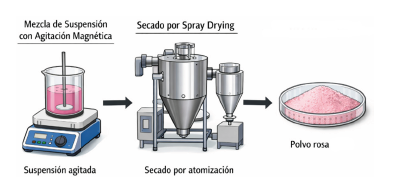
Objetivo: desarrollar un producto en polvo a base de suero lácteo dulce, pulpa de mora (Rubus glaucus), maltodextrina e inulina, mediante tecnología spray drying. Metodología: se caracterizó fisicoquímicamente la materia prima. Se optimizó la formulación de una suspensión, mediante un diseño experimental de superficie respuesta tipo Box-Behnken. Las variables independientes fueron; pulpa de mora (0,30 – 0,50), suero lácteo dulce (0,30 – 0,50), maltodextrina (0,10 – 0,20), todas en unidades de fracción másica, la inulina fue una variable fija al 6 %. Las variables dependientes fueron; pH, sólidos solubles (°Brix) y viscosidad (cP). La suspensión óptima se secó mediante spray drying y se evaluó el factor temperatura del aire de entrada (130 °C, 140 °C y 150 °C) con un diseño unifactorial y las variables dependientes fueron: Humedad ( %), actividad de agua (aw), solubilidad ( %), humectabilidad (g/min), capacidad antioxidante (ug/g) y color (L*a*b*). Con el mejor tratamiento se realizó análisis sensorial (sabor, olor, color y aceptación general).
Resultados: la formulación óptima de la suspensión resultó con pulpa de mora (0,419); suero lácteo (0,319); maltodextrina (0,202) y (0,060) inulina. La viscosidad fue de 1.631 cP, pH 3,64 y 31,40 °Brix. El mejor tratamiento en el proceso de secado se obtuvo a 130 °C, con aw = 0,247±0,037, solubilidad = 60,44 ±0,53 %, humectabilidad = 0.082±0.006 (g/min) y capacidad antioxidante de 8,39±0,07 mg ácido gálico/g. En el análisis sensorial se obtuvo una aceptación general de 4,4±0,6 en escala de 1 a 5. Conclusiones: la formulación óptima de la suspensión permitió obtener un producto en polvo con potencial aporte funcional para el consumidor.
Abstract (en)
Objective: To develop a powdered product based on sweet whey, blackberry pulp (Rubus glaucus), maltodextrin and inulin, using spray drying technology.
Methodology: the raw material was characterized physicochemically. The formulation of a suspension was optimized using a Box-Behnken type response surface experimental design. The independent variables were: blackberry pulp (0,30 – 0,50), sweet whey (0,30 – 0,50), maltodextrin (0,10 – 0,20), all in units of mass fraction; inulin was a fixed variable at 6 %. The dependent variables were; pH, soluble solids (°Brix) and viscosity (cP). The optimum suspension was dried by spray drying, the inlet air temperature factor was evaluated (130°C, 140°C and 150°C) with a unifactorial design and the dependent variables were: humidity ( %), water activity (aw), solubility ( %), wettability (g/min), antioxidant capacity (ug/g) and color (L*a*b*). Sensory analysis (taste, odor, color and general acceptance) was performed with the best treatment.
Results: the optimal formulation of the suspension was blackberry pulp (0,419); whey (0,319); maltodextrin (0,202) and (0,060) inulin. The viscosity was 1.631 cP, pH 3,64 and 31,40 °Brix. The best treatment in the drying process was obtained at 130 °C, with aw = 0,247±0.037, solubility = 60,44 ±0.53 %, wettability = 0,082±0.006 (g/min) and antioxidant capacity of 8,39±0.07 mg gallic acid/g. In the sensory analysis, a general acceptance of 4,4±0.6 on a scale of 1 to 5 was obtained.
Conclusions: the optimal formulation of the suspension allowed obtaining a powdered product with potential functional benefits for the consumer.
References
[1] T. Zotta, L. Solieri, L. Iacumin, C. Picozzi & M. Gullo. Valorization of cheese whey using microbial fermentations. Applied Microbiology and Biotechnology, 104(7), 2749–2764, 2020, doi: https://doi.org/10.1007/s00253-020-10408-2
[2] G. Ozturk, N. Liang, M. Bhattacharya, R. C. Robinson, S. Shankar, Y. Huang, B. Paviani, A. Taha & D. Barile. Glycoproteomic and Lipidomic Characterization of Industrially Produced Whey Protein Phospholipid Concentrate with Emphasis on Antimicrobial Xanthine Oxidase, Oxylipins and Small Milk Fat Globules. Dairy, 3(2), 277–302, 2022, doi: https://doi.org/10.3390/dairy3020022
[3] N. Kaur, P. Sharma, S. Jaimni, B. A. Kehinde & S. Kaur. Recent developments in purification techniques and industrial applications for whey valorization: A review. Chemical Engineering Communications, 207(1), 123–138, 2020, doi: https://doi.org/10.1080/00986445.2019.1573169
[4] M. Mora, F. Pardo & H. Bastidas. Diagnóstico Patológico en Mora de Castilla Rubus glaucus Bentham (Rosales: Rosaceae). Orinoquia, 24 (2) 27-32. 2020, doi: https://doi.org/10.22579/20112629.618
[5] M. B. Braga, P. C. Veggi, M. C. Codolo, M. A. Giaconia, C. L. Rodrigues y A. R. C. Braga. Evaluation of freeze-dried milk-blackberry pulp mixture: Influence of adjuvants over the physical properties of the powder, anthocyanin content and antioxidant activity. Food Research International, 125, 108557, 2019, doi: https://doi.org/10.1016/j.foodres.2019.108557
[6] O. Frumuzachi, A. Flanagan, S. Rohn y A. Mocan. The dichotomy between functional and functionalized foods – A critical characterization of concepts. Food Research International, 208, 116173, 2025, doi: https://doi.org/10.1016/j.foodres.2025.116173
[7] M. Alsubhi, M. Blake, T. Nguyen, I. Majmudar, M. Moodie y J. Ananthapavan. Consumer willingness to pay for healthier food products: A systematic review. Obesity Reviews, 24(1), e13525, 2023, doi: https://doi.org/10.1111/obr.13525
[8] D. Martini, M. Marino, S. Venturi, M. Tucci, D. Klimis-Zacas, P. Riso, M. Porrini y C. Del Bo. Blueberries and their bioactives in the modulation of oxidative stress, inflammation and cardio/vascular function markers: a systematic review of human intervention studies. The Journal of Nutritional Biochemistry, 111, 109154, 2023, doi: https://doi.org/10.1016/j.jnutbio.2022.109154
[9] Z. Abdi-Moghadam, M. Darroudi, M. Mahmoudzadeh, M. Mohtashami, A. M. Jamal, E. Shamloo y Z. Rezaei. Functional yogurt, enriched and probiotic: A focus on human health. Clinical Nutrition ESPEN, 57, 575–586, 2023, doi: https://doi.org/10.1016/j.clnesp.2023.08.005
[10] M. Ayala, D. Sánchez, R. Ruiz, S. Muñoz, R. Gama, O. Mendo y N. Torres Salado. Efecto prebiótico de dos fuentes de inulina en el crecimiento in vitro de Lactobacillus salivarius y Enterococcus faecium. Revista Mexicana de Ciencias Pecuarias, 9(2), 346–361, 2018, doi: https://doi.org/10.22319/rmcp.v9i2.4488
[11] A. F. Pires, N. G. Marnotes, O. D. Rubio, A. C. Garcia y C. D. Pereira. Dairy by-products: A review on the valorization of whey and second cheese whey. Foods, 10(5), 1067, 2021, doi: https://doi.org/10.3390/foods10051067
[12] F. Van de Velde, M. H. Grace, D. Esposito, M. É. Pirovani y M. A. Lila. Quantitative comparison of phytochemical profile, antioxidant, and anti-inflammatory properties of blackberry fruits adapted to Argentina. Journal of Food Composition and Analysis, 47, 82–91, 2016, doi: https://doi.org/10.1016/J.JFCA.2016.01.008
[13] AOAC Official Method 2012.04. Antioxidant Activity in Foods and Beverages: Reaction with 2,2′-Diphenyl-1-Picrylhydrazyl (DPPH), in Dr. George W Latimer, Jr. (ed.), Official Methods of Analysis of AOAC INTERNATIONAL, 22nd Edition (New York).
[14] R. Hoxha, Y. Evstatieva y D. Nikolova. Physicochemical, Rheological, and Sensory Characteristics of Yogurt Fermented by Lactic Acid Bacteria with Probiotic Potential and Bioprotective Properties. Foods, 12(13), 2552, 2023, doi: https://doi.org/10.3390/foods12132552
[15] R. A. Benavides Zambrano, A. M. Hernández Cardona y C. D. Narváez Pérez. Obtención de licor artesanal de café a partir de destilado de caña panelera y hierbas aromáticas, Universidad Mariana. 2023. Tesis.
[16] H. Castaño-Peláez, M. C. Rodríguez, J. H. Gil G., G. L. López y R. Ortega-Toro. Optimization of spray-drying process parameters on strawberry (Fragaria ananassa D.) extracts microcapsules quality. Journal of Berry Research, 12(4), 531-550, 2022, doi: https://doi.org/10.3233/JBR-220047
[17] M. I. Arango-Torres, M. Cortés-Rodríguez, E. Largo-Ávila, M. Gallón-Bedoya y R. Ortega-Toro. Yacon powder mix: Effects of the composition and the process of microencapsulation by spray drying. Heliyon, 10(13), 20224, doi: https://doi.org/10.1016/j.heliyon.2024.e33968
[18] B. T. Nguyen, E. Bujna, N. Fekete, A. T. M. Tran, J. M. Rezessy-Szabo, R. Prasad y Q. D. Nguyen. Probiotic Beverage From Pineapple Juice Fermented With Lactobacillus and Bifidobacterium Strains. Frontiers In Nutrition, 6. 2029, doi: https://doi.org/10.3389/fnut.2019.00054
[19] C. De los Rios Carvajal, M. Cortes Rodriguez y J. C. Arango Tobon. Physicochemical quality and antioxidant activity of blackberry suspensions: Compositional and process effects. Journal of Food Processing and Preservation, 45(6), e15498. 2021, doi: https://doi.org/10.1111/jfpp.15498
[20] A. Sozzi, M. Zambon, G. Mazza y D. Salvatori. Fluidized bed drying of blackberry wastes: Drying kinetics, particle characterization and nutritional value of the obtained granular solids. Powder Technology, 385, 37–49, 2021, doi: https://doi.org/10.1016/j.powtec.2021.02.058
[21] N. Deshmukh, P. S. Rao, H. Sharma y M. Kumar. Waste to nutrition: The evolution of whey, a byproduct to galactooligosaccharides production. Food Chemistry Advances, 4, 100642, 2024, doi: https://doi.org/10.1016/j.focha.2024.100642
[22] P. Papademas y P. Kotsaki. Technological utilization of whey towards sustainable exploitation. Journal of Advances In Dairy Research, 7(4), 231, 2019, doi: https://doi.org/10.35248/2329-888X.19.7.231
[23] M. N. S. Cerda, J. A. G. Martínez, S. P. T. Dávila, R. T. Flores, R. C. L. G. Reyes y D. A. J. Gámez. Lactosuero, estabilizantes comerciales y fécula de maíz en la producción de helados artesanales Whey, commercial stabilizers, and cornstarch in the production of artisanal ice cream. Revista Científica, 24(43), 150-157, 2024. Tesis.
[24] A. Merkel, D. Voropaeva y M. Ondrušek. The impact of integrated nanofiltration and electrodialytic processes on the chemical composition of sweet and acid whey streams. Journal Of Food Engineering, 298, 110500, 2021, doi: https://doi.org/10.1016/j.jfoodeng.2021.110500
[25] M. Saleem, Z. Ahmad, M. Waseem, T. Alsulami, M. R. Javed, M. Farhan, G. A. Nayik, M. F. Manzoor y G. Abdi. Nutritional, physicochemical, and antioxidant characterization of pomegranate, beetroot, and carrot concentrates supplemented functional whey beverages. Food Chemistry: X, 102206, 2025, doi: https://doi.org/10.1016/J.FOCHX.2025.102206
[26] Z. Gong, M. Yu, W. Wang y X. Shi. Functionality of spray-dried strawberry powder: effects of whey protein isolate and maltodextrin. International Journal of Food Properties, 21(1), 2229–2238, 2018, doi: https://doi.org/10.1080/10942912.2018.1506477
[27] Z. Dou, C. Chen, Q. Huang y X. Fu. Comparative study on the effect of extraction solvent on the physicochemical properties and bioactivity of blackberry fruit polysaccharides. International Journal Of Biological Macromolecules, 183, 1548–1559, 2021, doi: https://doi.org/10.1016/j.ijbiomac.2021.05.131
[28] M. Karim, M. Alimi, S. Shokoohi y F. Fazeli. Effect of long-chain inulin and modified starch on the physicochemical and rheological properties of doogh (Iranian yogurt drink). Acta Alimentaria, 46(1), 51-60, 2017, doi: https://doi.org/10.1556/066.2017.46.1.7
[29] R. Soni, N. K. Jain, V. Shah, J. Soni, D. Suthar y P. Gohel. Development of probiotic yogurt: effect of strain combination on nutritional, rheological, organoleptic and probiotic properties. Journal Of Food Science And Technology, 57(6), 2038-2050, 2020, doi: https://doi.org/10.1007/s13197-020-04238-3
[30] E. Hadjimbei, G. Botsaris y S. Chrysostomou. Beneficial effects of yoghurts and probiotic fermented milks and their functional food potential. Foods, 11(17), 2691, 2022, doi: https://doi.org/10.3390/foods11172691
[31] G. Kwon. Characteristics of inulin-based synbiotic powders and granules encapsulating Lactobacillus rhamnosus GG (Tesisi Doctoral. Seoul National University), 서울대학교 대학원). 2020.
[32] S. C. Lourenço, N. A. Lopes, F. M. Nunes y C. A. Pinto. Microencapsulation of pineapple peel extract by spray drying using maltodextrin, inulin, and Arabic gum as wall matrices. Foods, 9(6), 718, 2020, doi: https://doi.org/10.3390/foods9060718
[33] S. Santos, L. Rodrigues, S. Costa y G. Madrona. Antioxidant compounds from blackberry (Rubus fruticosus) pomace: Microencapsulation by spray-dryer and pH stability evaluation. Food Packaging And Shelf Life, 20, 100177, 2017, doi: https://doi.org/10.1016/j.fpsl.2017.12.001
[34] J. A. Figueiredo, A. M. Lago, J. M. Mar, L. S. Silva, E. A. Sanches, T. P. Souza, J. A. Bezerra, P. H. Campelo, D. A. Botrel y S. V. Borges. Stability of camu‐camu encapsulated with different prebiotic biopolymers. Journal Of The Science Of Food And Agriculture, 100(8), 3471–3480, 2020, doi: https://doi.org/10.1002/jsfa.10384
[35] B. F. Feitosa, B. L. A. Decker, E. S. De Brito, S. Rodrigues y L. R. B. Mariutti. Microencapsulation of anthocyanins as natural dye extracted from fruits – A systematic review. Food Chemistry, 424, 136361, 2023, doi: https://doi.org/10.1016/j.foodchem.2023.136361
[36] P. Glibowski y P. Rybak. Rheological and sensory properties of stirred yoghurt with inulin‐type fructans. International Journal Of Dairy Technology, 69(1), 122–128, 2015, doi: https://doi.org/10.1111/1471-0307.12231
How to Cite
APA
ACM
ACS
ABNT
Chicago
Harvard
IEEE
MLA
Turabian
Vancouver
Download Citation
License
Copyright (c) 2025 Adriana Micanquer Carlosama, Juan Fernando Muñoz Paredes

This work is licensed under a Creative Commons Attribution-ShareAlike 4.0 International License.
Esta licencia permite a otros remezclar, adaptar y desarrollar su trabajo incluso con fines comerciales, siempre que le den crédito y concedan licencias para sus nuevas creaciones bajo los mismos términos. Esta licencia a menudo se compara con las licencias de software libre y de código abierto “copyleft”. Todos los trabajos nuevos basados en el tuyo tendrán la misma licencia, por lo que cualquier derivado también permitirá el uso comercial. Esta es la licencia utilizada por Wikipedia y se recomienda para materiales que se beneficiarían al incorporar contenido de Wikipedia y proyectos con licencias similares.