
DOI:
https://doi.org/10.14483/22487638.23730Published:
2026-06-30Issue:
Vol. 30 No. 88 (2026): Abril - JunioSection:
ResearchAnalysis of the Instantaneous Center of Rotation of a Six-Bar Mechanism Using Nodal Coordinates
Análisis del Centro Instantáneo de Rotación de un Mecanismo de Seis Barras usando Coordenadas Nodales
Keywords:
Instantaneous center, nodal coordinates, six-bar mechanism, Aronhold-Kennedy theorem (en).Keywords:
Centro instantáneo, coordenadas nodales, mecanismo de seis barras, teorema de Aronhold-Kennedy (es).Downloads
Abstract (en)
Objective: Knowledge of the instantaneous center associated with two bodies in a mechanism is important for both analysis and synthesis, because it can simplify velocity and acceleration analysis. Moreover, accurate determination of the instantaneous center position is a key requirement for synthesis in many practical applications. The purpose of this work is to propose an analytical method for calculating the instantaneous center of rotation of a floating link in a six-bar mechanism with respect to the fixed link.
Methodology: The proposed procedure consists of the following steps. First, the variables representing the mechanism dimensions are defined. Unlike traditional approaches, this work uses initial nodal coordinates. The constraint equations are then formulated using both the current and initial nodal coordinates. Next, the Levenberg-Marquardt method is applied to solve the constraint equations robustly. Finally, the kinematic constraint equations for the instantaneous centers are established using the Aronhold-Kennedy theorem and solved to determine the coordinates of the desired instantaneous center.
Results: Using nodal coordinates and the Aronhold-Kennedy theorem, a procedure was developed to determine the instantaneous center of rotation of a link with respect to the fixed link of a six-bar mechanism. The proposed method is sufficiently robust for use in optimal synthesis processes, which will be addressed in future work.
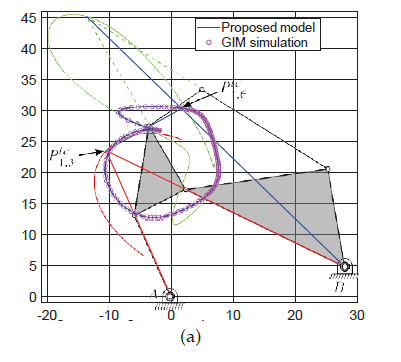
Conclusions: A method was developed to determine the instantaneous center in a six-bar mechanism using nodal coordinates. The method was validated by implementing the proposed procedure in a mechanism with arbitrary dimensions and comparing the results with those obtained using GIM (Geometric Interactive Method).
Abstract (es)
Objetivo: El conocimiento del centro instantáneo asociado a dos cuerpos en un mecanismo es importante tanto para el análisis como para la síntesis, dado que puede simplificar el análisis de velocidades y aceleraciones. Asimismo, la determinación precisa de la posición del centro instantáneo es un requisito clave para la síntesis en muchas aplicaciones prácticas. El propósito de este trabajo es proponer un método analítico para calcular el centro instantáneo de rotación de un eslabón flotante en un mecanismo de seis barras con respecto al eslabón fijo.
Metodología: El procedimiento propuesto consta de los siguientes pasos. En primer lugar, se definen las variables que representan las dimensiones del mecanismo. A diferencia de los enfoques tradicionales, este trabajo emplea coordenadas nodales iniciales. A continuación, se formulan las ecuaciones de restricción utilizando tanto las coordenadas nodales actuales como las iniciales. Posteriormente, se aplica el método de Levenberg-Marquardt para resolver de manera robusta las ecuaciones de restricción. Finalmente, se establecen las ecuaciones de restricción cinemática para los centros instantáneos mediante el teorema de Aronhold-Kennedy y se resuelven para determinar las coordenadas del centro instantáneo deseado.
Resultados: Utilizando coordenadas nodales y el teorema de Aronhold-Kennedy, se desarrolló un procedimiento para determinar el centro instantáneo de rotación de un eslabón con respecto al eslabón fijo de un mecanismo de seis barras. El método propuesto es suficientemente robusto para ser empleado en procesos de síntesis óptima, los cuales serán abordados en trabajos futuros.
Conclusiones: Se desarrolló un método para determinar el centro instantáneo en un mecanismo de seis barras utilizando coordenadas nodales. El método fue validado mediante la implementación del procedimiento propuesto en un mecanismo con dimensiones arbitrarias y la comparación de los resultados con los obtenidos mediante GIM (Método Interactivo Geométrico).
References
[1] S. Zarkandi, "Application of mechanical advantage and instant centers on singularity analysis of single-DOF planar mechanisms," J. Mech. Eng., vol. 41, no. 1, pp. 50–57, 2010. https://doi.org/10.3329/jme.v41i1.5362
[2] P. A. Simionescu, I. Talpasanu, and R. di Gregorio, "Instant-center based force transmissivity analysis in planar mechanisms," J. Mech. Des., vol. 132, no. 6, pp. 061003–1–061003–9, 2010. https://doi.org/10.1115/1.4001094
[3] L. Nie, H. Ding, K.-L. Ting, and A. Kecskeméthy, "Instant center identification of single-loop multi-DOF planar linkage using virtual link," Appl. Sci., vol. 11, no. 10, p. 4463, 2021. https://doi.org/10.3390/app11104463
[4] J. I. Valderrama-Rodríguez, J. M. Rico, J. J. Cervantes-Sánchez, and R. García-García, "A screw theory approach to computing the instantaneous rotation centers of indeterminate planar linkages," Robotics, vol. 11, no. 1, p. 6, 2021. https://doi.org/10.3390/robotics11010006
[5] R. Di Gregorio, "An algorithm for analytically calculating the positions of the secondary instant centers of indeterminate linkages," J. Mech. Des., vol. 130, no. 4, p. 042302, 2008. https://doi.org/10.1115/1.2839008
[6] Y. P. Chang and I. Her, "A virtual cam method for locating instant centers of kinematically indeterminate linkages," J. Mech. Des., vol. 130, no. 6, p. 062301, 2008. https://doi.org/10.1115/1.2900720
[7] J. I. Valderrama-Rodríguez, J. M. Rico, and J. J. Cervantes-Sánchez, "A general method for the determination of the instantaneous screw axes of one-degree-of-freedom spatial mechanisms," Mech. Sci., vol. 11, no. 1, pp. 91–99, 2020. https://doi.org/10.5194/ms-11-91-2020
[8] J. G. De Jalón, J. Unda, and A. Avello, "Natural coordinates for the computer analysis of multibody systems," Comput. Methods Appl. Mech. Eng., vol. 56, no. 3, pp. 309–327, 1986. https://doi.org/10.1016/0045-7825(86)90044-7
[9] J. G. De Jalón and E. Bayo, Kinematic and Dynamic Simulation of Multibody Systems. Berlin, Germany: Springer-Verlag, 1994.
[10] N. N. Romero, "Contributions to the kinematics and balancing of mechanisms," Ph.D. dissertation, 2023.
[11] R. Sancibrian, E. G. Sarabia, A. Sedano, and J. M. Blanco, "A general method for the optimal synthesis of mechanisms using prescribed instant center positions," Appl. Math. Model., vol. 40, no. 3, pp. 2206–2222, 2016. https://doi.org/10.1016/j.apm.2015.09.032
[12] J.-F. F. Collard, "Geometrical and kinematic optimization of closed-loop multibody systems," Ph.D. dissertation, Université Catholique de Louvain, 2007.
[13] H. R. Cazangi, "Aplicação do método de Davies para análise cinemática e estática de mecanismos com múltiplos graus de liberdade," M.S. thesis, 2008.
[14] R. L. Norton, Design of Machinery: An Introduction to the Synthesis and Analysis of Mechanisms and Machines. New York, NY, USA: McGraw-Hill Higher Education, 2003.
[15] N. N. Romero Nuñez, "Simulation of a four-bar mechanism in MATLAB and GIM," Zenodo, 2026. https://doi.org/10.5281/zenodo.19378994
[16] N. N. Romero Nuñez, "Simulation of a six-bar mechanism in MATLAB and GIM," Zenodo, 2026. https://doi.org/10.5281/zenodo.19379264
How to Cite
APA
ACM
ACS
ABNT
Chicago
Harvard
IEEE
MLA
Turabian
Vancouver
Download Citation
License
Copyright (c) 2026 Neider Nadid Romero Núñez, Gonzalo Moreno Contreras, Rafael Villalba González, Daniel Martins

This work is licensed under a Creative Commons Attribution-ShareAlike 4.0 International License.
Esta licencia permite a otros remezclar, adaptar y desarrollar su trabajo incluso con fines comerciales, siempre que le den crédito y concedan licencias para sus nuevas creaciones bajo los mismos términos. Esta licencia a menudo se compara con las licencias de software libre y de código abierto “copyleft”. Todos los trabajos nuevos basados en el tuyo tendrán la misma licencia, por lo que cualquier derivado también permitirá el uso comercial. Esta es la licencia utilizada por Wikipedia y se recomienda para materiales que se beneficiarían al incorporar contenido de Wikipedia y proyectos con licencias similares.