
DOI:
https://doi.org/10.14483/22487638.23836Published:
2025-09-30Issue:
Vol. 29 No. 85 (2025): Julio - SeptiembreSection:
ResearchHourly Prediction of Irradiance and Temperature Using Recurrent Neural Networks and Gaussian Process Models
Predicción horaria de irradiancia y temperatura usando redes recurrentes y modelos gaussianos
Keywords:
Hourly models, LSTM, GRU, Meteorological time series, Hourly prediction (en).Keywords:
Modelos horarios, LSTM, SGPR, series de tiempo metereológicas, predicción horaria (es).Downloads
Abstract (en)
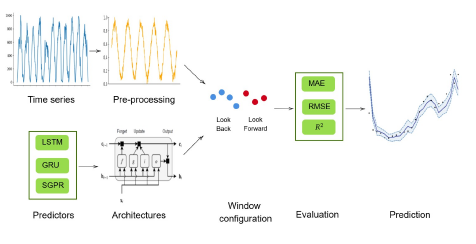
This research applies artificial intelligence techniques to predict physical variables such as irradiance and temperature, addressing the challenge of time series nonlinearity. The main objective is to compare the predictive performance of LSTM, GRU, and SGPR models across three datasets (Jena, Solcast, and IDEAM), evaluating threes liding-window configurations and an hourly prediction scheme, where a separate model is trained for each hour instead of relying on a single general model. Results, assessed using MAE, RMSE, and R², show that in the Jena dataset, for example, the SGPR model under the hourly approach achieves average values of 0.53◦C, 0.74◦C, and0.99, respectively. Overall, the findings suggest that employing multiple Gaussian process-based models trained with hour-specific information yields superior performance compared to using a single model.
Abstract (es)
Esta investigación aplica técnicas de inteligencia artificial para predecir variables físicas como irradiancia y temperatura, enfrentando el reto de la no linealidad en series de tiempo. El objetivo principal es comparar la eficiencia de modelos LSTM, GRU y SGPR en tres bases de datos (Jena, Solcast e IDEAM), evaluando tres configuraciones de ventanas deslizantes y un esquema de predicción horaria, en el cual se entrena un modelo independiente para cada hora en lugar de un único modelo general. Los resultados, medidos mediante MAE, RMSE y R², muestran que, en la base de datos Jena, por ejemplo, el modelo SGPR bajo el enfoque horario alcanza valores promedio de 0.53◦C, 0.74◦C y 0.99, respectivamente. En conjunto, los hallazgos sugieren que emplear múltiples modelos basados en procesos gaussianos con información específica por hora ofrece un desempeño superior al uso de un único modelo.
References
K. Qadeer, A. Ahmad, M. A. Qyyum, A.-S. Nizami, y M. Lee, "Developing machine learning models for relative humidity prediction in air-based energy systems and environmental management applications," Journal of Environmental Management, vol. 292, p. 112736, 2021. DOI: https://doi.org/10.1016/j.jenvman.2021.112736
E. Sarmas, N. Dimitropoulos, V. Marinakis, Z. Mylona, y H. Doukas, "Transfer learning strategies for solar power forecasting under data scarcity," Scientific Reports, vol. 12, pp. 1–13, 2022. DOI: https://doi.org/10.1038/s41598-022-18516-x
İ. F. Şener y İ. Tuğal, "Optimized cnn-lstm with hybrid metaheuristic approaches for solar radiation forecasting," Case Studies in Thermal Engineering, p. 106356, 2025. DOI: https://doi.org/10.1016/j.csite.2025.106356
C.-C. Lee, B. Zhou, T.-Y. Yang, C.-H. Yu, y J. Zhao, "The impact of urbanization on CO2 emissions in china: The key role of foreign direct investment," Emerging Markets Finance and Trade, vol. 59, pp. 451–462, 2023. DOI: https://doi.org/10.1080/1540496X.2022.2106843
J. Gaboitaolelwe, A. M. Zungeru, A. Yahya, C. K. Lebekwe, D. N. Vinod, y A. O. Salau, "Machine learning based solar photovoltaic power forecasting: a review and comparison," IEEE Access, vol. 11, pp. 40 820–40 845, 2023. DOI: https://doi.org/10.1109/ACCESS.2023.3270041
L. Abualigah, R. A. Zitar, K. H. Almotairi, A. M. Hussein, M. Abd Elaziz, M. R. Nikoo, y A. H. Gandomi, "Wind, solar, and photovoltaic renewable energy systems with and without energy storage optimization: A survey of advanced machine learning and deep learning techniques," Energies, vol. 15, p. 578, 2022. DOI: https://doi.org/10.3390/en15020578
B. Lim y S. Zohren, "Time-series forecasting with deep learning: a survey," Philosophical Transactions of the Royal Society A, vol. 379, p. 20200209, 2021. DOI: https://doi.org/10.1098/rsta.2020.0209
W. Li y K. E. Law, "Deep learning models for time series forecasting: A review," IEEE Access, vol. 12, pp. 92 306–92 327, 2024. DOI: https://doi.org/10.1109/ACCESS.2024.3422528
N. B. Mohamad, A.-C. Lai, y B.-H. Lim, "A case study in the tropical region to evaluate univariate imputation methods for solar irradiance data with different weather types," Sustainable Energy Technologies and Assessments, vol. 50, p. 101764, 2022. DOI: https://doi.org/10.1016/j.seta.2021.101764
T. Niu, J. Li, W. Wei, y H. Yue, "A hybrid deep learning framework integrating feature selection and transfer learning for multi-step global horizontal irradiation forecasting," Applied Energy, vol. 326, p. 119964, 2022. DOI: https://doi.org/10.1016/j.apenergy.2022.119964
A. Mendyl, B. Mabasa, H. Bouzghiba, y T. Weidinger, "Calibration and validation of global horizontal irradiance clear sky models against mcclear clear sky model in morocco," Applied Sciences, vol. 13, p. 320, 2022. DOI: https://doi.org/10.3390/app13010320
A. Behrouz, M. Santacatterina, y R. Zabih, "Chimera: Effectively modeling multivariate time series with 2-dimensional state space models," Advances in Neural Information Processing Systems, vol. 37, pp. 119 886–119 918, 2024. [En línea]. Disponible: https://proceedings.neurips.cc/paper_files/paper/2024/file/d8e80772c27beff4ae1676fb147bbf26-Paper-Conference.pdf
A. Dikshit, B. Pradhan, y A. M. Alamri, "Long lead time drought forecasting using lagged climate variables and a stacked long short-term memory model," Science of The Total Environment, vol. 755, p. 142638, 2021. DOI: https://doi.org/10.1016/j.scitotenv.2020.142638
H. Yadav y A. Thakkar, "Noa-lstm: An efficient lstm cell architecture for time series forecasting," Expert Systems with Applications, vol. 238, p. 122333, 2024. DOI: https://doi.org/10.1016/j.eswa.2023.122333
L. S. Hoyos-Gómez, J. F. Ruiz-Muñoz, y B. J. Ruiz-Mendoza, "Short-term forecasting of global solar irradiance in tropical environments with incomplete data," Applied Energy, vol. 307, p. 118192, 2022. DOI: https://doi.org/10.1016/j.apenergy.2021.118192
A. Agga, A. Abbou, M. Labbadi, Y. El Houm, y I. H. O. Ali, "Cnn-lstm: An efficient hybrid deep learning architecture for predicting short-term photovoltaic power production," Electric Power Systems Research, vol. 208, p. 107908, 2022. DOI: https://doi.org/10.1016/j.epsr.2022.107908
H. Zhang, B. Li, S.-F. Su, W. Yang, y L. Xie, "A novel hybrid transformer-based framework for solar irradiance forecasting under incomplete data scenarios," IEEE Transactions on Industrial Informatics, vol. 20, pp. 8605–8615, 2024. DOI: https://doi.org/10.1109/TII.2024.3369671
A. Almarshoud et al., "Validation of satellite-derived solar irradiance datasets: a case study in saudi arabia," Future Sustainability, vol. 2, n.º 2, pp. 1–7, 2024. DOI: https://doi.org/10.55670/fpll.fusus.2.2.1
A. M. Assaf, H. Haron, H. N. Abdull Hamed, F. A. Ghaleb, S. N. Qasem, y A. M. Albarrak, "A review on neural network based models for short term solar irradiance forecasting," Applied Sciences, vol. 13, n.º 14, p. 8332, 2023. DOI: https://doi.org/10.3390/app13148332
W. Dang, S. Liao, B. Yang, Z. Yin, M. Liu, L. Yin, y W. Zheng, "An encoder-decoder fusion battery life prediction method based on gaussian process regression and improvement," Journal of Energy Storage, vol. 59, p. 106469, 2023. DOI: https://doi.org/10.1016/j.est.2022.106469
G. Etxegarai, A. López, N. Aginako, y F. Rodríguez, "An analysis of different deep learning neural networks for intra-hour solar irradiation forecasting to compute solar photovoltaic generators' energy production," Energy for Sustainable Development, vol. 68, pp. 1–17, 2022. DOI: https://doi.org/10.1016/j.esd.2022.02.002
H. Tolba, N. Dkhili, J. Nou, J. Eynard, S. Thil, y S. Grieu, "Multi-horizon forecasting of global horizontal irradiance using online gaussian process regression: A kernel study," Energies, vol. 13, p. 4184, 2020. DOI: https://doi.org/10.3390/en13164184
How to Cite
APA
ACM
ACS
ABNT
Chicago
Harvard
IEEE
MLA
Turabian
Vancouver
Download Citation
License
Copyright (c) 2025 Mónica Yolanda Moreno Revelo, Juan Bernardo Gómez Mendoza, Javier Revelo Fuelagán

This work is licensed under a Creative Commons Attribution-ShareAlike 4.0 International License.
Esta licencia permite a otros remezclar, adaptar y desarrollar su trabajo incluso con fines comerciales, siempre que le den crédito y concedan licencias para sus nuevas creaciones bajo los mismos términos. Esta licencia a menudo se compara con las licencias de software libre y de código abierto “copyleft”. Todos los trabajos nuevos basados en el tuyo tendrán la misma licencia, por lo que cualquier derivado también permitirá el uso comercial. Esta es la licencia utilizada por Wikipedia y se recomienda para materiales que se beneficiarían al incorporar contenido de Wikipedia y proyectos con licencias similares.