
DOI:
https://doi.org/10.14483/22487638.23971Published:
2026-09-21Issue:
Vol. 30 No. 89 (2026): Julio - SeptiembreSection:
ResearchCharacterization and prediction of solar radiation in the municipality of Mompox-Bolívar using time series models
Caracterización y predicción de la radiación solar en el municipio de Mompox-Bolívar usando modelos de series de tiempo
Keywords:
ARIMA, solar energy, solar radiation, SARIMA, time series (en).Keywords:
ARIMA, energía solar, radiación solar, SARIMA, series de tiempo (es).Downloads
Abstract (en)
Objective: Considering the growing transition towards renewable energies and specifically the solar potential of Colombia and the Caribbean region with respect to photovoltaic solar energy, as well as the need to develop solar potential characterization studies, in this article, the adjustment and evaluation of four stationary and seasonal time series models (ARIMA, SARIMA, SARIMAX, and Exponential Smoothing) on solar radiation data from the municipality of Mompox-Bolívar are proposed as a contribution. Methodology: Methodologically, within this research, the CRISP-DM methodology was adapted into 4 phases, namely: F1. Business and data understanding, F2. Data preparation, F3. Modeling, F4. Model evaluation and deployment.
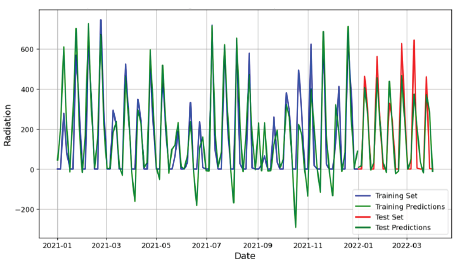
Results: As a result, it was obtained that at the level of stationary models, the ARIMA (3,0,3) model was the one that achieved the best fit, with a moderate coefficient of determination for the training and test sets. Likewise, with respect to models with a seasonal component, it was determined that the SARIMA model based on ARIMA (3,0,3) and with a seasonal component (1,0,1,8) had the best performance, with a good fit on the training set (R2 of 0.8571) and test set (R2 of 0.8152).
Conclusions: It is concluded that the incorporation of the exogenous variable into the SARIMA model did not improve the SARIMA model's performance, such that the SARIMAX model obtained good performance on the training set and moderate performance on the test set. Likewise, the models obtained in this research are of great utility for the characterization of solar radiation potential, as well as for efficient planning in the deployment of photovoltaic solar energy systems.
Abstract (es)
Objetivo: Teniendo en cuenta la transición creciente hacia las energías renovables y específicamente el potencial solar de Colombia y de la región caribe con respecto a la energía solar fotovoltaica, así como la necesidad de desarrollar estudios de caracterización del potencial solar, en este artículo se propone como contribución el ajuste y evaluación de cuatro modelos de series de tiempo estacionarios y estacionales (ARIMA, SARIMA, SARIMAX y Exponential Smoothing) sobre los datos de radiación solar del municipio de Mompox-Bolívar.
Metodología: A nivel metodológico, dentro de esta investigación fue adaptada la metodología CRISP-DM a 4 fases a saber: F1. Entendimiento del negocio y de los datos, F2. Preparación de los datos, F3. Modelado, F4 Evaluación y Despliegue del modelo.
Resultados: Como resultado, se obtuvo que a nivel de los modelos estacionarios, el modelo ARIMA (3,0,3) fue el que obtuvo un mejor ajuste, con un coeficiente de determinación moderado para el conjunto de entrenamiento y prueba. Así mismo, con respecto a los modelos con componente estacional, se determinó que el modelo SARIMA basado en ARIMA(3,0,3) y con componente estacional (1,0,1,8) fue el que tuvo el mejor rendimiento, con un buen ajuste en el conjunto de entrenamiento (R2 de 0.8571) y prueba (R2 de 0.8152).
Conclusiones: Se concluye que la incorporación de la variable exógena al modelo SARIMA no mejoró el rendimiento del modelo SARIMA, de tal modo que el modelo SARIMAX obtuvo un buen rendimiento en el conjunto de entrenamiento y un rendimiento moderado en el conjunto de prueba. Así mismo, los modelos obtenidos en esta investigación, son de gran utilidad para la caracterización del potencial de la radiación solar, así como para la planificación eficiente en el despliegue de sistemas de energía solar fotovoltaica.
References
[1] G. N. Tiwari and L. Sahota, “Solar Radiation and Heat Transfer,” 2017, pp. 63–119. [Online]. Available: https://doi.org/10.1007/978-981-10-4672-8_2.
[2] H. Hissou, S. Benkirane, A. Guezzaz, M. Azrour, and A. Beni-Hssane, “A novel machine learning approach for solar radiation estimation,” Sustainability, vol. 15, no. 13, p. 10609, Jul. 2023. [Online]. Available: https://doi.org/10.3390/su151310609.
[3] J. Polo, L. Martín-Pomares, C. A. Gueymard, J. L. Balenzategui, F. Fabero, and J. P. Silva, “Fundamentals: Quantities, Definitions, and Units,” 2019, pp. 1–14. [Online]. Available: https://doi.org/10.1007/978-3-319-97484-2_1.
[4] A. Madhlopa, “Solar Radiation Resource,” 2018, pp. 51–64. [Online]. Available: https://doi.org/10.1007/978-3-319-68388-1_3
[5] W. Contreras Sepúlveda, M. G. Galban Pineda, and S. B. Sepúlveda Mora, “Análisis estadístico de la radiación solar en la ciudad de Cúcuta,” Entre Ciencia e Ingeniería, vol. 12, no. 23, pp. 16–22, Jun. 2018. [Online]. Available: https://doi.org/10.31908/19098367.3698.
[6] A. E. Gürel, Ü. Ağbulut, H. Bakır, A. Ergün, and G. Yıldız, “A state of art review on estimation of solar radiation with various models,” Heliyon, vol. 9, no. 2, p. e13167, Feb. 2023. [Online]. Available: https://doi.org/10.1016/j.heliyon.2023.e13167.
[7] J. Tovar-Pescador, “Modelling the statistical properties of solar radiation and proposal of a technique based on Boltzmann statistics,” in Modeling Solar Radiation at the Earth’s Surface, Berlin, Heidelberg: Springer Berlin Heidelberg, 2008, pp. 55–91. [Online]. Available: https://doi.org/10.1007/978-3-540-77455-6_3.
[8] IEA, “World Energy Outlook 2023,” 2023. [Online]. Available: https://www.iea.org/news/the-energy-world-is-set-to-change-significantly-by-2030-based-on-today-s-policy-settings-alone.
[9] E. Alagoz and Y. Alghawi, “The future of fossil fuels: Challenges and opportunities in a low-carbon,” Int. J. Earth Sci. Knowl. Appl., vol. 5, no. 3, pp. 381–388, 2023.
[10] Á. Realpe, J. Garzón, and D. A. Montes, “Mathematical modelling of electric energy potential of Piedra Bolivar Campus of Cartagena University, obtained from solar radiation,” Int. J. ChemTech Res., vol. 10, no. 1, pp. 209–214, 2017.
[11] E. W. Likta, J. K. Gadzama, and D. I. Malgwi, “Evaluation of solar energy potentials for power energy generation in Maiduguri, Borno State,” FUDMA J. Sci., vol. 7, no. 3, pp. 223–231, Jul. 2023. [Online]. Available: https://doi.org/10.33003/fjs-2023-0703-1863.
[12] S. A. Shehzad, T. Hayat, A. Alsaedi, and B. Chen, “A useful model for solar radiation,” Energy, Ecol. Environ., vol. 1, no. 1, pp. 30–38, Feb. 2016. [Online]. Available: https://doi.org/10.1007/s40974-016-0014-y
[13] N. Kannan and D. Vakeesan, “Solar energy for future world: A review,” Renew. Sustain. Energy Rev., vol. 62, pp. 1092–1105, Sep. 2016. [Online]. Available: https://doi.org/10.1016/j.rser.2016.05.022
[14] P. Nikolaidis, “Solar energy harnessing technologies towards de-carbonization: A systematic review of processes and systems,” Energies, vol. 16, no. 17, p. 6153, Aug. 2023. [Online]. Available: https://doi.org/10.3390/en16176153
[15] S. Dixit, “Solar technologies and their implementations: A review,” Mater. Today Proc., vol. 28, pp. 2137–2148, 2020. [Online]. Available: https://doi.org/10.1016/j.matpr.2020.04.134
[16] N. K. Sharma, P. K. Tiwari, and Y. R. Sood, “Solar energy in India: Strategies, policies, perspectives and future potential,” Renew. Sustain. Energy Rev., vol. 16, no. 1, pp. 933–941, Jan. 2012. [Online]. Available: https://doi.org/10.1016/j.rser.2011.09.014
[17] H. S. K. Nathan, “Solar energy for rural electricity in India: A misplaced emphasis,” Econ. Polit. Wkly., vol. 49, no. 50, pp. 60–67, 2014
[18] F. M. Guangul and G. T. Chala, “Solar energy as renewable energy source: SWOT analysis,” in 2019 4th MEC International Conference on Big Data and Smart City (ICBDSC), IEEE, Jan. 2019, pp. 1–5. [Online]. Available: https://doi.org/10.1109/ICBDSC.2019.8645580
[19] R. V. Moharir and S. S. Dodani, “Solar energy as an energy source: An approach,” IOSR J. Mech. Civ. Eng., vol. 14, no. 3, pp. 87–92, Jun. 2017. [Online]. Available: https://doi.org/10.9790/1684-1403058792.
[20] R. Nasrin, M. Hasanuzzaman, and N. A. Rahim, “Effect of high irradiation on photovoltaic power and energy,” Int. J. Energy Res., vol. 42, no. 3, pp. 1115–1131, Mar. 2018. [Online]. Available: https://doi.org/10.1002/er.3907
[21] N. U. Putri, E. Pranita, J. P. Sembiring, A. Jayadi, A. Aryanto, and F. K. Muzamil Suat, “The effect of solar radiation on solar panels in aeroponic plant systems,” in 2023 International Conference on Networking, Electrical Engineering, Computer Science, and Technology (IConNECT), IEEE, Aug. 2023, pp. 121–126. [Online]. Available: https://doi.org/10.1109/IConNECT56593.2023.10327307.
[22] G. Senger, B. Chtirkova, D. Folini, J. Wohland, and M. Wild, “Persistent extreme surface solar radiation and its implications on solar photovoltaics,” Earth's Future, vol. 12, no. 8, Aug. 2024. [Online]. Available: https://doi.org/10.1029/2023EF004266
[23] A. Manowska, A. Dylong, B. Tkaczyk, and J. Manowski, “Analysis and monitoring of maximum solar potential for energy production optimization using photovoltaic panels,” Energies, vol. 17, no. 1, p. 72, Dec. 2023. [Online]. Available: https://doi.org/10.3390/en17010072
[24] IPSE, “La energía no es el fin, es el motor de la transformación,” Instituto de Planificación y Promoción de Soluciones Energéticas para Zonas No Interconectadas. [Online]. Available: https://ipse.gov.co/blog/2023/10/05/la-energia-no-es-el-fin-es-el-motor-de-la-transformacion-ipse/
[25] R. Prăvălie, C. Patriche, and G. Bandoc, “Spatial assessment of solar energy potential at global scale: A geographical approach,” J. Clean. Prod., vol. 209, pp. 692–721, Feb. 2019. [Online]. Available: https://doi.org/10.1016/j.jclepro.2018.10.239
[26] H. Khodayar Sahebi, S. Hoseinzadeh, H. Ghadamian, M. H. Ghasemi, F. Esmaeilion, and D. A. Garcia, “Techno-economic analysis and new design of a photovoltaic power plant by a direct radiation amplification system,” Sustainability, vol. 13, no. 20, p. 11493, Oct. 2021. [Online]. Available: https://doi.org/10.3390/su132011493.
[27] Ü. Ağbulut, A. E. Gürel, and Y. Biçen, “Prediction of daily global solar radiation using different machine learning algorithms: Evaluation and comparison,” Renew. Sustain. Energy Rev., vol. 135, p. 110114, Jan. 2021. [Online]. Available: https://doi.org/10.1016/j.rser.2020.110114.
[28] V. Demir and H. Citakoglu, “Forecasting of solar radiation using different machine learning approaches,” Neural Comput. Appl., vol. 35, no. 1, pp. 887–906, Jan. 2023. [Online]. Available: https://doi.org/10.1007/s00521-022-07841-x.
[29] L. Wang et al., “Prediction of diffuse solar radiation based on multiple variables in China,” Renew. Sustain. Energy Rev., vol. 103, pp. 151–216, Apr. 2019. [Online]. Available: https://doi.org/10.1016/j.rser.2018.12.029
[30] Z. Pang, F. Niu, and Z. O’Neill, “Solar radiation prediction using recurrent neural network and artificial neural network: A case study with comparisons,” Renew. Energy, vol. 156, pp. 279–289, Aug. 2020. [Online]. Available: https://doi.org/10.1016/j.renene.2020.04.042
[31] G. Narvaez et al., “An interactive tool for visualization and prediction of solar radiation and photovoltaic generation in Colombia,” Big Earth Data, vol. 7, no. 3, pp. 904–929, Jul. 2023. [Online]. Available: https://doi.org/10.1080/20964471.2023.2185920
[32] E. Miranda, J. F. G. Fierro, G. Narváez, L. F. Giraldo, and M. Bressan, “Prediction of site-specific solar diffuse horizontal irradiance from two input variables in Colombia,” Heliyon, vol. 7, no. 12, p. e08602, Dec. 2021. [Online]. Available: https://doi.org/10.1016/j.heliyon.2021.e08602
[33] G. Valencia, J. Duarte, and L. Obregon, “Global solar radiation prediction in Colombia using a backpropagation neural network architecture,” Int. Rev. Autom. Control, vol. 12, no. 6, p. 293, Nov. 2019. [Online]. Available: https://doi.org/10.15866/ireaco.v12i6.18388
[34] L. C. Ruiz, D. Amaya, and O. L. Ramos, “Prediction of solar radiation through the ANFIS algorithm,” Appl. Mech. Mater., vol. 823, pp. 389–395, Jan. 2016. [Online]. Available: https://doi.org/10.4028/www.scientific.net/AMM.823.389
[35] J. Urrego-Ortiz, J. A. Martínez, P. A. Arias, and Á. Jaramillo-Duque, “Assessment and day-ahead forecasting of hourly solar radiation in Medellín, Colombia,” Energies, vol. 12, no. 22, p. 4402, Nov. 2019. [Online]. Available: https://doi.org/10.3390/en12224402
[36] M. Vanegas Chamorro, E. Villicaña Ortíz, and L. Arrieta Viana, “Cuantificación y caracterización de la radiación solar en el departamento de La Guajira-Colombia mediante el cálculo de transmisibilidad atmosférica,” Prospectiva, vol. 13, no. 2, p. 54, Dec. 2015. [Online]. Available: https://doi.org/10.15665/rp.v13i2.487
[37] J. A. Hernández Mora, C. L. Trujillo Rodríguez, and W. A. Vallejo Lozada, “Modelamiento de la irradiancia y la temperatura ambiente utilizando funciones de probabilidad,” Rev. Tecnura, vol. 18, no. 39, p. 128, Dec. 2013. [Online]. Available: https://doi.org/10.14483/udistrital.jour.tecnura.2014.1.a09
[38] E. Chodakowska, J. Nazarko, Ł. Nazarko, and H. S. Rabayah, “Solar radiation forecasting: A systematic meta-review of current methods and emerging trends,” Energies, vol. 17, no. 13, p. 3156, Jun. 2024. [Online]. Available: https://doi.org/10.3390/en17133156
[39] E. Chodakowska, J. Nazarko, Ł. Nazarko, H. S. Rabayah, R. M. Abendeh, and R. Alawneh, “ARIMA models in solar radiation forecasting in different geographic locations,” Energies, vol. 16, no. 13, p. 5029, Jun. 2023. [Online]. Available: https://doi.org/10.3390/en16135029
[40] G. Carrascal, J. Barrios, F. Ferreira, and J. Plaza, “Solar radiation forecasting: A study case in the Colombian Caribbean region,” Springer Proc. Math. Stat., vol. 469, pp. 199–210, 2025. [Online]. Available: https://doi.org/10.1007/978-3-031-68949-9_15.
[41] J. Nava and P. Hernández, “Optimization of a hybrid methodology (CRISP-DM),” in Logistics Management and Optimization through Hybrid Artificial Intelligence Systems, IGI Global, 2012, pp. 356–379. [Online]. Available: https://doi.org/10.4018/978-1-4666-0297-7.ch014
[42] C. Schröer, F. Kruse, and J. M. Gómez, “A systematic literature review on applying CRISP-DM process model,” Procedia Comput. Sci., vol. 181, pp. 526–534, 2021. [Online]. Available: https://doi.org/10.1016/j.procs.2021.01.199.
[43] S. Maataoui, G. Bencheikh, and G. Bencheikh, “Predictive maintenance in the industrial sector: A CRISP-DM approach for developing accurate machine failure prediction models,” in 2023 Fifth International Conference on Advances in Computational Tools for Engineering Applications (ACTEA), IEEE, Jul. 2023, pp. 223–227. [Online]. Available: https://doi.org/10.1109/ACTEA58025.2023.10193983
[44] F. Martinez-Plumed et al., “CRISP-DM twenty years later: From data mining processes to data science trajectories,” IEEE Trans. Knowl. Data Eng., vol. 33, no. 8, pp. 3048–3061, Aug. 2021. [Online]. Available: https://doi.org/10.1109/TKDE.2019.2962680
[45] G. E. P. Box, G. M. Jenkins, G. C. Reinsel, and G. M. Ljung, Time Series Analysis: Forecasting and Control, 5th ed. Wiley, 2015
[46] R. J. Hyndman and G. Athanasopoulos, Forecasting: Principles and Practice. OTexts, 2013.
[47] Y. Patil, T. Shruti, and R. K., “Time-series forecasting using ARIMA and SARIMA models for solar NASA POWER data,” in 2025 3rd International Conference on Intelligent Systems, Advanced Computing and Communication (ISACC), IEEE, Feb. 2025, pp. 946–952. [Online]. Available: https://doi.org/10.1109/ISACC65211.2025.10969243
[48] D. K. Wijaya, R. Widjaya, A. Kurniawan, and Diana, “Using time series analysis to predict earthquake,” in 2024 International Conference on Artificial Intelligence, Blockchain, Cloud Computing, and Data Analytics (ICoABCD), IEEE, Aug. 2024, pp. 25–30. [Online]. Available: https://doi.org/10.1109/ICoABCD63526.2024.10704296
[49] E. S. Gardner, “Exponential smoothing: The state of the art,” J. Forecast., vol. 4, no. 1, pp. 1–28, Jan. 1985. [Online]. Available: https://doi.org/10.1002/for.3980040103.
[50] S. Dev, T. AlSkaif, M. Hossari, R. Godina, A. Louwen, and W. van Sark, “Solar irradiance forecasting using triple exponential smoothing,” in 2018 International Conference on Smart Energy Systems and Technologies (SEST), IEEE, Sep. 2018, pp. 1–6. [Online]. Available: https://doi.org/10.1109/SEST.2018.8495816
How to Cite
APA
ACM
ACS
ABNT
Chicago
Harvard
IEEE
MLA
Turabian
Vancouver
Download Citation
License
Copyright (c) 2026 Gabriel Elías Chanchí Golondrino, Manuel Alejandro Ospina-Alarcón, Álvaro Realpe-Jiménez

This work is licensed under a Creative Commons Attribution-ShareAlike 4.0 International License.
Esta licencia permite a otros remezclar, adaptar y desarrollar su trabajo incluso con fines comerciales, siempre que le den crédito y concedan licencias para sus nuevas creaciones bajo los mismos términos. Esta licencia a menudo se compara con las licencias de software libre y de código abierto “copyleft”. Todos los trabajos nuevos basados en el tuyo tendrán la misma licencia, por lo que cualquier derivado también permitirá el uso comercial. Esta es la licencia utilizada por Wikipedia y se recomienda para materiales que se beneficiarían al incorporar contenido de Wikipedia y proyectos con licencias similares.