DOI:
https://doi.org/10.14483/2256201X.23266Published:
2026-01-01Issue:
Vol. 29 No. 1 (2026): January-JuneSection:
Review articlesSequías e incendios forestales en América Latina: una revisión sistemática de literatura
Droughts and Forest Fires in Latin America: A Systematic Literature Review
Keywords:
cambio climático, evaluación de incendios, evaluación de sequías, monitoreo satelital (es).Keywords:
Climate change, fire assessment, drought assessment, satellite monitoring (en).Downloads
References
Afghah, F., Razi, A., Chakareski, J., & Ashdown, J. (2019). Wildfire monitoring in remote areas using autonomous unmanned aerial vehicles [Artículo de conferencia]. IEEE INFOCOM 2019 - IEEE Conference on Computer Communications Workshops (INFOCOM WKSHPS). https://doi.org/10.1109/INFCOMW.2019.8845309
Alizadeh, M. R., Adamowski, J., & Entekhabi, D. (2024). Land and atmosphere precursors to fuel loading, wildfire ignition and post‐fire recovery. Geophysical Research Letters, 51(2), e2023GL105324. https://doi.org/10.1029/2023GL105324
Aragão, L. E. O. C., Anderson, L. O., Fonseca, M. G., Rosan, T. M., Vedovato, L. B., Wagner, F. H., Silva, C. V. J., Silva Junior, C. H. L., Arai, E., Aguiar, A. P., Barlow, J., Berenguer, E., Deeter, M. N., Domingues, L. G., Gatti, L., Gloor, M., Malhi, Y., Marengo, J. A., Miller, J. B., ... Saatchi, S. (2018). 21st-century drought-related fires counteract the decline of Amazon deforestation carbon emissions. Nature Communications, 9(1), 536. https://doi.org/10.1038/s41467-017-02771-y
Armenteras, D., Retana-Alumbreros, J., Molowny-Horas, R., Román-Cuesta, R. M., González-Alonso, F., & Morales-Rivas, M. (2011). Characterising fire spatial pattern interactions with climate and vegetation in Colombia. Agricultural and Forest Meteorology, 151(3), 279-289. https://doi.org/10.1016/j.agrformet.2010.11.002
Armenteras, D., & Retana, J. (2012). Dynamics, patterns and causes of fires in northwestern Amazonia. PloS One, 7(4), e35288. https://doi.org/10.1371/journal.pone.0035288
Barros-Rosa, L., de Arruda, P. H. Z., Machado, N. G., Pires-Oliveira, J. C., & Eisenlohr, P. V. (2022). Fire probability mapping and prediction from environmental data: What a comprehensive savanna-forest transition can tell us. Forest Ecology and Management, 520, 120354. https://doi.org/10.1016/j.foreco.2022.120354
Bedia, J., Herrera, S., Gutiérrez, J. M., Benali, A., Brands, S., Mota, B., & Moreno, J. M. (2015). Global patterns in the sensitivity of burned area to fire-weather: Implications for climate change. Agricultural and Forest Meteorology, 214-215, 369-379. https://doi.org/10.1016/j.agrformet.2015.09.002
Bowman, D. M. J. S., O’Brien, J. A., & Goldammer, J. G. (2013). Pyrogeography and the global quest for sustainable fire management. Annual Review of Environment and Resources, 38(1), 57-80. https://doi.org/10.1146/annurev-environ-082212-134049
Brando, P. M., Balch, J. K., Nepstad, D. C., Morton, D. C., Putz, F. E., Coe, M. T., Silvério, D., Macedo, M. N., Davidson, E. A., Nóbrega, C. C., Alencar, A., & Soares-Filho, B. S. (2014). Abrupt increases in Amazonian tree mortality due to drought–fire interactions. Proceedings of the National Academy of Sciences, 111(17), 6347-6352. https://doi.org/10.1073/pnas.1305499111
Carvalho, N. S., Anderson, L. O., Nunes, C. A., Pessôa, A. C. M., Junior, C. H. L. S., Reis, J. B. C., Shimabukuro, Y. E., Berenguer, E., Barlow, J., & Aragão, L. E. O. C. (2021). Spatio-temporal variation in dry season determines the Amazonian fire calendar. Environmental Research Letters, 16(12), 125009. https://doi.org/10.1088/1748-9326/ac3aa3
Carvalho, T. C., Wittmann, F., Piedade, M. T. F., Resende, A. F. D., Silva, T. S. F., & Schöngart, J. (2021). Fires in Amazonian blackwater floodplain forests: Causes, human dimension, and implications for conservation. Frontiers in Forests and Global Change, 4, 755441. https://doi.org/10.3389/ffgc.2021.755441
Cavalcante, R. B. L., Souza, B. M., Ramos, S. J., Gastauer, M., Nascimento Junior, W. R., Caldeira, C. F., & Souza-Filho, P. W. M. (2021). Assessment of fire hazard weather indices in the eastern Amazon: A case study for different land uses. Acta Amazonica, 51, 352-362. https://doi.org/10.1590/1809-4392202101172
Cerano-Paredes, J., Villanueva-Díaz, J., Vázquez-Selem, L., Cervantes-Martínez, R., Esquivel-Arriaga, G., Cruz, V. G. la, & Fulé, P. Z. (2016). Historical fire regime and its relationship with climate in a forest of Pinus hartwegii to the north of Puebla State, Mexico. Revista Bosque, 37(2), 2. https://revistabosque.org/index.php/bosque/article/view/477
Chuvieco, E., Pettinari, M. L., Koutsias, N., Forkel, M., Hantson, S., & Turco, M. (2021). Human and climate drivers of global biomass burning variability. Science of The Total Environment, 779, 146361. https://doi.org/10.1016/j.scitotenv.2021.146361
Cohen, J. D., & Deeming, J. E. (1985). The national fire-danger rating system: Basic equations. US Department of Agriculture, Forest Service, Pacific Southwest Forest and Range Experiment Station. https://doi.org/10.2737/PSW-GTR-82
de Faria, B. L., Brando, P. M., Macedo, M. N., Panday, P. K., Soares-Filho, B. S., & Coe, M. T. (2017). Current and future patterns of fire-induced forest degradation in Amazonia. Environmental Research Letters, 12(9), 095005. https://doi.org/10.1088/1748-9326/aa69ce
de Magalhães Neto, N., & Evangelista, H. (2022). Human Activity Behind the Unprecedented 2020 Wildfire in Brazilian Wetlands (Pantanal). Frontiers in Environmental Science, 10, 1-15. https://doi.org/10.3389/fenvs.2022.888578
dos Reis, M., Graça, P. M. L. D. A., Yanai, A. M., Ramos, C. J. P., & Fearnside, P. M. (2021). Forest fires and deforestation in the central Amazon: Effects of landscape and climate on spatial and temporal dynamics. Journal of Environmental Management, 288, 112310. https://doi.org/10.1016/j.jenvman.2021.112310
Fernandes, P. M., Loureiro, C., Guiomar, N., Pezzatti, G. B., Manso, F. T., & Lopes, L. (2014). The dynamics and drivers of fuel and fire in the Portuguese public forest. Journal of Environmental Management, 146, 373-382. https://doi.org/10.1016/j.jenvman.2014.07.049
Ferreira, I. J. M., Campanharo, W. A., Barbosa, M. L. F., Silva, S. S. D., Selaya, G., Aragão, L. E. O. C., & Anderson, L. O. (2023). Assessment of fire hazard in Southwestern Amazon. Frontiers in Forests and Global Change, 6, 1107417. https://doi.org/10.3389/ffgc.2023.1107417
Flores, B. M., Fagoaga, R., Nelson, B. W., & Holmgren, M. (2016). Repeated fires trap Amazonian blackwater floodplains in an open vegetation state. Journal of Applied Ecology, 53(5), 1597-1603. https://doi.org/10.1111/1365-2664.12687
Ganteaume, A., & Syphard, A. D. (2018). Ignition Sources. En S. L. Manzello (Ed.), Encyclopedia of Wildfires and Wildland-Urban Interface (WUI) Fires (pp. 1-17). Springer International Publishing. https://doi.org/10.1007/978-3-319-51727-8_43-1
Gonçalves, K. D. S., Castro, H. A. D., & Hacon, S. D. S. (2012). As queimadas na região amazônica e o adoecimento respiratório. Ciência & Saúde Coletiva, 17(6), 1523-1532. https://doi.org/10.1590/S1413-81232012000600016
González-Alonso, L., Val Martin, M., & Kahn, R. A. (2019). Biomass-burning smoke heights over the Amazon observed from space. Atmospheric Chemistry and Physics, 19(3), 1685-1702. https://doi.org/10.5194/acp-19-1685-2019
González-Tagle, M. A., Cerano-Paredes, J., Himmelsbach, W., Alanís-Rodríguez, E., & Colazo-Ayala, Á. A. (2023). Historial de incendios basado en técnicas dendrocronológicas para un bosque de coníferas en la región sureste de Jalisco, México. Revista Chapingo, Serie Ciencias Forestales y del Ambiente, 29(1), 35-49. https://doi.org/10.5154/r.rchscfa.2022.03.018
Hagberg, A. A., Schult, D. A., & Swart, P. J. (2008). Exploring network structure, dynamics, and function using NetworkX [Artículo de conferencia]. 7th Python in Science Conference (SciPy2008). https://doi.org/10.25080/TCWV9851
Herawati, H., González-Olabarria, J. R., Wijaya, A., Martius, C., Purnomo, H., & Andriani, R. (2015, julio 7). Tools for assessing the impacts of climate variability and change on wildfire regimes in forests. CIFOR-ICRAF. https://doi.org/10.3390/f6051476
Hunter, J. D. (2007). Matplotlib: A 2D graphics environment. Computing in Science & Engineering, 9(3), 90-95. https://doi.org/10.1109/MCSE.2007.55
Jordahl, K. (2014, julio 6). GeoPandas: Python tools for geographic data. SciPy Proceedings. https://doi.org/10.25080/Majora-14bd3278-00a
Knutzen, F., Averbeck, P., Barrasso, C., Bouwer, L. M., Gardiner, B., Grünzweig, J. M., Hänel, S., Haustein, K., Johannessen, M. R., Kollet, S., Müller, M. M., Pietikäinen, J.-P., Pietras-Couffignal, K., Pinto, J. G., Rechid, D., Rousi, E., Russo, A., Suárez-Gutiérrez, L., Veit, S., … Gliksman, D. (2025). Impacts on and damage to European forests from the 2018–2022 heat and drought events. Natural Hazards and Earth System Sciences, 25(1), 77-117. https://doi.org/10.5194/nhess-25-77-2025
Krueger, E. S., Levi, M. R., Achieng, K. O., Bolten, J. D., Carlson, J. D., Coops, N. C., Holden, Z. A., Magi, B. I., Rigden, A. J., & Ochsner, T. E. (2022). Using soil moisture information to better understand and predict wildfire danger: A review of recent developments and outstanding questions. International Journal of Wildland Fire, 32(2), 111-132. https://doi.org/10.1071/WF22056
Lemos, N. S. A., & Cunha, J. M. (2021). Analysis of fire risk in the Amazon: A systematic review. Revista Ambiente & Água, 16, e2706. https://doi.org/10.4136/ambi-agua.2706
Littell, J. S., Peterson, D. L., Riley, K. L., Liu, Y., & Luce, C. H. (2016). A review of the relationships between drought and forest fire in the United States. Global Change Biology, 22(7), 2353-2369. https://doi.org/10.1111/gcb.13275
Loudermilk, E. L., O’Brien, J. J., Goodrick, S. L., Linn, R. R., Skowronski, N. S., & Hiers, J. K. (2022). Vegetation’s influence on fire behavior goes beyond just being fuel. Fire Ecology, 18(1), 9. https://doi.org/10.1186/s42408-022-00132-9
Maillard, O., Vides-Almonacid, R., Flores-Valencia, M., Coronado, R., Vogt, P., Vicente-Serrano, S. M., Azurduy, H., Anívarro, R., & Cuéllar, R. L. (2020). Relationship of forest cover fragmentation and drought with the occurrence of forest fires in the department of Santa Cruz, Bolivia. Forests, 11(9), 910. https://doi.org/10.3390/f11090910
Marengo, J. A., Cunha, A. P., Cuartas, L. A., Deusdará Leal, K. R., Broedel, E., Seluchi, M. E., Michelin, C. M., De Praga Baião, C. F., Chuchón Angulo, E., Almeida, E. K., Kazmierczak, M. L., Mateus, N. P. A., Silva, R. C., & Bender, F. (2021). Extreme drought in the Brazilian Pantanal in 2019–2020: Characterization, causes, and impacts. Frontiers in Water, 3, 1-20. https://doi.org/10.3389/frwa.2021.639204
McKinney, W. (2010, junio 28). Data structures for statistical computing in Python. SciPy Proceedings. https://doi.org/10.25080/Majora-92bf1922-00a
Microsoft Corporation (2024). Microsoft Excel (Versión 2501, compilación 18429.20158) [Software de computadora]. https://www.microsoft.com/es-co/microsoft-365/excel
Morgan, W. T., Darbyshire, E., Spracklen, D. V., Artaxo, P., & Coe, H. (2019). Non-deforestation drivers of fires are increasingly important sources of aerosol and carbon dioxide emissions across Amazonia. Scientific Reports, 9(1), 16975. https://doi.org/10.1038/s41598-019-53112-6
Nogueira, J. M. P., Rambal, S., Barbosa, J. P. R. A. D., & Mouillot, F. (2017). Spatial pattern of the seasonal drought/burned area relationship across Brazilian biomes: Sensitivity to drought metrics and global remote-sensing fire products. Climate, 5(2), 2. https://doi.org/10.3390/cli5020042
Nolan, R. H., Boer, M. M., Collins, L., Resco de Dios, V., Clarke, H., Jenkins, M., Kenny, B., & Bradstock, R. A. (2020). Causes and consequences of eastern Australia’s 2019–20 season of mega-fires. Global Change Biology, 26(3), 1039-1041. https://doi.org/10.1111/gcb.14987
Oliveira, J. G. D., Massi, K. G., Bortolozo, L. A. P., & Cunha, A. P. M. D. A. (2023). The influence of climate parameters on fires in the Paraíba do Sul River valley, southeast Brazil. Ambiente e Agua - An Interdisciplinary Journal of Applied Science, 18, 1-14. https://doi.org/10.4136/ambi-agua.2923
Oliveira, U., Soares-Filho, B., Bustamante, M., Gomes, L., Ometto, J. P., & Rajão, R. (2022). Determinants of fire impact in the Brazilian biomes. Frontiers in Forests and Global Change, 5, 735017. https://doi.org/10.3389/ffgc.2022.735017
Oliveira Júnior, J. F., Sousa, G. de, Nunes, M., Fernandes, M., & Tomzhinski, G. (2017). Relação entre o standardized precipitation index (SPI) e os relatórios de ocorrência de incêndios (ROI) no Parque Nacional do Itatiaia. Floresta e Ambiente, 24, e20160031. https://doi.org/10.1590/2179-8087.003116
Oliveira-Júnior, J. F. D., Mendes, D., Correia Filho, W. L. F., Silva Junior, C. A. D., Gois, G. D., Jardim, A. M. D. R. F., Silva, M. V. D., Lyra, G. B., Teodoro, P. E., Pimentel, L. C. G., Lima, M., Santiago, D. D. B., Rogério, J. P., & Marinho, A. A. R. (2021). Fire foci in South America: Impact and causes, fire hazard and future scenarios. Journal of South American Earth Sciences, 112, 103623. https://doi.org/10.1016/j.jsames.2021.103623
OpenAI (2023). ChatGPT (modelo GPT-4) [Modelo de lenguaje de gran escala]. https://chat.openai.com/
Pompa-García, M., Julio, C. J., Dante Arturo, R.-T., & Daniel Jose, V.-N. (2018). Drought and spatiotemporal variability of forest fires across Mexico. Chinese Geographical Science, 28(1), 25-37. https://doi.org/10.1007/s11769-017-0928-0
Python Software Foundation (2024). Python (versión 3.12.2) [Lenguaje de programación]. https://www.python.org/
Ranasinghe, R., Ruane, A. C., Vautard, R., Arnell, N., Coppola, E., Cruz, F. A., Dessai, S., Islam, A. S., Rahimi, M., Ruiz Carrascal, D., Sillmann, J., Sylla, M. B., Tebaldi, C., Wang, W., & Zaaboul, R. (2021).. Climate change information for regional impact and for risk assessment. En IPCC (Eds.), Climate Change 2021: The Physical Science Basis: Working Group I Contribution to the Sixth Assessment Report of the Intergovernmental Panel on Climate Change (pp. 1767-1926). Cambridge University Press. https://doi.org/10.1017/9781009157896.014
Riley, K. L., Abatzoglou, J. T., Grenfell, I. C., Klene, A. E., & Heinsch, F. A. (2013). The relationship of large fire occurrence with drought and fire danger indices in the western USA, 1984-2008: The role of temporal scale. International Journal of Wildland Fire, 22, 894-909. https://doi.org/10.1071/WF12149
Román-Cuesta, R. M., Rejalaga-Noguera, L., Pinto-García, C., & Retana, J. (2014). Pacific and Atlantic oceanic anomalies and their interaction with rainfall and fire in Bolivian biomes for the period 1992–2012. Climatic Change, 127(2), 243-256. https://doi.org/10.1007/s10584-014-1246-5
Silva Junior, C. H. L., Anderson, L. O., Silva, A. L., Almeida, C. T., Dalagnol, R., Pletsch, M. A. J. S., Penha, T. V., Paloschi, R. A., & Aragão, L. E. O. C. (2019). Fire responses to the 2010 and 2015/2016 Amazonian droughts. Frontiers in Earth Science, 7, 97. https://doi.org/10.3389/feart.2019.00097
Silva Junior, C. A. da, Lima, M., Teodoro, P. E., Oliveira-Júnior, J. F. de, Rossi, F. S., Funatsu, B. M., Butturi, W., Lourençoni, T., Kraeski, A., Pelissari, T. D., Moratelli, F. A., Arvor, D., Luz, I. M. dos S., Teodoro, L. P. R., Dubreuil, V., & Teixeira, V. M. (2022). Fires drive long-term environmental degradation in the Amazon Basin. Remote Sensing, 14(2), 338. https://doi.org/10.3390/rs14020338
Silveira, M. V. F., Silva-Junior, C. H. L., Anderson, L. O., & Aragão, L. E. O. C. (2022). Amazon fires in the 21st century: The year of 2020 in evidence. Global Ecology and Biogeography, 31(10), 2026-2040. https://doi.org/10.1111/geb.13577
Silvério, D. V., Oliveira, R. S., Flores, B. M., Brando, P. M., Almada, H. K., Furtado, M. T., Moreira, F. G., Heckenberger, M., Ono, K. Y., & Macedo, M. N. (2022). Intensification of fire regimes and forest loss in the Território Indígena do Xingu. Environmental Research Letters, 17(4), 045012. https://doi.org/10.1088/1748-9326/ac5713
Souza Vilanova, R., Delgado, R. C., Frossard de Andrade, C., Lopes dos Santos, G., Magistrali, I. C., Moreira de Oliveira, C. M., Teodoro, P. E., Capristo Silva, G. F., Silva Junior, C. A. D., & de Ávila Rodrigues, R. (2021). Vegetation degradation in ENSO events: Drought assessment, soil use and vegetation evapotranspiration in the Western Brazilian Amazon. Remote Sensing Applications: Society and Environment, 23, 100531. https://doi.org/10.1016/j.rsase.2021.100531
Ten Hoeve, J. E., Remer, L. A., Correia, A. L., & Jacobson, M. Z. (2012). Recent shift from forest to savanna burning in the Amazon Basin observed by satellite. Environmental Research Letters, 7(2), 024020. https://doi.org/10.1088/1748-9326/7/2/024020
Urrutia-Jalabert, R., González, M. E., González-Reyes, Á., Lara, A., & Garreaud, R. (2018). Climate variability and forest fires in central and south-central Chile. Ecosphere, 9(4), e02171. https://doi.org/10.1002/ecs2.2171
Xu, R., Yu, P., Abramson, M. J., Johnston, F. H., Samet, J. M., Bell, M. L., Haines, A., Ebi, K. L., Li, S., & Guo, Y. (2020). Wildfires, global climate change, and human health. New England Journal of Medicine, 383(22), 2173-2181. https://doi.org/10.1056/NEJMsr2028985
Yang, S., Huang, Q., & Yu, M. (2024). Advancements in remote sensing for active fire detection: A review of datasets and methods. Science of the Total Environment, 943, 173273. https://doi.org/10.1016/j.scitotenv.2024.173273
Ynouye-Francés, M., Ramos-Rodríguez, M. P., Martínez-Becerra, L. W., Cabrera-Reina, J. M., González-Rodríguez, R., Duany-Dangel, A., Ynouye-Francés, M., Ramos-Rodríguez, M. P., Martínez-Becerra, L. W., Cabrera-Reina, J. M., González-Rodríguez, R., & Duany-Dangel, A. (2021). Causalidad de los incendios forestales en Pinar del Río, Cuba (1975-2018). Colombia Forestal, 24(2), 24-38. https://doi.org/10.14483/2256201x.16881
Zuo, F., Yao, Q., Shi, L., Wang, Z., Bai, M., Fang, K., Guo, F., Yuan, L., & Zhang, W. (2024). Research on wildfire and soil water: A bibliometric analysis from 1990 to 2023. Fire, 7(12), 434. https://doi.org/10.3390/fire7120434
How to Cite
APA
ACM
ACS
ABNT
Chicago
Harvard
IEEE
MLA
Turabian
Vancouver
Download Citation
Recibido: 16 de febrero de 2025; Aceptado: 10 de septiembre de 2025
Resumen
Esta revisión sistemática abarca la literatura publicada entre 2012 y 2023 en las bases de datos SciELO y Scopus sobre las relaciones entre sequías e incendios forestales en América Latina, destacando la manera en que las sequías extremas incrementan la frecuencia y la intensidad de los incendios. Se identificaron diversas fuentes de datos que son clave para evaluar estos fenómenos. El Instituto Nacional de Pesquisas Espaciais (INPE) fue la fuente más citada, donde el 37 % de los estudios utilizó datos del Programa Queimadas. Para la evaluación de sequías, el 27 % empleó la misión Tropical Rainfall Measuring Mission (TRMM) de la NASA, y el 23 % utilizó datos del Climate Hazards Group InfraRed Precipitation with Station data (CHIRPS). Los enfoques estadísticos, como las correlaciones, las regresiones y los modelos predictivos, evidencian la complejidad de estas interacciones. Finalmente, se resalta la necesidad de mejorar la disponibilidad y accesibilidad de datos para una mejor gestión de sequías e incendios en el contexto del cambio climático.
Palabras clave:
cambio climático, evaluación de incendios, evaluación de sequías, monitoreo satelital.Abstract
This systematic review covers the literature published between 2012 and 2023 from the SciELO and Scopus databases on the relationships between droughts and wildfires in Latin America, highlighting how extreme droughts increase the frequency and intensity of fires. Multiple data sources were identified as key to assessing these phenomena. Instituto Nacional de Pesquisas Espaciais (INPE) was the most frequently cited source, with 37% of the studies using data from the Queimadas Program. For drought assessment, 27% employed NASA’s Tropical Rainfall Measuring Mission (TRMM), while 23% used data from the Climate Hazards Group InfraRed Precipitation with Station (CHIRPS). Statistical approaches, such as correlations, regressions, and predictive models, reveal the complexity of these interactions. Finally, the review emphasizes the need to improve data availability and accessibility for better drought and fire management in the context of climate change.
Keywords:
climate change fire assessment, drought assessment, satellite monitoring.INTRODUCCIÓN
El fuego es un componente esencial en muchos ecosistemas forestales, pues desempeña un papel clave en la promoción de la diversidad y la regeneración natural. Se ha argumentado que varios de los principales biomas del mundo deben su distribución y características ecológicas a los regímenes de incendios (Gonçalves et al., 2012; Bedia et al., 2015; Chuvieco et al., 2021; Ynouye-Francés et al., 2021). Sin embargo, en las últimas décadas, su impacto ha cambiado drásticamente debido al aumento de las igniciones antropogénicas, responsables del 90 % de los incendios forestales a gran escala (Ganteaume & Syphard, 2018; Chuvieco et al., 2021; U. Oliveira et al., 2022).
Las causas de estos incendios varían según la región y responden a múltiples factores, como el crecimiento poblacional, los cambios en los patrones de consumo, la intensificación de actividades económicas y tecnológicas, las condiciones climáticas extremas (e.g., temperaturas elevadas y déficit hídrico), la disponibilidad y el tipo de combustible, y los usos del suelo (Bedia et al, 2015; Herawati et al., 2015; Ynouye-Francés et al., 2021). En esta línea, se han identificado cuatro componentes principales que determinan el impacto del fuego: (i) el uso y cambio de uso del suelo (LUCC), (ii) las cargas de combustible, (iii) las fuentes de ignición naturales y (iv) el clima (Bowman et al., 2013).
En los últimos años, el mundo ha sido testigo de incendios de escala y duración sin precedentes, como los ocurridos en Australia y la Amazonía en 2019 y 2020, en el oeste de Estados Unidos en 2018 y 2020, y en Columbia Británica (Canadá) en 2017 y 2018 (Xu et al., 2020). Estos eventos han generado un panorama preocupante, pues el sexto informe del Panel Intergubernamental sobre Cambio Climático (IPCC) evidencia que el riesgo de incendios seguirá en aumento conforme el cambio climático se intensifique (Ranasinghe et al., 2021).
En Suramérica, el fuego es ampliamente utilizado para renovar pastizales degradados y eliminar biomasa tras la deforestación, facilitando la expansión agrícola y ganadera, prácticas que, en algunos casos, han contado con el respaldo de políticas gubernamentales (Armenteras et al., 2011; González-Alonso et al., 2019; Lemos & Cunha, 2021; Oliveira Júnior et al., 2021; Silveira et al., 2022). Sin embargo, las sequías extremas agravan la ocurrencia de los incendios al reducir la humedad del suelo y la vegetación, creando condiciones altamente inflamables que favorecen la propagación del fuego en grandes extensiones forestales (Ferreira et al., 2023). Además, los incendios recurrentes pueden generar un efecto de retroalimentación positiva, ya que las áreas que se queman con frecuencia retienen menos humedad en la biomasa residual, lo que las hace más susceptibles a futuras igniciones (Fernandes et al., 2014).
En particular, las condiciones de sequía severa están moduladas por variaciones interanuales y decadales de la temperatura superficial del mar (SST) en el Pacífico y el Atlántico, afectando la disponibilidad de agua y la inflamabilidad del combustible vegetal en diversas regiones del mundo (Aragão et al., 2018; dos Reis et al., 2021; Silveira et al., 2022; Ferreira et al., 2023). Incluso las sequías de corta duración pueden incrementar significativamente el riesgo de incendios, pues una anomalía de aridez de al menos 30 días es suficiente para secar el material combustible muerto y vivo, aumentando la probabilidad de ignición (Cohen & Deeming, 1985; Riley et al., 2013).
La relación entre sequía e incendios ha sido abordada mediante diversos enfoques metodológicos, incluyendo el uso de índices de sequía y modelos de comportamiento del fuego, en aras de predecir la ocurrencia, la propagación y la extensión de los incendios (Littell et al., 2016). No obstante, esta interrelación es compleja, pues la inflamabilidad y la disponibilidad del combustible vegetal varían según el tipo de ecosistema y responden de manera diferencial a las mismas condiciones meteorológicas (Loudermilk et al., 2022).
Ante este panorama, este estudio buscó sintetizar la literatura existente sobre la relación entre las condiciones de sequía y la ocurrencia de incendios forestales en América Latina. Esto, mediante una revisión sistemática de literatura (RSL) que consideró publicaciones entre 2012 y 2023, con el propósito de identificar y describir metodologías, fuentes de datos y análisis estadísticos, contribuyendo así al entendimiento de esta problemática en el contexto del cambio climático en la región.
MATERIALES Y MÉTODOS
Este estudio consistió en RSL estructurada en tres fases: (i) identificación y selección de estudios, (ii) inclusión de estudios y (iii) análisis de información.
Fase 1. Identificación y selección de estudios
Entre marzo y agosto de 2023, se realizó una búsqueda sistemática en las bases de datos Scopus y SciELO, utilizando los términos "incendio", "sequía", "relación", "Amazonas", "América Latina" y "Suramérica", junto con sus equivalentes en inglés. Estos términos fueron combinados mediante el operador lógico "AND" en distintas expresiones, con el objetivo de captar tanto estudios sobre la relación entre los incendios y las sequías en general, como aquellos centrados en regiones específicas. En total, se emplearon tres combinaciones de búsqueda para cada base de datos:
-
En Scopus:
-
TITLE-ABS-KEY(fire) AND TITLE-ABS-KEY(relationship) AND TITLE-ABS-KEY(drought)
-
TITLE-ABS-KEY(drought) AND TITLE-ABS-KEY(fire) AND TITLE-ABS-KEY(south AND america)
-
TITLE-ABS-KEY(drought) AND TITLE-ABS-KEY(fire) AND TITLE-ABS-KEY(amazon)
-
En SciELO:
-
Fire AND Relationship AND Drought
-
Drought AND Fire AND South America
-
Drought AND Fire AND Amazon
El período de búsqueda comprendió publicaciones entre el 1 de enero de 2012 y el 31 de agosto de 2023 (en adelante, periodo 2012-2023). Solo se incluyeron estudios disponibles en formato electrónico que cumplieran los siguientes criterios de selección: (i) artículos de investigación o revisiones (excluyendo libros, capítulos de libro, documentos de conferencias, artículos de discusión, etc.), (ii) publicaciones en español o inglés) y (iii) estudios en etapa final de publicación (excluyendo preprints o documentos en revisión).
Fase 2. Inclusión de estudios. Los estudios preseleccionados fueron descargados y codificados con base en el apellido del autor principal y el año de publicación. Posteriormente, se llevó a cabo una revisión detallada de cada documento para verificar su cumplimiento con los criterios de inclusión específicos, a saber:
-
Calidad de la fuente. Solo se incluyeron estudios publicados en revistas clasificadas en los cuartiles Q1, Q2 o Q3 según el SCImago Journal Rank (SJR)
-
Alcance geográfico. Se aceptaron estudios enfocados en un país, región o bioma de América Latina
-
Uso de fuentes de datos para la evaluación de sequías e incendios. Se verificó que los estudios incluyeran datos cuantitativos, e.g., índices de sequía, precipitaciones, focos de incendio o áreas quemadas
-
Evidencia de la relación sequía-incendios. Los resultados debían mostrar explícitamente las interacciones entre las condiciones de sequía y la ocurrencia de incendios
-
Disponibilidad completa y gratuita del documento, incluyendo material suplementario si correspondía
Fase 3. Análisis de información. Para la extracción y síntesis de la información, se diseñó una matriz basada en 22 categorías informativas y descriptivas. Las categorías informativas recopilaron datos básicos y contextuales de los estudios, como el año de publicación, la ubicación geográfica, el perfil de los autores y la clasificación de la revista en el SJR. Su propósito fue identificar tendencias generales en las áreas de estudio, las regiones analizadas y las características de los investigadores. Por otro lado, las categorías descriptivas permitieron extraer información clave sobre la metodología y los resultados obtenidos, incluyendo los objetivos de investigación; las fuentes de datos utilizadas para la evaluación de sequías, temperaturas, incendios, área quemada y cobertura y uso del suelo; los métodos estadísticos aplicados; la evidencia sobre la relación entre sequías e incendios; y las principales conclusiones y recomendaciones de cada estudio.
La información fue almacenada y organizada manualmente por medio de Microsoft Excel (Microsoft 365 MSO, versión 2504). La información extraída de cada estudio se clasificó según las 22 categorías establecidas en la matriz de análisis, registrando cada categoría en una hoja individual del archivo Excel. En cada hoja, las filas representaban los estudios incluidos, mientras que las columnas contenían los datos correspondientes a cada categoría. Para la elaboración de las figuras, se empleó Python (versión 3.12.2) a través del entorno de desarrollo Visual Studio Code (versión 1.100.0 para Windows), con las librerías pandas (McKinney, 2010), matplotlib (Hunter, 2007), geopandas (Jordahl, 2014), y matplotlib.image. Con pandas se organizaron y manipularon los datos; con matplotlib se generaron gráficos de barras, circulares y personalizados, y se configuraron fuentes, colores y leyendas; con matplotlib.image se incorporaron íconos ilustrativos (hombre y mujer); y con geopandas se procesó información espacial, como el mapa de América y el shapefile de la cuenca del río Amazonas. Todas las figuras fueron exportadas en alta resolución (dpi=300) para garantizar su calidad. El diagrama de flujo de la metodología (Figura 1) se elaboró manualmente, mientras que las tablas de distribución de estudios por categoría fueron construidas en Microsoft Excel.
Adicionalmente, se utilizó inteligencia artificial generativa (ChatGPT, modelo GPT-4) (OpenAI, 2023) como herramienta de apoyo para la clasificación semiautomática de ciertas categorías cualitativas, como los objetivos de los estudios y las relaciones sequía-incendio. Esta asistencia consistió en el análisis de fragmentos de texto extraídos de los artículos para identificar patrones y facilitar la categorización. Todo ello, sujeto a la supervisión y la validación manual de los autores. No se aplicaron algoritmos de aprendizaje automático propios ni se entrenaron modelos adicionales.
Resultados
Búsqueda, selección e inclusión de estudios
La búsqueda bibliográfica inicial identificó un total de 1057 registros en Scopus y nueve en SciELO. Después de aplicar los criterios de selección, el número de estudios se redujo a 156 (148 de Scopus y ocho de SciELO). Posteriormente, se realizó una evaluación detallada de títulos, resúmenes y palabras clave, lo que permitió seleccionar 55 estudios (53 de Scopus y dos de SciELO). Finalmente, los 30 estudios que cumplieron con todos los criterios de inclusión fueron considerados en la RSL. La Figura 1 presenta un esquema detallado del proceso de selección, desde la identificación inicial hasta la inclusión final, así como las razones específicas para la exclusión de estudios en cada etapa.
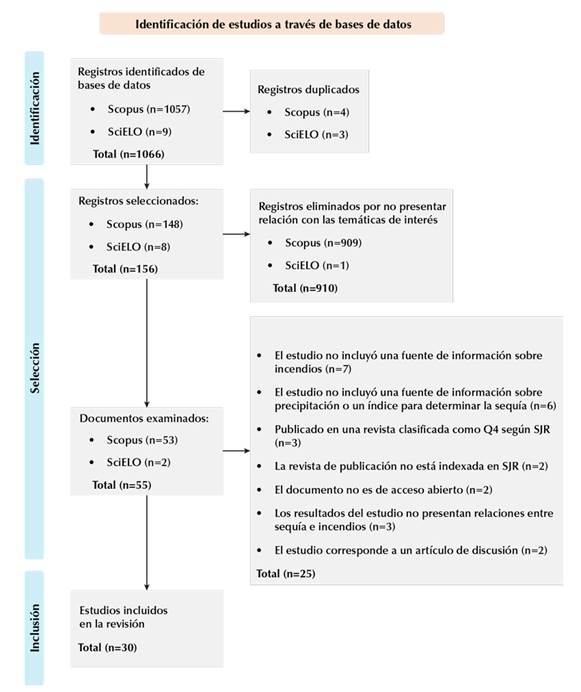
Figura 1: Diagrama de flujo de la RSL (incluye únicamente búsquedas en bases de datos)
Información general de los estudios
La producción científica sobre sequías e incendios ha aumentado significativamente desde el 2018, alcanzando su punto máximo en el periodo 2021-2022, posiblemente debido a avances en tecnologías de monitoreo y a una mayor preocupación ambiental (Yang et al., 2024; Zuo et al., 2024) (Figura 2a).
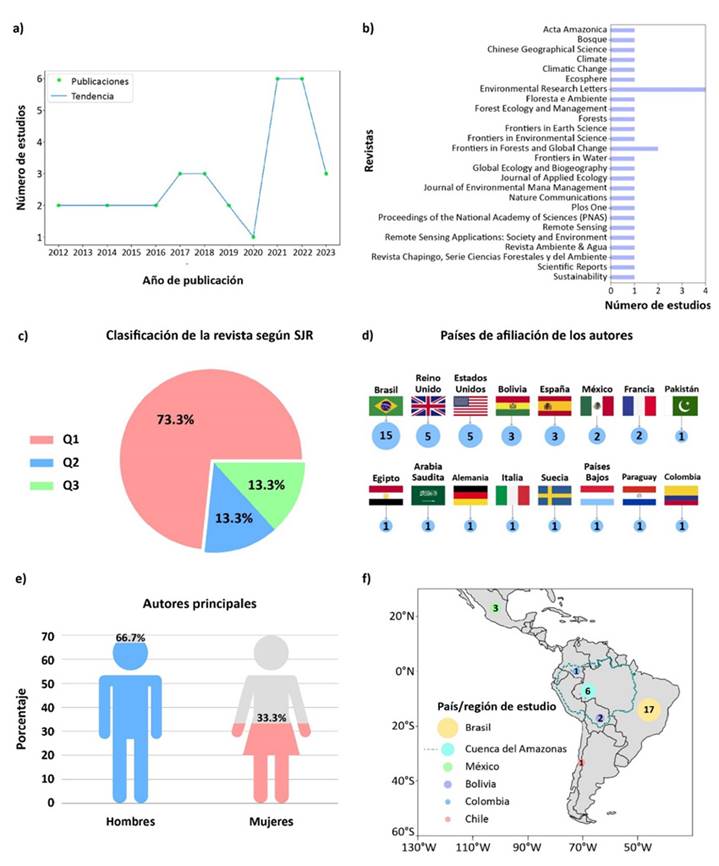
Figura 2: a) Distribución temporal del número de estudios publicados en el periodo 2012-2023. b) Número de estudios publicados en cada revista científica analizada. c) Proporción de estudios según el cuartil de la revista, con base en el índice SJR, indicando su impacto y calidad científica. d) Distribución de los autores según su país de afiliación, representando el origen institucional de los investigadores. e) Proporción de autores principales de los estudios según su género. f) Distribución geográfica de los países o regiones donde se llevaron a cabo los estudios,con énfasis en América Latina.
En cuanto a la difusión académica, Environmental Research Letters y Frontiers in Forests and Global Change emergen como las principales publicaciones. No obstante, la diversidad de revistas identificadas evidencia el carácter interdisciplinario de estos estudios, abordando temas como el cambio climático, el manejo forestal y la teledetección (Figura 2b).
El 73.3 % de las investigaciones se publicaron en revistas Q1, lo que refleja un alto rigor metodológico y procesos estrictos de revisión por pares en la mayoría de los trabajos. El 26.6 % restante corresponde a publicaciones en revistas de cuartiles Q2 y Q3, testimonio de la difusión de estas investigaciones en plataformas de impacto moderado o emergentes (Figura 2c).
En términos de afiliación institucional, Brasil lidera la producción científica, seguido por el Reino Unido y Estados Unidos. La participación de investigadores de América Latina, Europa, África y Asia destaca la relevancia global del estudio de incendios y sequías en ecosistemas tropicales, promoviendo una colaboración científica internacional (Figura 2d).
Desde una perspectiva de género, el 66.7 % de los estudios tiene como autor principal a un hombre y el 33.3 % a una mujer. Aunque la participación femenina es significativa, persiste una disparidad que sugiere la necesidad de fortalecer la equidad de género en roles de liderazgo dentro de la academia (Figura 2e).
Geográficamente, los estudios revisados abarcan diversas regiones de América Latina, donde Brasil figura como el país con el mayor número de investigaciones, lo que resalta su papel en la restauración ecológica y la conservación de la biodiversidad. La cuenca del río Amazonas se posiciona como una región prioritaria, mientras que la presencia de estudios en México, Bolivia, Colombia y Chile refleja un interés creciente en la conservación de ecosistemas estratégicos en la región (Figura 2f).
Descripción de las fuentes de información utilizadas en los estudios
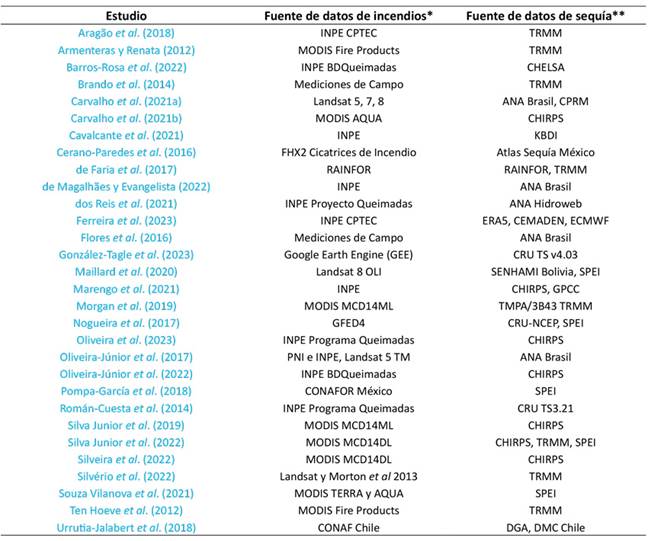
Las fuentes de información empleadas en los estudios se clasificaron en función de la institución o sistema que suministró los datos y los sensores satelitales y las plataformas de procesamiento que se utilizaron (Tabla 1). El 67 % de los estudios combinó fuentes primarias y secundarias, mientras que el 33 % restante se basó exclusivamente en fuentes secundarias.
*Siglas de las fuentes de datos de incendios:
MODIS (TERRA y AQUA): Moderate Resolution Imaging Spectroradiometer, sensor a bordo de los satélites Terra y Aqua de la NASA. INPE: Instituto Nacional de Pesquisas Espaciais (Brasil). INPE Proyecto Queimadas/Programa Queimadas/BDQueimadas: Programas y bases de datos del INPE dedicados al monitoreo de incendios forestales (focos, áreas quemadas). FHX2 (cicatrices de incendio): Software Fire History Analysis. RAINFOR: Red Amazónica de Inventarios Forestales. Mediciones de campo: Datos obtenidos directamente mediante trabajo de campo (mediciones in situ). GEE: Plataforma de procesamiento de datos geoespaciales en la nube. Landsat 5 TM/Landsat 8 OLI: Satélites Landsat; Thematic Mapper (TM) y Operational Land Imager (OLI). MODIS MCD14ML/MCD14DL: Productos de incendios activos (Collection 6) detectados por MODIS; MCD14ML (low confidence), MCD14DL (daily). GFED4: Global Fire Emissions Database versión 4. PNI: Parque Nacional de Itatiaia (Brasil). CONAFOR: Comisión Nacional Forestal (México). MODIS Fire Products: Conjunto de productos derivados de los datos del sensor MODIS (focos de calor, áreas quemadas, aerosoles, etc.). **Siglas de las fuentes de datos de sequía:
CHIRPS: Climate Hazards Group InfraRed Precipitation with Station data. KBDI: Keetch-Byram Drought Index. Atlas Sequía México: Plataforma con información histórica y actual de sequías en México. TRMM: Tropical Rainfall Measuring Mission. ANA: Agência Nacional de Águas e Saneamento Básico (Brasil). ANA Hidroweb: Plataforma de datos hidrometeorológicos de la ANA, Brasil. ERA5: Reanálisis climático global del ECMWF. CEMADEN: Centro Nacional de Monitoramento e Alertas de Desastres Naturais (Brasil). ECMWF: European Centre for Medium-Range Weather Forecasts. CRU TS v4.03: Climate Research Unit Time Series, versión 4.03. SENHAMI: Servicio Nacional de Meteorología e Hidrología (Bolivia). SPEI: Standardized Precipitation-Evapotranspiration Index. GPCC: Global Precipitation Climatology Centre. TMPA/3B43 TRMM: Tropical Rainfall Measuring Mission, producto 3B43 del algoritmo TMPA (TRMM Multi- satellite Precipitation Analysis). CRU-NCEP: Conjunto de datos combinado de CRU TS (Reino Unido) y reanálisis NCEP (National Centers for Environmental Prediction) (Estados Unidos). DGA: Dirección General de Aguas (Chile). DMC: Dirección Meteorológica de Chile
Tabla 1: Fuentes de datos para el análisis de incendios y sequías en los estudios revisados
Fuentes de datos utilizadas para evaluar incendios
Los estudios analizados utilizaron diversas fuentes de datos para el análisis de incendios forestales, combinando imágenes satelitales, registros históricos y mediciones de campo. El Instituto Nacional de Investigaciones Espaciales de Brasil (INPE) fue la fuente más citada (37 %), principalmente a través de su Programa Queimadas, que utiliza satélites como MODIS, AVHRR y GOES para la detección de incendios. MODIS (NASA) fue empleado en el 27 % de los estudios por su cobertura global y resolución de 1 km, destacando los productos MCD14DL para monitoreo en tiempo real y MCD14ML para análisis retrospectivos. Por su parte, Landsat (13 %) permitió evaluar áreas quemadas con mayor resolución (30 m), mientras que las mediciones de campo (13 %) complementaron los datos satelitales mediante el análisis de cicatrices de incendios y la medición de su intensidad. Además, Google Earth Engine (7 %) facilitó el procesamiento de imágenes a gran escala. Por último, otras fuentes (10 %), como los registros históricos de CONAFOR (México), CONAF (Chile) y la base global GFED, contribuyeron con información adicional sobre la incidencia y el impacto de los incendios.
Fuentes de datos utilizadas para evaluar sequías
Para analizar las condiciones de sequía, los estudios usaron imágenes satelitales, estaciones meteorológicas, índices climáticos y modelos de precipitación. La Misión de Medición de Lluvias Tropicales (TRMM) de la NASA fue utilizada en el 27 % de los estudios, dada su capacidad de estimar la precipitación a escala regional, facilitando el cálculo de anomalías y del déficit hídrico máximo acumulado (MCWD). CHIRPS (23 %) combinó datos satelitales y estaciones locales para estimar la precipitación desde 1981 con alta resolución, permitiendo calcular indicadores como el índice de precipitación estandarizado (SPI) y el MCWD. El índice estandarizado de precipitación-evapotranspiración (SPEI) se empleó en el 17 % de los estudios para evaluar la intensidad y la duración de sequías a partir de datos climáticos, mientras que los datos de la Agencia Nacional de Aguas de Brasil (ANA) (17 %) fueron utilizados para analizar tendencias de precipitación mediante la plataforma Hidroweb. La Unidad de Investigación Climática (CRU) (10 %) proporcionó series de datos históricos para modelar tendencias de sequía a largo plazo, y fuentes especializadas como ERA5, CEMADEN, ECMWF y CHELSA (3 %) aportaron información de alta resolución sobre el déficit de presión de vapor y los días con precipitaciones inferiores a 1 mm. Además, varios registros nacionales complementaron el análisis en distintas regiones, destacando el Global Precipitation Climatology Centre (GPCC) para tendencias globales, SENHAMI en Bolivia, el Atlas de Sequía de México para reconstrucciones climáticas, y datos meteorológicos de la Dirección General de Aguas (DGA) y la Dirección Meteorológica de Chile (DMC) para evaluar sequías en el centro y sur del país.
Descripción de las técnicas y pruebas estadísticas empleadas en los estudios
Para analizar la relación entre incendios forestales, sequías y variables climáticas, los estudios revisados emplearon diversos enfoques estadísticos, seleccionados según las características de los datos. Las pruebas de correlación, como los coeficientes de Pearson y Spearman, fueron ampliamente utilizadas, complementadas en algunos casos con mapas de calor y redes de correlación para visualizar las interacciones entre variables. Los modelos predictivos, como los modelos lineales generalizados (GLM), permitieron identificar factores asociados a los incendios, combinándose a veces con análisis de componentes principales (ACP) para detectar patrones espaciales y temporales. Para evaluar tendencias y cambios en datos hidroclimáticos, se aplicaron pruebas no paramétricas (e.g., Mann-Kendall y Pettitt).
El modelado espacial incluyó el uso del algoritmo MaxEnt para determinar la idoneidad espacial de los incendios, así como el análisis de patrones de vecinos más cercanos (RNA) para evaluar su distribución. Técnicas de aprendizaje automático, como los random forests y las redes neuronales profundas, fueron implementadas para mapear cicatrices de incendios y predecir su evolución. La validación de modelos predictivos se realizó con métricas como el área bajo la curva ROC (AUC) y la estadística de habilidad verdadera (TSS). Además, la estadística descriptiva fue clave para caracterizar las variables de interés, utilizando análisis de series temporales, boxplots y la prueba U de Mann-Whitney para comparar parámetros hidroclimáticos en años con y sin incendios. Finalmente, algunos estudios aplicaron modelos dinámicos para proyectar escenarios futuros, como el carbon and land use change (CARLUC), utilizado para estimar la intensidad de incendios bajo distintos escenarios climáticos, y el skill score (SS) para evaluar la capacidad predictiva de modelos de peligro de incendio.
Descripción de las relaciones sequía-incendio encontradas en los estudios
Los principales hallazgos en torno a la relación entre sequías e incendios que se identificaron en los estudios fueron agrupados en cinco categorías clave (Tabla 2):
Tabla 2: Clasificación de los estudios según la relación entre sequías e incendios
-
Relación entre sequía y aumento en la ocurrencia de incendios (27.1 %): examina cómo el déficit de precipitación y la reducción de la humedad del suelo aumentan la frecuencia, la intensidad y la extensión de los incendios, con estudios que emplean índices de sequía para cuantificar esta relación.
-
Variabilidad climática y su relación espacio-temporal con incendios (22.9 %): analiza cómo la variabilidad en la precipitación y la humedad del suelo afecta la distribución de incendios en distintos biomas y temporadas, determinando la susceptibilidad de los paisajes al fuego.
-
Impacto de las sequías extremas en incendios y degradación forestal (18.8 %): evalúa el impacto de sequías severas, especialmente las que se asocian con El Niño, en la pérdida de cobertura arbórea, las emisiones de carbono y la degradación del paisaje, aumentando la incidencia de incendios.
-
Relación entre sequía, uso del suelo y patrones de combustión (16.7 %): Explora cómo la deforestación y las prácticas agrícolas, combinadas con las sequías, incrementan la inflamabilidad del paisaje y la frecuencia de incendios.
-
Eventos climáticos extremos como impulsores de incendios (14.6 %): Estudia la manera en que fenómenos como la Oscilación Multidecadal del Atlántico (AMO) y el Fenómeno del Niño-Oscilación del Sur (ENSO) alteran las condiciones climáticas, aumentando la vulnerabilidad de los ecosistemas al fuego, con énfasis en la Amazonía y el centro de Chile.
DISCUSIÓN
Relación entre las sequías y la ocurrencia de incendios
Los resultados de esta RSL ofrecen una visión general sobre la relación entre las condiciones de sequía y la ocurrencia de incendios forestales en América Latina, resaltando la influencia de factores climáticos, espaciales y de uso del suelo en la dinámica del fuego.
En la mayoría de los estudios analizados se identificó una relación directa entre la ocurrencia de sequías y el aumento en la frecuencia, la intensidad y la extensión de los incendios forestales. Estos hallazgos son consistentes con investigaciones previas que destacan el papel de los déficits de precipitación y la disminución de la humedad del suelo como factores críticos en la propagación del fuego (Krueger et al., 2022; Alizadeh et al., 2024). Los estudios que emplearon índices como el SPI y el SPEI concluyeron que las sequías prolongadas aumentan la inflamabilidad de la vegetación, generando condiciones propicias para la ignición y la propagación de los incendios (Ferreira et al., 2023; Oliveira et al., 2023).
Un hallazgo relevante es que los incendios tienden a ser más destructivos cuando las sequías se combinan con condiciones extremas como las altas temperaturas y los vientos fuertes, lo cual intensifica su propagación. Este patrón coincide con estudios realizados en otras regiones (i.e., Europa y Australia) donde la interacción entre sequías y olas de calor ha contribuido a incendios forestales de gran magnitud (Nolan et al, 2020; Knutzen et al, 2025). Asimismo, Armenteras y Renata (2012) destacaron que la variabilidad de la temperatura en los meses previos a la temporada seca puede incrementar significativamente el riesgo de incendios en zonas previamente afectadas por sequías.
Diversos estudios también analizaron la influencia de la variabilidad climática, particularmente en términos de precipitación y humedad del suelo, sobre la distribución y la frecuencia de los incendios. Más allá de las sequías prolongadas, se encontró que los eventos climáticos interanuales (como El Niño y La Niña) y la variabilidad estacional también modifican la susceptibilidad de los ecosistemas al fuego. Marengo et al. (2021) señalaron que estos patrones de variabilidad climática modulan tanto la intensidad como la localización de los incendios en la región. En particular, en la Amazonía se ha observado una concentración de incendios en años marcados por sequías severas relacionadas con El Niño (Brando et al., 2014; Román-Cuesta et al, 2014).
Otro hallazgo importante es la asociación entre sequías extremas, incendios y degradación ecosistémica. Durante eventos severos como los vinculados al Niño, no solo aumenta la ocurrencia de incendios; también se intensifica la degradación forestal, lo que implica la pérdida de cobertura vegetal, alteraciones en los ciclos biogeoquímicos y mayores emisiones de carbono (Cerano-Paredes et al., 2016; Silva Junior et al., 2019; Aragão et al., 2018). En la región amazónica, estos procesos han sido identificados como impulsores clave de la deforestación y la pérdida de biodiversidad, generando un ciclo negativo que favorece la ocurrencia de nuevos incendios (Aragão et al., 2018).
Asimismo, la interacción entre las sequías y el uso del suelo emerge como un factor determinante. En zonas afectadas por la deforestación y las prácticas agrícolas extensivas, actividades humanas como la quema de vegetación para habilitar terrenos de cultivo se ven potenciadas por condiciones de sequía, intensificando los incendios. La deforestación disminuye la capacidad del ecosistema para retener humedad, lo cual agrava los efectos de las sequías y favorece la regeneración de vegetación inflamable (Silva Junior et al., 2022). Barros-Rosa et al. (2022) también evidenciaron que las prácticas de quema agrícola se vuelven más intensas y peligrosas durante periodos secos, elevando el riesgo de incendios a gran escala.
Finalmente, varios estudios destacaron la influencia de fenómenos climáticos interanuales y decadales, e.g., ENSO y las anomalías en la temperatura superficial de los océanos Atlántico y Pacífico, como determinantes clave en la dinámica de los incendios. Estos fenómenos alteran las condiciones atmosféricas regionales, incrementando la vulnerabilidad de los ecosistemas e incidiendo en la frecuencia y la distribución de los incendios forestales (Urrutia-Jalabert et al., 2018; González-Tagle et al., 2023). En este sentido, la recurrencia de eventos extremos relacionados con ENSO plantea un reto significativo para la gestión del riesgo de incendios en América Latina, dada su imprevisibilidad y sus efectos acumulativos sobre el paisaje (Marengo et al., 2021).
Brechas de información en la región y propuestas para futuras investigaciones
A pesar de los avances en la comprensión de la relación sequía-incendio, persisten importantes vacíos de información que limitan la capacidad de respuesta en América Latina. Uno de los principales desafíos es la escasez de datos locales de alta resolución. Aunque existen bases de datos globales sobre incendios y sequías, muchas regiones rurales o remotas carecen de una infraestructura de monitoreo adecuada, dificultando la evaluación precisa de los impactos de las sequías (Afghah et al., 2019; González-Tagle et al., 2023). Para superar esta brecha, es esencial fortalecer los sistemas de monitoreo local mediante tecnologías de bajo costo como sensores remotos, estaciones meteorológicas móviles y redes de sensores inalámbricos. Estas herramientas permitirían generar datos específicos, esenciales para comprender la relación sequía-incendios a escala local.
Otra de las limitaciones identificadas es la dificultad para integrar datos provenientes de distintas fuentes y disciplinas. La falta de estandarización y compatibilidad entre bases de datos de clima, uso del suelo e incendios forestales dificulta los análisis espacio-temporales integrados (Ferreira et al., 2023). Se recomienda promover plataformas de datos abiertos y el uso de estándares internacionales de intercambio de datos, facilitando así la integración de datos satelitales, climáticos y socioambientales, y promoviendo la interoperabilidad entre diferentes sistemas de información.
El uso limitado de modelos predictivos basados en aprendizaje automático representa otra brecha crítica. Aunque estas herramientas han demostrado eficacia en otras regiones, su adopción en América Latina es incipiente debido a la escasez de datos históricos de calidad, la infraestructura tecnológica limitada y la falta de personal capacitado (de Magalhães Neto & Evangelista, 2022). Potenciar estos enfoques podría mejorar la predicción de incendios en escenarios de sequía extrema.
Adicionalmente, se destaca la necesidad de fomentar investigaciones interdisciplinares que integren perspectivas ecológicas, climáticas y sociales. Estudios como los de Silva Junior et al. (2019) y Barros-Rosa et al. (2022) muestran que es fundamental fomentar la colaboración entre científicos, comunidades locales y tomadores de decisiones, integrando conocimientos tradicionales y técnicos. Esto no solo enriquecería la precisión de los modelos predictivos; también fortalecería la formulación de estrategias de manejo adaptativas e inclusivas, centradas en las necesidades de las poblaciones vulnerables.
Por último, se identificó una brecha en la literatura respecto a la evaluación de los impactos socioeconómicos y ecológicos a largo plazo de los incendios relacionados con sequías. Resulta prioritario impulsar investigaciones de carácter longitudinal que examinen el impacto de estos eventos en la resiliencia de los ecosistemas, la biodiversidad, la salud humana y las economías locales. Los métodos de simulación ecológica, como los modelos de dinámica de poblaciones y paisajes, podrían ser una herramienta importante para proyectar los efectos de estos eventos en el tiempo y desarrollar políticas de restauración y adaptación más efectivas.
Limitaciones de la RSL
Esta revisión presenta algunas limitaciones que deben ser consideradas a la hora de interpretar sus resultados. En primer lugar, la inclusión de estudios estuvo condicionada por el acceso a bases de datos específicas y se limitó a publicaciones indexadas, lo que pudo excluir literatura relevante no disponible en dichas plataformas o publicada en otros formatos. Asimismo, la búsqueda realizada en la Fase 1 utilizó una combinación específica de términos clave relacionados con sequías, incendios forestales, Sudamérica y el Amazonas, utilizando únicamente un operador booleano (e.g., "sequía" AND "incendio" AND "Amazonas"), lo cual pudo haber sesgado los resultados hacia estudios centrados particularmente en la región amazónica, limitando la representación de investigaciones realizadas en otros ecosistemas relevantes de la región. Esta estrategia, si bien facilitó el enfoque temático, puede haber restringido la diversidad geográfica de los estudios incluidos. Una descripción más detallada y variada de las combinaciones de búsqueda habría permitido una cobertura más amplia de contextos regionales.
Por otra parte, la selección de estudios se basó en criterios específicos en torno a la interacción directa entre sequías e incendios forestales, lo que pudo haber excluido investigaciones que abordan estos fenómenos de manera indirecta o en contextos más amplios, como el cambio climático, la variabilidad climática o la gestión territorial.
Nuestra revisión se basó principalmente en fuentes secundarias y datos agregados, lo que limitó la posibilidad de analizar variaciones espaciales y temporales más detalladas. Además, la heterogeneidad en las metodologías empleadas pudo haber influido en la interpretación general de los resultados.
Finalmente, es importante señalar que las interpretaciones expuestas se sustentan en la literatura disponible hasta el 31 de agosto de 2023, por lo que revisiones posteriores podrían enriquecer o modificar estas conclusiones. Dado el carácter dinámico del clima y de eventos como sequías e incendios forestales, se recomienda realizar revisiones periódicas que permitan actualizar el conocimiento disponible y mejorar la comprensión de estas interacciones en la región.
CONCLUSIONES
La producción científica sobre la relación entre sequías e incendios en América Latina ha crecido de manera significativa en los últimos años, especialmente a partir de 2018, con un marcado carácter interdisciplinario y una activa colaboración internacional. Brasil se consolida como líder regional en este campo, en articulación con países como el Reino Unido y Estados Unidos, aunque persisten retos en cuanto a la equidad de género en roles de liderazgo y la representación territorial, pues gran parte de los estudios se concentran en la cuenca amazónica.
Los hallazgos de esta revisión confirman que la sequía es un factor crítico en la ocurrencia y la propagación de los incendios forestales, particularmente cuando interactúa con altas temperaturas, vientos fuertes y prácticas de deforestación y quema agrícola. La Amazonía se perfila como un epicentro de vulnerabilidad, donde eventos extremos como El Niño intensifican la recurrencia y la severidad de los incendios, profundizando procesos de degradación, con implicaciones ecológicas, sociales y económicas de gran alcance.
Un aporte clave de esta revisión es la sistematización de las principales tendencias metodológicas en la región, entre ellas el uso integrado de múltiples fuentes de datos (satélites, reanálisis climáticos, estaciones meteorológicas y mediciones de campo), las cuales han permitido caracterizar con mayor detalle la temporalidad, la severidad y la distribución espacial de los incendios. Asimismo, se evidencia la incorporación—aún incipiente pero con alto potencial—de enfoques estadísticos avanzados y de aprendizaje automático para proyectar escenarios futuros bajo condiciones de cambio climático.
Esta revisión también identifica vacíos críticos que deben ser atendidos para fortalecer el conocimiento regional, como la escasez de datos locales de alta resolución, la falta de integración y estandarización entre bases de datos heterogéneas, la baja adopción de modelos predictivos basados en inteligencia artificial y la limitada atención a los impactos socioeconómicos y ecológicos a largo plazo. Estos vacíos constituyen prioridades claras para la investigación futura y para la formulación de políticas públicas orientadas a la gestión del riesgo y la adaptación.
En conjunto, esta revisión no solo reafirma la estrecha relación entre sequías e incendios en América Latina, sino que también aporta una síntesis comparativa de patrones regionales y metodologías empleadas, al tiempo que visibiliza las principales brechas del conocimiento en este campo. De este modo, ofrece insumos valiosos para orientar el avance científico, la toma de decisiones y el diseño de estrategias que fortalezcan la resiliencia socioecológica frente a escenarios de creciente vulnerabilidad climática.
Acknowledgements
AGRADECIMIENTOS
Las autoras agradecen al programa de investigación Desarrollo de un programa de gestión del conocimiento en contaminación atmosférica y sus efectos en la salud en el Valle de Aburrá-Antioquia, ejecutado por el Politécnico Colombiano Jaime Isaza Cadavid y la Universidad de Antioquia, y financiado por el Fondo de Ciencia, Tecnología e Innovación del Sistema General de Regalías (MinCiencias). P. A. A. fue financiada por la Universidad de Antioquia, mediante el proyecto del Comité para el Desarrollo de la Investigación (CODI) TEM2022-55390.
REFERENCIAS




License
Copyright (c) 2025 Colombia Forestal

This work is licensed under a Creative Commons Attribution-ShareAlike 4.0 International License.
Colombia Forestal retains the patrimonial rights (copyright) of the published works, and favors and allows the reuse of the same under the Creative Commons Attribution-ShareAlike 4.0 International license, so they can be copied, used, disseminated, transmitted and exhibited publicly, provided that:
You acknowledge the credits of the work in the manner specified by the author or licensor (but not in a way that suggests that you have their support or that they endorse your use of their work).