DOI:
https://doi.org/10.14483/2256201X.24006Published:
2026-01-01Issue:
Vol. 29 No. 1 (2026): January-JuneSection:
Scientific articleInfluencia de actividades económicas sobre la captura y almacenamiento de carbono en el Pacífico colombiano
Influence of Economic Activities on Carbon Capture and Storage in the Colombian Pacific
Keywords:
Deforestation, global climate change, carbon capture, conservation, Chocó biogeographic region, mining, gross domestic product (en).Keywords:
deforestación, cambio climático global, captura de carbono, conservación, Chocó biogeográfico, minería, producto interno bruto (es).Downloads
References
Álvarez, E., Duque, A., Saldarriaga, J., Cabrera, K., de las Salas, G., del Valle, I., Lema, A., Moreno, F., Orrego, S., & Rodríguez, L. (2012). Tree above-ground biomass allometries for carbon stocks estimation in the natural forests of Colombia. Forest Ecology and Management, 267(2012), 297-308. https://doi.org/10.1016/j.foreco.2011.12.013
Aragão, L. E. O., Malhi, Y., Metcalfe, D. B. J. Silva-Espejo, E., Jiménez, E., Navarrete, D., Almeida, S., Costa, A. C. L., Salinas, N., Phillips, O. L., Anderson, L. O., Baker, T. R., Goncalvez, P. H., Huamán-Ovalle, J., Mamani-Solórzano, M., Meir, P., Monteagudo, A., Peñuela, M. C., Prieto, A., … Vásquez, R. (2009). Above- and below-ground net primary productivity across ten Amazonian forests on contrasting soils. Biogeosciences, 6(2009), 2441-2488. https://www.biogeosciences.net/6/2759/2009/
Bernal, R., Gradstein, S. R., & Celis, M. (2016). Catálogo de plantas y líquenes de Colombia. Instituto de Ciencias Naturales. Universidad Nacional de Colombia. Editorial UNAL.
Clark, D. A., Brown, S., Kicklighter, D. W., Chambers, J. D., Thomlinson, J. R., Ni, J., & Holland, E. (2001b). Net primary production in forest: An evaluation and synthesis of existing field data. Ecological Applications, 11(2), 371-384.
Clark, D. A., Brown, S., Kicklighter, D. W., Chambers, J. D., Thomlinson, J. R., & Ni, J. (2001a). Measuring net primary production in forest: concepts and field methods. Ecological Applications, 11(2), 356-370.
Corporación Autónoma Regional para el Desarrollo Sostenible del Chocó (CODECHOCÓ) (2016). Informe de Actividad Forestal del departamento del Chocó. https://www.codechoco.gov.co/zonasdeamenazas.
Cubero, J. J., González, N., Ortiz, R., Pérez, D., Reyes, A., & Téllez J. (2024). El bosque, palanca de desarrollo sostenible en Colombia. Sostenibilidad medioambiental y social. BBVA Research Colombia.
del Valle, J. I., Moreno, F. H., & Orrego, S. A. (2003). Medición de la captura de C en ecosistemas forestales tropicales de Colombia. Contribuciones para la mitigación del cambio climático. Universidad Nacional de Colombia, sede Medellín, Centro Andino para la Economía en el Medio Ambiente.
Departamento Administrativo Nacional de Estadística (DANE). (2013). Metodología General Cuentas Trimestrales-CT. BASE 2005. https://www.dane.gov.co/files/investigaciones/fichas/Cuentas_trimestrales_b2000_05_13.pdf
Departamento Administrativo Nacional de Estadística (DANE) (2024). Producto interno Bruto por Departamento (PIBDEP). Boletín técnico. 2023 preliminar. https://www.dane.gov.co/files/operaciones/PIB/bol-PIBDep-2023pr.pdf
di Rienzo J. A., Casanoves F., Balzarini M. G., González L., Tablada M., & Robledo C. W. (2020). InfoStat versión 2020. Centro de Transferencia InfoStat, FCA, Universidad Nacional de Córdoba. http://www.infostat.com.ar
Dinda, S. (2004). Environmental Kuznets curve hypothesis: A survey. Ecological Economics, 49, 431-455.
Faber-Langendoen, D., & Gentry, A. H. (1991). The structure and diversity of rain forests at Bajo Calima, Chocó Region, western Colombia. Biotropica, 23(1), 2-11.
Organización de las Naciones Unidas para la Alimentación y la Agricultura (FAO) (2024). El estado de los bosques del mundo 2024: Innovaciones en el sector forestal para lograr un futuro más sostenible. Editorial FAO. https://doi.org/10.4060/cd1211es
Hernández, Y. (2020). Cambio climático: causas y consecuencias. RenovaT, 4(1),38-53. https://core.ac.uk/reader/542924970
Departamento Nacional de Planeación (DNP) (2007). Agenda Interna para la Productividad y la Competitividad. Documento regional, Chocó. Departamento Nacional de Planeación.
Instituto Geográfico Agustín Codazzi (IGAC) (2006). Chocó. Características geográficas. Editorial IGAC.
Instituto de Investigaciones Ambientales del Pacífico (IIAP) (2015). Plan integral de cambio climático del departamento del Chocó (PICC-Chocó). IIAP, Ministerio de Ambiente.
Intergovernmental Panel on Climate Change (IPCC) (2014). Climate change 2014: Synthesis report. Contribution of Working Groups I, II and III to the Fifth Assessment Report of the Intergovernmental Panel on Climate Change [Core Writing Team, R. K. Pachauri, and L.A. Meyer (Eds.)]. IPCC.
Intergovernmental Panel on Climate Change (IPCC). (2022). Climate Change 2022: Impacts, Adaptation and Vulnerability. Contribution of Working Group II to the Sixth Assessment Report of the Intergovernmental Panel on Climate Change (eds. Pörtner, H. O. et al.). Cambridge University Press 2023.
LaPorte, N. T., Stabach, J. A., Grosch, R., Lin, T. S., & Goetz, S.J. (2007). Expansion of industrial logging in Central Africa. Science, 316(5830), 1451.
Laurance, W. F. (2007). Have we overstated the tropical biodiversity crisis? Trends in Ecology and Evolution, 22, 65-70.
Laurance, W. F., & Williamson, B. (2001). Positive feedbacks among forests fragmentation, drought, and climate change in the Amazon. Conservation Biology, 15, 1529-1535.
Ministerio de Ambiente y Desarrollo Sostenible & IDEAM (2024). Propuesta del nivel de referencia de las emisiones forestales de Colombia para el periodo 2023 – 2027 como mecanismo para optar al pago por resultados de REDD+ bajo la CMNUCC. Ministerio de Ambiente y Desarrollo Sostenible, Instituto de Hidrología, Meteorología y Estudios Ambientales, Programa ONU REDD Colombia.
Mo, L., Zohner, C. M., Reich, P. B., Piotto, D., Pitman, N. C. A., Poulsen, A. D., Poulsen, J. R., Pretzsch, H., Ramírez Arévalo, F., Restrepo-Correa, Z., Rodeghiero, M., Rolim, S. G., Roopsind, A., Rovero, F., Rutishauser, E., Saikia, P., Salas-Eljatib, C., Saner, P., Schall, P., Schelhaas, M. J., … Crowther, T. W. (2023) Integrated global assessment of the natural forest carbon potential. Nature, 624(2023), 92-101. https://doi.org/10.1038/s41586-023-06723-z
Moreno-Hurtado, F. (2004). Soil carbon dynamics in primary and secondary tropical forests in Colombia. Florida International University. https://digitalcommons.fiu.edu/dissertations/AAI3165150
Mostacedo, B., & Fredericksen, T. (2000). Manual de métodos básicos de muestreo y análisis en ecología vegetal. Proyecto de Manejo Forestal Sostenible (BOLFOR).
Myers N., Mittermeier, R. A., Mittermeier, C. G., da Fonseca G. A. B., & Kent, J. (2000). Biodiversity hotspots for conservation priorities. Nature, 403, 853-858.
Olarte, C. P., Rodríguez, J. A., Jurado, R. D., & Hernández, J. S. (2024). Cálculo de los factores de emisión para los sumideros forestales de carbono: biomasa aérea, biomasa subterránea, carbono orgánico del suelo y detritos de madera, a partir de datos del Inventario Forestal Nacional. IDEAM.
Palacios-Torres, Y., Caballero-Gallardo, K., & Olivero-Verbel, J. (2018). Mercury pollution by gold mining in a global biodiversity hotspot, the Choco biogeographic region, Colombia. Chemosphere, 193(2018) 421-430. https://doi.org/10.1016/j.chemosphere.2017.10.160
Pan, Y., Birdsey, R. A., Phillips, O. L., & Jackson, R. B. (2013). The structure, distribution, and biomass of the world’s forests. Annual Review Ecological Evolution and Systematics, 44, 593-622.
Pan, Y., Birdsey, R. A., Phillips, O. L., Houghton, R. A., Fang, J., Kauppi, P. E., Keith, H., Kurz, W. A., Ito, A., Lewis, S. L., Nabuurs, G .J., Shvidenko, A., Hashimoto, S., Lerink, B., Schepaschenko, D., Castanho, A., & Murdiyarso, D. (2024). The enduring world forest carbon sink. Nature,631(2024), 563–569 (2024). https://doi.org/10.1038/s41586-024-07602-x
Paoli, G. D., Curran L. M., & Zak, D. R. (2005). Phosphorus efficiency of aboveground productivity in Bornean rain forest: evidence against the unimodal efficiency hypothesis. Ecology, 86, 1548-1561.
Phillips, J., Duque, A., C. Scott, C. Wayson, G. Galindo, E. Cabrera, J. Chave, M. Peña, E. Álvarez, D. Cárdenas, Duivenvoorden, J., Hildebrand, P., Stevenson, P., Ramírez, S., & Yepes, A. (2016). Live aboveground carbon stocks in natural forests of Colombia. Forest Ecology and Management, 374(2016), 119-128. https://doi.org/10.1016/j.foreco.2016.05.009
Phillips, J. F., Duque, A. J., Yepes, A. P., Cabrera, K. R., García, M. C., Navarrete, D. A., Álvarez, E., & Cárdenas, D. (2011). Estimación de las reservas actuales (2010) de carbono almacenadas en la biomasa aérea en bosques naturales de Colombia. Estratificación, alometría y métodos analíticos. Instituto de Hidrología, Meteorología, y Estudios Ambientales.
Poveda, I. C., Rojas, C., Rudas, A., & Rangel, O. (2004). El Chocó biogeográfico: ambiente físico. En O. Rangel (Ed.). Colombia Diversidad Biótica IV. El Chocó biogeográfico/Costa Pacífica (pp. 1-23). Instituto de Ciencias Naturales, Universidad Nacional de Colombia.
Primack, R., & Vidal, O. (2019). Introducción a la biología de la conservación (1ra ed.). Fondo de Cultura Económica.
Quinto, H. (2023). El Papel de los Bosques del Pacífico colombiano en la mitigación del cambio climático global. Fundación Biodiversidad, Cambio Climático y Bienestar Social, Instituto de Investigaciones Ambientales del Pacífico, Universidad Tecnológica del Chocó.
Quinto, H., & Moreno, F. H. (2011). Dinámica de la Biomasa Aérea en un Bosque Pluvial Tropical del Chocó Biogeográfico. Revista Facultad Nacional de Agronomía Medellín, 64(1), 5917-5936.
Quinto, H., & Moreno, F. (2017). Net primary productivity and edaphic fertility in two pluvial tropical forests in the Chocó biogeographical region of Colombia. PLoS ONE, 12(1), e0168211.
Quinto, H., Moreno, F. H., Caicedo, M. H., & Pérez, L. M. (2016). Biomasa de raíces finas y fertilidad del suelo en bosques pluviales tropicales del Pacífico colombiano. Colombia Forestal, 19(1), 53-66.
R Development Core Team, (2013). R: A language and environment for statistical computing. R Foundation for Statistical Computing. http://www.r-project.org
Ramírez Moreno, G., & Ledezma Rentería, E. (2007). Efectos de las actividades socio-económicas (minería y explotación maderera) sobre los bosques del departamento del Chocó. Revista de Investigaciones, 26(1), 58-65. https://dialnet.unirioja.es/servlet/articulo?codigo=2544441
Rangel, O. (2004). Colombia Diversidad Biótica IV. El Chocó biogeográfico/Costa Pacífica. Instituto de Ciencias Naturales, Universidad Nacional de Colombia.
Sánchez, V. (2017). Relación entre crecimiento económico y degradación ambiental, un análisis a nivel global por niveles de ingresos. Revista Económica, 2(1),96-109.
Schuur, E.A. (2003). Productivity and global climate revisited: The sensitivity of tropical forest growth to precipitation. Ecology, 84, 1165-1170.
Song, Y. (2023). An empirical study on the relationship between economic growth and forest carbon sink value based on PVAR model. Frontiers in Energy Research, 11, 1249144. https://doi.org/10.3389/fenrg.2023.1249144
Valois-Cuesta, H. (2016). Sucesión primaria y ecología de la revegetación de selvas degradadas por minería en el Chocó, Colombia: bases para su restauración ecológica [Tesis Doctoral, Universidad de Valladolid]. https://uvadoc.uva.es/handle/10324/19089
Valois-Cuesta, H., & Martínez-Ruiz, C. (2016). Vulnerabilidad de los bosques naturales en el Chocó biogeográfico colombiano: actividad minera y conservación de la biodiversidad. Bosque, 37, 295-305.
Wu, Z., Dijkstra, P., Koch, G. W., Peñuelas, J., & Hungate, B. A. (2011). Responses of terrestrial ecosystems to temperature and precipitation change: a meta-analysis of experimental manipulation. Global Change Biology, 17, 927-942.
Zhao, M., & Running, S. W. (2010). Drought-induced reduction in global terrestrial net primary production from 2000 through 2009. Science, 329, 940-945.
How to Cite
APA
ACM
ACS
ABNT
Chicago
Harvard
IEEE
MLA
Turabian
Vancouver
Download Citation
Recibido: 8 de agosto de 2025; Aceptado: 25 de noviembre de 2025
Resumen
Los bosques tropicales contribuyen sustancialmente en la mitigación del cambio climático mediante la captura y almacenamiento de carbono (C). Sin embargo, se ha planteado que indicadores económicos como el producto interno bruto (PIB) están negativamente relacionados con la conservación de bosques. Para probarlo, se evaluó la relación entre la captura y almacenamiento de C y el PIB de los municipios del Chocó. Con este fin, se cuantificó el contenido y la captura de C, la minería, la tala de árboles y el potencial de mitigación de cambio climático, valores que se relacionaron con el PIB. Se registraron promedios de contenido total de C de 115.41 ton C ha-1 y una tasa de captura de C de 9.8 ton C ha-1.año-1. Asimismo, el PIB se correlacionó positivamente con el contenido total y la captura de C. En síntesis, se observa la compatibilidad y la relación positiva entre el desarrollo económico y la conservación de bosques del Pacífico colombiano.
Palabras clave:
deforestación, cambio climático global, conservación, Chocó biogeográfico, minería, producto interno bruto.Abstract
Tropical forests contribute substantially to climate change mitigation through carbon capture and storage. However, it has been suggested that economic indicators such as gross domestic product (GDP) are negatively related to forest conservation. To test this, the relationship between carbon capture and storage and the GDP of the municipalities in Chocó was evaluated. To this effect, carbon content and sequestration, mining, logging, and climate change mitigation potential were quantified and related to the GDP. Averages of 115.41 ton C ha-1 for total carbon content were recorded, as well as 9.8 ton C ha-1.year-1 for the carbon sequestration rate. The GDP was also positively correlated with total carbon content and sequestration. In summary, the compatibility and positive relationship between economic development and forest conservation in the Colombian Pacific is observed.
Keywords:
deforestation, global climate change, conservation, Chocó biogeographic region, mining, gross domestic product.INTRODUCCIÓN
El cambio climático global—definido como los cambios significativos en los patrones climáticos (temperatura y precipitación) del planeta a causa del incremento en las emisiones de gases con efecto de invernadero (GEI) a la atmosfera, principalmente de dióxido de carbono (CO2) (IPCC, 2014)—está generando efectos negativos sobre el ciclo global del carbono (C), el clima (sequías, huracanes, tornados), los océanos, el nivel del mar, los caudales de los ríos, la producción de alimentos, la salud, la economía, la generación de energía, la infraestructura humana, la agricultura, los ecosistemas terrestres, la biodiversidad de fauna y flora, y los servicios ecosistémicos, entre otros (Zhao & Running, 2010; IPCC, 2022; Hernández, 2020). Por tal razón, en las últimas décadas se han aunado esfuerzos y se han desarrollado diferentes iniciativas globales para contribuir a la reducción y/o adaptación a este fenómeno, como es el caso de los proyectos de Reducción de Emisiones por Degradación y Deforestación (REDD+) (MinAmbiente & IDEAM, 2024), entre otros.
Debido a sus tasas de captura y almacenamiento de C, los bosques contribuyen sustancialmente a la mitigación del cambio climático (del Valle et al., 2003; Pan et al., 2024). Se encontró que, entre 2000 y 2010, hubo un sumidero de C de 3.5 ± 0.4 PgC.año−1 en los bosques globales. Sin embargo, aunque han aumentado en bosques templados (30±5 %) y tropicales secundarios (29±8 %), los sumideros de C han disminuido en los bosques boreales (36±6 %) y tropicales maduros (31±7 %) debido a la deforestación (Pan et al., 2024). En consecuencia, se ha evidenciado que los bosques tropicales pueden servir como sumidero o fuente (emisión) de C para la atmósfera (Pan et al., 2013), puesto que su función de mitigación del cambio climático se ha visto afectada (Mo et al., 2023) por fenómenos naturales como la mortalidad arbórea por sequías (Zhao & Running, 2010) y por actividades antrópicas como la deforestación, la tala de árboles, la ganadería, la minería y el establecimiento de cultivos (FAO, 2024). En síntesis, el papel de estos bosques frente al cambio climático está determinado en gran medida por el uso del suelo (actividades económicas) y por los fenómenos naturales (sequías) que afecten cada región.
En Colombia, un país ubicado en la región tropical que posee más de 59.7 millones de hectáreas de bosque natural, se encontró que estos ecosistemas poseen un contenido total de C de entre 47.75 y 139.84 ton C.ha-1 (Olarte et al., 2024). Sin embargo, actividades económicas como la ganadería, la minería, la tala de madera y los cultivos ilícitos, entre otras, generan pérdidas de cobertura boscosa que afectan el balance de C (MinAmbiente & IDEAM, 2024). Particularmente, se registró una tasa promedio de deforestación de bosques naturales de 159 966 ha.año-1 en el periodo comprendido entre 2013 y 2022 (MinAmbiente & IDEAM, 2024). Lo complejo del asunto es que la tasa de deforestación no es uniforme en el país, siendo mayor en regiones como la Amazonía y el Pacífico (MinAmbiente & IDEAM, 2024), que, a su vez, son las regiones con el menor aporte al producto interno bruto (PIB) (DANE, 2024). En consecuencia, la deforestación parece ser independiente de los indicadores económicos (e.g., el PIB de cada región) o presentar relaciones negativas.
Contrario a lo anterior, en otras localidades y regiones tropicales, con mayor desarrollo económico y mayores aportes al PIB, aumentan las tasas anuales de deforestación y degradación de bosques (Primack & Vidal, 2019), más aún si se tiene en cuenta que las actividades antrópicas económicas como la minería a cielo abierto, la ganadería, el establecimiento de cultivos, la urbanización, la construcción de carreteras, la expansión de la frontera agrícola y la tala de árboles generan destrucción de ecosistemas y pérdidas de biodiversidad (Primack & Vidal, 2019; FAO, 2024). Asimismo, Mo et al. (2023) observaron una disminución constante en la densidad de C en los biomas del mundo a lo largo de las gradientes de degradación antropogénica, evidenciando una la afectación del almacenamiento de C a causa de la deforestación generada por actividades económicas en diferentes latitudes (Mo et al., 2023). Según estos resultados, con una mayor cantidad de actividades económicas (y, por ende, mayor PIB) tiende a generarse una mayor deforestación y más afectación al almacenamiento de C de los ecosistemas.
Al respecto, los análisis realizados por Cubero et al. (2024) plantean que los valores altos en el PIB de los municipios y las localidades no necesariamente están relacionados con niveles altos de deforestación de bosques naturales, lo que podría evidenciar la independencia de las variables de medición económica respecto a los valores de deforestación y, por ende, de almacenamiento de C en bosques (Cubero et al., 2024). Entretanto, los análisis de Song (2023) mostraron que el crecimiento económico promovió un incremento de sumideros de C en los bosques, i.e., el crecimiento económico tuvo un efecto positivo significativo en la acumulación de C forestal. En consecuencia, los estudios y análisis mencionados (Mo et al., 2023; Song, 2023; Cubero et al., 2024) sugieren una controversia y una falta de consenso en torno a la relación entre el crecimiento económico y el almacenamiento de C atmosférico por parte de los bosques, especialmente en Colombia y en la región del Pacífico, donde se han hecho esfuerzos por contabilizar las tasas de captura y almacenamiento de C de los bosques naturales (Quinto, 2023; Olarte et al., 2024) pero se desconoce la influencia de las actividades y los indicadores económicos (PIB) sobre estos procesos ambientales. Por tal razón, para probar la hipótesis de que el PIB afecta negativamente el almacenamiento de C en bosques, este estudio buscó evaluar la influencia del PIB y de varias actividades económicas (i.e., minería y tala de árboles) sobre la captura y el almacenamiento de C en bosques del Pacífico colombiano. Además, se planteó la siguiente pregunta de investigación: ¿qué tanto se relaciona el PIB con la captura y almacenamiento de C en bosques del Pacífico colombiano, cuando se emplean nuevos índices de mitigación de cambio climático global?
MATERIALES Y MÉTODOS
Área de estudio
Este estudio se desarrolló en el departamento del Chocó, ubicado en la región del Pacífico colombiano, donde existen más 46 530 Km2 de bosque (IGAC, 2006). Está localizado entre los 04º00’50’’ y los 08°41’32’’ de latitud N y entre los 76°02’57’’ y los 77°53’38’’ de longitud O (IGAC, 2006).
El departamento cubre un amplio rango de pisos térmicos, que van desde los 10 a los 1000 m de altitud. Los ecosistemas se caracterizan principalmente por su alta pluviosidad, con valores de entre 4000 y 12 500 mm anuales (Poveda et al., 2004); por su amplia variedad de tipos de suelos (ultisoles, inceptisoles, oxisoles, entisoles y andisoles) (IGAC, 2006); y por una temperatura promedio de 26 °C y una humedad relativa de 80-90 % (Poveda et al., 2004). La región es considerada como un hotspot de biodiversidad debido us las tasas de endemismos y deforestación (Myers et al., 2000; Rangel, 2004; Bernal et al., 2016). En efecto, se ha registrado una riqueza que incluye 4525 especies de espermatofitas, 132 de musgos, 189 de líquenes, 170 de hepáticas, 424 de helechos, 192 de mamíferos, 778 de aves, 188 de reptiles, 139 de anfibios, 196 de peces y 183 de escarabajos (Rangel, 2004).
Los bosques son en su mayoría primarios y de diferentes tipos (secos, húmedos, muy húmedos, pluviales y premontanos) (Poveda et al., 2004; IGAC, 2006), aunque en los últimos años ha aumentado su deforestación y degradación debido a actividades como la minería y la tala de árboles (Ramírez & Ledezma, 2007). De acuerdo con los reportes del IDEAM, en la última década, la región registró una tasa de deforestación de 13 290 ha.año-1 (MinAmbiente & IDEAM, 2024). Además, se han reportado tasas altas de degradación de bosques por minería (Ramírez & Ledesma, 2007).
Medición del C en bosques del Chocó biogeográfico
Para evaluar la influencia del PIB y las actividades económicas mencionadas en la captura y el almacenamiento de C en los bosques lluviosos del Chocó, se consideraron los 30 municipios del departamento como unidades de muestreo, así como las cinco subregiones (San Juan, Medio Atrato, Litoral del Pacífico, Alto Atrato, y Bajo Atrato) y las unidades de gobernanza del territorio (consejo comunitario, resguardo indígena, mixto). Posteriormente, se desarrolló un modelo para estimar la capacidad de mitigación del cambio climático en cada municipio (Quinto, 2023). Dicho modelo empleó datos sobre el C total (aéreo y subterráneo) (Faber-Langendoen & Gentry, 1991; Quinto & Moreno, 2011; Phillips et al., IDEAM 2011; Álvarez et al., 2012; Phillips et al., 2016; Quinto et al., 2016), las capturas de C anuales (Quinto & Moreno, 2011; 2017), la minería y la tala de madera (IGAC, 2006; Valois-Cuesta & Martínez-Ruiz, 2016; CODECHOCÓ, 2016).
Para tener mayor precisión en las estimaciones de los contenidos y las tasas de captura de C, se emplearon datos de mediciones directas en campo, realizadas en 13 parcelas permanentes de 1.0 ha en las localidades de Bajo Calima, Salero, Pacurita y Opogodó (Faber-Langendoen & Gentry, 1991; Quinto & Moreno, 2011; Álvarez et al., 2012; Phillips et al., 2016; Quinto et al., 2016). Posteriormente, se emplearon las características ambientales (precipitación, altitud y tipo de bosque) de estas localidades para estimar y extrapolar la captura de C de los municipios restantes (Quinto, 2023). Para la extrapolación, se empleó un modelo de regresión basado en el área (ha) y el porcentaje de cobertura boscosa (obtenido mediante un sistema de información geográfica, o SIG) de los municipios. Asimismo, se emplearon datos de minería (Valois-Cuesta & Martínez-Ruiz, 2016) y tala de madera (CODECHOCO, 2016) para determinar el papel (positivo o negativo) de los bosques en la mitigación del cambio climático global.
Establecimiento y re-censos de parcelas permanentes
Nueve parcelas permanentes, de las 13 empleadas en el estudio, se emplearon como unidades básicas de muestreo. Allí, se inventariaron los árboles y arbustos con diámetro a la altura del pecho (DAP) ≥ 10 cm. También se registraron los individuos vivos y muertos, la forma de mortalidad y los reclutados en cada censo. Se realizaron censos a los árboles en el mes de agosto de los años 2010, 2020, 2021 y 2022.
Medición de diámetros y las alturas de árboles
Con cinta métrica (a 1.30 m de altura), se midió la circunferencia de todos los árboles y arbustos presentes en cada cuadrícula. Posteriormente, se transformaron los valores de circunferencia a valores de DAP. Se marcó con pintura amarilla el perímetro del tronco donde se midió el diámetro del árbol, a fin de garantizar que las mediciones posteriores se hicieran en la misma zona. Las mediciones se hicieron en áreas libres de nudos o ramas. Se identificó el hábito de crecimiento en las categorías de árbol, arbusto, bejuco o liana y palma. Para las mediciones de la altura, se empleó un clinómetro Suunto a distancias fijas de observación de 15 y 20 m. Asimismo, la altura de los árboles más pequeños (<10-15 m) se midió con mira graduada y/o tubos (Mostacedo & Fredericksen, 2000).
Estimación de la biomasa aérea y subterránea del ecosistema
Se empleó el modelo de Álvarez et al. (2012), según se muestra en la Ecuación (1), para estimar la biomasa aérea (BA) de los árboles y arbustos. Este modelo incluye el DAP, la altura y la densidad de la madera como variables, proporcionando una estimación que considera la mayor variabilidad natural de la BA (Quinto & Moreno, 2011). Asimismo, la biomasa subterránea (BS) se estimó como el 21 % de la BA, como se muestra en la Ecuación (2) (Aragão et al., 2009). Los modelos utilizados fueron los siguientes:


donde la BA es la biomasa aérea de los árboles con DAP ≥ 10 cm, DAP es el diámetro a la altura del pecho, Ln es el logaritmo neperiano, H es la altura total y pi es la densidad de la madera (Álvarez et al., 2012). Con la información de los muestreos, se calculó el incremento en BA y BS.
Evaluación de las tasas de captura y almacenamiento de carbono
La captura y el almacenamiento de C se estimaron con base en la Ecuaciones (3), (4) y (5) (Clark et al., 2001):



Aquí, PPN es la productividad primaria neta (captura de C), PPNA es la productividad primaria neta aérea y PPNS es la productividad primaria neta subterránea. Asimismo, ∆BA sobrevivientes es el incremento en la BA de los árboles sobrevivientes, determinado como la BA final (segunda medición) menos la BA inicial (primera medición) de cada individuo; ∆BA reclutados es el incremento en la BA de los árboles reclutados en los muestreos, calculada como la BA de los árboles reclutados (individuos nuevos que alcanzaron ≥10 cm de DAP) que se registraron en la segunda medición menos la BA de un individuo con 10 cm de DAP; y PH es la producción de hojarasca (Quinto & Moreno 2011, 2017, 2023). Finalmente, debido a que es una variable de difícil medición directa, el incremento en la BS se determinó de manera similar a la estimación del incremento en BA. Asimismo, la PRF es la producción de raíces finas (Clark et al., 2001a; Quinto et al., 2016; Quinto & Moreno, 2017).
Dado que no se han realizado mediciones de BA y captura de C que permitan estimar los valores correspondientes a algunos bosques húmedos y secos del Chocó biogeográfico, se empleó un modelo que estima la captura de C y PPN en función de la precipitación anual (Schuur, 2003).
Medición de la biomasa y producción de raíces finas
Para medir la productividad de raíces finas, se empleó una modificación del método de cilindros de crecimiento utilizada por Moreno-Hurtado (2004) y Quinto et al., (2016). Aquí, el suelo libre de raíces no se introdujo en cilindros o mallas metálicas, sino en hoyos hechos con barreno sin ninguna clase de empaque, de forma tal que el suelo estuviera en contacto completo con el medio circundante, eliminando los obstáculos que limitan el crecimiento de las raíces. Para alinderar el espacio de llenado y facilitar la recolección de la muestra, se utilizaron alambres metálicos sobre las paredes del orificio en tres puntos diferentes, los cuales sirvieron como guía para el barreno (Quinto et al., 2016).
En cada parcela se midió la biomasa y la producción de raíces finas mediante barrenos de suelos de 8 cm de diámetro y 15 cm de profundidad. Se extrajeron calicatas de 0-15 cm de profundidad, de las cuales se les separaron las raíces finas (diámetro ≤ 2 mm).
Se retiraron los residuos de suelo de las raíces finas, muestreadas semestralmente, empleando cernidores de diferentes tamices (de 0.5 y 1 mm de amplitud), y se sometieron las muestras a diferentes presiones de agua. Las raíces colectadas se secaron a 70 °C durante 48 h en un horno Acequilab y se pesaron secas con una balanza analítica de precisión (0.0001 g).
Determinación de las tasas de emisión de carbono producto de la deforestación
Para determinar las tasas de emisión de C aéreo y subterráneo producto de la deforestación de los distintos tipos de bosque, se empleó información generada satelitalmente por el IDEAM sobre las tasas de deforestación del Choco. Adicionalmente, se empleó información publicada sobre explotación forestal y minería por municipio (CODECHOCÓ, 2016; Valois-Cuesta & Martínez-Ruiz, 2016). Los valores de tala de árboles y minería se emplearon en términos totales y porcentuales.
Medición del PIB del departamento del Chocó
El PIB se define como el valor total de los bienes y servicios finales producidos por un país, una región o un sector durante un trimestre definido, con énfasis en la producción y el gasto, a precios corrientes y constantes (DANE, 2024). En este sentido, el Departamento Nacional de Estadística (DANE) de Colombia determina el PIB con base en cuentas anuales, trimestrales, nacionales, departamentales y satélite, en aras de evaluar el crecimiento económico nacional, departamental y sectorial (DANE, 2013). La metodología empleada por el DANE para determinar el PIB se detalla en el documento técnico titulado Metodología general cuentas trimestrales (DANE, 2013). En este estudio, el PIB se calculó a partir del valor agregado por municipio, empleando la sección de Grandes actividades económicas a precios corrientes en valores de miles de millones de pesos para el periodo entre 2011 y 2022 (DANE, 2024). Para este caso, se seleccionaron los valores promedio del PIB de los municipios del Chocó, y luego se determinó el aporte porcentual de cada municipio.
Análisis de datos
Para evaluar la influencia del PIB y las actividades antrópicas (minería y tala de árboles) sobre la captura y el almacenamiento de C en bosques lluviosos del Pacífico colombiano, se desarrollaron índices de potencial de carbono y de mitigación de cambio climático global, los cuales permitieron evidenciar la influencia positiva o negativa de cada localidad (Quinto, 2023). Dichos índices se definen en las Ecuaciones (6), (7) y (8):



Aquí, IP-Carbono representa el índice de potencial de carbono, IMCCG es el índice de mitigación de cambio climático global, PCTC denota el porcentaje de contenido total de C, PCAC es el porcentaje de captura anual de C y PDP corresponde al porcentaje de deforestación potencial. Para determinar IP-Carbono, el porcentaje de contenido total de C (aéreo + subterráneo) se calculó a partir del contenido total de C de cada municipio. Para determinar el porcentaje de captura anual de C, se empleó el mismo procedimiento. En cuanto al PDP, se utilizó la información de minería (Valois-Cuesta & Martínez-Ruiz, 2016) y de tala de árboles—con cierto nivel de incertidumbre por la poca rigurosidad en la toma de datos (CODECHOCO, 2016). En este caso, se modificó el índice publicado inicialmente por Quinto (2023), con base en que se pierde cerca del 70 % de la cobertura con la minería y se deforesta hasta el 30 % del bosque con la tala (FAO, 2024). Los índices se validaron mediante una comparación de los resultados con datos de coberturas y SIG del ecosistema.
Adicionalmente, se evaluó la normalidad y la homogeneidad de distribución de varianzas de los datos de captura y almacenamiento de C, cantidad de habitantes, PIB, IMCCG, IP-Carbono y PDP para los municipios del Chocó mediante las pruebas de Shapiro-Wilk y Kurtosis. Como no se cumplieron los supuestos de normalidad, se transformaron los datos (Ln(x+5)).
Posteriormente, se realizó un análisis de componentes principales (ACP) para develar la relación entre las variables mencionadas. Asimismo, para evaluar el efecto del PIB, las subregiones, y el tipo de gobernanza del territorio sobre variables como captura de C, contenido de C total, PIB, IMCCG, IP-Carbono, PDP, habitantes, minería y tala selectiva, se empleó un análisis de varianza (ANOVA) cuando se cumplían los supuestos y una prueba Kruskal-Wallis cuando no se cumplían.
Adicionalmente, se empleó un análisis de correlación de Pearson para evaluar la relación entre el contenido de C total, la captura anual de C, el PIB promedio, la cantidad de habitantes, la minería y la tala de madera. Finalmente, mediante regresiones lineales, se evaluó la relación entre el PIB y las tasas de captura y almacenamiento de C. Los análisis se realizaron con el programa InfoStat, versión 2020 (Di Rienzo et al., 2020) y el entorno de programación R (R Core Team, 2013).
RESULTADOS
Se obtuvo un promedio de BA de 190.76 ton.ha-1 y un contenido de C total de 115.4 ton C.ha-1 para el departamento del Chocó, con una tasa promedio de captura de C de 9.8 ton.ha.año-1 (Tabla 1). Sin embargo, a nivel de subregiones, no hubo diferencias significativas en los promedios por hectárea de BA y contenido de C.
Los valores de contenido de C*área total y captura de C*área total están en Ln(x+5).
Tabla 1: Biomasa aérea, contenido de C total, captura de C, área, contenido de C*área total, captura de C *área total, minería, tala selectiva de árboles, PIB, índice potencial de C e IMCCG en las subregiones del Chocó. Los promedios (±error estándar) con una letra en común (a y b) no son significativamente diferentes según la prueba Fisher Alfa con un 95 % de confianza. *** p < 0.001; ** p <0.01; * p < 0.05. ns significa no significativo.
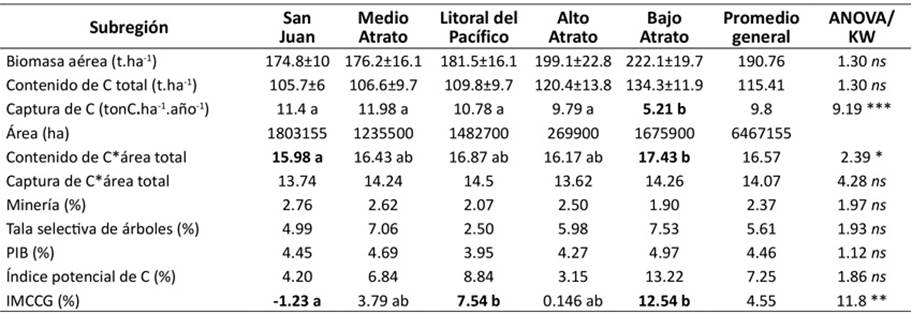
La tasa de captura de C por ha.año-1 presentó diferencias significativas entre las subregiones del Chocó (F=9.19; p=0.0001). Sin embargo, el resultado fue similar al evaluar la captura de C en función del área de las subregiones. Contrario a ello, el contenido de C total en función del área presentó diferencias marginalmente significativas, con un mayor valor en el Bajo Atrato (F=2.39; p=0.077). Por su parte, el IMCCG fue mayor en las subregiones de Litoral del Pacífico y Bajo Atrato. La diferencia fue estadísticamente significativa (Kruskal-Wallis=11.8; p=0.018) (Tabla 1).
No hubo diferencias estadísticamente significativas entre subregiones en términos de la afectación por minería (F=1.97; p=0.1294) y tala de árboles (F=1.93; p=0.1363), ni en los valores promedio del PIB (F=1.12; p=0.369) (Tabla 1). Por su parte, en cuanto al tipo de gobernanza del territorio, se determinó que la captura de C fue significativamente mayor en bosques de resguardos indígenas (prueba F=5.44; p=0.0104) (Figura 1). Por su parte, la captura de C, el contenido de C, la minería, la tala de árboles y el IMCCG de cada municipio se presentan en el material suplementario.
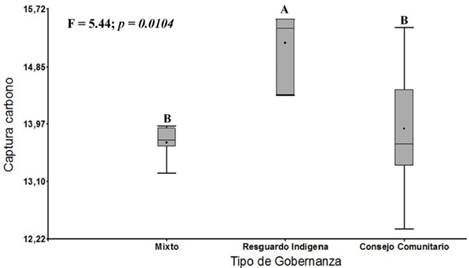
Figura 1: Tasas de captura de carbono total (t.ha-1.año-1) por tipo de gobernanza del territorio (consejo comunitario, resguardo indígena, mixto) en el Chocó, Colombia. Las letras A y B denotan diferencias significativas a un 95 % de confianza. Los valores están transformados en Ln(+5).
Mediante el ACP de las variables, se determinó que las tasas de captura y contenido de C total y el índice potencial de C presentan una correlación positiva más fuerte. Asimismo, se evidenció una mayor asociación positiva entre variables como el PIB, la cantidad de habitantes, la minería y la tala selectiva. El componente 1 del ACP explicó el 49.9 % de la variación en los datos, mientras que el componente 2 explicó el 23.0 % (Figura 2).
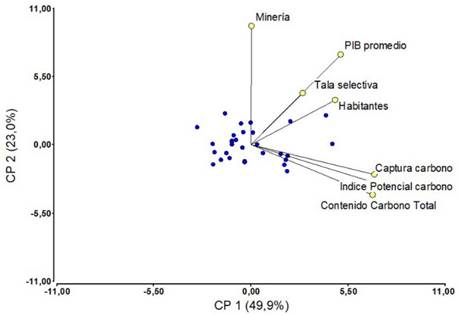
Figura 2: ACP para variables ambientales como la captura de C, el contenido de C total, el índice potencial de carbono, el PIB, la cantidad de habitantes, la minería y la tala selectiva para los municipios del departamento del Chocó, Colombia
Por su parte, mediante el coeficiente de correlación de Pearson, se determinó que el PIB promedio se correlacionó positiva y significativamente con la cantidad de habitantes (r=0.67; p=0.0001), el índice potencial de C (r=0.41; p=0.0235), el contenido de C total (r=0.38; p=0.039), la tasa de captura de C total (r=0.39; p=0.033) y las áreas afectadas por minería (r=0.43; p=0.018) y tala de árboles (r=0.43; p=0.018) (Tabla 2, Figura 3). Entretanto, las áreas afectadas por minería y tala selectiva de madera no estuvieron significativamente correlacionadas con la cantidad de C total y las tasas de captura de C de los bosques naturales del departamento del Chocó (Tabla 2).
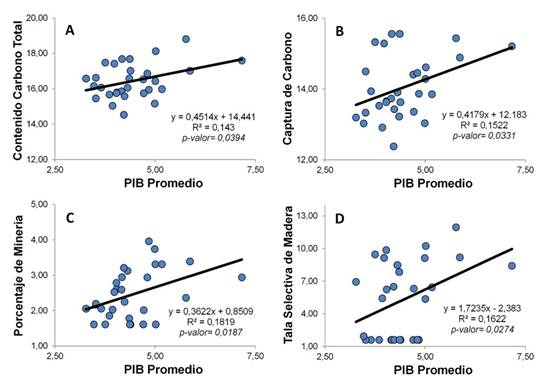
Figura 3.: Modelos de regresión lineal para el PIB, la tasa de captura de C, el contenido de C, la minería y la tala selectiva de madera de los municipios del Chocó, Colombia
DISCUSIÓN
Biomasa aérea
Se cuantificó una BA promedio de 190.76 ton.ha-1 y un contenido de C total de 115.41 ton C.ha-1 para los bosques lluviosos tropicales del Chocó. En este sentido, a nivel de subregiones, se determinó que los mayores valores de BA y contenido de C se presentaron en las subregiones de Bajo y Alto Atrato respectivamente. Estas estimaciones (190.76 ton.ha-1) son inferiores a las reportadas en el inventario nacional forestal para el Pacífico colombiano, i.e., 226.86 ton.ha-1 de promedio general (Olarte et al., 2024). Asimismo, la BA del Pacífico colombiano que se observó en este estudio se encuentra dentro del rango reportado para bosques tropicales: entre 22.5 y 324.5 ton.ha-1 (Clark et al., 2001b). Lo anterior corrobora el rol de estos bosques tropicales en la mitigación del cambio climático (IPCC, 2014), dado su significativo almacenamiento de C, que equivale a 691.3 millones de toneladas de C (Quinto, 2023).
Captura de carbono
La tasa de captura de C para los bosques tropicales del Chocó fue de 9.8 ton C.ha-1.año-1. A nivel de subregiones, la mayor tasa de captura de C se observó en Medio Atrato y San Juan. Este valor se encuentra dentro del rango de variación de PPN total reportado para bosques tropicales: entre 1.7 y 21.7 ton C.ha-1.año-1 (Clark et al., 2001b). Asimismo, tanto para los bosques del Chocó como para la región tropical, esta PPN total presenta gran variación, pues está influenciada por diversos factores como la precipitación, la radiación solar, la temperatura y los nutrientes del suelo (Clark et al., 2001b; Schuur, 2003; Paoli et al., 2005; Zhao & Running, 2010), así como por factores relacionados con la dinámica del ecosistema y la diversidad (Del Valle et al., 2003; Quinto & Moreno, 2011; Wu et al., 2011; Quinto, 2023). En síntesis, se ratificó la funcionalidad de estos bosques en la mitigación del cambio climático (Quinto, 2023).
Relación entre PIB y captura y almacenamiento de carbono
Según Primack y Vidal (2019), entre las principales amenazas a la biodiversidad y sus servicios ecosistémicos (entre ellos la captura y el almacenamiento de C), se pueden mencionar la destrucción y fragmentación del hábitat, la contaminación, el cambio climático, la sobreexplotación de recursos y el aumento de especies exóticas, todas de origen humano. Estos factores devienen en la extinción de especies, la degradación de ecosistemas, la disminución de la diversidad y la pérdida de servicios ecosistémicos (Primack & Vidal, 2019). En este sentido, las actividades económicas evaluadas para el Chocó (minería y tala) son un claro ejemplo de las amenazas a la biodiversidad; con la minería por ejemplo, se destruyen más de 360 ha.año-1 de bosque (Ramírez & Ledesma, 2007); se afectan fuentes hídricas; se contaminan suelos, peces, y ríos por vertimientos de mercurio (Palacios Torres et al., 2018); y se reforesta con especies exóticas como Acacia mangium (Valois-Cuesta, 2016). Asimismo, con la tala se fragmentan los bosques (Laurance & Williamson, 2001; Primack & Vidal, 2019) y se reduce la BA (Quinto & Moreno, 2011) y la diversidad (LaPorte et al., 2007; Laurance, 2007). Ambas actividades económicas aumentan las emisiones de C (Quinto et al., 2023; Quinto, 2023) y favorecen el cambio climático (del Valle et al., 2003; IPCC, 2014).
Adicionalmente, la minería y la tala están relacionadas con el incremento en la población humana, Así como con el aumento en el PIB de distintas regiones (Primack & Vidal, 2019). Lo anterior supone que los aumentos en la población humana generan un mayor crecimiento económico (PIB) y, con ello, un mayor deterioro de los ecosistemas, incluidos los tropicales (Primack & Vidal, 2019). En síntesis, se espera un mayor deterioro ambiental y una reducción de los servicios ecosistémicos relacionados con el almacenamiento de C a medida que aumenta el PIB de las regiones tropicales. En este sentido, se ha propuesto la hipótesis de que la relación entre la contaminación ambiental y el PIB genera una curva ambiental de Kuznets (EKC) con forma de U invertida (Figura 4a) (Dinda, 2004; Sánchez, 2017; Song, 2023).
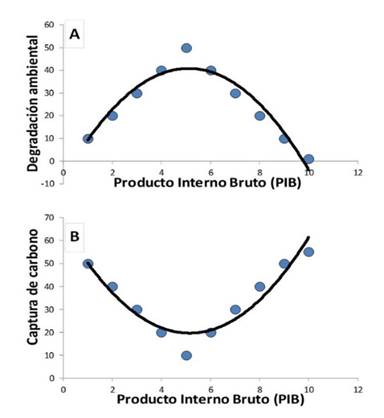
Figura 4: Tendencias teóricas de la relación entre el PIB y el ambiente. a) Degradación ambiental vs. PIB según la EKC, con forma de U invertida; b) captura de C vs. PIB según los datos de este estudio, con forma de U.
La hipótesis de la EKC plantea que las etapas iniciales de desarrollo económico de una región o país presentan un deterioro de la calidad ambiental a medida que aumenta el desarrollo económico, hasta llegar a un punto (umbral) de máxima contaminación ambiental. Luego, en las etapas posteriores y/o finales, el deterioro ambiental disminuye y el crecimiento económico se mantiene estable y/o aumenta (Dinda, 2004; Sánchez, 2017; Song, 2023). Esta relación entre crecimiento económico e impacto ambiental es verdaderamente dinámica (Song, 2023). Una de las razones que explica la dinámica de la relación EKC es el hecho de que una economía subdesarrollada se puede ver afectada por el crecimiento descontrolado de la población y, en consecuencia, por la demanda de alimentos—y, siempre que la producción agrícola sea baja, se destinará más tierra para la siembra de cultivos alimentarios, reduciendo las tierras forestales y generando deterioro ambiental (Song, 2023).
En este contexto aumenta la demanda de madera y otros productos forestales, lo que conduce a la degradación de los ecosistemas (Song, 2023). No obstante, luego de alcanzar el umbral de deterioro, y con el incremento en el desarrollo económico, la producción de alimentos ya no depende de las áreas de cultivo, por lo que muchas tierras agrícolas con bajo rendimiento económico son abandonadas y se convierten en bosques en regeneración, generando la mencionada U invertida entre el crecimiento económico y la conservación (Dinda, 2004; Song, 2023). Otra posible explicación es que el progreso económico mejora el nivel de vida de las personas, por lo que la sociedad comienza a prestar mayor atención a la protección del medio ambiente (Dinda, 2004); se implementan mejores leyes y regulaciones en torno a estos aspectos (Song, 2023). Además, la estructura de la industria forestal se vuelve más razonable, y gradualmente se recuperan los recursos forestales (Dinda, 2004; Sánchez, 2017; Song, 2023). Por tanto, se forma una U invertida en la relación entre el PIB y la conservación del ambiente (Figura 4a).
En el departamento del Chocó, el PIB se correlacionó positiva y significativamente con el porcentaje de áreas afectadas por la minería y la tala de árboles, corroborando lo evidenciado en cuanto a la relación entre el crecimiento económico y el deterioro ambiental en las etapas iniciales de la EKC (Dinda, 2004; Sánchez, 2017). Este incremento en la minería, la tala de árboles y el PIB podría deberse a la influencia del mayor crecimiento económico, poder adquisitivo y solidez financiera de la población dedicada a dichas actividades (DANE 2024), lo que a su vez deviene en una mayor capacidad económica para invertir en dichos sectores.
Los municipios con mayor producción minera se localizan en la subregión del San Juan, y los de mayor tala de madera en el Bajo Atrato. Estas actividades económicas son respaldadas por los ingresos que generan el comercio, el sector público y las microempresas en el San Juan (IGAC 2006). Entretanto, en Riosucio (Bajo Atrato) se observan actividades como la pesca, la producción forestal legal (cultivos de palma de aceite, plátano y banano), el comercio, el sector público y las microempresas, los cuales favorecen la inversión en actividades forestales (IGAC 2006). Esto explica la relación positiva y significativa entre estas actividades económicas y el PIB. Sin embargo, es importante mencionar que tanto la minería del San Juan como el aprovechamiento de madera del Bajo Atrato se realizan también de manera ilegal; los grupos armados al margen de la ley utilizan dichas actividades como mecanismos de financiación (IGAC 2006). En síntesis, estas economías (minería y tala de árboles), aunque ilegales, contribuyen significativamente al PIB de la región. De igual manera, es importante mencionar que estas correlaciones no deben asumirse como causales directas; los datos de minería y tala poseen limitaciones en términos de tiempo y precisión.
Contrario a lo esperado, en términos ambientales, se observó que el PIB promedio tiene una correlación positiva, significativa e indirecta con el índice potencial de C, el contenido de C total y la tasa de captura de C. Lo anterior evidencia una relación positiva entre los servicios ambientales de los bosques naturales y el crecimiento económico (PIB) en el Chocó. Estas observaciones están relacionadas con lo reportado para la relación entre crecimiento económico y deterioro ambiental (contrario a la conservación del ecosistema) en las etapas finales de la EKC (Dinda, 2004; Sánchez, 2017), i.e., al evaluar la relación EKC entre el crecimiento económico y la contaminación ambiental se obtiene una U invertida (Dinda, 2004). Esto implica una relación de U no invertida entre el crecimiento económico y la conservación de los servicios ambientales de captura y almacenamiento de C (Figura 4b).
Con base en lo anterior, puede concluirse que se está generando, de manera indirecta, una mayor conservación del ecosistema y una mayor mitigación del cambio climático en los municipios de mayor PIB. Es importante mencionar que estos resultados son similares a los reportados por Song (2023), quien determinó que el crecimiento económico tiene un efecto positivo en el desarrollo de sumideros de C forestales en las localidades de China (Song, 2023). Las razones de estas tendencias están relacionadas con que el crecimiento económico ha impulsado un aumento de la inversión en silvicultura, reservas forestales, gestión forestal, implementación de proyectos de forestación y cuidado forestal, mejorando la conservación de bosques (Song, 2023). Esto es parcialmente similar a lo reportado en este estudio; la relación positiva—no causal—entre PIB y captura y almacenamiento de C en los bosques del Chocó posiblemente se deba a las siguientes razones:
-
Mayor control ambiental mediante entidades gubernamentales y normativas nacionales y locales en municipios con mayor cantidad de habitantes y PIB, las cuales promueven la conservación y la mitigación del cambio climático global (IIAP, 2015).
-
Mayor diversificación de actividades económicas (comercio, pesca, turismo, sector público, etc.) en las localidades con mayor PIB, lo que favorece la conservación de los bosques naturales (IGAC, 2006; DNP 2007).
-
Implementación de programas de conservación, restauración y reforestación, así como de programas REDD+, en los bosques de los consejos comunitarios y municipios de mayor PIB (IGAC, 2006; IIAP, 2015), lo cual favorece el rol de estos bosques en la mitigación del cambio climático.
CONCLUSIONES
En el Pacífico colombiano, los municipios y las regiones pueden presentar altos niveles de PIB, minería y tala de árboles y, al mismo tiempo—aunque de manera no causal—poseer tasas altas de captura de C y mitigación de cambio climático. Asimismo, se puede determinar que un desarrollo económico (evaluado mediante el PIB) con conciencia social y ecológica, con inversiones, normatividad ambiental, actividades de control y regulación ambiental, y proyectos de conservación (como los programas REDD+) que vinculen directamente a las comunidades, puede promover y fortalecer la restauración y conservación de los bosques, favoreciendo los servicios ambientales de almacenamiento de C, que a su vez contribuyen en la mitigación del cambio climático. En regiones como el Pacífico colombiano, estos servicios representan una alternativa de desarrollo sostenible y amigable con el ambiente.
Acknowledgements
AGRADECIMIENTOS
Esta investigación fue financiada mediante el proyecto Evaluación del efecto de la fertilización del suelo sobre la producción neta del ecosistema en áreas degradadas por minería, como estrategia para potenciar la captura de carbono y la venta de servicios ambientales en el Chocó Biogeográfico (código 1128-852-72243), presentado por la Universidad Tecnológica del Chocó D. L. C., la Universidad Nacional de Colombia (sede Medellín), la Universidad de Valladolid (España), el Instituto de Investigaciones Ambientales del Pacífico y el SENA, y aprobado por Ministerio de Ciencia, Tecnología e Innovación.
REFERENCIAS




License
Copyright (c) 2025 Colombia Forestal

This work is licensed under a Creative Commons Attribution-ShareAlike 4.0 International License.
Colombia Forestal retains the patrimonial rights (copyright) of the published works, and favors and allows the reuse of the same under the Creative Commons Attribution-ShareAlike 4.0 International license, so they can be copied, used, disseminated, transmitted and exhibited publicly, provided that:
You acknowledge the credits of the work in the manner specified by the author or licensor (but not in a way that suggests that you have their support or that they endorse your use of their work).