DOI:
https://doi.org/10.14483/25009311.23149Published:
2025-06-12Issue:
Vol. 11 No. 19 (2025): julio-diciembre 2025Section:
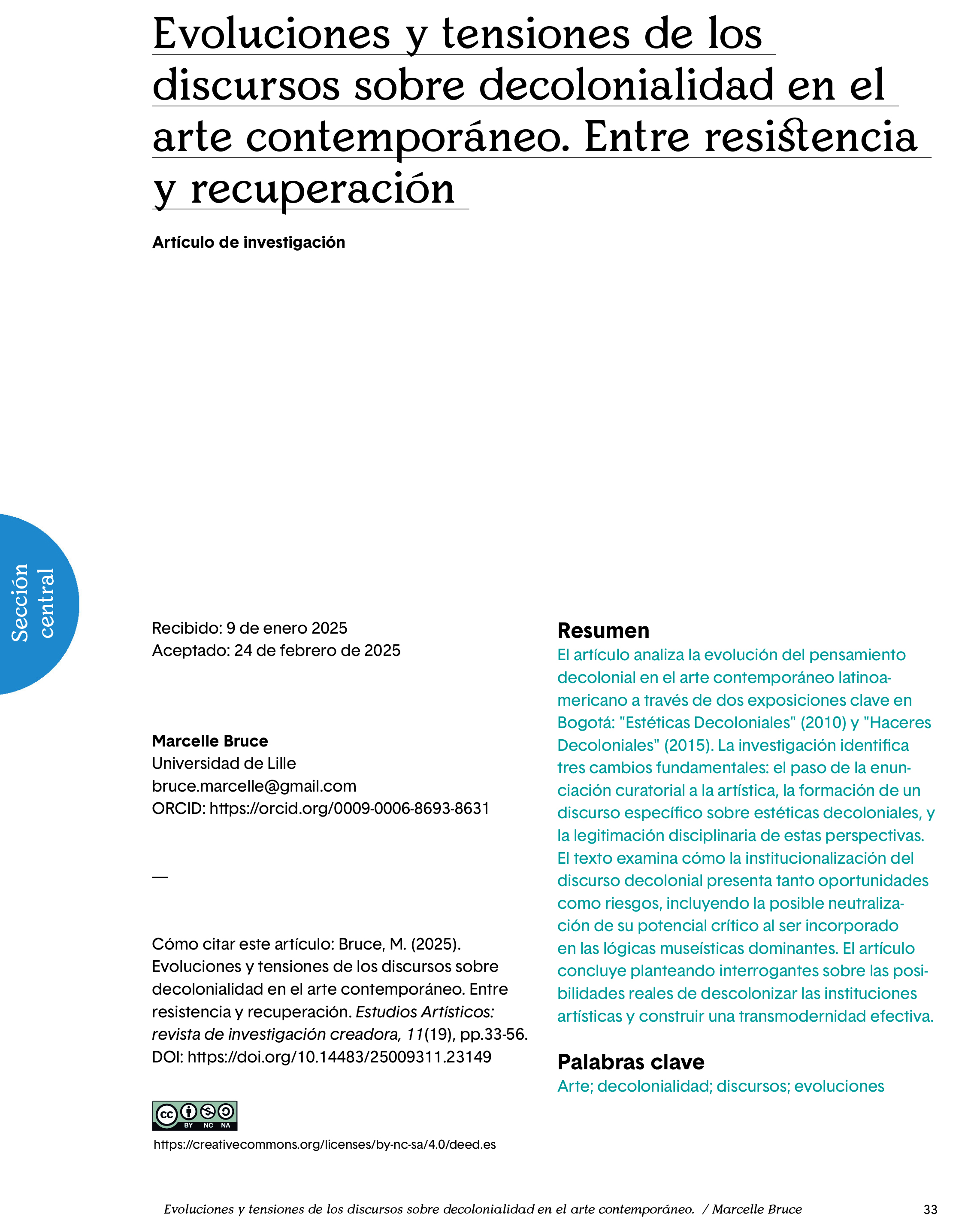
Sección CentralEvoluciones y tensiones de los discursos sobre decolonialidad en el arte contemporáneo. Entre resistencia y recuperación
Evolutions and Tensions in Discourses on Decoloniality in Contemporary Art: Between Resistance and Recovery
Evoluções e tensões dos discursos sobre a decolonialidade na arte contemporânea. Entre resistência e recuperação
Keywords:
Arte, decolonialidad, discursos, evoluciones (es).Keywords:
Art, decoloniality, discourses, evolutions (en).Keywords:
Arte, decolonialidade, Discursos, Evoluções (pt).Downloads
Abstract (es)
El artículo analiza la evolución del pensamiento decolonial en el arte contemporáneo latinoamericano a través de dos exposiciones clave en Bogotá: "Estéticas Decoloniales" (2010) y "Haceres Decoloniales" (2015). La investigación identifica tres cambios fundamentales: el paso de la enunciación curatorial a la artística, la formación de un discurso específico sobre estéticas decoloniales, y la legitimación disciplinaria de estas perspectivas. El texto examina cómo la institucionalización del discurso decolonial presenta tanto oportunidades como riesgos, incluyendo la posible neutralización de su potencial crítico al ser incorporado en las lógicas museísticas dominantes. El artículo concluye planteando interrogantes sobre las posibilidades reales de descolonizar las instituciones artísticas y construir una transmodernidad efectiva
Abstract (en)
The article analyzes the evolution of decolonial thought in contemporary Latin American art throu-gh two key exhibitions in Bogotá: "Decolonial Aesthetics" (2010) and "Decolonial Practices" (2015). The research identifies three fundamental changes: the shift from curatorial to artistic enun-ciation, the formation of a specific discourse on decolonial aesthetics, and the disciplinary legiti-mization of these perspectives. The text examines how the institutionalization of decolonial discourse presents both opportunities and risks, including the potential neutralization of its critical potential when incorporated into dominant museum logics. The article concludes by raising questions about the real possibilities of decolonizing artistic institutions and constructing an effective transmodernity.
Abstract (pt)
O artigo analisa a evolução do pensamento decolonial na arte contemporânea latino-americana por meio de duas exposições importantes em Bogotá: "Estética Decolonial" (2010) e "Fazeres Decoloniais" (2015). A pesquisa identifica três mudanças fundamentais: a mudança da enun-ciação curatorial para a artística, a formação de um discurso específico sobre a estética decolonial e a legitimação disciplinar dessas perspectivas. O texto examina como a institucionalização do discurso decolonial apresenta oportunidades e riscos, incluindo a possível neutralização de seu potencial crítico ao ser incorporada às lógicas museológicas dominantes. O artigo conclui levantando questões sobre as reais possibilidades de descolonização das instituições de arte e construção de uma transmodernidade efetiva.
References
Barriendos Rodríguez, J. (2013). La idea del arte latinoamericano. Estudios globales del arte, geografías subalternas, regionalismos críticos
[Universitat de Barcelona]. «https://www.tdx.cat/handle/10803/110924#page=1»
Brizuela, N. (2019). Global? Contemporary? Latin American? Time Matters in/and Art Today. Revista Hispánica Moderna, 72(2), 135–148.
Escobar, A. (2014). Sentipensar con la tierra. Ediciones Unaula.
Gómez Moreno, P. P. (2016). HD: Haceres Decoloniales: Prácticas liberadoras del estar, el sen-tir y el pensar. Universidad Distrital Francisco José de Caldas.
Gómez, P. P., & Mignolo, W. D. (2012). Estéticas decoloniales. Sentir, Pensar, Hacer en Abya Yala y la Gran Comarca. Universidad Distrital Francisco José de Caldas.
Mignolo, W. D. (2011). Aiesthesis decolonial. Calle 14 revista de investigación en el campo del arte, 4(4), 10–25. https://doi.org/10.14483/21450706.1224
Mignolo, W. (2014). Activar los archivos, descentra-lizar a las musas. F. Quincoces, (Trad.). MACBA.
Vázquez, R. (Ed.). (2014). Colonialidad y Relacionalidad. En Los desafíos decoloniales de nuestros días: Pensar en colectivo (pp. 173–196).
Encuentro Internacional del Colectivo Modernidad / Colonialidad - Patagonia 2012, Neuquén. Educo, Editorial de la Universidad Nacional del Comahue.
Vázquez, R. (2018). El museo, decolonialidad y el fin de la contemporaneidad. Otros Logos, Revista de Estudios Críticos, 9, 46–61.
Vázquez, R. (2022). Temporalidades relacionales: De la modernidad a lo decolonial (M. Bruce, Trad.). Espacios Transnacionales. Revista Latinoamericana-Europea de Pensamiento y Acción, 18, 20–36.
Villegas, L. (2021). ¿Opacar los bordes, reactivar la otredad? Curadurías críticas en la era de la diversi-dad. post(s), 7, 98–130.
How to Cite
APA
ACM
ACS
ABNT
Chicago
Harvard
IEEE
MLA
Turabian
Vancouver
Download Citation
License
Copyright (c) 2025 Marcelle Bruce Vázquez del Mercado

This work is licensed under a Creative Commons Attribution-NonCommercial-ShareAlike 4.0 International License.

Este obra está bajo una licencia de Creative Commons Reconocimiento 4.0 Internacional.
The ESTUDIOS ARTÍSTICOS Journal exposes the guidelines on good practices in scientific publication, as a framework for the development and implementation of its own policies and ethics system in the publication. The Editors of the journal ARTISTIC STUDIES, select the reviewers under guidelines of impartiality and professionalism, so that they can ensure fair evaluations, the Editors guarantee the authors that the appropriate reviewers are selected for revisions of their works, and readers can trust the peer review process.
The ESTUDIOS ARTÍSTICOS Editors are aware of the work necessary to make firm decisions and the creation of solid editorial processes, designed to manage their interests and promote an efficient and sustainable publishing system, which will benefit academic institutions, publishers of journals, the authors, those who finance the research and the readers. Good practices in scientific publication do not develop spontaneously but are consciously established and actively promoted.
Responsibilities of the authors of the works
All the authors that are reflected in the work must have actively contributed to it.
ESTUDIOS ARTÍSTICOS provides the authors with clear instructions explaining the concepts of academic authorship, specifying that the contributions should be clear. The editors of ARTISTIC STUDIES request the declaration to the authors that they meet the criteria of the journal in relation to the authorship. In the event of a conflict in the authorship of a published work, the ARTISTIC STUDIES Editors will contact the author who claims their authorship to establish the veracity of the case. If the Editors deem it appropriate, temporary access to the article in question will be closed until a final decision is made.
The documents to be published must not have been published before