DOI:
https://doi.org/10.14483/23448393.17797Publicado:
2022-04-25Número:
Vol. 27 Núm. 2 (2022): Mayo-agostoSección:
Ingeniería de SistemasRelaciones sociales y comunidades en una plataforma virtual para cursos de programación de computadores
Social Relations and Communities in a Virtual Platform for Computer Programming Courses
Descargas
Referencias
Piazza, “Ask. Answer. Explore. Whenever”. http://www.piazza.com
C. Lozares, “La teoría de redes sociales”, Rev. Socio., vol. 48, pp. 103-124, 1996. http://dx.doi.org/10.5565/rev/papers/v48n0.1814 DOI: https://doi.org/10.5565/rev/papers/v48n0.1814
P. Jafari, E. Mohamed, S. Lee, and S. Abourizk, “Social network analysis of change management processes for communication assessment”, Autom. Constr., vol. 118, 2020. https://doi.org/10.1016/j.autcon.2020.103292 DOI: https://doi.org/10.1016/j.autcon.2020.103292
S. Wasserman, and K. Faust, Social Network Analysis: Methods and Applications. Cambridge: Cambridge University Press, 1994. https://doi.org/10.1017/CBO9780511815478 DOI: https://doi.org/10.1017/CBO9780511815478
N. Akhtar, “Social network analysis tools”, 2014 Fourth International Conference on Communication Systems and Network Technologies, pp. 388-392, 2014. doi: 10.1109/CSNT.2014.83 DOI: https://doi.org/10.1109/CSNT.2014.83
R. Avello Martínez, “Las fuentes de información y su evaluación”, Comunicar. Escuela de Autores. https://doi.org/10.3916/escuela-de-autores-068 DOI: https://doi.org/10.3916/escuela-de-autores-068
T. Jia, X. Zhao, Z. Wang, D. Gong, and G. Ding, “Model Transformation and data migration from relational database to MongoDB”, 2016 IEEE International Congress on Big Data (BigData Congress), pp. 60-67, 2016. doi: 10.1109/BigDataCongress.2016.16 DOI: https://doi.org/10.1109/BigDataCongress.2016.16
A. Kuz, M. Falco, y R. Giandini, “Análisis de redes sociales: un caso práctico”, Comput. Sist., vol. 20, no. 1, pp. 89-106, 2016. https://doi.org/10.13053/cys-20-1-2321 DOI: https://doi.org/10.13053/cys-20-1-2321
J. F. Franco-Bermúdez y W. L. Ruiz-Castañeda, “Análisis de redes sociales para un sistema de innovación generado a partir de un modelo de simulación basado en agentes”, TecnoLógicas, vol. 22, no. 44, 2019. https://doi.org/10.22430/22565337.1183 DOI: https://doi.org/10.22430/22565337.1183
A. Balderas, J. M. Dodero, M. Palomo, and I. Ruiz, “A domain specific language for online learning competence assessments”, Inter. J. Eng. Edu., vol. 31, no. extra 3, pp. 851-862, 2015.
M. Á. Conde-González y Á. Hernández-García, “Bridging the gap between LMS and Social network learning analytics in online learning”, J. Inf. Technol. Res., vol. 9, no. 4, pp. 1-15, 2016, https://doi.org/10.4018/JITR.2016100101 DOI: https://doi.org/10.4018/JITR.2016100101
L. M. Oliva Córdova, H. R. Amado-Salvatierra, and K. O. Villalba Condori, “An experience making use of learning analytics techniques in discussion forums to improve the interaction in learning ecosystems”, P. Zaphiris, and A. Ioannou (eds.), Learning and Collaboration Technologies. Designing Learning Experiences, pp. 64-76, Springer, 2019. https://doi.org/10.1007/978-3-030-21814-0 DOI: https://doi.org/10.1007/978-3-030-21814-0_6
M. Á. Conde-González, Á. Hernández-García, F. García-Peñalvo, and M. L. Sein-Echaluce, “Exploring student interactions: Learning analytics tools for student tracking”, P. Zaphiris, and A. Ioannou (eds.), Learning and Collaboration Technologies, pp. 50-61, Springer, 2015. https://doi.org/10.1007/978-3-319-20609-7_6 DOI: https://doi.org/10.1007/978-3-319-20609-7_6
J. Miceli y S. Guerrero, “Redes libres de escala y su uso en el análisis de datos etnográficos: el caso de la comunidad tehuelche del Chalía”, 1ª Congreso Latinoamericano de Antropología, 2005.
D. Mora Langa, Estudio topológico de redes sociales en foros virtuales (proyecto de grado), Universidad pública en Madrid, España, 2016. https://oa.upm.es/44524/
L. A. Navarro Sánchez y J. P. Salazar Fernández, “Análisis de redes sociales aplicado a redes de investigación en ciencia y tecnología”, Sínt. Tecnológica, vol. 3, no. 2, pp. 69-86. https://doi.org/10.4206/sint.tecnol.2007.v3n2-03 DOI: https://doi.org/10.4206/sint.tecnol.2007.v3n2-03
E. Villegas Iriarte, “Construcción de saberes en la web social: estado de la cuestión”, Prax. Saber, vol. 7, no. 15, pp. 183-205, 2016. https://doi.org/10.19053/22160159.v7.n15.2016.5729 DOI: https://doi.org/10.19053/22160159.v7.n15.2016.5729
F. J. Moreno, and S. Hernández, “An algorithm for identifying the best current friend in a social network”, Ing. e Investig., vol. 35, no. 2, pp. 80-88, 2015. http://dx.doi.org/10.15446/ing.investig.v35n2.50339 DOI: https://doi.org/10.15446/ing.investig.v35n2.50339
A. Knutas, J. Ikonen, U. Nikula, and J. Porras, “Increasing collaborative communications in a programming course with gamification: A case study”, CompSysTech ’14: Proceedings of the 15th International Conference on Computer Systems and Technologies, pp. 370-377, 2014. https://doi.org/10.1145/2659532.2659620 DOI: https://doi.org/10.1145/2659532.2659620
B. Barros, R. Conejo, A. Ruiz-Sepulveda, and F. Triguero-Ruiz, “I explain, you collaborate, he cheats: An empirical study with social network analysis of study groups in a computer programming subject”, Appl. Sci., vol. 11, no. 19, 2021. https://doi.org/10.3390/app11199328 DOI: https://doi.org/10.3390/app11199328
M. Aldana, “Redes complejas: estructura, dinámica y evolución”, fdocuments.es, 2011. https://fdocuments.es/document/redes-complejas-estructura-dinamica-y-evolucion.html
L. C. Freeman, “Centrality in social networks conceptual clarification”, Soc. Netw., vol. 1, no. 3, pp. 215-239. https://doi.org/10.1016/0378-8733(78)90021-7 DOI: https://doi.org/10.1016/0378-8733(78)90021-7
E. Ortiz Muñoz y Y. Hidalgo Delgado, “Detección de comunidades a partir de redes de coautoría en grafos RDF”, Rev. Cuba. Inf. Cienc. Salud, vol. 27, no. 1, pp. 90-99, 2016.
W. Kuang Lai, Y. Uan Chen, and T.-Y. Wu, “Analysis and evaluation of random-based message propagation models on the social networks” Computer Networks, vol. 170, 2020. https://doi.org/10.1016/j.comnet.2019.107047 DOI: https://doi.org/10.1016/j.comnet.2019.107047
Cómo citar
APA
ACM
ACS
ABNT
Chicago
Harvard
IEEE
MLA
Turabian
Vancouver
Descargar cita
Recibido: 23 de febrero de 2021; Revisión recibida: 19 de octubre de 2021; Aceptado: 17 de noviembre de 2021
Resumen
Contexto:
Identificar la relación entre el desempeño académico de los estudiantes y las métricas de los grafos obtenidos correspondientes a las interacciones de los usuarios en la plataforma Piazza.
Método:
Se estudian los resultados obtenidos correspondientes a las interacciones entre estudiantes y docentes en la plataforma Piazza, realizando un caso práctico de análisis de redes sociales a través de herramientas computacionales y definición de métricas.
Resultados:
La información resultante es un valioso apoyo para la implementación de estrategias en los contenidos de un curso asistido con plataformas virtuales, puesto que se identifican las estructuras sociales que resultan de las diferentes formas de relación, lo que permite mapear o analizar relaciones entre personas y cooperación entre actores, grupos o comunidades, entre otras.
Conclusiones:
Las métricas establecidas para evaluar las redes sociales obtenidas de la plataforma permiten a los docentes determinar la participación y la interacción entre los estudiantes, identificando diferentes patrones de interacción que determinan una relación en la construcción de los vínculos sociales con el desempeño académico de los estudiantes.
Palabras clave:
análisis de redes sociales, Piazza, grafos, métricas, notas..Abstract
Context:
To identify the relationship between the students’ academic performance and the metrics of the graphs obtained corresponding to the interactions of the users in the Piazza platform.
Method:
The results obtained corresponding to the interactions between students and teachers in the Piazza platform are studied, carrying out a practical case of social network analysis through computational tools and definition of metrics.
Results:
The resulting information is a valuable support for the implementation of strategies in the content of a course assisted with virtual platforms, since the social structures that result from the different forms of relationship are identified, which allows mapping or analyzing the relationships between people, cooperation between actors, groups, or communities, among others.
Conclusions:
The metrics established to evaluate the social networks obtained from the platform allow teachers to determine the participation and interaction between students, identifying different patterns of interaction that define a relationship between the construction of social ties with the students’ academic performance.
Keywords:
Social network analysis, Piazza, graphs, metrics, notes..Introducción
En los últimos años el desarrollo de diferentes tecnologías ha facilitado la interacción y la colaboración entre individuos en la web, se han creado plataformas para redes sociales que permiten al usuario comunicarse y generar relaciones con otros usuarios. Estas plataformas se han enfocado en dar soporte para producir y compartir contenido académico en el caso de Moodle, Piazza, Google Classroom, entre otros, o de esparcimiento en el caso de Facebook y Twitter. Piazza es una plataforma en línea que facilita la interacción entre estudiantes y docentes, los estudiantes pueden apoyarse en el desarrollo de una tarea mediante la resolución de dudas por parte de sus compañeros, docentes o asistentes de clase 1.Para todos los casos anteriormente mencionados las redes se componen de actores denominados en el análisis de redes sociales como nodos o vértices y de relaciones como aristas o arcos 2. La relación entre actores sociales se realiza mediante un grafo, que corresponde a la representación de una agrupación de elementos conectados mediante relaciones entre ellos. Los arcos se usan para interpretar los comportamientos sociales de las personas implicadas o la contextualización de fenómenos sociales, lo que permite a la academia realizar diferentes análisis de estas interacciones mediante los nuevos modos de socialización 3.
Para la evaluación de este tipo de redes, se recurre a un método denominado análisis de redes sociales (ARS), el cual estudia la estructura social a partir de un patrón de relación o la interpretación de patrones sociales. Los datos de las relaciones o interacciones se obtienen por variables explicativas del comportamiento social sobre conductas, opiniones o roles de las personas implicadas; luego se procesan mediante procedimientos formales como la teoría de grafos o teoría de matrices. Frente a esto, se encuentran herramientas que permiten extraer los datos de la red a través de diferentes técnicas o métodos 4 con el apoyo de diversas aplicaciones desarrolladas para tal fin como Mathematica o Gephi, entre otras. Estas son usadas para comprender y analizar métricas que permiten visualizar el análisis de la dinámica de comunicación, detectar los patrones de interacción en línea y sacar conclusiones de estos 5.
Las técnicas, métricas o medidas permiten determinar los nodos que constituyen la red y las relaciones que se generan entre ellos, además de procesar diferentes datos, realizar cálculos de métricas de manera simple y ordenada, crear imágenes visuales que facilitan la organización y análisis de datos. Existen muchas reglas para entender las redes y los actores. Las más usadas se clasifican en métricas de centralidad, grado y grupo. A través de las métricas los datos pueden ser organizados y analizados.
La motivación para la realización de la presente investigación se encuentra enmarcada en el análisis de las redes sociales, para entender las estructuras en las relaciones de un sistema complejo, identificar competencias de liderazgo y la importancia de los vínculos generados en un contexto educativo. El análisis del funcionamiento de la red a través de las relaciones entre actores permite generar oportunidades o limitaciones que se presenten en la red y en cada uno de sus actores, visualizando su posición, para posteriormente diseñar estrategias de crecimiento y desarrollo.
En este artículo, mediante tres estudios de caso se desea dar a conocer cómo un foro Piazza impacta en la construcción de vínculos sociales y en el desempeño académico, es decir, la relación entre la participación de los estudiantes en los foros y la calificación obtenida al final del curso. Los estudios de caso se llevaron a cabo en tres cursos de programación de computadores, impartidos en los programas profesionales de Ingeniería de Sistemas de la Universidad Nacional de Colombia y la Universidad Cesmag, a través del análisis de redes sociales. Los cursos son obligatorios y se impartieron de manera presencial, apoyados en la plataforma Piazza. Los estudiantes mediante los foros debían coordinar su participación para resolver diferentes temáticas y discutir sobre ellas, fomentando la interacción y el trabajo grupal entre compañeros.
Este análisis permite la extracción de conocimiento de una red, por medio de la herramienta Mathematica y la aplicación de una serie de métricas, para entender a las redes y sus actores. Las métricas establecidas en el análisis son centralidad de intermediación, grado de centralidad y comunidades o grupos conformados. En el caso de las métricas establecidas, se hace referencia a las habilidades de liderazgo e interacción social, las cuales son importantes en los estudiantes. Estas habilidades son importantes en el entorno laboral, de gran demanda para la gestión de proyectos y el trabajo en equipo a nivel profesional.
Es importante establecer en el documento algunos conceptos clave para el análisis de redes sociales, dado que será de utilidad para el entendimiento del artículo, además de describir el proceso metodológico para seleccionar la fuente, procesar los datos, generar los grafos, realizar el análisis de las métricas y mostrar la discusión de los resultados obtenidos, las conclusiones y el trabajo futuro.
Método
A continuación, se presenta de forma organizada la metodología empleada para la presente investigación, así mismo se presenta la figura 1, en la cual se establece de forma ordenada una representación gráfica del método o proceso descrito. Se realizan tres estudios de caso, en los cuales se discute la influencia de algunos actores de la red y las comunidades que se conforman a partir de las interacciones. El curso duro 16 semanas, se contó con 110 estudiantes participantes, dos docentes titulares de las materias y cuatro docentes asistentes.
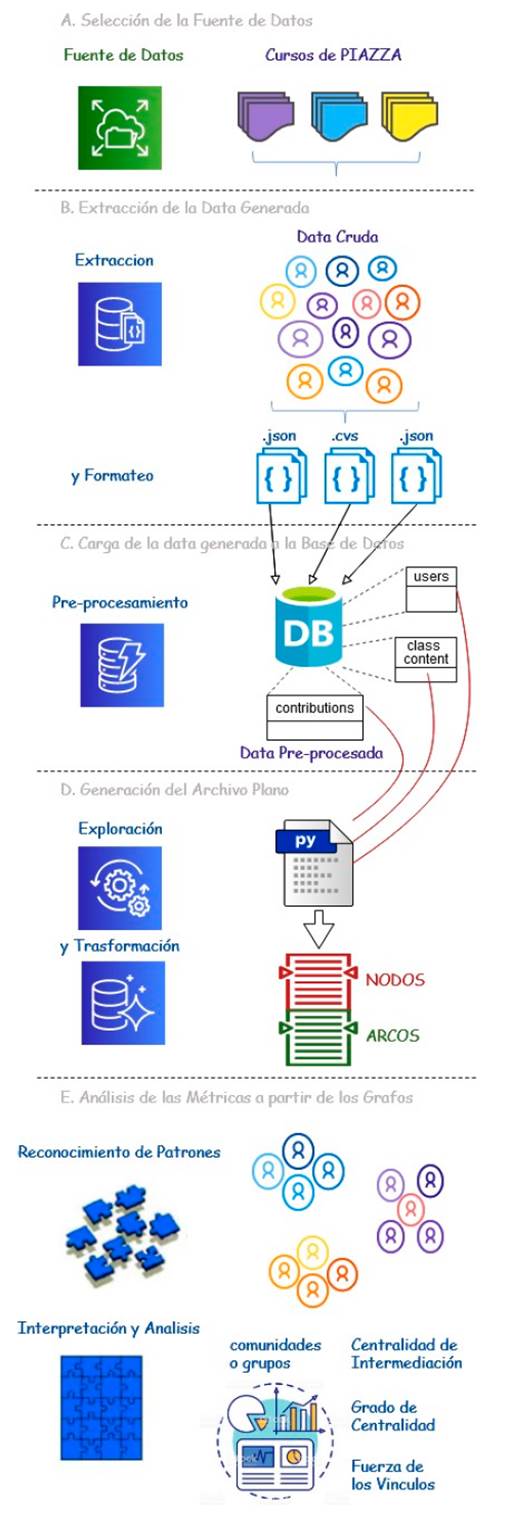
Figura 1: Visualización de la metodología
Selección de la fuente de datos Piazza
Si bien es cierto que existen diferentes plataformas que pueden ofrecer datos útiles para una investigación y considerarse una fuente fiable, también es cierto que seleccionar la fuente adecuada para el trabajo que se desea realizar es una parte importante del proceso de investigación.
Existen diferentes criterios para considerar una fuente de datos como apta para el trabajo que se desea realizar, entre los que se encuentran 6:
-
su relevancia para el tema de trabajo
-
la naturaleza de sus contenidos
-
la autoridad en la materia de quienes elaboran la información
-
la actualización de sus contenidos
-
su nivel de especialización
-
su autenticidad, si se puede identificar quiénes la producen y la editan
-
su propósito, que puede estar orientado al mundo académico, ser informativo o divulgativo
-
el formato: textual, multimedia, sonoro, gráfico, etc.
-
el idioma
-
su origen: si es personal, institucional
-
su accesibilidad
Teniendo en cuenta varios de los criterios mencionados, se selecciona Piazza como la plataforma educativa que permitirá obtener todos los datos necesarios para realizar el análisis de redes y sus métricas, en el marco del trabajo que se pretende abordar en este artículo. A continuación, se mencionan algunos de los puntos que dieron mayor fuerza en la selección de esta plataforma.
Piazza es una plataforma de gran aceptación entre profesores y estudiantes, diseñada para que los instructores administren eficientemente preguntas y respuestas de la clase, simulando una discusión en clase real, relevante para el tema de trabajo y generando un ambiente de interacción entre los agentes de propósito académico, cumpliendo los criterios 1 y 7.
En Piazza los estudiantes pueden publicar preguntas y colaborar para editar las respuestas a estas preguntas. Los instructores también pueden responder preguntas, respaldar las respuestas de los estudiantes y editar o eliminar cualquier contenido publicado. Se puede asumir así que los datos son confiables, al representar de manera textual la interacción del actor, escrita por él mismo; la edición de los datos no es responsabilidad ajena de los actores, así que esto refina la interacción, haciéndola más rica en contenido; con esto cumple los criterios 4 y 6.
Aunque existen diferentes tipos de plataformas educativas, Piazza es una herramienta de fácil acceso para el presente trabajo, pues se cuenta con la colaboración de instructores de programación para extraer los datos requeridos para los análisis, lo que da un valor agregado al presente estudio. La naturaleza del contenido relacionada con cursos de lógica de programación y la formación de las autoras de este artículo hacen que el idioma usado sea entendido y facilita el análisis de las métricas, cumpliendo así los criterios 2, 3, 9 y 11.
Como punto final, Piazza cuenta con una serie de utilidades relacionadas con la visualización, la generación de estadísticas y la exportación de los datos en diferentes formatos, cumpliendo el criterio 8. Siendo este aspecto un punto diferenciador, ya que con la extracción de los datos es posible preprocesarlos, procesarlos y analizarlos.
Extracción de los datos a partir de las interacciones
Teniendo en cuenta la facilidad de acceso a la plataforma, se obtienen los datos de tres cursos de asignaturas relacionadas con la programación:
-
Dos cursos de la Universidad Nacional correspondientes a la materia de Programación de computadores, cohortes 2019-1 y 2019-2, clase grupo 8.
-
Un curso de la Universidad Cesmag correspondiente a la materia Programación de computadores, cohorte 2020-I, grupos jornadas mañana y tarde.
Aunque la plataforma Piazza permite generar estadísticas correspondientes a los usuarios registrados en la plataforma y los contenidos de clases, es decir, las publicaciones realizadas en los foros o cuestionarios, se busca una visualización más clara sobre las métricas a construir y analizar, y, por lo tanto, se decide realizar el estudio con la herramienta de análisis de redes (Wolfram Mathematica 12.1).
Por tanto, se hace necesario el uso de la utilidad de extracción que posee Piazza para obtener los datos de los usuarios y sus interacciones en archivos formateados en .csv y .json, para posteriormente cargarlos en la base de datos seleccionada. La estructura general de Piazza es igual para los cursos que se crean en la plataforma, independiente del contexto o la temática, los archivos generados serán iguales para todos los cursos analizados, lo único que cambia será el contenido de cada uno. Las estructuras extraídas corresponden a: usuarios, contenido de la clase y contribuciones (users, class content y contributions).
Carga de los datos en la base de datos MongoDB
Una vez se tienen los archivos planos .json y .csv, se procede a importarlos a la base de datos, en nuestro caso se seleccionó MongoDB, dado que es un motor basado en documentos que almacena los datos en estructuras parecidas a los documentos .json, haciendo más fácil la interpretación de los datos y casi trasparente la carga de los mismos. Además, tiene como característica principal la flexibilidad al permitir que la base de datos crezca sin tener que alterar la estructura de los documentos que ya se encuentran almacenados en la base 7, pues los documentos dentro de la colección pueden no tener exactamente los mismos campos, además de la capacidad para proveer modularidad y alta disponibilidad.
En el momento en que se cargan los archivo .json usuarios, contenido de la clase y contribuciones a la base de datos, de inmediato se crean las colecciones con los mismos nombres y se llenan con todos los datos que trae el archivo. Una vez se validan los campos de cada una de las colecciones, se construyen las consultas para proyectar los datos de los usuarios estudiantes como “nodos” de la red y las relaciones generadas por las interacciones de los actores en la plataforma como “arcos”.
Para la colección “usuarios” se hace necesario crear un campo autoincremental que identifique con unicidad al estudiante y que sea de tipo numérico, y un campo que contenga la información de las notas finales, para luego generar a través de las consultas las relaciones de los actores mediante este identificador y los análisis basados en la relación entre las métricas y el desempeño académico. Una vez realizadas las pruebas de las consultas definidas para obtener la información requerida, se procede a buscar el mecanismo para la extracción de datos ya depurados a la herramienta de análisis de redes, para esto es necesario generar un archivo plano en formato .net, que corresponde al formato aceptado por Mathematica. El archivo se genera con un programa desarrollado en Python, que se explica en detalle en la siguiente etapa.
Generación del archivo plano con los datos para analizar Python
Teniendo como objetivo la generación de un archivo plano en formato net, se crea una aplicación en Python en la que se establece una conexión con la base de datos de MongoDB y se ejecuten las consultas construidas previamente. Primero se obtienen los resultados de la consulta “nodos”, al traer la información del autonumérico correspondiente al usuario con su respectivo nombre, las notas de cada uno y la cantidad de nodos existentes en el archivo.
Posteriormente, se obtienen los resultados de la consulta “arcos”, al traer la información de la relación entre los nodos con una pareja de valores que representan los autonuméricos de los usuarios (nodos) y si existe interacción a través de alguna pregunta, respuesta, edición o replica en la plataforma Piazza.
Finalmente, con el archivo .net generado se culmina el proceso operativo, cargando los archivos de cada curso a la herramienta Wolfram Mathematica 12.1, la cual permite construir los grafos, representando las interacciones entre nodos y arcos, y a partir de ellos realizar el análisis de las métricas seleccionadas.
Análisis de las métricas a partir de los grafos en Mathematica
Tomando como base un estudio previo que ahonda en el análisis de redes sociales y la implicación de estas para la valoración del clima en el aula 8, las métricas que se propone extraer son:
-
Centralidad de intermediación: que corresponde a los estudiantes o docentes que ocupan una posición intermedia en las comunicaciones informales entre el resto de los estudiantes.
-
Grado de centralidad: se refiere al análisis de rango coercible para determinar cuáles estudiantes tienen la mayor cantidad de relaciones e influencias dentro del grupo.
-
Estructura de comunidades o grupos: se determina en la actitud y el comportamiento de sí mismos con otros actores.
Estado del arte
Las redes son un conjunto particular de interrelaciones entre un conjunto de individuos. A través de la teoría de grafos, la red se compone por nodos o vértices que serían los actores, y las aristas o arcos sus relaciones. La relación entre actores sociales se realiza mediante un grafo, que corresponde a la representación de una agrupación de elementos conectados mediante relaciones entre ellos. Los lazos se usan para interpretar los comportamientos sociales de las personas implicadas.
Estas redes son evaluadas por métodos denominados análisis de redes sociales (ARS), que estudian las relaciones existentes entre los actores que conforman un sistema, estos se identifican como nodos que cuentan con atributos como los vínculos con otros actores, componiendo una estructura social. A partir del análisis de las interacciones, se producen comportamientos sociales de las conductas y relaciones establecidas en la participación de una red social. Para el análisis, se utilizan herramientas para procesar matrices o grafos, extrayendo datos de la red mediante métricas, que determinan los nodos y las relaciones que componen la red utilizando diferentes medidas, de manera simple, se representan los datos para el análisis de datos.
En 9 se precisa como el análisis de innovación en ARS ha sido inspirado por los trabajos de los sociólogos, quienes centran su trabajo en el potencial innovador de los lazos débiles y agujeros estructurales que se presenten en una red. Esto se entiende como una brecha en las redes sociales en diferentes dimensiones: geográficos, cognitivos, comunicativos, culturales, sociales, entre otros. Las brechas que se pueden presentar en este tipo de estudios dificultan la innovación, justificando la existencia de vínculos que puedan cerrar estas brechas mediante el grado de centralidad y lazos fuertes que posean algunos nodos de la red, facilitando el proceso de transferencia tecnológica entre participantes.
Por otro lado, existen estudios que han aplicado este enfoque a la evaluación de competencias de aprendizaje en línea, mediante el análisis de interacción de los estudiantes en Moodle LMS, para estudios de caso realizados en cursos de ciencias de la computación e ingeniería. Los resultados evidencian el desempeño de los estudiantes en competencias como liderazgo y habilidades interpersonales. Estas habilidades son importantes en ingeniería, puesto que muchas empresas enumeran el liderazgo como una competencia crucial para satisfacer las necesidades de la sociedad actual 10.
Otra implementación del análisis de redes sociales en LMS están en 11 y 12. En el primero se realiza un análisis de ventajas, desventajas e idoneidad de herramientas para la generación de grafos de las interacciones en redes sociales, es decir, el análisis efectivo del aprendizaje social, utilizando la combinación de dos herramientas como GraphFES y LMS. El GraphFES es un servicio web para la extracción de datos del foro en Moodle, generando un archivo con el formato específico para ser procesado en Gephi, a partir del cual se realiza el análisis. En el segundo se investigó el modo en que herramientas como SNapp, Vela, GISMO y GraphFES pueden aplicarse al análisis de cursos, mediante el análisis de datos provenientes de foros, wikis, videos, entre otros recursos. Se evalúan las fortalezas y deficiencias de las herramientas, cada una abordando problemas específicos como analítica de aprendizaje, seguimiento del progreso de estudiantes y detección de estudiantes en riesgo.
Las técnicas de analítica de aprendizaje también se han incorporado en el análisis de foros de discusión, como es en el caso de 13, donde mediante el uso de foros en MOOC se busca evaluar la importancia del uso de análisis de aprendizaje visual para mejorar la interacción en ecosistemas de aprendizaje, evaluando las alertas tempranas o la participación baja que se presente en los patrones. Por otro lado, en otra investigación correspondiente a las redes etnográficas en la comunidad Tehuelche del Chalía 14 se evidencia el resultado de una red heterogénea, puesto que se muestran las relaciones entre actores de dos unidades domésticas A y B, teniendo en cuenta relaciones por lazos de sangre, compadrazgo o cooperación económica o laboral.
Otros estudios de redes sociales 9, 14- 18 muestran un consenso similar, como el análisis de estudios etnográficos, el análisis de las redes de amistades entre personas, la red de internet y la construcción de saberes en la web. Por lo tanto, los datos obtenidos en el estudio a través del análisis de las métricas son de gran interés, dado que existen varios cursos impartidos en universidades que son asistidos con plataformas virtuales y que podrían apoyarse en las métricas aplicadas en la investigación para determinar si las características evidenciadas en este tipo de redes constituyen un regla general de dichos cursos, precisando la existencia de una correlación entre el desempeño académico y la estructura de la red.
Para el caso específico de esta investigación, encontramos dos artículos 19, 20 en los que se presentan dos casos de estudio con un enfoque para usar sistemas de discusión en línea para introducción a la programación, con el fin de motivar a los estudiantes a apoyarse entre sí, aumentando las comunicaciones colaborativas del curso. El primer caso de estudio fue un éxito porque se encontraron elementos importantes para la colaboración en línea y apoyo entre estudiantes del curso. En el segundo caso se fomenta la colaboración mediante el trabajo en grupo y el análisis de la similitud de códigos realizados por cada estudiante, el análisis sobre similitud fue de carácter cuantitativo, pero el análisis de redes sociales se realizó para determinar si la creación de grupos y las interacciones establecidas por los estudiantes influían en la similitud.
Análisis y discusión de resultados
A continuación se presentan los resultados obtenidos de la ejecución de la metodología expuesta en el ítem anterior, evidenciando los análisis generados a partir de las métricas construidas de manera visual, a través de grafos, y las inferencias a las que se llegó con la información analizada. Según 8, las métricas seleccionadas para el análisis brindan información útil que puede llevar a un docente a tomar decisiones importantes sobre cómo abordar ciertos temas del curso o cómo dinamizar una clase, entre otras cosas. Algunas de las actividades establecidas para la participación en la plataforma son obligatorias y otras voluntarias, y se desarrollan en casa de manera individual. Las calificaciones están sujetas a un rango establecido de 0 a 5.
Se creó el espacio en Piazza con el fin de aumentar la comunicación colaborativa dentro del curso, además de mostrar la relación entre la construcción de vínculos sociales de los actores y el desempeño académico, determinado si existe correlación entre las calificaciones del curso y las métricas establecidas para el análisis. La participación en los foros se registra como tuplas (lista de elementos de forma ordenada), que contienen información como autor, hora, fecha, quiénes respondieron, entre otros y de ellas se pueden obtener medidas de red social globales, individuales (grado de vértice y centralidad) e intermedias. Dentro de dichas medidas está el grado del vértice que corresponde al número de conexiones que un individuo tiene y que pueden ser direccionadas, el intercambio de ideas y conocimientos de manera grupal a través de las comunidades y la fuerza de los vínculos, que es una combinación de tiempo, intensidad emocional, confianza mutua y servicios recíprocos 8.
Para el curso de Programación de computadores llevado a cabo en el periodo académico 2019- 1, se encontró en la colección de usuarios de la base de datos un total de 35 participantes, entre estudiantes y docentes, de los cuales se obtuvieron 43 interacciones entre los mismos, como se muestra en el grafo de la figura 2. Esto se traduce en el análisis a 35 vértices y 43 arcos de la red, dando como resultado que solo el 31 % de los vértices se encuentran relacionados mediante arcos o conexiones, es decir que han interactuado en algún foro, ya sea como editor o creador de preguntas o respuestas.
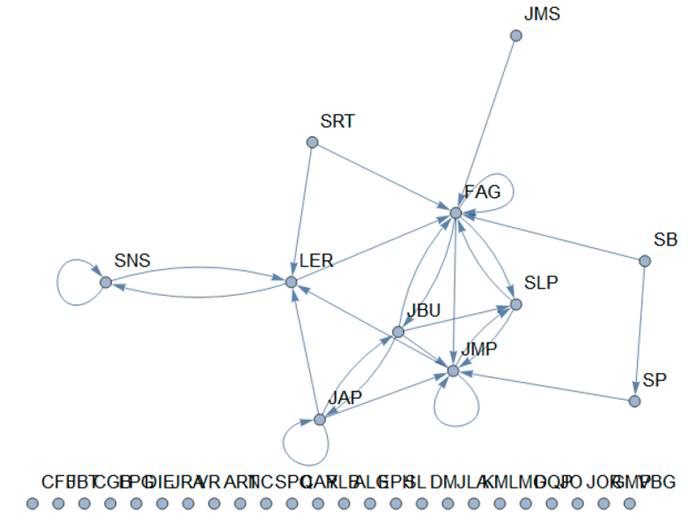
Figura 2: Grafo Curso Programación 1
Para el curso de Programación de computadores llevado a cabo en el periodo académico 2019- 2 se encontró un total de 44 participantes, entre estudiantes y docentes, de los que se obtuvieron 93 interacciones entre los mismos, como se muestra en el grafo de la figura 3. Esto se traduce en el análisis a 44 vértices y 93 arcos de la red, de los que el 87 % de los vértices se encuentran relacionados mediante arcos o conexiones.
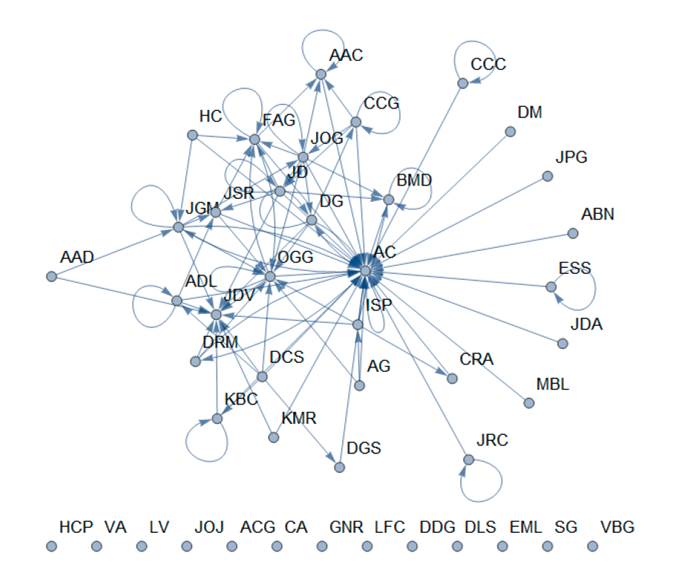
Figura 3: Grafo Curso Programación 2
Para el curso de Programación de computadores llevado a cabo en el periodo académico 2020-1 de la Universidad Cesmag, se encontró un total de 39 participantes, entre estudiantes y docentes, de los que se obtuvieron 96 interacciones entre los mismos, como se muestra en el grafo de la figura 4. Esto se traduce en el análisis a 39 vértices y 96 arcos de la red, de los que el 100 % de los vértices se encuentran relacionados por lo menos una vez mediante arcos o conexiones, puesto que todos los actores debían participar tan siquiera con una intervención en el foro.
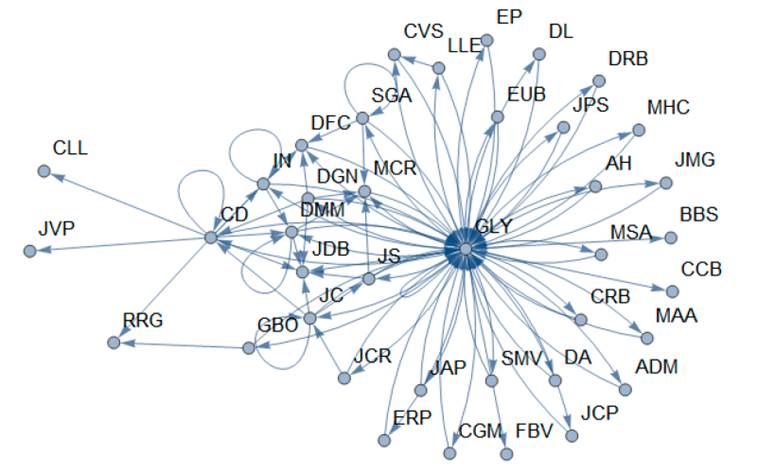
Figura 4: Grafo Curso Programación 3
En cuanto la estructura de la red, para todos los estudios de caso se aprecia una red con topología de alta heterogeneidad 21, dado que la mayoría de los nodos de cada red presenta baja conectividad y solo algunos tienen alta conectividad. Para todos los casos se observa la existencia de nodos con muy pocas conexiones, como los nodos que se encuentran en los extremos del grafo, así como nodos medianamente conectados y nodos extremadamente conectados, con mayor número de intervenciones.
En el caso de los cursos 1 y 3 se evidencia que los nodos que tienen mayor número de intervenciones corresponden al nodo de docente titular, es decir que las respuestas a modo de comentarios realizadas en el foro son en mayor medida dadas por el docente titular. No se presenta un gran porcentaje de estudiantes que participe activamente del foro a modo de colaboración para resolver inquietudes y apoyar a los compañeros, las intervenciones realizadas por los estudiantes son las establecidas por el docente de forma obligatoria. Esta estructura demuestra que los mensajes son centralizados y existe facilidad en el control de tráfico de la información que fluye en la red; sin embargo, tiene limitaciones, pues todo depende básicamente de la intervención del docente.
En el caso del curso 2, se encuentra un cambio con respecto al nodo con mayor número de intervenciones, puesto que ya no es el docente titular sino el asistente de docencia, quien se caracteriza por ser un estudiante de maestría que apoya al docente titular en el desarrollo temático de la clase. Para entender el objeto del estudio y si existe la correlación con el desempeño académico, se detalla el análisis de los grafos mostrados con anterioridad a través de las métricas establecidas y las notas finales obtenidas en cada curso.
Métrica 1: centralidad de intermediación
La centralidad de intermediación es una medida que permite identificar al actor con la posición más favorable, en la medida en que dicho actor esté situado entre los caminos más cortos de todos los demás individuos, es decir, entre más nodos necesiten pasar por este actor para hacer sus conexiones indirectas, mayor centralidad de intermediación tendrá ese actor 22. Debido a esto, pueden definirse aquellos docentes o estudiantes con una posición intermediaria en las comunicaciones entre el resto de los estudiantes.
Para obtener la centralidad de intermediación, se aplicó la función BetweennessCentrality a los datos de los tres cursos, obteniendo los vértices con centralidad de intermediación en la red, de mayor a menor y excluyendo todos los nodos que no presentan dicho índice. Para el curso 1 (Pro gramación de computadores, cohorte 2019-1, Universidad Nacional) se obtienen siete vértices, de los cuales dos son el docente principal y el asistente de docencia (ver tabla I). Para el curso 2 (Programación de computadores, cohorte 2019-2, Universidad Nacional) se obtienen 12 vértices, incluyendo el docente principal y el asistente de docencia (ver tabla II). Para el curso 3 (Programación de computadores, cohorte 2020-1, Universidad Cesmag) se obtienen seis vértices con un nodo correspondiente al docente principal (ver tabla III).
Tabla I: Centralidad de intermediación curso 1: Programación de computadores cohorte 2019-1
Identificación vértice
Nombre vértice (estudiante/docente/asistente de docencia)
Centralidad de intermediación
Nota final
34
FAG
28,5
NA
11
LER
17,5
NA
33
JMP
15,5
4,3
24
JBU
10
5
9
SLP
3
4,4
18
SP
1,5
1,4
Tabla II: Centralidad de intermediación curso 2: Programación de computadores cohorte 2019-2
Identificación vértice
Nombre vértice (estudiante/docente/asistente de docencia)
Centralidad de intermediación
Nota final
36
AC
218,929
NA
33
JGM
100,143
3
15
JOG
62,2857
4,8
23
DG
56,4524
4,7
17
OGG
40
4,6
22
CCG
18,5
5
Tabla III: Centralidad de intermediación curso 3: Programación de computadores cohorte 2020-1
Identificación vértice
Nombre vértice (estudiante/docente/asistente de docencia)
Centralidad de intermediación
Nota final
39
GLY
1109,67
NA
22
CD
80,66
4,1
33
GBO
13,83
4,1
28
JC
2,83
4,3
26
DMM
1,5
4,6
1
JS
0,5
3,6
A cada nodo obtenido se anonimiza su nombre y se establece con un nombre representativo mediante las iniciales de sus nombres y apellidos. Se le adiciona la nota final, para observar la correlación entre la centralidad de intermediación y la nota final del curso. En el caso de los nodos docente la nota es NA para no sesgar los resultados.
Realizando la comparación de la centralidad de intermediación y las calificaciones obtenidas, no se evidencia una relación directa entre ellas, puesto que se presenta bastante heterogeneidad. Se encuentran nodos que han obtenido notas menores a 4.0, por ejemplo, el nodo JGM con nota de 3.0 y con el mayor grado de intermediación para el curso 2 y SP con nota de 1.4 en el curso 1.
Se debe recordar que para medir la centralidad de intermediación se tienen en cuenta los nodos que sirven como puente para conectar extremos aislados dentro de un grafo, más no los nodos con mayor número de interacciones en la red. Sin embargo, se continúa analizando las métricas para determinar si en conjunto con las demás existe alguna relación con el desempeño académico.
También se muestra gráficamente el resultado de la centralidad de intermediación de los tres cursos, cohorte 2019-1 en la figura 5, cohorte 2019-2 en la figura 6 y cohorte 2020-1 en la figura 7, en estas se pueden apreciar los puntos rojos correspondientes a los vértices que poseen mayor poder de intermediación. En el caso del curso 1, se presenta el docente identificado con el vértice 34, puesto que cuenta con la centralidad de intermediación mayor del grupo (28.5) observada en figura 5.
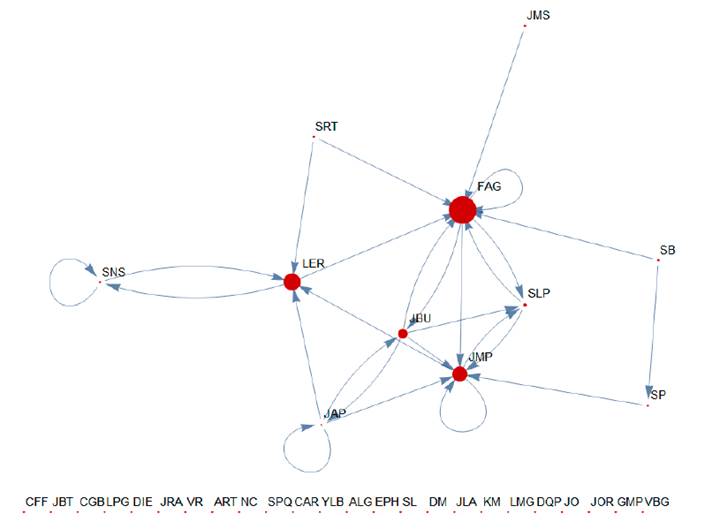
Figura 5: Grafo Centralidad intermedia Curso Programación 1
Para el curso 2 se presenta el asistente de docencia identificado con el vértice 36, puesto que cuenta con la centralidad de intermediación mayor del grupo (218.929) observada en figura 6.
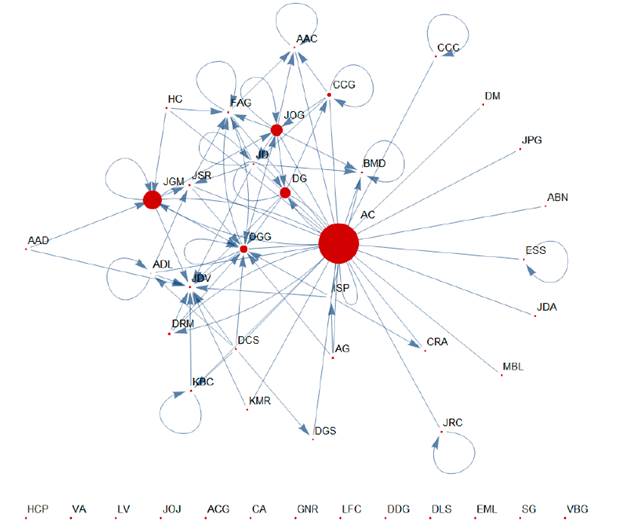
Figura 6: Grafo Centralidad intermedia Curso Programación 2
Para el curso 3 se presenta al docente principal identificado con el vértice 39, puesto que cuenta con la centralidad de intermediación mayor del grupo (1109.67) observada en figura 7.
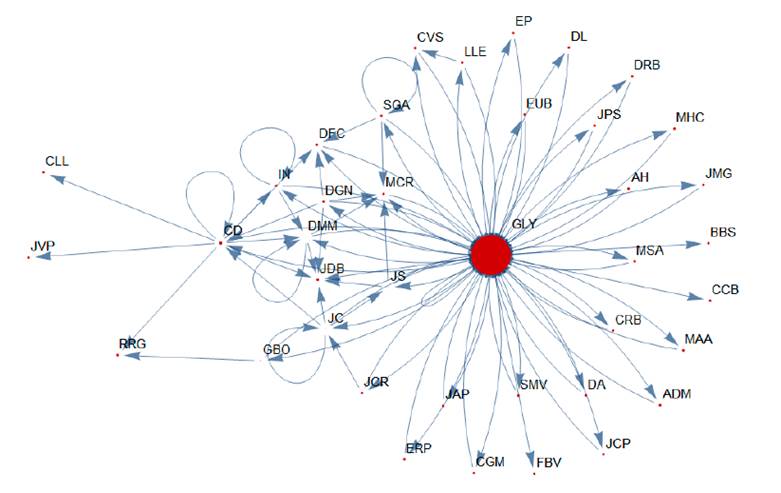
Figura 7: Grafo Centralidad intermedia Curso Programación 3
En la mayoría de los casos los docentes principales son los intermediarios en la comunicación de los cursos. Aunque en el curso 1 se evidencia que el asistente de docencia se encuentra en segundo lugar como puente de comunicación entre varios estudiantes que han asistido al mismo para resol ver las inquietudes presentes en las actividades. Por otro lado, en el curso 2 quien posee el liderazgo es el asistente de docencia no el docente principal, ya que es quien ha permitido la conexión en los nodos de extremos de la red. No existen estudiantes predominantes o que realicen intervenciones que involucren a la mayoría de los estudiantes, por lo que se pueden considerar grupos que requieren siempre de la guía del docente principal o el asistente de docencia; tampoco se evidencia una relación directa entre la intermediación y el buen desempeño académico.
En caso de que se elimine el nodo con mayor grado de intermediación correspondiente al docente principal o asistente de docencia, se podría designar a los estudiantes con la segunda mayor centralidad de intermediación como monitores o asistentes del docente y, aunque la información fluirá a la mayor parte del grupo, no se garantizaría que llegue a todos, de hecho se evidencia la desconexión o desaparición de ciertos nodos que solo se conectaban con el docente; sin embargo, los nodos que han intervenido con otros nodos aparte del docente podrían reafirmar o incluso aumentar el nivel de centralidad de intermediación. Este comportamiento confirma que las topologías de estrella suelen tener implicaciones en la red cuando el hub o nodo conector tiene problemas, en realidad no es una red de fácil recuperación y los nodos que no tienen conexión adicional con otros nodos no centrales tienden a desaparecer o desconectarse totalmente; en lo que respecta al desempeño académico, la intermediación sin el nodo principal no se afecta y continúa sin tener una relación directa con las notas.
Métrica 2: grado de centralidad
Con el grado de centralidad se pueden identificar aquellos actores con mayor cantidad de interacciones en el grupo y que tienen influencia en el mismo. Para realizar el análisis se utilizaron diferentes funciones, entre ellas Part —una función que proporciona una parte indexada de una expresión—, VertexList —devuelve la lista de vértices o nodos—, Ordering —ordena la posición en la que todos los elementos de la lista aparecen—, Greater —señala desigualdad fuerte o estricta, utilizando aproximaciones numéricas para establecer un orden numérico.
Conjuntamente estas funciones confirman el algoritmo 22, que obtiene los vértices con su respectiva centralidad de grado en la red organizada de mayor a menor índice de centralidad, se excluyen los que no presentan este índice, ya que no aportan al análisis. Se muestran los resultados obtenidos para cada curso en las tablas IV, V y VI; como en la anterior métrica, se relaciona la nota definitiva obtenida por los estudiantes en el curso.
Tabla IV: Grado de centralidad curso 1: Programación de computadores cohorte 2019-1
Identificación vértice
Nombre vértice (estudiante)
Grado de centralidad
Nota final
34
FAG
9
NA
33
JMP
7
4,3
24
JBU
6
5
11
LER
6
NA
9
SLP
5
4,4
25
JAP
4
4,8
Tabla V: Grado de centralidad curso 2: Programación de computadores cohorte 2019-2
Identificación vértice
Nombre vértice (estudiante)
Grado de centralidad
Nota final
36
AC
31
NA
17
OGG
12
4,6
4
JDV
11
NA
15
JOG
9
4,8
43
FAG
8
NA
33
JGM
8
3
Tabla VI: Grado de centralidad curso 3: Programación de computadores cohorte 2020-1
Identificación vértice
Nombre vértice (estudiante)
Grado de centralidad
Nota final
39
GLY
66
NA
22
CD
11
4,1
30
MCR
6
4,2
28
JC
6
4,3
26
DMM
6
4,6
23
JDB
6
2,4
A continuación se muestra gráficamente la centralidad de grado de cada curso: para el curso 1 figura 8, para el curso 2 figura 9 y para el curso 3 figura 10, donde los puntos rojos con mayor tamaño corresponden a los vértices que poseen mayor cantidad de conexiones, cabe mencionar que los nodos que no tienen relación o no han tenido intervención dentro de la plataforma fueron eliminados para evitar ruido en los datos analizados.
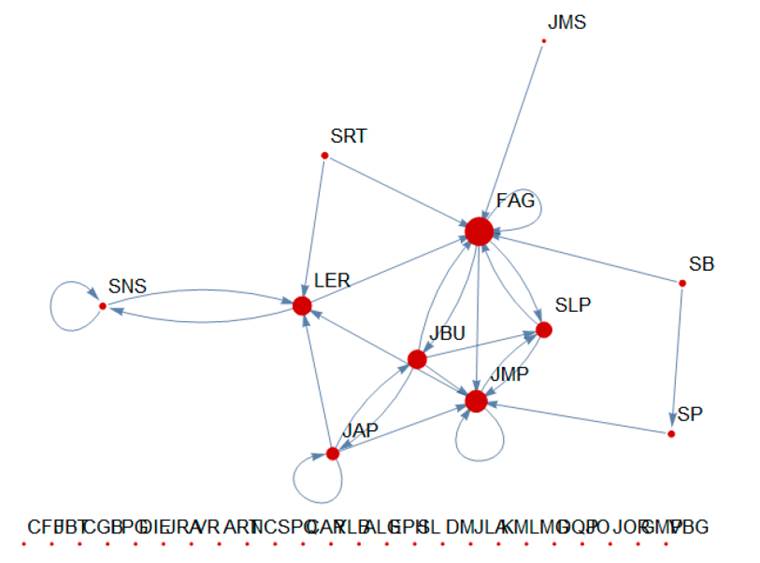
Figura 8: Grado de centralidad Curso 1
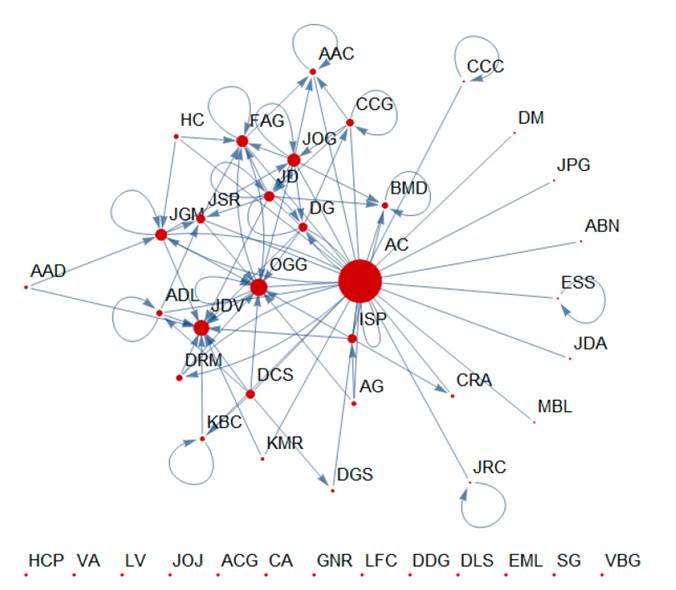
Figura 9: Grado de centralidad Curso 2
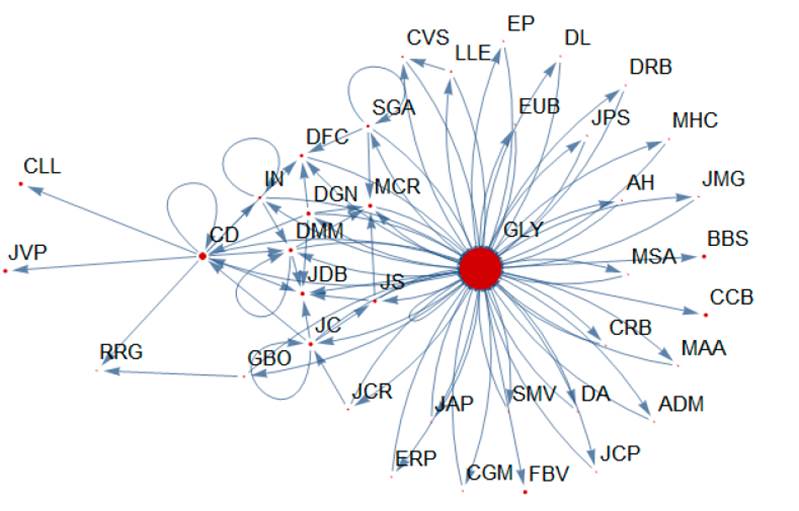
Figura 10: Grado de centralidad Curso 3
En comparación con el grupo del curso 1, se puede inferir que los cursos 2 y 3 cuentan con gran número de vértices que participan con mayor frecuencia, a través de las diferentes formas de intervención existentes en la plataforma, mientras que el curso 1 tiene menos participación. En cuanto al desempeño académico de los actores con mayor grado de centralidad en cada una de las redes, se evidencia para los tres cursos que los dos primeros actores obtienen notas superiores a 4. Para el curso 1 están: JMP y JBU con notas de 4,3 y 5, en el curso 2 están: OGG y JOG con notas de 4,6 y 4,8, y en el curso 3 están: CD y MCR con notas de 4,1 y 4,2 respectivamente.
Esta correlación entre centralidad y desempeño académico puede presentarse cuando un actor interviene más en el flujo de la información, puesto que puede enriquecer su experiencia y conocimiento al tener más oportunidad de resolver inquietudes, proponer alternativas de solución, sentirse influyente, mediático y participativo en el grupo, además de empoderarlo en su proceso de aprendizaje; como se evidencia en el estudio realizado por Antti Knutas 19, en el que se realizó un sistema de discusión para la colaboración comunicativa entre compañeros. Se concluye que las personas que consiguieron mayores interacciones en el sistema fueron los que tenían mayor probabilidad de obtener una calificación alta en el curso. Con el grado de centralidad se pueden identificar aquellos actores con mayor cantidad de interacciones en el grupo y que tienen influencia en el mismo.
Métrica 3: estructura de comunidades o grupos
Se dice que una red tiene estructura de comunidades si los nodos de la red pueden ser fácilmente agrupados en nodos, la red se divide de forma natural en grupos de nodos densamente conectados internamente y con pocas conexiones entre estos. La definición general está basada en el principio de que un par de nodos tiene mayor probabilidad de estar conectado si ambos son miembros de la(s) misma(s) comunidad(es), y menor probabilidad de estar conectado si no comparten comunidades.
En este caso se determinan las comunidades mediante una función en Mathematica, que realiza un agrupamiento según los nodos que han tenido mayores interacciones entre ellos.
La detección de comunidades tiene como objetivo la identificación de los módulos o grupos con alguna o varias propiedades en común, basándose únicamente en la información codificada en la topología del grafo 23. Para este caso se utiliza la función y el método Modularity de la herramienta para el análisis de las redes seleccionadas. La función anteriormente mencionada, permite encontrar los agrupamientos naturales de cada curso y realizarlos en base a la modularidad de cada una de las comunidades. Estas son identificadas con bordes que unen vértices de la misma comunidad.
Para mejorar la visualización del análisis se identificó a cada grupo con una etiqueta de diferente color y se correlacionó con la nota promedio de la comunidad para sustentar la propiedad que interesaba asociar con la métrica correspondiente al desempeño académico.
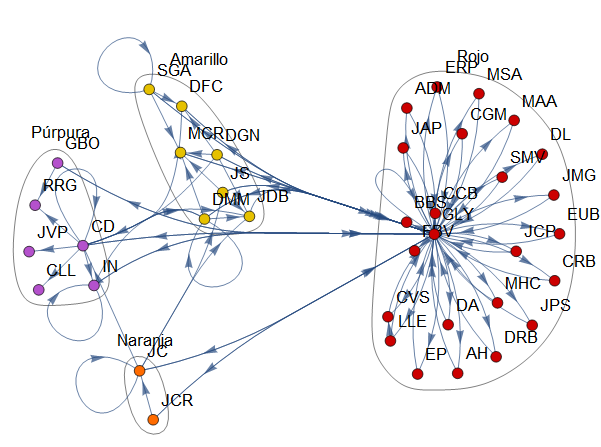
Curso 1: Programación de computadores 2019-1. En la imagen obtenida por la función (figura 11) se evidencia que existen cuatro comunidades establecidas, las cuales han sido identificadas con la etiqueta “rojo” que cuenta con cuatro vértices asociados, incluido el docente, con “amarillo” que cuenta con tres vértices asociados, con “púrpura” y “naranja” que cuentan solo con dos vértices asociados cada uno. Los estudiantes que no realizaron ninguna interacción no se encuentran incluidos en ningún grupo.
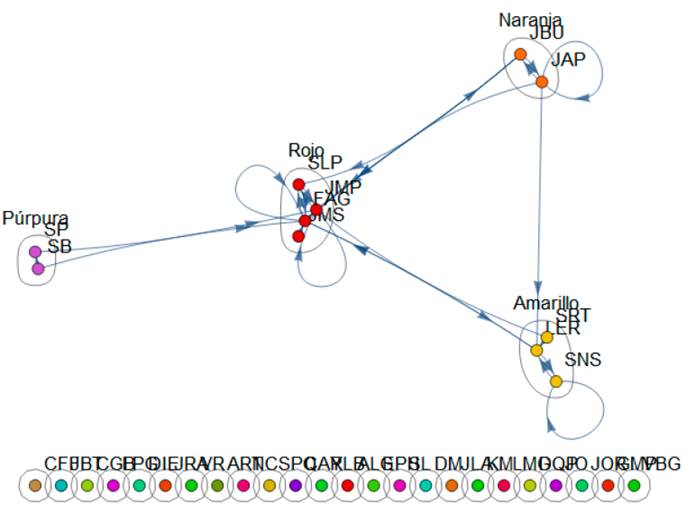
Figura 11: Grafo Grupos o comunidades Curso 1
Para cada una de las comunidades asociadas, se realiza un promedio correspondiente a los integrantes de cada grupo, esto con el fin de contrastar la información con los actores que se encuentran dentro de las comunidades y la influencia que tienen. Se tienen en cuentan las métricas anteriores para determinar si en las comunidades obtenidas se encuentran los nodos con mayor grado de centralidad e intermediación, con el fin de determinar si esto influye en el desempeño académico de los actores que conforman cada comunidad.
Los vértices correspondientes a la comunidad “rojo” son quienes han tenido intervenciones o conexiones directamente con el nodo con mayor grado de centralidad e intermediación en las métricas antes descritas, los estudiantes pertenecientes a esta comunidad cuentan con un buen promedio (4,5), poseen cuatro nodos conformando la agrupación. La comunidad “naranja” tiene el mejor promedio de toda la red (4,9) y solo posee dos nodos, estos nodos, aunque tienen homogeneidad en la calificación y grado de centralidad, son totalmente heterogéneos.
Para las comunidades “amarilla” y “púrpura” la relación con las notas obtenidas para ambos casos en el promedio de calificación es de 3,6 y 3,2 respectivamente, además se encuentran notas bastante heterogéneas en estas comunidades. Por lo tanto, se podría concluir que cada comunidad establecida tiene una relación indirecta con el desempeño académico para el caso de este curso, aunque si es importante resaltar que la comunidad “rojo”, conformada por estudiantes y el docente principal, cuenta con notas en el rango de 4,3 a 4,9. Al ser pocos nodos cuentan con una relación más estrecha y bidireccional con el docente.
En general, se podría determinar que el curso cuenta con pocos estudiantes con buen desempeño, pero el desempeño académico global no es sobresaliente, esto se puede evidenciar en la poca participación de los estudiantes en el curso.
Curso 2: Programación de computadores 2019-2. Como se aprecia en la figura 12, existen cinco comunidades establecidas, las cuales han sido identificadas como: “rojo” que cuenta con diez vértices asociados, “amarillo” que cuenta con nueve vértices asociados, “púrpura” que cuenta con seis vértices asociados, “naranja” que cuenta con tres vértices asociados y “verde” que cuenta con tres vértices asociados, en esa última incluido el docente del curso. Los estudiantes que no realizaron ninguna interacción no se encuentran incluidos en ningún grupo.
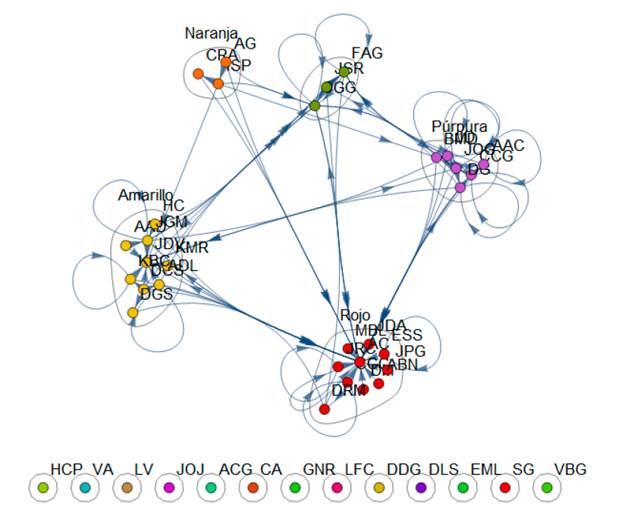
Figura 12: Grafo Grupos o comunidades Curso 2
Los vértices correspondientes al grupo “verde”, en el que se encuentra el docente, obtuvieron notas en promedio de 4,5 y corresponden al grupo más pequeño conformado por solo tres nodos.
El grupo “naranja” obtuvo notas en promedio de 3,9 también con tres nodos. En el grupo “rojo” obtuvieron notas aleatorias, pero ninguno perdió el curso, en este grupo se encuentra incluido el asistente de docencia.
En el grupo “amarillo” el 40 % del grupo perdió el curso, aunque el promedio obtenido fue de 3,2. Y finalmente, en el grupo “púrpura” un 83 % tiene notas superiores a 4,7, convirtiéndose en el grupo con mejor rendimiento académico, según el promedio obtenido por las calificaciones de los actores que conforman cada comunidad.
Curso 3: Programación de computadores 2020-1. Como se aprecia en la figura 13, existen cuatro comunidades establecidas, las cuales han sido identificadas como “rojo” con la mayor cantidad de nodos para un total de 24, “amarillo” que cuenta con siete vértices asociados, “púrpura” que cuenta con seis vértices asociados y “naranja” que cuenta con dos vértices asociados.
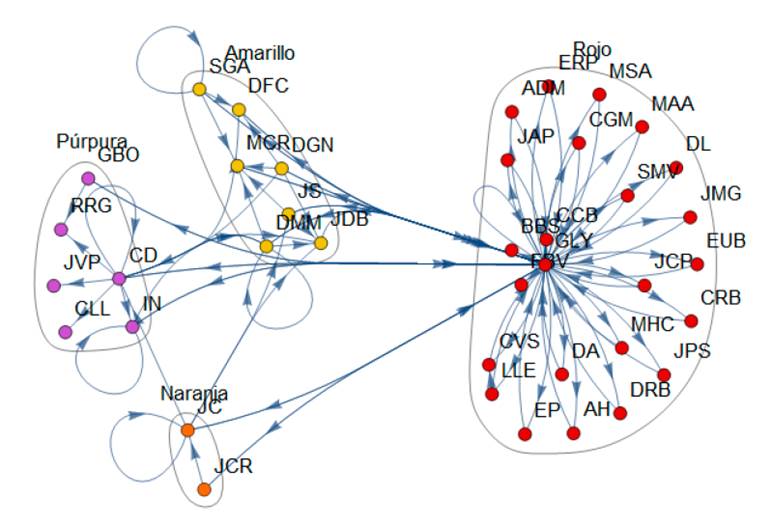
Figura 13: Grafo Grupos o comunidades Curso 3
Los vértices correspondientes al grupo “rojo”, en el que se encuentra el docente, obtuvieron notas heterogéneas, puesto que se encuentran en el rango de 1,8 a 5; también se debe considerar que el grupo cuenta con un promedio de 4,1 y que corresponde a la comunidad más grande, con 62 % de actores de la red; además, se puede inferir que esta comunidad tiene un desempeño académico sobresaliente, lo que puede mejorar no solo la dinámica del curso sino incentivar a la mejora en el desempeño académico en general al ser mayoría.
La comunidad “amarillo” cuenta con siete nodos con un promedio de 3,9, en los cuales se encuentra el nodo 18 correspondiente al estudiante DGN, quien obtuvo el mejor desempeño académicoal obtener 5 como nota definitiva del curso y mayor nota en esta comunidad, cabe resaltar que el estudiante realizó varias intervenciones en la plataforma virtual. Se podría inferir que el estudiante cuenta con participación y posee liderazgo dentro del grupo, dado que en el transcurso de la carrera ha sido la representante estudiantil del semestre.
Para la comunidad “naranja” se cuenta con solo dos nodos con un promedio de 3,7, es importante resaltar que en esta comunidad se encuentra el nodo 28 correspondiente al estudiante JC, quien cuenta con una participación aceptable dentro de la plataforma, además de destacar que cuenta con un desempeño académico de 4,3, en este caso para los estudiantes mencionados se encuentra correlación entre el desempeño académico y su participación, así como también su liderazgo en la plataforma.
Por último, para la comunidad “púrpura” se cuenta con seis nodos con un promedio de 4,4, el cual sería el mayor promedio de todas las comunidades. En esta comunidad se encuentra el nodo 22 correspondiente al estudiante CD, quien no obtiene el mejor desempeño académico de la comunidad, pero presenta el mayor número de intervenciones dentro de la red. Se puede afirmar que el estudiante cuenta con credibilidad, participación y podría sin lugar a duda apoyar al docente en caso de que no pudiera estar, además, es necesario mencionar que el estudiante fue representante estudiantil del programa de Ingeniería de Sistemas de la Universidad Cesmag.
Es importante mencionar que en este caso práctico cada uno de los nodos que componen la red se considera un actor interdependiente con características propias y que esa interdependencia podría determinar el tipo de relaciones que establece con los demás actores de la red 24. Cada nodo o actor esta voluntariamente relacionado con otros al establecer algún tipo de interacción. Cada relación existente entre los actores representa no solo la interacción entre los estudiantes en el aula o en la plataforma, sino que determina los caminos por donde puede fluir la información del curso, o la trasferencia del conocimiento y las experiencias individuales, lo que contribuye a que el vínculo pueda trascender de una relación casual en el aula a una relación duradera fuera de ella.
De acuerdo con 8, se deben resaltar las habilidades sociales, de comunicación y de influencia del docente del curso, así como la capacidad de adaptación del curso frente a los diferentes tipos de estudiantes, puesto que en los cursos analizados en este estudio es evidente que el docente es considerado el actor principal de la red; sin embargo, pueden presentarse otros actores con mayor influencia. Por ejemplo, el análisis de grado de centralidad de intermediación para la red del curso 2 permitió determinar que no siempre el docente es el principal mediador, sino que también pueden presentarse otro tipo de actores como intermediarios del grupo, en este caso se determina que es independiente el rol establecido dentro de la red. Esto sugiere que otros actores como el docente asistente o estudiantes pueden tener una importante influencia en la dinámica en el curso, al ser poseedores del liderazgo e influir en los flujos de comunicación.
En consecuencia, la aplicación de estas métricas podría ayudar a desentrañar características específicas en otras redes académicas, ya que a través de la herramienta Mathematica se han obtenido grafos cuyo análisis permite discernir la presencia del rol docente, así como también actores activos y pasivos dentro de la red. Lo que deja en claro que, aunque puedan tener características comunes como rangos de edad, intereses en programación o formación en lógica matemática, presentan como grupo características heterogéneas, como el hecho de que haya estudiantes populares, activos y con gran interés en participar y estudiantes tímidos, pasivos o con poco interés en relacionarse o participar, quizás de pocas habilidades sociales o de comunicación. Teniendo en cuenta esto, es importante incluir el factor del desempeño académico, en el que se observa que en algunos casos los estudiantes que tienen buen desempeño académico también cuentan con alta centralidad de intermediación y grado de centralidad, es decir son estudiantes activos que cuentan con liderazgo e influencia dentro del grupo y control en los flujos de comunicación.
Por otro lado, no se puede inferir con total certeza que las interacciones provocan una relación de amistad entre dos o más actores, o como se conoce normalmente como una relación afectiva interpersonal común entre personas. Si es un primer paso de acercamiento que puede aumentar la probabilidad de que eso suceda y se establezca una relación determinada; se debe tener una riqueza de escenarios adicionales en los que se nos permitiera comparar o analizar dichos vínculos, esto podría hacer parte del trabajo futuro. Así como también se podría realizar un análisis de los aspectos más específicos de los estudiantes pasivos para determinar cuáles agentes de motivación común pueden influir, como estilos de aprendizaje o intereses, objetivos, expectativas del curso e incluso rasgos de personalidad común, para de esta manera incluir diferentes ideas en la planeación del contenido del curso que capturen el interés de todos los estudiantes, mejorando el desempeño académico y tratando de conseguir homogeneidad en el mismo.
Validez de la información
Hay muchos factores que influyen en la validez de la información recolectada y extraída de la plataforma, como por ejemplo las estadísticas básicas suministradas que solo contaban con información referente a los usuarios con mayor participación en los foros de trabajo, a través de una gráfica de líneas o área; adicionalmente se presentaron inconvenientes para procesar la interacción entre nodos con el código alfanumérico generado por la plataforma, por tal motivo en el programa desarrollado en Python se estableció generar un identificador numérico para cada usuario y posteriormente usarlo para representar las interacciones de los usuarios. De esta manera fue posible procesar el archivo en Mathematica. La información fue validada por cada uno de los autores, con el fin de verificar los datos generados por la plataforma.
Conclusiones
En vista de que existen muchas redes en la naturaleza y es necesario aplicar un método de evaluación para las mismas, se presenta el análisis de redes sociales (ARS), que permite realizar un estudio de la estructura social de una red a través de un método cuantitativo. Este caracteriza fenómenos sociales, a partir de las relaciones establecidas entre las entidades sociales identificadas como personas, grupos u organizaciones. Para ello se cuenta con un conjunto de herramientas, métricas y características que facilitan el ARS en diferentes terrenos como la salud, la georreferenciación, las redes sociales y la educación, como es este caso. Estas herramientas y este tipo de análisis deben tenerse en cuenta para definir qué métricas son las adecuadas para el estudio y qué herramientas y funciones se utilizarán
En este caso práctico, mediante el análisis de métricas y patrones de interacción, se presentó un cambio entre los cursos de programación analizados, ya que en el primero no se evidencia gran participación por parte de los estudiantes y, por lo tanto, el vértice central es el docente del curso. Para el segundo curso se evidencia mayor participación por parte de los estudiantes, se observa que el vértice central es el docente asistente. La comunidad con mayor cantidad de participantes es la del docente asistente. Y finalmente, para el tercer curso se evidencia una total participación por parte de los estudiantes, unos con más participaciones que otros, pero con gran influencia de estudiantes del curso que presentan centralidad de intermediación y centralidad de grado alta, después del docente, que para este caso es el vértice principal de la red.
Las métricas establecidas para evaluar las redes sociales obtenidas de la plataforma Piazza permiten a los docentes determinar la participación e interacción entre los estudiantes, mediante la publicación de notas, foros de discusión y cuestionarios en la plataforma, identificando diferentes patrones de interacción como quiénes son los estudiantes que poseen el liderazgo en el grupo, quiénes revisten de influencia dentro del mismo, lazos débiles o fuertes que puedan presentarse entre estudiantes y esto con el fin de determinar la presencia de grupos o comunidades dentro del aula, así como también determinar si la construcción de estos vínculos sociales se encuentra relacionada con el desempeño académico de los estudiantes. En la métrica 1 se pudo establecer que no hay correlación entre las calificaciones obtenidas y la centralidad de intermediación, pero sí se presentó relación entre los actores que realizaron mayor número de intervenciones en la red y la calificación obtenida, así como también estos actores son el centro de la comunidad (métrica 2 y 3).
Cabe resaltar que en el presente estudio se realizó un especial énfasis en el análisis de cada uno de los nodos que conforman las comunidades, para establecer si los estudiantes con mayor participación dentro de la plataforma influían de alguna manera dentro de los grupos. Para corroborar esta información, se obtuvo el promedio de calificación por comunidad y se verificó la nota del estudiante influyente, determinando que en algunos casos el participante tenía mayor intervención dentro de la comunidad y presentaba una influencia positiva en el desempeño del grupo.
Comparando los estudios de caso se puede afirmar que los foros de discusión fomentan la participación de los estudiantes, pero aún no hay seguridad en apoyar a los compañeros que tienen una consulta dentro de la plataforma, lo que puede presentarse por temor a equivocarse o por el simple hecho de no participar de la actividad. Para trabajos futuros es necesario establecer incentivos para la participación y la generación de discusión en los foros académicos.
Por otro lado, como trabajo futuro es posible analizar la probabilidad de que se establezca una relación de amistad a partir de las interacciones de dos o más nodos de una red, puesto que es necesario incorporar información de otros escenarios que permitan la comparación de los vínculos. De la misma manera, se podrían analizar más a fondo los resultados obtenidos con las redes heterogéneas, aplicando a redes más grandes que cuenten con mayor cantidad de nodos y relaciones entre los mismos, como también la aplicación de otras métricas como clasificación por clustering, centralidad de proximidad, autoridad, participación, entre otras.
Referencias
Licencia
Derechos de autor 2022 Ginna Viviana Leytón Yela, Astrid Johana Valencia, Victor Andrés Bucheli Guerrero

Esta obra está bajo una licencia internacional Creative Commons Atribución-NoComercial-CompartirIgual 4.0.

A partir de la edición del V23N3 del año 2018 hacia adelante, se cambia la Licencia Creative Commons “Atribución—No Comercial – Sin Obra Derivada” a la siguiente:
Atribución - No Comercial – Compartir igual: esta licencia permite a otros distribuir, remezclar, retocar, y crear a partir de tu obra de modo no comercial, siempre y cuando te den crédito y licencien sus nuevas creaciones bajo las mismas condiciones.

2.jpg)