DOI:
https://doi.org/10.14483/22487085.23179Published:
2026-03-16Issue:
Vol. 28 No. 1 (2026): CALJ: january-juneSection:
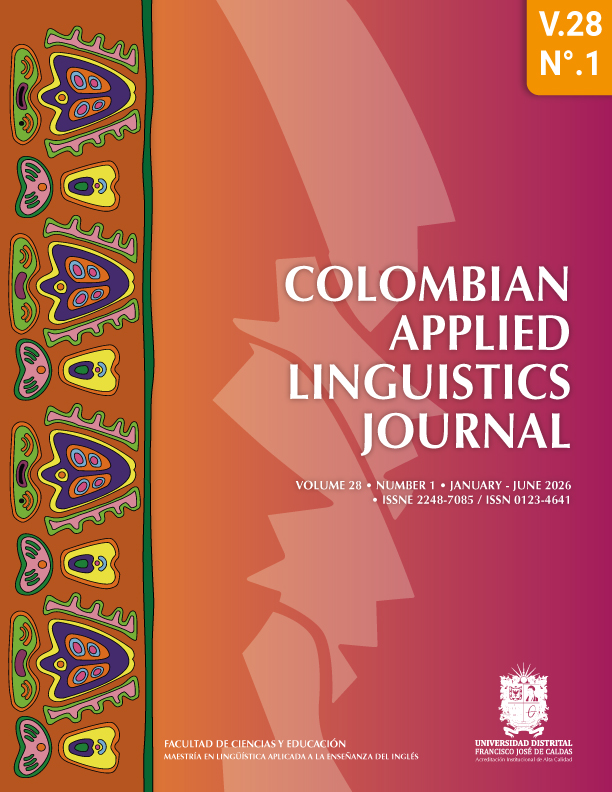
Research ArticlesExploring Teacher’s Cognition and Practices of Testing Speaking in Colombian Universities
Explorando la cognición y las prácticas para evaluar la habilidad de habla de los docentes en las universidades colombianas
Keywords:
Experiences, Language Testing, Speaking, Opinions, Knowledge (en).Keywords:
conocimientos, experiencias, habilidad de habla, opiniones, prueba (es).Downloads
Abstract (en)
This study examines Colombian English teachers’ knowledge, experiences, and views regarding speaking assessments. Semi-structured interviews were conducted with Colombian teachers, some of whom also shared classroom assessment samples. Thematic analysis was used for the interviews, and content analysis was applied to the assessment materials. Findings revealed a clear link between teachers’ perceptions of testing and their approach to presenting it to students. Furthermore, a correlation exists between their knowledge and experience in designing, administering, and evaluating speaking tests. Lastly, there is evidence of teachers’ awareness of the issues surrounding these testing practices. The shared concern about the effectiveness of current practices, along with the expressed need for further training, underscore the importance of developing targeted professional development programs to better prepare teachers in this area.
Abstract (es)
Este estudio examina los conocimientos, experiencias y percepciones de los docentes colombianos de inglés en relación con la evaluación de la habilidad de habla. Se llevaron a cabo entrevistas semiestructuradas con profesores colombianos, algunos de los cuales también compartieron muestras de evaluaciones utilizadas en el aula. Para el análisis de las entrevistas, se empleó un análisis temático, mientras que las muestras de evaluación se examinaron mediante el análisis de contenido. Los hallazgos revelaron una relación clara entre las percepciones de los docentes sobre la evaluación y la manera en que la presentan a los estudiantes. Así mismo, se identificó una correlación entre sus conocimientos y experiencias en el diseño, aplicación y evaluación de pruebas orales. Finalmente, se evidenció que los docentes eran conscientes respecto a los desafíos asociados con estas prácticas evaluativas. La preocupación compartida sobre la efectividad de las prácticas actuales, junto con la necesidad expresada de recibir mayor formación, subrayan la importancia de desarrollar programas de desarrollo profesional específicos que fortalezcan las competencias docentes en esta área.
References
Attride-Stirling, J. (2001). Thematic networks: An analytic tool for qualitative research. Qualitative Research, 1(3), 385-405. https://doi.org/10.1177/146879410100100307
Bachman, L. F., & Palmer, A. S. (1996). Language testing in practice: Designing and developing useful language tests. Oxford University Press.
Borg, M. (2001). Key concepts in ELT: Teachers’ beliefs. ELT Journal, 55(2), 186-188. https://doi.org/10.1093/elt/55.2.186
Brown, G. T. L. (2004). Teachers’ conceptions of assessment: Implications for policy and professional development. Assessment in Education: Principles, Policy & Practice, 11(3), 301-318. https://doi.org/10.1080/0969594042000304601
Brown, H. D. (2014). Principles of language learning and teaching (6th ed.). Pearson Education.
Calderhead, J. (1996). Teachers’ beliefs and knowledge. In R. C. Calfee & D. C. Berliner (Eds.), Handbook of educational psychology (pp. 709-725). Routledge.
Cheng, L., Rogers, T., & Hu, H. (2004). ESL/EFL instructors’ classroom assessment practices: Purposes, methods, and procedures. Language Testing, 21(3), 360-389. https://doi.org/10.1191/0265532204lt268oa
Childs, R. A., & Lawson, A. (2003). What do teacher candidates know about large-scale assessments? What should they know? Alberta Journal of Educational Research, 49(4), 341-350.
Cizek GJ, Fitzgerald SM, Rachor RE (1995/6) Prácticas de evaluación de los docentes: preparación, aislamiento y el fregadero de la cocina. Educational Assessment 3: 159–179.
Clark, C., & Peterson, P. (1986). Teachers’ thought processes. In M. C. Wittrock (Ed.), Handbook of research on teaching (pp.255-296). Macmillan; Collier-Macmillan.
Claudio Díaz Larenas, P., Alarcón Hernández, P., & Mabel, O. N. (2012). The English teacher: His beliefs about English language assessment at primary, secondary, and tertiary levels. Ikala: Revista de Lenguaje y Cultura, 17(1), 15-26. https://doi.org/10.17533/udea.ikala.10039
Devrim Höl. (2018). Current problems and proposed solutions for testing speaking: Opinions of EFL teachers. Literacy Trek, 4(1), 27-36. https://doi.org/10.29081/lt.2018.4.1.27
Dörnyei, Z. (2007). Research methods in applied linguistics: Quantitative, qualitative, and mixed methodologies. Oxford University Press.
East, M. (2015). Coming to terms with innovative high-stakes assessment practice: Teachers’ viewpoints on assessment reform. Language Testing, 32(1), 101-120. https://doi.org/10.1177/0265532214556410
Farrell, T. S. (2012). Reflecting on reflective practice: (Re) visiting Dewey and Schön. TESOL Journal, 3(1), 7-16. https://doi.org/10.1002/tesj.13
Fulcher, G. (2003). Testing second language speaking. Pearson Longman.
Heigham, J., & Croker, R. A. (2009). Qualitative research in applied linguistics: A practical introduction. Palgrave Macmillan. https://doi.org/10.1057/9780230239517
Hughes, A. (2003). Testing for language teachers (2nd ed.). Cambridge University Press.
Johnson, M., Mehta, S., & Rushton, N. (2015). Assessment, aim, and actuality: Insights from teachers in England about the validity of a new language assessment model. Pedagogies: An International Journal, 10(2), 1-21. https://doi.org/10.1080/1554480X.2015.1018397
Kahn, E. A. (2000). A case study of assessment in a grade 10 English course. The Journal of Educational Research, 93(5), 276-286. https://doi.org/10.1080/00220670009598759
Leighton, J. P., Gokiert, R. J., Cor, M. K., & Heffernan, C. (2010). Teacher beliefs about the cognitive diagnostic information of classroom versus large-scale tests: Implications for assessment literacy. Assessment in Education: Principles, Policy & Practice, 17(1), 7-21. https://doi.org/10.1080/09695940903526880
López Mendoza, A. A., & Bernal Arandia, R. (2009). Language testing in Colombia: A call for more teacher education and teacher training in language assessment. Profile: Issues in Teachers’ Professional Development, 11(2), 55-66.
Luoma, S. (2004). Assessing speaking. Cambridge University Press. https://doi.org/10.1017/CBO9780511733017
McNamara, T. F. (2000). Language testing. Oxford University Press.
Messick, S. (1996). Validity and washback in language testing. Language Testing, 13(3), 241-256. https://doi.org/10.1177/026553229601300302
Muñoz, A. P., Palacio, M., & Escobar, L. (2012). Teachers’ beliefs about assessment in an EFL context in Colombia. Profile: Issues in Teachers’ Professional Development, 14(1), 143-158.
Ministerio de Educación Nacional (2006). Estándares Básicos de Competencias en Lenguaje, Matemáticas, Ciencias y Ciudadanas. Guía sobre lo que los estudiantes deben saber y saber hacer con lo que aprenden. Bogotá: MEN.
Numrich, C. (1996). On becoming a language teacher: Insights from diary studies. TESOL Quarterly, 30(1), 131-153. https://doi.org/10.2307/3587685
Pajares, M. F. (1992). Teachers’ beliefs and educational research: Cleaning up a messy construct. Review of Educational Research, 62(3), 307-332. https://doi.org/10.3102/00346543162003307
Palacio, M., Gaviria, S., & Brown, J. D. (2016). Aligning English language testing with curriculum. Profile: Issues in Teachers’ Professional Development, 18(2), 63-74. https://doi.org/10.15446/profile.v18n2.53302
Pica, T., Kanagy, R., & Falodun, J. (1993). Choosing and using communication tasks for second language instruction and research. In G. G. Crookes & S. M. (Eds.), Tasks and language learning: Integrating theory and practice (pp. 9-34). Multilingual Matters.
Reynolds, C. R. (2010). Measurement and assessment in education (2nd ed.). Pearson Education International.
Shohamy, E. (2001). The power of tests: A critical perspective on the uses of language tests. Longman.
Taylor, L. (2011). Examining speaking: Research and practice in assessing second language speaking. Cambridge University Press.
Thompson, A. (2006). Teachers’ beliefs and conceptions: A synthesis of the research. In D. Grouws (Ed.), Handbook of research on mathematics teaching and learning (pp. 127-146). IAP. https://doi.org/10.1108/9781-60752-874-620251010
Toro, C. I. A., & Patarroyo, L. M. M. (2005). Evaluación en lenguas extranjeras: Discursos y prácticas. Ikala, 10(1), 63-91. https://doi.org/10.17533/udea.ikala.v10n1a06
Richards, J. C. (2003). Curriculum development in language teaching. Cambridge University Press.
Schreier, M. (2012). Qualitative content analysis in practice. SAGE Publications. https://doi.org/10.4135/9781529682571
White, H. P., & Marsh, E. (2006). Content analysis: A flexible methodology. SAGE Publications. https://doi.org/10.1353/lib.2006.0053
How to Cite
APA
ACM
ACS
ABNT
Chicago
Harvard
IEEE
MLA
Turabian
Vancouver
Download Citation
Metrics
License
Copyright (c) 2026 Lorena Idarraga Robayo

This work is licensed under a Creative Commons Attribution-NonCommercial-NoDerivatives 4.0 International License.

This work is licensed under a Creative Commons Attribution-NonCommercial-NoDerivatives 4.0 International License.
Attribution — You must give appropriate credit, provide a link to the license, and indicate if changes were made. You may do so in any reasonable manner, but not in any way that suggests the licensor endorses you or your use.
NonCommercial — You may not use the material for commercial purposes.
NoDerivatives — If you remix, transform, or build upon the material, you may not distribute the modified material.
The journal allow the author(s) to hold the copyright without restrictions. Also, The Colombian Apllied Linguistics Journal will allow the author(s) to retain publishing rights without restrictions.