DOI:
https://doi.org/10.14483/23448393.24176Published:
2026-09-25Issue:
Vol. 31 No. 2 (2026): May-AugustSection:
Electrical, Electronic and Telecommunications EngineeringInventory Localization in Agriculture, a Swarm Intelligence Approach
Localización de inventario en agricultura, un enfoque de inteligencia de enjambre
Keywords:
BeeClust, Clustering algorithm, Swarm intelligence, Inventory localization (en).Keywords:
BeeClust, algoritmo de agrupamiento, inteligencia de enjambre, localización de inventario (es).Downloads
Abstract (en)
Context. Locating lost inventory is a key challenge in agricultural logistics, as traditional tracking systems such as radio-frequency identification (RFID) and barcodes remain costly and infrastructure-dependent. Swarm robotics offers a decentralized alternative, and the BeeClust algorithm enables robots to self-organize around environmental stimuli without direct communication. This study validates a BeeClust-inspired approach for inventory localization in a warehouse-like maze.
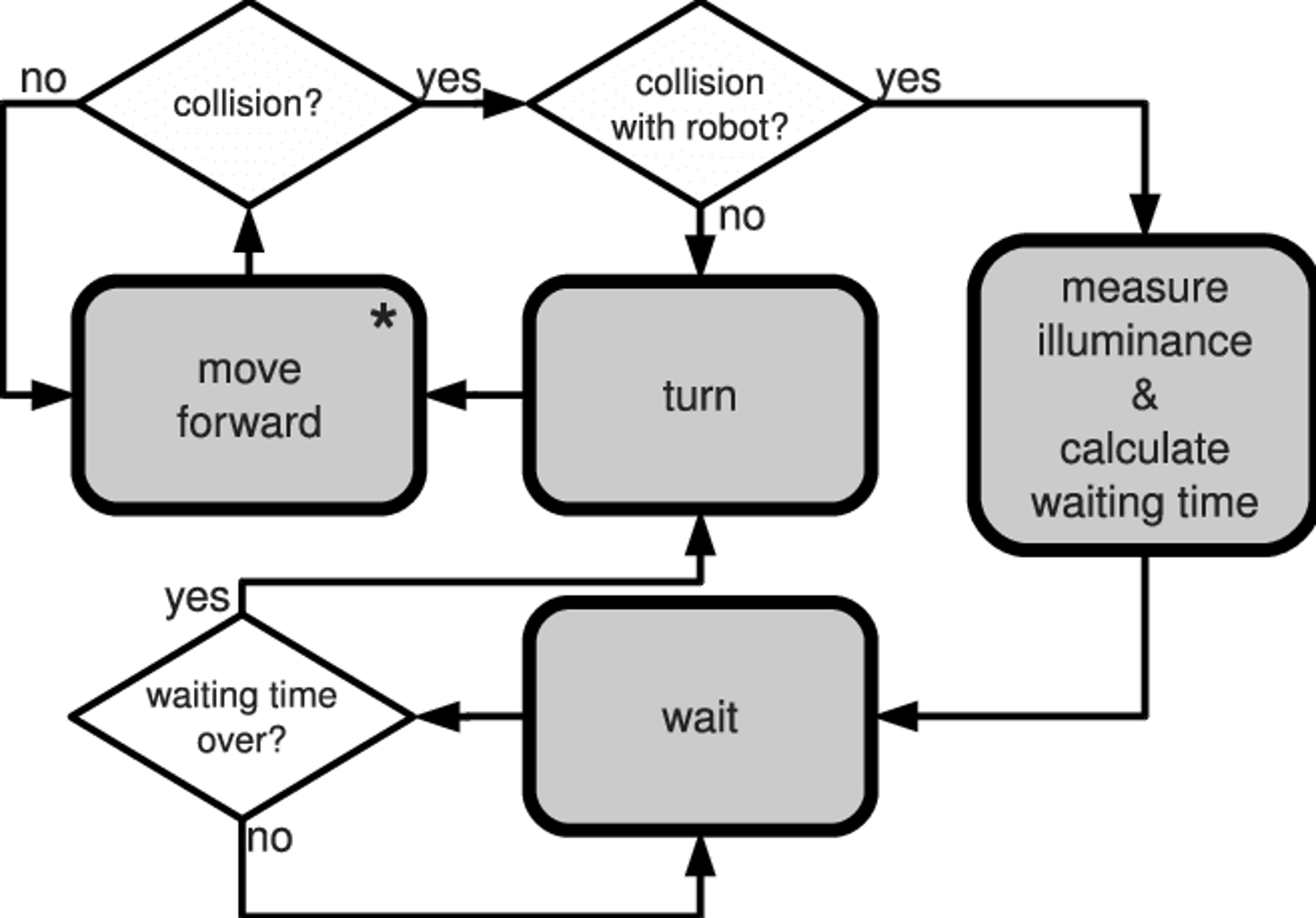
Method. Formula AllCode robots equipped with light and distance sensors were programmed with an adapted BeeClust finite state machine including forward, rotation, and waiting states. Experiments evaluated the effects of workspace size, light source size, and light source position on clustering performance. Detection accuracy was also tested under different orientations and distances.
Results. Larger light sources accelerated clustering but produced dispersed formations, while smaller sources promoted compact clusters at the cost of longer convergence times. Mid-sized arenas yielded faster and more consistent aggregation than very small or very large spaces. The system achieved 96.67% accuracy in robot detection, while obstacle recognition was identified as an aspect requiring further improvement.
Conclusions. The findings confirm the feasibility of BeeClust-based swarm robotics for inventory localization in structured environments and provide experimental evidence that support future work on swarm scalability, enhanced perception, and validation in real agricultural facilities.
Abstract (es)
Contexto. La localización de inventario perdido es un reto en la logística agrícola, ya que los sistemas de identificación por radiofrecuencia y códigos de barras dependen de infraestructura y generan altos costos. La robótica de enjambre ofrece una alternativa descentralizada, y el algoritmo BeeClust permite que los robots se agrupen en torno a estímulos ambientales sin comunicación directa. Este estudio valida un enfoque inspirado en BeeClust para la localización de inventario en un entorno tipo almacén.
Método. Se emplearon robots Formula AllCode con sensores de luz y distancia, programados con una máquina de estados finitos adaptada de BeeClust que comprendía los estados de avance, rotación y espera). Los experimentos evaluaron el efecto del tamaño y la posición de la fuente de luz y del espacio de trabajo sobre la agrupación. También se midió la precisión en la detección de robots y obstáculos en distintas orientaciones.
Resultados. Las fuentes grandes aceleraron la formación de clústeres pero produjeron agrupaciones más dispersas, mientras que las pequeñas favorecieron clústeres compactos con mayor tiempo de convergencia. Los espacios intermedios mostraron mayor rapidez y consistencia que las áreas muy pequeñas o muy grandes. El sistema alcanzó un 96.67% de precisión en la detección de robots, y el reconocimiento de obstáculos se identifica como un aspecto a mejorar.
Conclusiones. Los hallazgos confirman la viabilidad de un enfoque basado en BeeClust para la localización de inventario en entornos estructurados y aportan evidencia experimental que contribuye a cerrar la brecha entre simulaciones y pruebas reales, abriendo camino a investigaciones sobre escalabilidad y validación en instalaciones agrícolas.
References
[1] S. K. Chaharsooghi and H. Yadegari, “Developing a two-echelon inventory model with simultaneous consideration of backorders and lost sales,” in 2013 IEEE International Conference on Industrial Engineering and Engineering Management, IEEE, Dec. 2013, pp. 940–947. https://doi.org/10.1109/IEEM.2013.6962550
[2] E. T. Ruíz-Orjuela, G. Gatica-González, and W. Adarme-Jaimes, “Revisión de literatura con análisis bibliométrico de la cadena de suministro hospitalaria,” Ingeniería, vol. 28, no. Suppl, p. e18987, Feb. 2023. https://doi.org/10.14483/23448393.18987
[3] A. A. Ali, R. A. Rashid, N. M. Abdikadir, A. A. Mohamed, and M. M. Ahmed, “IoT Based Warehouse Management System Leveraging On RFID and Cloud Platform Technologies,” in 2024 IEEE International Conference on Advanced Telecommunication and Networking Technologies (ATNT), IEEE, Sep. 2024, pp. 1–4. https://doi.org/10.1109/ATNT61688.2024.10719252
[4] V. Casamayor-Pujol, M. Morenza-Cinos, B. Gastón, and R. Pous, “Autonomous stock counting based on a stigmergic algorithm for multi-robot systems,” Comput. Ind., vol. 122, p. 103259, Nov. 2020. https://doi.org/10.1016/j.compind.2020.103259
[5] Z. Chen, H. Wang, M. Zhou, J. Zhu, J. Chen, and B. Li, “Design and Experiment of an Autonomous Navigation System for a Cattle Barn Feed-Pushing Robot Based on UWB Positioning,” Agriculture, vol. 14, no. 5, p. 694, Apr. 2024. https://doi.org/10.3390/agriculture14050694
[6] M. Nowakowski, J. Kurylo, and P. Dabrowski, “Object tracking based follow me for optionally Unmanned Ground Vehicles,” Def. Sci. J., vol. 75, no. 2, pp. 199–205, Mar. 2025. https://doi.org/10.14429/dsj.20331
[7] M. K. Heinrich, M. D. Soorati, T. K. Kaiser, M. Wahby, and H. Hamann, “Swarm robotics: Robustness, scalability, and self-X features in industrial applications,” it - Information Technology, vol. 61, no. 4, pp. 159–167, Aug. 2019. https://doi.org/10.1515/itit-2019-0003
[8] M. Vogrin, M. Stefanec, and T. Schmickl, “Social Distancing in Robot Swarms: Modulating Exploitation and Exploration Without Signal Exchange,” in 2020 IEEE Symposium Series on Computational Intelligence (SSCI), IEEE, Dec. 2020, pp. 2233–2240. https://doi.org/10.1109/SSCI47803.2020.9308502
[9] M. Bodi, R. Thenius, M. Szopek, T. Schmickl, and K. Crailsheim, “Interaction of robot swarms using the honeybee-inspired control algorithm BEECLUST,” Math. Comput. Model. Dyn. Syst., vol. 18, no. 1, pp. 87–100, Feb. 2012. https://doi.org/10.1080/13873954.2011.601420
[10] A. Hafid, R. Hocine, and L. Guezouli, “Analyzing Swarm Robotics Approaches in Natural Disaster Scenarios: A Comparative Study,” in 2024 1st International Conference on Innovative and Intelligent Information Technologies (IC3IT), IEEE, Dec. 2024, pp. 1–6. https://doi.org/10.1109/IC3IT63743.2024.10869410
[11] Y. Jia, J. Zhao, and Q. Li, “Analysis of Aggregation Behavior of Swarm Robotics Inspired by Temperature Source,” 2024, pp. 177–190. https://doi.org/10.1007/978-981-97-3951-6_18
[12] O. Acevedo, Y. Y. Rios, L. Garcia, and D. Narvaez, “A study of the Beeclust algorithm for robot swarm aggregation,” in 2022 IEEE International Conference on Machine Learning and Applied Network Technologies (ICMLANT), IEEE, Dec. 2022, pp. 1–6. https://doi.org/10.1109/ICMLANT56191.2022.9996514
[13] M. Wahby, A. Weinhold, and H. Hamann, “Revisiting BEECLUST: Aggregation of Swarm Robots with Adaptiveness to Different Light Settings,” in Proceedings of the 9th EAI International Conference on Bio-inspired Information and Communications Technologies (formerly BIONETICS), ACM, 2016. https://doi.org/10.4108/eai.3-12-2015.2262877
[14] M. Bodi, R. Thenius, T. Schmickl, and K. Crailsheim, “How Two Cooperating Robot Swarms Are Affected by Two Conflictive Aggregation Spots,” 2011, pp. 367–374. https://doi.org/10.1007/978-3-642-21314-4_46
[15] O. Acevedo, Y. Y. Rios, J. Duque, E. Gomez, and L. García, “A Software for Simulating Robot Swarm Aggregation,” 2022, pp. 386–399. https://doi.org/10.1007/978-3-031-20611-5_32
[16] R. V. Nanavati, M. J. Coombes, and C. Liu, “Distributed multi-robot source term estimation with coverage control and information theoretic based coordination,” Information Fusion, vol. 111, p. 102503, Nov. 2024. https://doi.org/10.1016/j.inffus.2024.102503
How to Cite
APA
ACM
ACS
ABNT
Chicago
Harvard
IEEE
MLA
Turabian
Vancouver
Download Citation
License
Copyright (c) 2026 Hernán D. Sánchez-Restrepo, Yennifer Yuliana Ríos-Díaz, Manuel del Jesus Martinez

This work is licensed under a Creative Commons Attribution-NonCommercial-ShareAlike 4.0 International License.

From the edition of the V23N3 of year 2018 forward, the Creative Commons License "Attribution-Non-Commercial - No Derivative Works " is changed to the following:
Attribution - Non-Commercial - Share the same: this license allows others to distribute, remix, retouch, and create from your work in a non-commercial way, as long as they give you credit and license their new creations under the same conditions.

2.jpg)