DOI:
https://doi.org/10.14483/23448393.23742Published:
2026-09-08Issue:
Vol. 31 No. 2 (2026): May-AugustSection:
Mechanical EngineeringEvaluation of Acetylglycerols as Process Oils in Natural Rubber Composites
Evaluación de acetil gliceroles como aceites de proceso en compuestos de caucho natural
Keywords:
acetylation, composites, glycerol, MDTAG, natural rubber, vulcanization (en).Keywords:
caucho natural, compuestos, glicerol, MDTAG, vulcanización, acetilación (es).Downloads
Abstract (en)
Context: In this study, technical-grade glycerin from the biodiesel industry was chemically modified to obtain mono-, di-, and triacetylglycerols (MDTAG). The main objective was to use MDTAG to partially replace naphthenic and aromatic oils, which are actively used as plasticizers in the natural rubber industry.
Method: The synthesis of MDTAG was carried out by mixing glycerin with acetic acid in the presence of an ion-exchange resin as a catalyst. Compounds were prepared by mixing 100 parts of natural rubber with 60 parts of carbon black and adding MDTAG at concentrations of 0, 10, 20, and 30 parts by weight. Curing was performed using a sulfur-based acceleration system. Rheometric properties were evaluated before vulcanization, followed by measurements of tensile strength, elongation at break, tear resistance, abrasion resistance, and compression properties on vulcanized specimens.
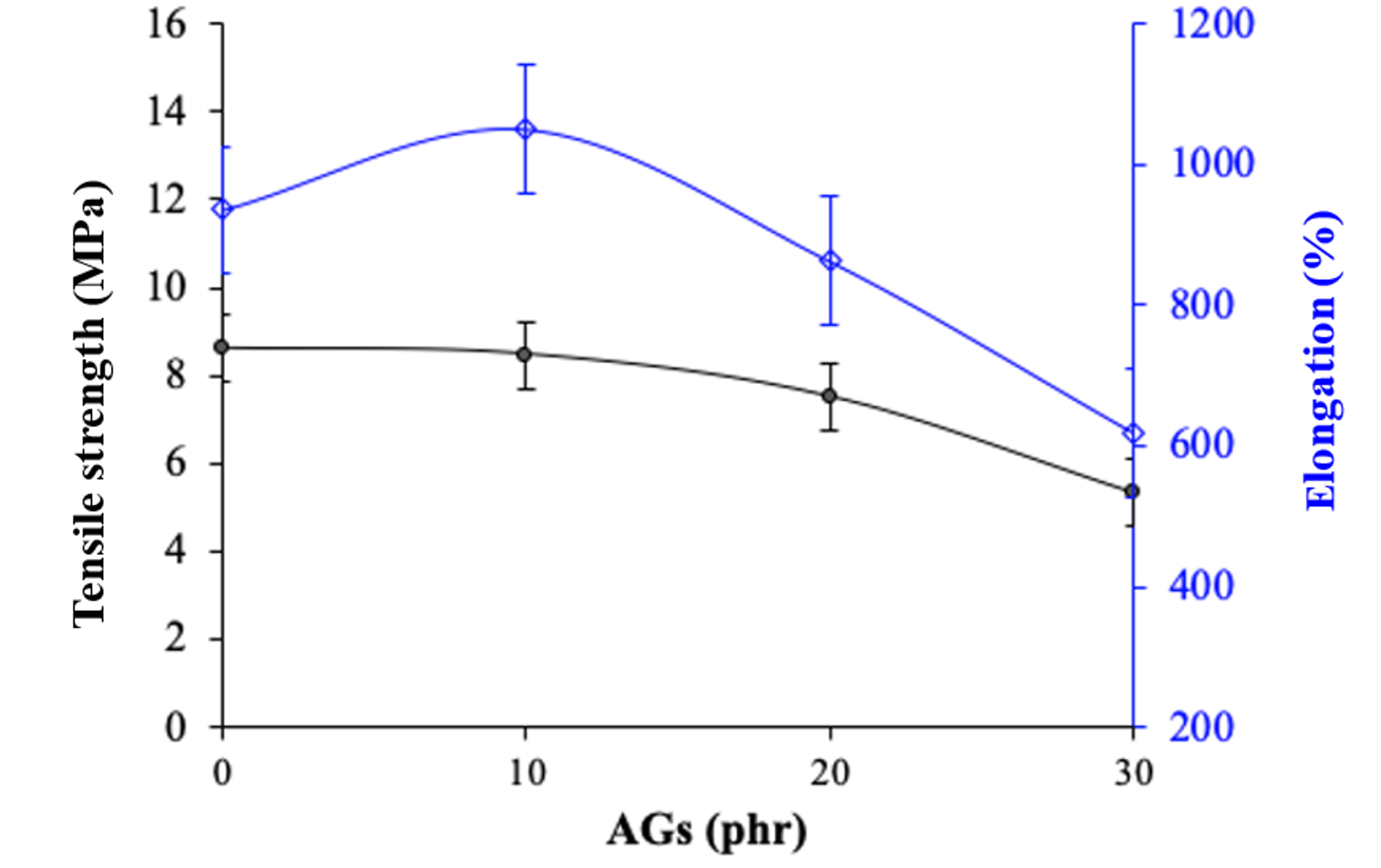
Results: Rheometric analyses showed that the addition of MDTAG influenced the curing parameters and the mechanical properties of the compounds. At a dosage of 30 phr, compared with the compound without MDTAG, the maximum torque (MH) decreased by 58.3% when reducing the degree of crosslinking. Tensile strength decreased by 38.2%, elongation at break by 42.1%, tear strength by 24.35%, and comprehensive strength by 27.5%.
At a dosage of 10 phr the maximum torque MH was not affected, and tensile strength, elongation at break, and compressive strength were preserved, while the tear resistance decreased by only 5.8%.
Conclusions: The addition of 30 parts by weight of acetylglycerols caused a significant deterioration in the mechanical properties and curing behavior, which may be attributed to the low compatibility between the MDTAG mixture and the NR natural rubber. These results were confirmed by the ANOVA statistical analysis, leading to the conclusion that the MDTAG dosage should be limited to a maximum of 10 phr when used as a partial substitute for naphthenic and aromatic oils in natural rubber mixtures
Abstract (es)
Contexto: En este estudio se modificó químicamente la glicerina de grado técnico proveniente de la industria del biodiesel para obtener mono, di, tri acetil gliceroles (MDTAG). El objetivo principal fue usar MDTAG para reemplazar parcialmente aceites nafténicos y aromáticos, los cuales se usan activamente como plastificantes en la industria del caucho natural.
Método: La síntesis de MDTAG se realizó mediante la mezcla de glicerina con ácido acético en presencia de una resina de intercambio iónico como catalizador. Se prepararon compuestos mezclando 100 partes de caucho natural y 60 partes de negro de humo, agregando MDTAG en concentraciones de 0, 10, 20 y 30 partes en peso. El proceso de curado se realizó con un sistema de aceleración a base de azufre. Se evaluaron propiedades reométricas antes de la vulcanización y, posteriormente, se midieron resistencia a la tracción, la elongación a la rotura, la resistencia al desgarro, la resistencia a la abrasión y las propiedades de compresión en probetas vulcanizadas.
Resultados: Los análisis reométricos mostraron que la adición de MDTAG influyó en los parámetros de curado y en las propiedades mecánicas de los compuestos. Con una dosificación de 30 phr, en comparación con el compuesto sin MDTAG, se obtuvo una disminución del torque máximo (MH) en 58.3%, lo que indica una reducción en el grado de entrecruzamiento. Asimismo, se observó una reducción del 38.2% en la resistencia a la tracción, del 42.1% en la elongación a la rotura, del 24.35% en la resistencia al desgarro y del 27.5% en la resistencia a la compresión.
Con una dosificación del 10 phr, el torque máximo (MH) no se vio afectado significativamente, y se conservaron la resistencia a la tracción, la elongación a la rotura y la resistencia a la compresión, mientras que la resistencia al desgarro disminuyó solo en un 5.8%.
Conclusiones: La adición de 30 partes en peso de acetil gliceroles provocó una degradación significativa de las propiedades mecánicas y del comportamiento de curado, lo que puede atribuirse a la baja compatibilidad entre la mezcla del MDTAG y el caucho natural (NR). Estos resultados fueron confirmados mediante el análisis estadístico ANOVA, lo que permite concluir que la dosificación de MDTAG debe limitarse a un máximo de 10 phr cuando se utiliza para su uso como sustituto parcial de aceites nafténicos y aromáticos en mezclas de caucho natural.
References
[1] E. Kaya Ekinci and N. Oktar, “Production of Value-Added Chemicals from Esterification of Waste Glycerol over MCM-41 Supported Catalysts,” Green Processing and Synthesis, vol. 8, no. 1, pp. 128–134, 2019. https://doi.org/110.1515/gps-2018-0034
[2] M. H. Moklis, S. Cheng, and J. S. Cross, “Current and Future Trends for Crude Glycerol Upgrading to High Value-Added Products,” Sustainability, vol. 15, no. 4, p. 2979, 2023. https://doi.org/110.3390/su15042979
[3] S. C. D’Angelo, A. Dall’Ara, C. Mondelli, J. Pérez-Ramírez, and S. Papadokonstantakis, “Techno-Economic Analysis of a Glycerol Biorefinery,” ACS Sustainable Chemistry & Engineering, vol. 6, no. 2, pp. 16563–16572, 2018. https://doi.org/110.1021/acssuschemeng.8b03770
[4] H. W. Tan, A. Abdul Aziz, and M. Aroua, “Glycerol Production and Its Applications as a Raw Material: A Review,” Renewable and Sustainable Energy Reviews, vol. 27, pp. 118–127, 2013. https://doi.org/110.1016/j.rser.2013.06.035
[5] J. A. Hernández Mora, J. C. Acevedo Paez, C. F. Valdes Rentería, and F. R. Posso Rivera, “Evaluation of Using Alternative Routes of Glycerin Obtained in the Biodiesel Production: A Review,” Ingeniería y Desarrollo, vol. 33, no. 1, pp. 126–148, 2015. https://doi.org/110.14482/inde.33.1.5573
[6] Z. I. Ishak, N. A. Sairi, Y. Alias, M. K. T. Aroua, and R. Yusoff, “Production of Glycerol Carbonate from Glycerol with Aid of Ionic Liquid as Catalyst,” Chemical Engineering Journal, vol. 297, pp. 128–138, 2016. https://doi.org/110.1016/j.cej.2016.03.104
[7] I. Corrêa, R. P. V. Faria, and A. E. Rodrigues, “Continuous Valorization of Glycerol into Solketal: Recent Advances on Catalysts, Processes, and Industrial Perspectives,” Sustainable Chemistry, vol. 2, no. 2, pp. 286–324, 2021. https://doi.org/110.3390/suschem2020017
[8] U. I. Nda-Umar, I. Ramli, Y. H. Taufiq-Yap, and E. N. Muhamad, “An Overview of Recent Research in the Conversion of Glycerol into Biofuels, Fuel Additives and Other Bio-Based Chemicals,” Catalysts, vol. 9, no. 1, p. 15, 2019. https://doi.org/110.3390/catal9010015
[9] C. G. Chol, R. Dhabhai, A. K. Dalai, and M. Reaney, “Purification of Crude Glycerol Derived from Biodiesel Production Process: Experimental Studies and Techno-Economic Analyses,” Fuel Processing Technology, vol. 178, pp. 78–87, 20183 https://doi.org/110.1016/j.fuproc.2018.05.023
[10] N. Hidayati, R. P. Sari, and H. Purnama, “Catalysis of Glycerol Acetylation on Solid Acid Catalyst: A Review,” Jurnal Kimia Sains dan Aplikasi: Journal of Scientific and Applied Chemistry, vol. 23, no. 12, pp. 414–423, 2020. https://doi.org/110.14710/jksa.23.12.414-423.
[11] M. Aghbashlo, M. Tabatabaei, H. Rastegari, and H. S. Ghaziaskar, “Exergy-based sustainability analysis of acetins synthesis through continuous esterification of glycerol in acetic acid using Amberlyst®36 as catalyst,” Journal of Cleaner Production, vol. 183, pp. 1265–1275, 2018. https://doi.org/110.1016/j.jclepro.2018.02.218
[12] A. Cornejo, I. Barrio, M. Campoy, J. Lázaro, and B. Navarrete, “Oxygenated Fuel Additives from Glycerol Valorization: Main Production Pathways and Effects on Fuel Properties and Engine Performance: A Critical Review,” Renewable and Sustainable Energy Reviews, vol. 79, pp. 1400–1413, 2017. https://doi.org/110.1016/j.rser.2017.04.005
[13] E. Delgado Tobón and E. Rodríguez-Carmona, “Síntesis de mono di tri acetil gliceroles a partir de glicerina grado técnico,” Tecciencia, vol. 15, no. 29, pp. 23–30, 2020. https://doi.org/110.18180/tecciencia.2020.29.3
[14] I. Banu, G. Bumbac, D. Bombos, S. Velea, A. M. Gălan, and G. Bozga, “Glycerol Acetylation with Acetic Acid over Purolite CT-275: Product Yields and Process Kinetics,” Renewable Energy, vol. 148, pp. 548–557, 2020. https://doi.org/10.1016/j.renene.2019.10.060
[15] I. Dosuna-Rodríguez and E. Gaigneaux, “Glycerol Acetylation Catalysed by Ion Exchange Resins,” Catalysis Today, vol. 195, no. 1, pp. 14–21, 2012. https://doi.org/10.1016/j.cattod.2012.04.031
[16] S. Kale, S. Umbarkar, M. Dongare, R. Eckelt, U. Armbruster, and A. Martin, “Selective Formation of Triacetin by Glycerol Acetylation Using Acidic Ion-Exchange Resins as Catalyst and Toluene as an Entrainer,” Applied Catalysis A: General, vol. 490, pp. 10–16, 2015. https://doi.org/10.1016/j.apcata.2014.10.059
[17] R. Li, Z. Wei, H. Li, Z. Yin, and Z. Wang, “Selective Esterification of Glycerol with Acetic Acid to Green Fuel Bio-Additive over a Lignosulfonate-Based Renewable Solid Acid,” Renewable Energy, vol. 201, pp. 125–134, 2022. https://doi.org/10.1016/j.renene.2022.11.040
[18] B. Dalla Costa, H. Decolatti, M. Legnoverde, and C. Querini, “Influence of Acidic Properties of Different Solid Acid Catalysts for Glycerol Acetylation,” Catalysis Today, vol. 289, pp. 222–230, 2017. https://doi.org/10.1016/j.cattod.2016.09.015
[19] D. M. Reinoso and G. M. Tonetto, “Bioadditives Synthesis from Selective Glycerol Esterification over Acidic Ion Exchange Resin as Catalyst,” Journal of Environmental Chemical Engineering, vol. 6, no. 2, pp. 3399–3407, 2018. https://doi.org/10.1016/j.jece.2018.05.027
[20] L. Lenzi, M. D. Esposti, S. Braccini, C. Siracusa, F. Quartinello, G. M. Guebitz, D. Puppi, D. Morselli, and P. Fabbri, “Further Step in the Transition from Conventional Plasticizers to Versatile Bioplasticizers Obtained by the Valorization of Levulinic Acid and Glycerol,” ACS Sustainable Chemistry & Engineering, vol. 11, no. 25, pp. 9455–9469, 2023. https://doi.org/10.1021/acssuschemeng.3c01536
[21] A. Ciesielski, An Introduction to Rubber Technology, 1st ed. United Kingdom: Rapra Technology Limited, 1999.
[22] J. S. Dick, “General Purpose Elastomers and Blends,” in Rubber Technology: Compounding and Testing for Performance. Cincinnati, OH, USA: Hanser Publications, pp. 165–201, 2020.
[23] R. Estevez, L. Aguado-Deblas, D. Luna, and F. M. Bautista, “An Overview of the Production of Oxygenated Fuel Additives by Glycerol Etherification, Either with Isobutene or tert-Butyl Alcohol, over Heterogeneous Catalysts,” Energies, vol. 12, no. 2, p. 2364, 2019. https://doi.org/10.3390/en12122364
[24] B. Nebel, M. Mittelbach, and G. Uray, “Determination of the Composition of Acetylglycerol Mixtures by 1H NMR Followed by GC Investigation,” Analytical Chemistry, vol. 80, no. 22, pp. 8712–8716, 2008. https://doi.org/10.1021/ac800706s
[25] W. Naebpetch, S. Thumrat, I. Indriasari, Y. Nakaramontri, and S. Sattayanurak, “Effect of Glycerol as Processing Oil in Natural Rubber/Carbon Black Composites: Processing, Mechanical, and Thermal Aging Properties,” Polymers, vol. 15, no. 17, p. 3599, 2023. https://doi.org/10.3390/polym15173599
[26] J. Kruželák, K. Hložeková, A. Kvasničáková, M. Džuganová, I. Chodák, and I. Hudec, “Application of Plasticizer Glycerol in Lignosulfonate-Filled Rubber Compounds Based on SBR and NBR,” Materials, vol. 16, no. 2, p. 635, 2023. https://doi.org/10.3390/ma16020635
[27] M. Vlacha, A. Giannakas, P. Katapodis, H. Stamatis, A. Ladavos, and N. M. Barkoula, “On the Efficiency of Oleic Acid as Plasticizer of Chitosan/Clay Nanocomposites and Its Role on Thermo-Mechanical, Barrier and Antimicrobial Properties—Comparison with Glycerol,” Food Hydrocolloids, vol. 57, pp. 10–19, 2016. https://doi.org/10.1016/j.foodhyd.2016.01.003
[28] J. S. Dick, “Compound Processing Characteristics and Testing,” in Rubber Technology: Compounding and Testing for Performance. Cincinnati, OH, USA: Hanser Publications, pp. 19–52, 2020.
[29] J. L. Leblanc, Filled Polymers: Science and Industrial Applications, 1st ed. Boca Raton, FL, USA: CRC Press, 2009. https://doi.org/10.1201/9781439800430
[30] H. Ismail and H. Hairunezam, “The Effect of a Compatibilizer on Curing Characteristics, Mechanical Properties and Oil Resistance of Styrene Butadiene Rubber/Epoxidized Natural Rubber Blends,” European Polymer Journal, vol. 37, no. 1, pp. 39–44, 2001. https://doi.org/10.1016/S0014-3057(00)00099-9
How to Cite
APA
ACM
ACS
ABNT
Chicago
Harvard
IEEE
MLA
Turabian
Vancouver
Download Citation
License
Copyright (c) 2026 Arnoldo Emilio Delgado-Tobón, Esperanza Rodríguez Carmona

This work is licensed under a Creative Commons Attribution-NonCommercial-ShareAlike 4.0 International License.

From the edition of the V23N3 of year 2018 forward, the Creative Commons License "Attribution-Non-Commercial - No Derivative Works " is changed to the following:
Attribution - Non-Commercial - Share the same: this license allows others to distribute, remix, retouch, and create from your work in a non-commercial way, as long as they give you credit and license their new creations under the same conditions.

2.jpg)