DOI:
https://doi.org/10.14483/23448393.23951Published:
2026-10-22Issue:
Vol. 31 No. 2 (2026): May-AugustSection:
Environmental EngineeringEnergy Recovery from Methane Generated at the Los Picachos Landfill in Popayán, Colombia
Valorización energética del metano generado en el Relleno Sanitario Los Picachos en Popayán, Colombia
Keywords:
methane, renewable energy, syngas, sanitary landfill (en).Keywords:
relleno sanitario, metano, energía renovable, gas de síntesis (es).Downloads
Abstract (en)
Context: Methane generation in sanitary landfills poses an environmental risk due to the global warming potential of methane; however, it also presents an opportunity for renewable energy production. While previous studies have provided biogas estimates, few have addressed the comprehensive energy valorization of biogas. This study assesses the energy potential of methane at the Los Picachos Landfill through various recovery pathways: conversion to electrical, thermal, and chemical energy, and the production of hydrogen and syngas.
Method: Historical population data, per capita waste generation rates, and waste disposal records were used to estimate methane generation with the Landfill Gas Emissions Model (LandGEM). The modeling horizon included two periods: an active disposal period from 2014 to 2044, according to the projected closure year of the landfill, and a post-closure methane generation period from 2045 to 2154, during which no additional waste input was assumed. Energy conversion coefficients were then applied to calculate chemical, electrical, and thermal energy outputs. Hydrogen production was estimated through three technological pathways: steam methane reforming (SMR), chemical looping reforming (CLR), and chemical looping reforming in a packed-bed reactor (CL_PB). Syngas production was also estimated using these pathways.
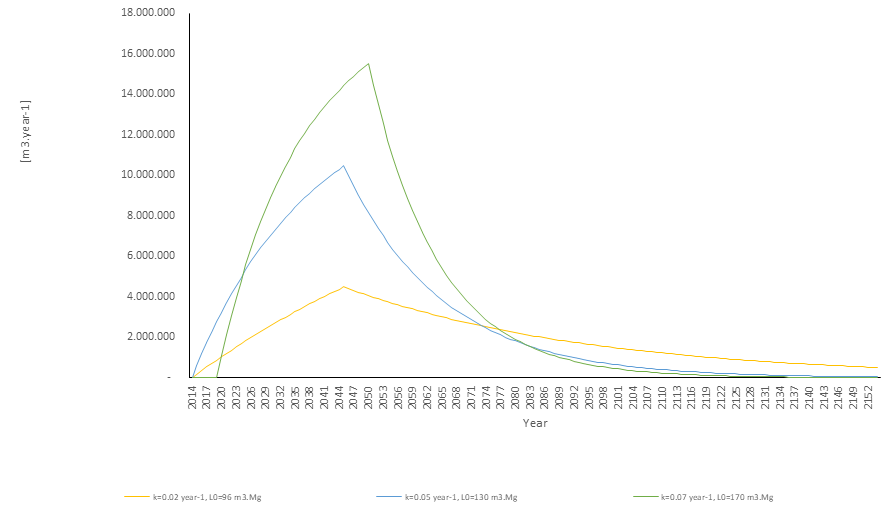
Results: The findings indicate sustained growth in methane generation, peaking at approximately 10 478 673 m3 in 2045, with an energy potential of 1 473 156 MJ·d−1. Annual hydrogen production ranges from 20 000 Nm3 to 33 000 000 Nm3, depending on the conversion pathway. A significant quantity of syngas was also estimated, with potential applications in both chemical synthesis and energy production.
Conclusions: The methane generated at the site presents a high potential for energy valorization, particularly between 2020 and 2070. These findings can inform the development of waste-to-energy policies and support future research into hybrid conversion routes and integrated energy systems.
Abstract (es)
Contexto: La generación de metano en rellenos sanitarios implica un riesgo ambiental por el potencial de calentamiento global del metano, pero también una oportunidad para producir energía renovable. Aunque existen estimaciones previas de biogás, pocos estudios abordan su valorización energética integral. Este trabajo evalúa el potencial energético del metano en el Relleno Sanitario Los Picachos mediante diversas rutas de aprovechamiento: conversión a energía eléctrica, térmica y química, y producción de hidrógeno y gas de síntesis.
Método: Se emplearon datos históricos de población, tasas de generación per cápita de residuos y registros de disposición de residuos para estimar la generación de metano mediante el modelo LandGEM (Landfill Gas Emissions Model). El horizonte de modelación incluyó dos periodos: un periodo de disposición activa entre 2014 y 2044, de acuerdo con el año proyectado de cierre del relleno sanitario, y un periodo posclausura de generación de metano entre 2045 y 2154, durante el cual no se asumió ingreso adicional de residuos. Posteriormente, se aplicaron coeficientes de conversión energética para calcular la energía química, eléctrica y térmica. La producción de hidrógeno se estimó mediante tres rutas tecnológicas: reformado de metano con vapor (SMR, steam methane reforming), reformado por bucle químico (CLR, chemical looping reforming) y reformado por bucle químico en reactor de lecho empacado (CL_PB). La producción de gas de síntesis también se estimó mediante estas rutas.
Resultados: Los resultados muestran un crecimiento sostenido en la generación de metano, con un pico cercano a 10 478 673 m3 en 2045 y un potencial energético de 1 473 156 MJ·d−1. La producción anual de hidrógeno varía entre 20 000 Nm³ y 33 000 000 Nm³, según la ruta de conversión. Se estimó además una producción significativa de gas de síntesis, con potencial para aplicaciones tanto en síntesis química como en producción de energía.
Conclusiones: El metano generado en el sitio presenta un alto potencial de valorización energética, especialmente entre 2020 y 2070. Estos hallazgos pueden orientar el desarrollo de políticas de aprovechamiento energético de residuos y apoyar futuras investigaciones en rutas híbridas de conversión y sistemas energéticos integrados.
Palabras clave: energía renovable, gas de síntesis, metano, relleno sanitario.
References
[1] A. Ghosh, S. Kumar, and J. Das, “Impact of leachate and landfill gas on the ecosystem and health: Research trends and the way forward towards sustainability,” J. Environ. Manage., vol. 336, art. 117708, Jun. 2023. https://doi.org/10.1016/j.jenvman.2023.117708
[2] L. D. Rodríguez Delgado, “Formulación Técnica de la Cartilla ‘Gestión Integral de Residuos Sólidos en las Ciudades Capitales de Colombia’ de Acuerdo a los Requerimientos del Proyecto de Ley 085 de 2023 de Asocapitales,” Universidad Francisco José de Caldas, 2024.
[3] L. F. Ramírez-Ríos, D. Becerra Moreno, and J. Y. Ortega-Contreras, “Potential use of methane gas from the Villavicencio sanitary landfill, Colombia,” Ing. Compet., vol. 26, no. 2, p. 18, Jul. 2024. https://doi.org/10.25100/iyc.v26i2.14019
[4] Ministerio de Vivienda, Ciudad y Territorio, “Estructuración y Formulación de la NAMA de Residuos Sólidos Municipales,” Ministerio de Vivienda, Ciudad y Territorio, Feb. 2021.
[5] M. M. Ahmed, M. N. Hossan, and M. H. Masud, “Prospect of waste-to-energy technologies in selected regions of lower and lower-middle-income countries of the world,” J. Clean. Prod., vol. 450, art. 142006, Apr. 2024. https://doi.org/10.1016/j.jclepro.2024.142006
[6] T. Hai et al., “A novel trigeneration model using landfill gas upgrading process and waste heat recovery: Application of methanol, desalinated water, and oxygen production,” J. Clean. Prod., vol. 393, art. 136224, Mar. 2023. https://doi.org/10.1016/j.jclepro.2023.136224
[7] S. Erdoğdu, “Landfill gas to energy beyond an age of waste: A review of research trends,” Curr. Opin. Green Sustain. Chem., vol. 53, art. 101019, Jun. 2025. https://doi.org/10.1016/j.cogsc.2025.101019
[8] A. M. D. C. Crispim, R. M. Barros, G. L. Tiago Filho, and I. F. S. Dos Santos, “An economic study of hydrogen and ammonia generation from the reforming of biogas from co-digestion of municipal solid waste and wastewater sludge in a Brazilian state,” Int. J. Hydrog. Energy, vol. 67, pp. 312-326, May 2024. https://doi.org/10.1016/j.ijhydene.2024.04.108
[9] P. A. Guapacha Muñoz, “Transformación sostenible: gestión de residuos sólidos en la vereda La Yunga, Popayán – Cauca,” Universidad Nacional Abierta y a Distancia – UNAD, 2024.
[10] Alcaldía Municipal de Popayán, “Plan de Gestión Integral de Residuos Sólidos (PGIRS), Popayán-Cauca,” Alcaldía Municipal de Popayán, 2016.
[11] Z. Liu, Y. Gu, M. Shariat, and F. Izadpanah, “Innovative environmental impact index function to determine the optimal operating point of the trigeneration (CCHP) using landfill gas,” Appl. Therm. Eng., vol. 240, art. 122190, Mar. 2024. https://doi.org/10.1016/j.applthermaleng.2023.122190
[12] O. Khan et al., “Waste-to-energy power plants: Multi-objective analysis and optimization of landfill heat and methane gas by recirculation of leachate,” Process Saf. Environ. Prot., vol. 186, pp. 957-968, Jun. 2024. https://doi.org/10.1016/j.psep.2024.04.022
[13] “Reglamento Operativo del Parque Tecnológico Ambiental los Picachos,” URBASER, 2020.
[14] IDEAM, “Carta climatológica de Popayán para la estación Aeropuerto Guillermo León Valencia,” IDEAM, 2026. Accessed: Mar. 5, 2026. [Online]. Available: http://dhime.ideam.gov.co/atencionciudadano/
[15] S. Mondal and I. M. Rafizul, “Evaluating energy generation potential from municipal solid waste in an open dumping site of Khulna,” City Environ. Interact., vol. 24, art. 100172, Dec. 2024. https://doi.org/10.1016/j.cacint.2024.100172
[16] E. Y. Paddy, B. V. Namondo, A. Fopah-Lele, J. Foba-Tendo, F. S. Ibrahim, and E. Tanyi, “Assessment of the energy potential of municipal solid waste: A case study of Mussaka dumpsite, Buea Cameroon,” Bioresour. Technol. Rep., vol. 25, art. 101784, Feb. 2024. https://doi.org/10.1016/j.biteb.2024.101784
[17] C. A. Moraes, L. D. L. C. D. Santos, A. C. L. D. Oliveira, D. F. Botelho, J. Moltó Berenguer, and N. D. S. Renato, “Biogas-based electricity production from landfills in places of irregular disposal: Overview for the southeast region of Brazil,” Energy, vol. 290, art. 130161, Mar. 2024. https://doi.org/10.1016/j.energy.2023.130161
[18] V. Noudeng, Z. Aminov, and T. D. Xuan, “Assessing landfill gas emissions and their environmental and economic impact potential in Vientiane Capital’s landfill, Laos,” Fuel, vol. 398, art. 135536, Oct. 2025. https://doi.org/10.1016/j.fuel.2025.135536
[19] S. Chandra and R. Ganguly, “Assessment of landfill gases by LandGEM and energy recovery potential from municipal solid waste of Kanpur city, India,” Heliyon, vol. 9, no. 4, art. e15187, Apr. 2023. https://doi.org/10.1016/j.heliyon.2023.e15187
[20] A. Lakhouit, “Mitigating landfill emissions strategies for effective waste management in Tabuk,” Clean. Waste Syst., vol. 9, art. 100187, Dec. 2024. https://doi.org/10.1016/j.clwas.2024.100187
[21] M. Saeedi, M. Mohammadi, N. Esmaeili, F. Farjami Niri, and H. Gol, “Optimizing LandGEM model parameters using a machine learning method to improve the accuracy of landfill methane gas generation estimates in the United States,” J. Environ. Manage., vol. 373, art. 124029, Jan. 2025. https://doi.org/10.1016/j.jenvman.2025.124029
[22] R. Bouyakhsass et al., “Adding value to unused landfill gas for renewable energy on-site at Oum Azza landfill (Morocco): Environmental feasibility and cost-effectiveness,” Trends Food Sci. Technol., vol. 142, art. 104168, Dec. 2023. https://doi.org/10.1016/j.tifs.2023.104168
[23] X.-X. Niu, S.-Z. Wang, Y.-C. Niu, L.-F. Wei, and L.-Y. Yu, “Improvement and optimization for the first order decay model parameters at typical municipal solid waste landfills in China,” Adv. Clim. Change Res., vol. 14, no. 4, pp. 605-614, Aug. 2023. https://doi.org/10.1016/j.accre.2023.07.002
[24] L. F. Ramírez Ríos, D. Becerra Moreno, and N. J. Cely Calixto, “Feasibility for Energy Recovery from Biogas at los Corazones Landfill, Valledupar,” Cienc. En Desarro., vol. 16, no. 1, Apr. 2025. https://doi.org/10.19053/uptc.01217488.v16.n1.2025.18533
[25] C. L. Y. Wong and W. Zawadzki, “Emissions rate measurement with flow modelling to optimize landfill gas collection from horizontal collectors,” Waste Manag., vol. 157, pp. 199-209, Feb. 2023. https://doi.org/10.1016/j.wasman.2022.12.018
[26] C. Scheutz, Z. Duan, J. Møller, and P. Kjeldsen, “Environmental assessment of landfill gas mitigation using biocover and gas collection with energy utilisation at aging landfills,” Waste Manag., vol. 165, pp. 40-50, Jun. 2023. https://doi.org/10.1016/j.wasman.2023.04.014
[27] C. R. Giordano, M. E. Van Brunt, S. J. Halevi, M. J. Castaldi, Z. Orlovits, and Z. Illes, “Landfill gas collection efficiency: Categorization of data from existing in-situ measurements,” Waste Manag., vol. 175, pp. 83-91, Mar. 2024. https://doi.org/10.1016/j.wasman.2023.12.042
[28] M. R. Dihan, T. Naha, and K. Kirtania, “Comparative assessment of waste-to-energy scenarios to mitigate GHG emission from MSW in a developing mega city,” Energy Sustain. Dev., vol. 82, art. 101540, Oct. 2024. https://doi.org/10.1016/j.esd.2024.101540
[29] B. Alboğa, M. Nil, M. R. A. Bhuiyan, and H. Mamur, “Evaluation of municipal solid waste characterization and landfill gas power plant electrical energy production efficiency during COVID-19 pandemic,” Sustain. Energy Technol. Assess., vol. 70, art. 103947, Oct. 2024. https://doi.org/10.1016/j.seta.2024.103947
[30] V. Spallina, G. Motamedi, F. Gallucci, and M. Van Sint Annaland, “Techno-economic assessment of an integrated high pressure chemical-looping process with packed-bed reactors in large scale hydrogen and methanol production,” Int. J. Greenh. Gas Control, vol. 88, pp. 71-84, Sep. 2019. https://doi.org/10.1016/j.ijggc.2019.05.026
[31] V. Spallina, A. Shams, A. Battistella, F. Gallucci, and M. V. S. Annaland, “Chemical Looping Technologies for H2 Production With CO2 Capture: Thermodynamic Assessment and Economic Comparison,” Energy Procedia, vol. 114, pp. 419-428, Jul. 2017. https://doi.org/10.1016/j.egypro.2017.03.1184
[32] V. Spallina, D. Pandolfo, A. Battistella, M. C. Romano, M. Van Sint Annaland, and F. Gallucci, “Techno-economic assessment of membrane assisted fluidized bed reactors for pure H2 production with CO2 capture,” Energy Convers. Manag., vol. 120, pp. 257-273, Jul. 2016. https://doi.org/10.1016/j.enconman.2016.04.073
[33] J. A. Medrano, V. Spallina, M. Van Sint Annaland, and F. Gallucci, “Thermodynamic analysis of a membrane-assisted chemical looping reforming reactor concept for combined H2 production and CO2 capture,” Int. J. Hydrog. Energy, vol. 39, no. 9, pp. 4725-4738, Mar. 2014. https://doi.org/10.1016/j.ijhydene.2013.11.126
[34] C. De Leeuwe, S. Z. Abbas, A. Amieiro, S. Poulston, and V. Spallina, “Carbon-neutral and carbon-negative chemical looping processes using glycerol and methane as feedstock,” Fuel, vol. 353, art. 129001, Dec. 2023. https://doi.org/10.1016/j.fuel.2023.129001
[35] V. Spallina, B. Marinello, F. Gallucci, M. C. Romano, and M. Van Sint Annaland, “Chemical looping reforming in packed-bed reactors: Modelling, experimental validation and large-scale reactor design,” Fuel Process. Technol., vol. 156, pp. 156-170, Feb. 2017. https://doi.org/10.1016/j.fuproc.2016.10.014
[36] V. Spallina, G. Motamedi, F. Gallucci, and M. Van Sint Annaland, “Techno-economic assessment of an integrated high pressure chemical-looping process with packed-bed reactors in large scale hydrogen and methanol production,” Int. J. Greenh. Gas Control, vol. 88, pp. 71-84, Sep. 2019. https://doi.org/10.1016/j.ijggc.2019.05.026
[37] P. A. Argyris, J. Wong, A. Wright, L. M. C. Pereira, and V. Spallina, “Reducing the cost of low-carbon hydrogen production via emerging chemical looping process,” Energy Convers. Manag., vol. 277, art. 116581, Feb. 2023. https://doi.org/10.1016/j.enconman.2022.116581
[38] V. Stenberg, V. Spallina, T. Mattisson, and M. Rydén, “Techno-economic analysis of H2 production processes using fluidized bed heat exchangers with steam reforming – Part 1: Oxygen carrier aided combustion,” Int. J. Hydrog. Energy, vol. 45, no. 11, pp. 6059-6081, Feb. 2020. https://doi.org/10.1016/j.ijhydene.2019.10.202
[39] V. Spallina et al., “Direct route from ethanol to pure hydrogen through autothermal reforming in a membrane reactor: Experimental demonstration, reactor modelling and design,” Energy, vol. 143, pp. 666-681, Jan. 2018. https://doi.org/10.1016/j.energy.2017.11.031
[40] R. J. Lee Pereira, P. A. Argyris, and V. Spallina, “A comparative study on clean ammonia production using chemical looping based technology,” Appl. Energy, vol. 280, art. 115874, Dec. 2020. https://doi.org/10.1016/j.apenergy.2020.115874
[41] P. A. Argyris et al., “Chemical looping reforming for syngas generation at real process conditions in packed bed reactors: An experimental demonstration,” Chem. Eng. J., vol. 435, art. 134883, May 2022. https://doi.org/10.1016/j.cej.2022.134883
[42] V. Spallina, F. Gallucci, M. C. Romano, and M. Van Sint Annaland, “Pre-combustion packed bed chemical looping (PCCL) technology for efficient H2-rich gas production processes,” Chem. Eng. J., vol. 294, pp. 478-494, Jun. 2016. https://doi.org/10.1016/j.cej.2016.03.011
[43] S. M. Rafew and I. M. Rafizul, “Application of system dynamics for municipal solid waste to electric energy generation potential of Khulna city in Bangladesh,” Energy Rep., vol. 9, pp. 4085-4110, Dec. 2023. https://doi.org/10.1016/j.egyr.2023.02.087
[44] “Proyección Demanda 2024/2038 sem2 17_01_2025,” Looker Studio. Accessed: Jul. 18, 2025. [Online]. Available: http://lookerstudio.google.com/reporting/43400636-68d3-45a1-889c-da6427f37b2e/page/iX4iB?feature=opengraph
[45] A. Mojtahed, G. Lo Basso, L. M. Pastore, A. Sgaramella, and L. De Santoli, “Application of machine learning to model waste energy recovery for green hydrogen production: A techno-economic analysis,” Energy, vol. 315, art. 134337, Jan. 2025. https://doi.org/10.1016/j.energy.2024.134337
[46] C. De Leeuwe et al., “Thermochemical syngas generation via solid looping process: An experimental demonstration using Fe-based material,” Chem. Eng. J., vol. 453, art. 139791, Feb. 2023. https://doi.org/10.1016/j.cej.2022.139791
[47] V. Spallina, L. Mastropasqua, P. Iora, M. C. Romano, and S. Campanari, “Assessment of finite volume modeling approaches for intermediate temperature Solid Oxide Fuel Cells working with CO-rich syngas fuels,” Int. J. Hydrog. Energy, vol. 40, no. 43, pp. 15012-15031, Nov. 2015. https://doi.org/10.1016/j.ijhydene.2015.08.101
[48] V. Spallina, F. Gallucci, M. C. Romano, P. Chiesa, G. Lozza, and M. Van Sint Annaland, “Investigation of heat management for CLC of syngas in packed bed reactors,” Chem. Eng. J., vol. 225, pp. 174-191, Jun. 2013. https://doi.org/10.1016/j.cej.2013.03.054
[49] D. A. Serrato, E. F. Chala, and S. D. Ramos, “Actualización del Plan Energético Nacional (PEN) 2022 - 2052,” República de Colombia Ministerio de Minas y Energía, 2023.
How to Cite
APA
ACM
ACS
ABNT
Chicago
Harvard
IEEE
MLA
Turabian
Vancouver
Download Citation
License
Copyright (c) 2026 Luisa F. Ramírez-Ríos, Dorance Becerra-Moreno, Judith Y. Ortega-Contreras

This work is licensed under a Creative Commons Attribution-NonCommercial-ShareAlike 4.0 International License.

From the edition of the V23N3 of year 2018 forward, the Creative Commons License "Attribution-Non-Commercial - No Derivative Works " is changed to the following:
Attribution - Non-Commercial - Share the same: this license allows others to distribute, remix, retouch, and create from your work in a non-commercial way, as long as they give you credit and license their new creations under the same conditions.