DOI:
https://doi.org/10.14483/23448393.24130Published:
2026-07-27Issue:
Vol. 31 No. 1 (2026): January-AprilSection:
Mechanical EngineeringR-SWARA and COPRAS Integration for Evaluating Third-Party Logistics Providers
Integración de R-SWARA y COPRAS para la evaluación de proveedores logísticos externos
Keywords:
Third-party logistics, Rough SWARA, COPRAS, multi-criteria decision-making, fishery industry, vendor selection (en).Keywords:
R-SWARA, COPRAS, toma de decisiones multicriterio, industria pesquera, selección de proveedores, logística tercerizada (es).Downloads
Abstract (en)
Context: Evaluating third-party logistics (3PL) providers is a complex task since multiple criteria assessed by experts with potentially diverse perspectives are involved, leading to varying scores based on individual prioritizations. This study attempts to evaluate 3PL providers for a mid-sized fishery company in Jakarta, Indonesia, focusing on refrigerated transportation within cold chain logistics.
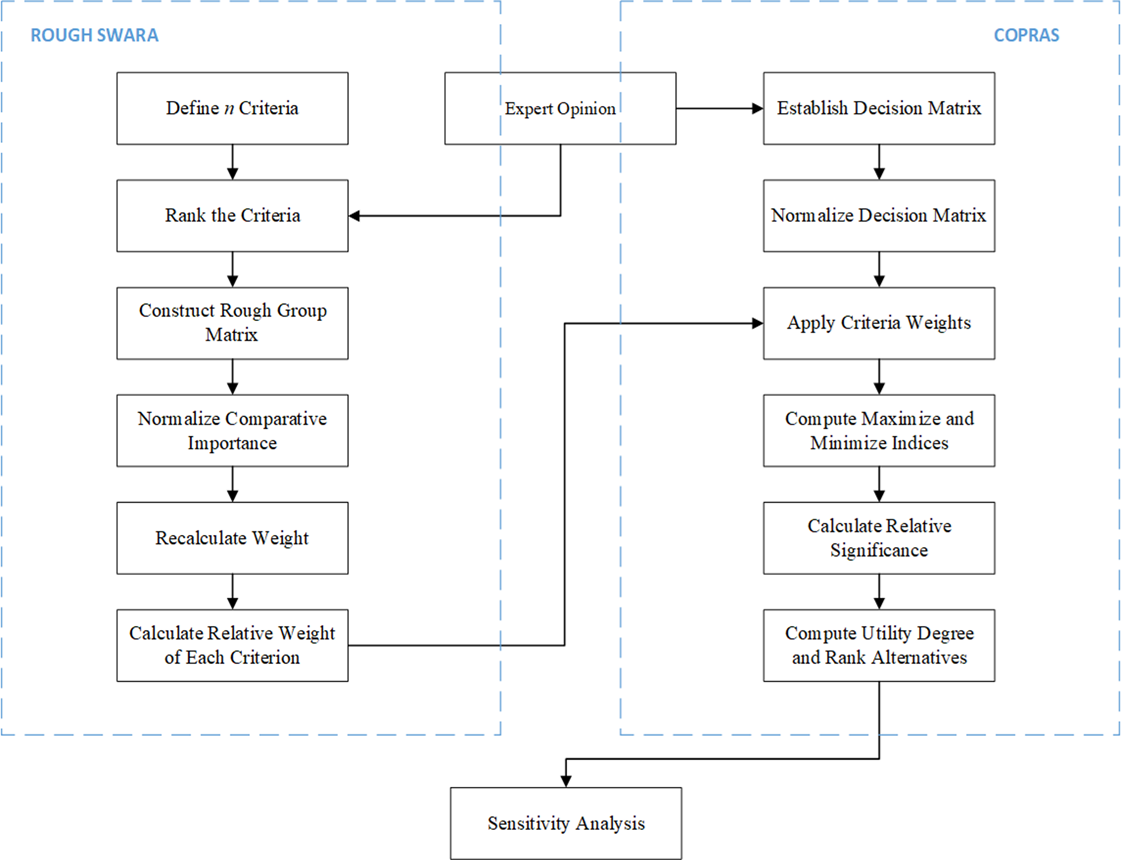
Method: A methodology integrating rough stepwise weight assessment ratio analysis (R-SWARA) and complex proportional assessment (COPRAS) is employed to address expert uncertainty and rank six providers based on seven criteria: security, punctuality, cost, delivery area, customer service, assurance, and logistics experience. R-SWARA assigns weights using rough set intervals, while COPRAS ranks providers.
Results: The integrated methods yield Vendor A as the top choice, with a utility degree of 100%, followed by Vendor D and others ranging from 96.7 to 98.4%. These rankings highlight the critical role of punctuality and security in refrigerated transportation, aligning with the fishery industry’s need to ensure product freshness and reliability. A sensitivity analysis that varies the weight of punctuality by ± 20% confirms the ranking’s stability, highlighting the methodology’s robustness. The findings align with prior studies emphasizing performance and quality in logistics, while R-SWARA’s use of intervals offers a novel approach to handling uncertainty.
Conclusions: The proposed method recommends Vendor A to ensure timely and secure seafood delivery, with implications for perishable goods logistics. The limitations include a small expert panel and a single-case focus, suggesting the need for future research with larger samples and broader applications. Another limitation of the proposed approach is its reliance on expert judgement for criteria weighting, as well as its sensitivity to the selected criteria and case context. Therefore, the findings should be interpreted as a decision support rather than universal rankings.
Abstract (es)
Contexto: Evaluar proveedores de logística tercerizada (3PL) es una tarea compleja, pues involucra múltiples criterios evaluados por expertos con perspectivas potencialmente diversas, lo que conduce a puntuaciones variables según las priorizaciones individuales. Este estudio busca evaluar proveedores 3PL para una empresa pesquera de tamaño medio en Yakarta, Indonesia, con enfoque en el transporte refrigerado dentro de la logística de cadena de frío.
Método: Se emplea una metodología que integra el análisis de razón de evaluación de pesos por etapas aproximado (R-SWARA) y la evaluación proporcional compleja (COPRAS) para abordar la incertidumbre de los expertos y clasificar seis proveedores en función de siete criterios: seguridad, puntualidad, costo, área de entrega, servicio al cliente, garantía y experiencia logística. R-SWARA asigna los pesos mediante intervalos de conjuntos aproximados, mientras que COPRAS clasifica a los proveedores.
Resultados: Los métodos integrados sitúan al Proveedor A como la mejor opción, con un grado de utilidad del 100 %, seguido del Proveedor D y otros, con valores que oscilan entre 96.7 y 98.4 %. Estas clasificaciones destacan el papel fundamental de la puntualidad y la seguridad en el transporte refrigerado, en concordancia con la necesidad de la industria pesquera de garantizar la frescura y confiabilidad del producto. Un análisis de sensibilidad que varía el peso de la puntualidad en ± 20 % confirma la estabilidad de la clasificación, subrayando la robustez de la metodología. Los hallazgos coinciden con estudios previos que enfatizan el desempeño y la calidad en la logística, mientras que el uso de intervalos de R-SWARA ofrece un enfoque novedoso para el manejo de la incertidumbre.
Conclusiones: El método propuesto recomienda al Proveedor A para garantizar una entrega de comida marina que sea oportuna y segura, con implicaciones para la logística de bienes perecederos. Las limitaciones incluyen un panel reducido de expertos y el enfoque en un solo caso, lo que sugiere la necesidad de futuras investigaciones con muestras más amplias y aplicaciones más generales. Otra limitación del enfoque propuesto es su dependencia del juicio experto para la ponderación de criterios, así como su sensibilidad a los criterios seleccionados y al contexto del caso. Por lo tanto, los hallazgos deben interpretarse como un apoyo a la toma de decisiones más que como clasificaciones universales.
References
[1] P. Thompson, C. Okorie, and K. El Sakty, “An Exploratory Study of the Strategic Use of 3PLs for Cost Reduction and Customer Satisfaction in the Oil and Gas Industry: Nigerian Firms’ Experience,” Manag. Res. Pract., vol. 13, no. 1, p. 27, 2019, [Online]. Available: https://jscm.au.edu/index.php/jscm/article/download/165/123
[2] M. Heiyantuduwa, W. M. N. N. Wannisingha, and T. Rupasinghe, “A Strategic Analysis of the use of Third Party Logistics Providers (3PLs) in Fast Moving Consumer Goods (FMCG) Industry: A Systematic Review of Literature,” Soc. Sci. Res. Netw., 2015. https://doi.org/10.2139/ssrn.2699881
[3] I. Vlachos and V. Polichronidou, “The role of Third-Party Logistics Providers in managing international supply chain triads,” Int. Conf. Logist. Oper. Manag., pp. 1–10, 2022. https://doi.org/10.1109/gol53975.2022.9820185
[4] X. Chen, G. Cai, and J.-S. J. Song, “The Cash Flow Advantages of 3PLs as Supply Chain Orchestrators,” Soc. Sci. Res. Netw., 2016. https://doi.org/10.2139/ssrn.2679357
[5] H. T. Mengistu, K. S. Dimitrov, and M. H. Qureshi, “Impact of 3PL Outsourcing on Supply Chain Management in Manufacturing Companies in Norway: Case Study Norsk Hydro,” J. Procure. Supply Chain, vol. 7, no. 1, pp. 1–11, 2023. https://doi.org/10.53819/81018102t5174
[6] G. Turner, “A 3PL’s role in perishable freight transportation,” J. Supply Chain Manag. Logist. Procure., vol. 2, no. 1, pp. 84–93, 2019.
[7] S. A. Baidoo-Baiden, “3PL Relationship Management Practices as a Cost Reduction Tool in the Supply Chain: A Case of Stellar Logistics,” Am. J. supply Chain Manag., vol. 7, no. 1, pp. 1–18, 2022. https://doi.org/10.47672/ajscm.1175
[8] S. Boakai and F. Samanlioglu, “An MCDM approach to third party logistics provider selection,” Int. J. Logist. Syst. Manag., vol. 44, no. 3, p. 283, 2023. https://doi.org/10.1504/ijlsm.2023.129365
[9] R. D. Raut, B. B. Gardas, S. Pushkar, and B. E. Narkhede, “Third-party logistics service providers selection and evaluation: A hybrid AHP-DEA-COPRAS-G group decision-making approach,” Int. J. Procure. Manag., vol. 12, no. 6, pp. 632–651, 2019. https://doi.org/10.1504/ijpm.2019.102936
[10] T. D. Nguyen and T. C. Le, “3PL provider selection in oil and gas industry using the analytic hierarchy process: A case study in oil-field services company X,” vol. 9, no. 1, 2020. https://doi.org/10.46223/hcmcoujs.econ.en.9.1.176.2019
[11] K. Suroto and H. Hasbullah, “Third Party Logistics Selection in Fast Moving Consumer Goods using AHP Method: A Case Study at PT.PZC,” 2022. https://doi.org/10.4108/eai.25-11-2021.2318835
[12] Y. Yuan, Z. Xu, and Y. Zhang, “The DEMATEL–COPRAS hybrid method under probabilistic linguistic environment and its application in Third Party Logistics provider selection,” Fuzzy Optim. Decis. Mak., pp. 1–20, 2021. https://doi.org/10.1007/s10700-021-09358-9
[13] A. Ulutaş and A. Topal, “A new hybrid model based on rough step-wise weight assessment ratio analysis for third-party logistics selection,” Soft Comput., pp. 1–12, 2021. https://doi.org/10.1007/s00500-021-06374-0
[14] C.-N. Wang, N.-A.-T. Nguyen, T.-T. Dang, and C.-M. Lu, “A compromised decision-making approach to third-party logistics selection in sustainable supply chain using fuzzy ahp and fuzzy vikor methods,” Mathematics vol. 9, no. 8, p. 886, 2021. https://doi.org/10.3390/math9080886
[15] S. N. W. Pramono et al., “Integrating the analytic hierarchy process and importance-performance analysis into ISO 14001 framework for assessing campus sustainability,” AIP Conf. Proc., vol. 1902, no. 1, p. 20035, 2017. https://doi.org/10.1063/1.5010652
[16] M. M. Ulkhaq, W. R. Wijayanti, D. A. Dilaga, A. A. Qadarullah, and F. Arfi, “Combining the Analytic Hierarchy Process and Importance-Performance Analysis to Assess Service Quality of m-Commerce: A Case of Indonesian m-Commerce,” in 2021 IEEE 8th Int. Conf. Ind. Eng. App. (ICIEA), 2021, pp. 6–10. https://doi.org/10.1109/iciea52957.2021.9436718
[17] D. P. Sari, W. R. Wijayanti, A. Prayogo, M. Mujiya Ulkhaq, and D. I. Rinawati, “An integrated fuzzy AHP and TOPSIS model for evaluating the performance of raw material suppliers: A case study in lasem batik writing centre,” MATEC Web Conf., vol. 204, p. 2014, 2018. https://doi.org/10.1051/matecconf/201820402014
[18] M. M. Ulkhaq, R. L. Nartadhi, and P. Y. Akshinta, “Evaluating Service Quality of Korean Restaurants: A Fuzzy Analytic Hierarchy Approach,” Ind. Eng. Manag. Syst., vol. 15, no. 1, pp. 77–91, 2016. https://doi.org/10.7232/iems.2016.15.1.077
[19] M. M. Ulkhaq, A. D. Siamiaty, A. Handoko, S. A. Madjid, and D. ‘Sa Nu, “The Fuzzy Analytic Hierarchy Process for Prioritizing the Sustainable Tourism Attitude Scale,” IOP Conf. Ser. Earth Environ. Sci., vol. 219, no. 1, p. 12012, Jan. 2019. https://doi.org/10.1088/1755-1315/219/1/012012
[20] W. R. Wijayanti, W. R. Dewi, F. Ardi, A. Fajri, M. M. Ulkhaq, and P. Y. Akshinta, “Combining the fuzzy AHP and TOPSIS to evaluate service quality of e-commerce website,” in Proc. 10th Int. Conf. Ed. Tech. Comp., 2018, pp. 397–402. https://doi.org/10.1145/3290511.3290514
[21] N. U. Handayani, D. P. Sari, M. M. Ulkhaq, and R. A. C. Fitriani, “The Analytic Network Process for Identifying the Potential Sub-Sectors of Creative Industry: Empirical Finding from Semarang, Indonesia,” Rev. Gestão - RGSA, vol. 18, no. 3, p. e05016, 2024. https://doi.org/10.24857/rgsa.v18n3-098
[22] E. Çakir, “Selecting Contractor Company in Urban Transformation Using SWARA - Gray Relationship Analysis Method,” J. Int. Sci. Res., vol. 2, no. 6, pp. 79–95, 2017. https://doi.org/10.23834/isrjournal.327313
[23] H. E. Gürler, “Assessment of Third-Party Reverse Logistics Provider Through the SWARA-WASPAS Integrated Framework,” Kahramanmaraş Sütçü İmam Üniversitesi Sos. Bilim. Derg., vol. 21, no. 1, pp. 204–217, 2024. https://doi.org/10.33437/ksusbd.1422598
[24] A. K. Narayanan and J. N, “Application of SWARA and TOPSIS Methods for Supplier Selection in a Casting Unit,” Int. J. Eng. Res. Technol., vol. 7, no. 5, 2018, [Online]. Available: https://www.ijert.org/research/application-of-swara-and-topsis-methods-for-supplier-selection-in-a-casting-unit-ijertv7is050210.pdf
[25] V. V. A. Almeida, C. F. S. Gomes, L. H. C. Pinochet, and M. dos Santos, “Prioritization of investment order in Brazil among renewable energy sources: an analysis using the SWARA-MOORA-3NAG method,” J. Model. Manag., vol. 20, no. 2, pp. 620–647, 2025. https://doi.org/10.1108/jm2-09-2023-0208
[26] P. G. Fernandes et al., “Product Engineering Assessment of Subsea Intervention Equipment Using SWARA-MOORA-3NAG Method,” Systems, vol. 11, no. 3, 2023. https://doi.org/10.3390/systems11030125
[27] E. Adalı and A. Işik, “Integration of DEMATEL, ANP and DEA methods for third party logistics providers’ selection,” Manag. Sci. Lett., vol. 6, no. 5, pp. 325–340, 2016. https://doi.org/10.5267/j.msl.2016.3.004
[28] S. Hasibuan and C. Jaqin, “Seleksi dan Penentuan Third Party Logistik Transportasi Produk Pelumas Menggunakan Metode TOPSIS dan PROMETHE,” Oper. Excell., vol. 14, no. 3, p. 235, 2022. https://doi.org/10.22441/oe.2022.v14.i3.058
[29] M. P. Basilio, V. Pereira, and F. Yigit, “New Hybrid EC-Promethee Method with Multiple Iterations of Random Weight Ranges: Applied to the Choice of Policing Strategies,” Mathematics, vol. 11, no. 21, 2023. https://doi.org/10.3390/math11214432
[30] S. Shukla, S. Khare, T. Verma, M. Chhimwal, and G. Kumar, "Selection of Third-Party Reverse Logistics Partners Using Multi-criteria Decision Making: A Case Study of EV Industry," in Recent Advances in Mechanical Engineering. ICRAMERD 2023, S. Sahoo and N. Yedla, Eds. Singapore: Sprin.ger, 2024, pp. 209–219. https://doi.org/10.1007/978-981-97-1080-5_17
[31] M. M. Ulkhaq, P. Y. Akshinta, R. L. Nartadhi, and W. P. Susatyo Nugroho, “Assessing Sustainable Rural Community Tourism Using the AHP and TOPSIS Approaches under Fuzzy Environment,” MATEC Web Conf., vol. 68, p. 9003, 2016. https://doi.org/10.1051/matecconf/20166809003
[32] M. M. Ulkhaq et al., “Evaluating Hospital Service Quality: A Combination of the AHP and TOPSIS,” in Proc. 2nd Int. Conf. Med. Health Infor., 2018, pp. 117–124. https://doi.org/10.1145/3239438.3239448
[33] M. M. Ulkhaq, W. R. Wijayanti, M. S. Zain, E. Baskara, and W. Leonita, “Combining the AHP and TOPSIS to evaluate car selection,” in Proc. 2nd Int. Conf. High Perf. Compil., Comp. Comm., 2018, pp. 112–117. https://doi.org/10.1145/3195612.3195628
[34] A. Jayant and P. Singh, “Application of AHP-VIKOR Hybrid MCDM Approach for 3pl Selection: A Case Study,” Int. J. Comp. App., no. 5, pp. 4–11, 2015. [Online]. Available: https://research.ijcaonline.org/icaet2015/number5/icaet4061.pdf
[35] R. Kumar, H. Singh, and J. S. Dureja, “An approach to analyze logistic outsourcing problem in medium‐scale organization by CFPR and VIKOR,” J. Manuf. Technol. Manag., vol. 23, no. 7, pp. 885–898, 2012. https://doi.org/10.1108/17410381211267718
[36] E. Rosiana, A. K. Garside, and I. Amallynda, “Integration of Rough SWARA and COPRAS in the Performance Evaluation of Third-Party Logistics Providers,” JTI., vol. 22, no. 1, pp. 31–42, 2021. https://ejournal.umm.ac.id/index.php/industri/article/view/15823
F[37] S. S. Goswami and D. K. Behera, “Developing Fuzzy-AHP-Integrated Hybrid MCDM System of COPRAS-ARAS for Solving an Industrial Robot Selection Problem,” Int. J. Decis. Support Syst. Technol., vol. 15, no. 1, pp. 1–38, 2023. https://doi.org/10.4018/ijdsst.324599
[38] S. K. Tembhare, A. K. Amar, and J. George, “Evaluating Alternatives Using ARAS Method Integrated with Entropy Weight Method for Vendor Selection in Supply Chain Management,” J. Emerg. Technol. Innov. Res., vol. 8, no. 2, pp. 1271–1275, 2021, [Online]. Available: https://www.jetir.org/view?paper=JETIR2102149
[39] S. Sremac, Ž. Stević, D. Pamučar, M. Arsić, and B. Matić, “Evaluation of a Third-Party Logistics (3PL) Provider Using a Rough SWARA–WASPAS Model Based on a New Rough Dombi Aggregator,” Symmetry (Basel)., vol. 10, no. 8, p. 305, 2018. https://doi.org/10.3390/sym10080305
[40] M. P. Basílio, V. Pereira, H. G. Costa, M. Santos, and A. Ghosh, “A Systematic Review of the Applications of Multi-Criteria Decision Aid Methods (1977–2022),” Electronics, vol. 11, no. 11, 2022. https://doi.org/10.3390/electronics11111720
[41] M. P. Basilio, V. Pereira, and M. dos Santos, “Preface to the Special Issue ‘Advanced Applications of Multi-Criteria Decision-Making Methods in Operational Research,’” Mathematics, vol. 13, no. 11, 2025. https://doi.org/10.3390/math13111888
[42] V. Keršuliene, E. K. Zavadskas, and Z. Turskis, “Selection of rational dispute resolution method by applying new step‐wise weight assessment ratio analysis (Swara),” J. Bus. Econ. Manag., vol. 11, no. 2, pp. 243–258, 2010. https://doi.org/10.3846/jbem.2010.12
[43] E. K. Zavadskas, Ž. Stević, I. Tanackov, and O. Prentkovskis, “A Novel Multicriteria Approach – Rough Step-Wise Weight Assessment Ratio Analysis Method (R-SWARA) and Its Application in Logistics,” Stud. Informatics Control, vol. 27, pp. 97–106, 2018. https://doi.org/10.24846/v27i1y201810
[44] E. K. Zavadskas, A. Kaklauskas, and V. Sarka, “The New Method of Multicriteria Complex Proportional Assessment of Projects,” Technol. Econ. Dev. Econ., vol. 3, pp. 131–139, 1994.
[45] S. Jovčić and P. Průša, “A Hybrid MCDM Approach in Third-Party Logistics (3PL) Provider Selection,” Mathematics2, vol. 9, no. 21, 2021. https://doi.org/10.3390/math9212729
[46] Ö. Bali and Ö. EROĞLU, “Assessment of 3PL Providers for Hazardous Materials,” J. Mil. Inf. Sci., vol. 2, no. 2, pp. 27–40, 2014. https://doi.org/10.17858/jmisci.38531
[47] S. Çıkmak, “Sustainable 3PL Service Provider Selection in the Pharmaceutical Industry Using Fuzzy-Based SWARA and MAIRCA Methods,” Abant Sos. Bilim. Derg., vol. 25, no. 1, pp. 306–333, 2025. https://doi.org/10.11616/asbi.1585792
[48] A. Ulutaş, “A grey hybrid model to select the optimal third-party logistics provider,” South African J. Ind. Eng., vol. 32, no. 1, 2021. https://doi.org/10.7166/32-1-2126
[49] S. Sremac, Ž. Stević, D. Pamučar, M. Arsić, and B. Matić, “Evaluation of a Third-Party Logistics (3PL) Provider Using a Rough SWARA–WASPAS Model Based on a New Rough Dombi Aggregator,” Symmetry (Basel)., vol. 10, no. 8, 2018. https://doi.org/10.3390/sym10080305
[50] M. E. Akpınar, “Third-Party Logistics (3PL) Provider Selection Using Hybrid Model of SWARA and WASPAS,” Int. J. Pure Appl. Sci., vol. 7, no. 3, 2021. https://doi.org/10.29132/ijpas.972885
How to Cite
APA
ACM
ACS
ABNT
Chicago
Harvard
IEEE
MLA
Turabian
Vancouver
Download Citation
License
Copyright (c) 2026 Adhie Prayogo, Muhammad Mujiya Ulkhaq

This work is licensed under a Creative Commons Attribution-NonCommercial-ShareAlike 4.0 International License.

From the edition of the V23N3 of year 2018 forward, the Creative Commons License "Attribution-Non-Commercial - No Derivative Works " is changed to the following:
Attribution - Non-Commercial - Share the same: this license allows others to distribute, remix, retouch, and create from your work in a non-commercial way, as long as they give you credit and license their new creations under the same conditions.



2.jpg)