DOI:
https://doi.org/10.14483/23448393.15329Published:
2020-03-12Issue:
Vol. 25 No. 1 (2020): January - AprilSection:
Petroleum EngineeringExtractos de las Hojas de Salvia officinalis y Sambucus peruviana H.B.K. como Inhibidores de Incrustación
Extracts from Salvia Officinalis and Sambucus Peruviana H.B.K. Leaves as Scale Inhibitors
Keywords:
Production water, scale bioinhibitor, oil industry (en).Keywords:
Agua de producción, bioinhibidor de incrustaciones, industria petrolera (es).Downloads
References
K. Arnold y M. Stewart, Surface production operations, design of oil handling systems and facilities. Houston: Gulf Professional Publishing, 2008.
A. B. BinMerdhah, “Inhibition of barium sulfate scale at high-barium formation water”, Journal of Petroleum Science and Engineering, vol. 90, pp. 124–130, 2012. https://doi.org/10.1016/j.petrol.2012.04.005
M. Abdou et al., “Valor del agua de formación”, Oilfield Review, vol. 23, n.◦ 1, pp. 26-39, 2011.
K. S. Venkateswarlu, Water chemistry, industrial and power station water treatment. Bombay: New Age International Limited Publishers, 1996.
M. F.B. Sousa and C. A. Bertran, “New methodology based on static light scattering measurements for evaluation of inhibitors for in bulk CaCO3 crystallization”, Journal of Colloid and Interface Science, vol. 420, pp. 57–64, 2014. https://doi.org/10.1016/j.jcis.2014.01.001
A. Khormali, A. R. Sharifov, and D. I. Torba, “Increasing efficiency of calcium sulfate scale prevention using a newmixture of phosphonate scale inhibitors during waterflooding”, Journal of Petroleum Scienceand Engineering, vol. 164, pp. 245-258, 2018. https://doi.org/10.1016/j.petrol.2018.01.055
Y. M. Al-Roomi, K. F. Hussain and M. Al-Rifaie, “Performance of inhibitors on CaCO3 scale deposition in stainless steel and copper pipe surface”, Desalination, vol. 375, pp. 138–148, 2015. https://doi.org/10.1016/j.desal.2015.07.028
A. Rochdi et al., “Inhibitive properties of 2,5-bis(n-methylphenly)-1,3,4-oxidiazole and biocide on corrosion”, Corrosion Science, vol. 80, pp. 442–452, 2014. https://doi.org/10.1016/j.corsci.2013.11.067
A. M. Abdel-Gaber, B.A. Abd-El-Nabey, E. Khamis, y D.E. Abd-El-Khalek, “A natural extract as scale and corrosion inhibitor for steel surface in brine solution”, Desalination, vol. 278, pp. 337–342, 2011. https://doi.org/10.1016/j.desal.2011.05.048
Suharso, Buhani, S. Bahri y T. Endaryanto, “Gambier extracts as an inhibitor of calcium carbonate (CaCO3) scale formation”, Desalination, vol. 265, pp. 102–106, 2011. https://doi.org/10.1016/j.desal.2010.07.038
A. Reyes, J. Ruiz y L. Castillo, “Inhibidor de incrustaciones natural a base del mucílago de la hoja de cayena (Hibiscus rosa sinensis)”, Enfoque UTE, vol. 10, n.◦ 2, pp. 63-78, 2019. https://doi.org/10.29019/enfoque.v10n2.460
Z. Mohammadi y M. Rahsepar, “The use of green Bistorta Officinalis extract for effective inhibition of corrosion and scale formation problems in cooling water system”, Journal of Alloys and Compounds, vol. 770, pp. 669-678, 2018. https://doi.org/10.1016/j.jallcom.2018.08.198
P. Mahase y J. Rivas, Desarrollo de un inhibidor a base de linaza (Linum Usitatissimum) que controle la precipitación de incrustaciones a nivel experimental, Tesis de grado, Departamento de Ingeniería de Petróleo, Universidad de Oriente, Maturín, 2018.
J. Aguilera y H. Mencía, Determinación del rango de temperatura óptimo de un inhibidor de incrustaciones a base de linaza (Linum usitatissimum) en muestras de agua de producción del Campo Oritupano a una presión de trabajo de 100 lpc, Tesis de grado, Departamento de Ingeniería de Petroleo, Universidad de Oriente, Matutín, 2018.
H. Wang, M. Gao, Y. Guo, Y. Yang, y R. Hu, “A natural extract of tobacco rob as scale and corrosion inhibitor in artificial seawater”, Desalination, vol. 398, pp. 198-207, 2016. https://doi.org/10.1016/j.desal.2016.07.035
K. Rendón y E. Azocar, Evaluación de la aplicabilidad de pectina deshidratada a base de parchita (Passiflora edulis) como inhibidor de incrustaciones minerales, Tesis de grado, Departamento de Ingeniería de Petróleo, Universidad de Oriente, Maturín, 2016.
A. Fuenmayor y R. Peña, Evaluación de una pectina natural a base de parchita (Passiflora edulis) como inhibidor de incrustaciones en muestras de agua sintética, Tesis de grado, Departamento de Ingeniería de Petróleo, Universidad de Oriente, Maturín, 2016.
X. Guo et al., “Preparation, characterization and scale performance of scale inhibitor copolymer modification with chitosan”, Journal of Industrial and Engineering Chemistry, vol. 18, pp. 2177–2183, 2012. https://doi.org/10.1016/j.jiec.2012.06.015
National Association of Corrosion Engineers (NACE), “Laboratory Screening Tests to Determine the Ability of Scale Inhibitors to Prevent the Precipitation of Calcium Sulfate and Calcium Carbonate from Solution”, 2007.
ASTM International, ASTM D369: Standard Test Method for Specific Gravity of Creosote Fractions and Residue. West Conshohocken: ASTM International, 2002. ↑4 [21] Comisión Venezolana de Normas Industriales, COVENIN 2342-86 Agua potable. Determinación del residuo filtrable total secado a 180 ◦C (Solidos disueltos). Caracas: Fondonorma, 1986.
Comisión Venezolana de Normas Industriales, COVENIN 2461-87 Aguas naturales, industriales y residuales. Determinacion de sólidos, Primera ed. Caracas: Fondonorma, 1987.
Comisión Venezolana de Normas Industriales, COVENIN 2462-87 Aguas naturales, industriales y residuales. Determinación del pH. Caracas: Fondonorma, 1987.
American Petroleum Institute, API RP 13B-1 Recommended Practice for Field Testing Water-based Drilling Fluids. Washington: API Publishing Services, 2017.
Comisión Venezolana de Normas Industriales, COVENIN 3141-95 Aguas naturales, industriales y residuales. Determinación de cloruros. Caracas: Fondonorma, 1995.
Comisión Venezolana de Normas Internacionales, COVENIN 2771-91 Aguas naturales, industriales y residuales. Determinación de dureza. Caracas: Fondonorma, 1991
W. J. Langelier, “Chemical equilibria in water treatment”, Journal of the American Water Works Association, vol. 38, n.◦ 2, pp. 169-178, 1946. https://www.jstor.org/stable/23349196
ASTM International, ASTM C136-01, Standard Test Method for Sieve Analysis of Fine and Coarse Aggregates. West Conshohocken: ASTM International, 2001
ASTM International, ASTM E1148-02 Standard Test Method for Measurements of Aqueous Solubility. West Conshohocken: ASTM International, 2002.
ASTM International, ASTM D445-19, Standard Test Method for Kinematic Viscosity of Transparent and Opaque Liquids (and Calculation of Dynamic Viscosity). West Conshohocken: ASTM International, 2019.
R. Arnold et al., “Manejo de la producción de agua: de residuo a recurso”, Oilfield Review Magazine, pp. 30-45, 2004.
Decreto 883, Normas para la Clasificación y el Control de la Calidad de los Cuerpos de Agua y Vertidos o Efluentes Líquidos. Caracas, 1995.
J. Gal y Y. Fovet, “Mechanisms of scale formation and carbon dioxide partial pressure influence, Part I, elaboration of an experimental method and a scaling model”, Water Research, vol. 36, pp. 755-763, 2002. https://doi.org/10.1016/S0043-1354(01)00270-6
Y. M. Al-Roomi y K. F. Hussain, “Potential kinetic model for scaling and scale inhibition mechanism”, Desalination, vol. 393, pp. 186–195, 2016. https://doi.org/10.1016/j.desal.2015.07.025
American Public Health Association (APHA), Standard Methods for the examination of water and wastewaters, Washington: American Public Health Association and American Water Works Association, 2005.
J. D. Hem, “Study and Interpretation of the Chemical Characteristics of Natural Water”, US Geological Survey Water-Supply Paper, pp. 2254- 2263, 1986.
C. Patton, Applied water technology, Oklahoma: Editorial Campbell Petroleum Series, 1995.
E. Rice, R. Baird, A. Eaton y L. Clesceri, Standard Methods for the Examination of Water and Wastewater. Washington: American Public Health Association and American Water Works Association, 2012.
Alberta Health Service, “Interpretation of Chemical Analysis of Drinking Water Recommended Levels”. [En línea]. Disponible en; http://www.albertahealthservices.ca/eph.asp
Observatorio Nacional de Degradación de Tierras y Desertificación, “Indicadores”, 2014. [En línea]. Disponible en: http://www.desertificacion.gob.ar/indicadores/suelo-ph/
N. Kevern, “Alkalinity water, classification systems, Part 1”, Michigan State University, Michigan, U.S.A., 1989.
J. Lillo, “Técnicas hidrogeoquímicas”, Tesis de maestría, Universidad Rey Juan Carlos, Madrid, 2007.
NALCO, The NALCO Water Handbook, México D.F.: Editorial McGraw-Hill, 2004.
D. Jenkins y V. Snoeyink, Química del Agua. México D.F.: Editorial Limusa, 2003.
M.C. Menkiti, C.M. Sgu, and T.K. Udeigwe, “Extraction of oil from Terminalia catappa L.: process parameter impacts, kinetics, and thermodynamics”, Industrial Crops Products, vol. 77, pp. 713–723, 2015. https://doi.org/10.1016/j.indcrop.2015.08.019
S. Sulaiman, A.R. Abdul Aziz y M.K. Aroua, “Optimization and modeling of extraction of solid coconut waste oil”, Journal Food Engineering, vol. 114, pp. 228–234, 2013. https://doi.org/10.1016/j.jfoodeng.2012.08.025
Q. He, B. Du, y B. Xu, “Extraction optimization of phenolics and antioxidans from black goji berry by accelerated solven extractor using response sourface methodology”, Applied Sciences, vol. 8, n.◦ 10, pp. 1905–1918, 2018. https://doi.org/10.3390/app8101905
G. Ríos y P. Ruiz, Determinación de los rangos óptimos de aplicación de un inhibidor de incrustaciones natural a base del mucílago extraído de la hoja de la planta de de cayena (Hibiscus rosa-sinensis), Trabajo de grado, Departamento de Ingeniería de Petróleo, Universidad de Oriente, Maturín, 2018.
M. Crabtree et al., “La lucha contra las incrustaciones-remoción y prevención”, Oilfield Review Magazine, 1999.
C. Mata, Polisacaridos naturales como agentes anti-incrustantes, Trabajo de grado, Universidad Simón Bolívar (USB), Caracas, 2007.
N. Garin et al., “Cambios en la viscosidad del agua con espesantes por la adición de fármacos altamente prescritos en geriatría”, Nutrición Hospitalaria, vol. 27, n.◦ 4, pp. 1298-1303. http://dx.doi.org/10.3305/nh.2012.27.4.5838
M. Grieve. “Sages.Botonical.com”. [En línea]. Disponible en: http://www.botanical.com/botanical/mgmh/s/sages-05.html
B. M. Grajales, M. M. Botero y J. F. Ramírez, “Características, manejo, usos y beneficios del sauco (Sambucus nigra L.) con énfasis en su implementación en sistemas silvopastoriles del Trópico Alto”, ´ Revista de Investigación Agraria y Ambiental, vol. 6, n.◦ 1, pp. 155-168, 2015. https://doi.org/10.22490/21456453.1271
N. Stanciuc et al., “Investigations on binding mechanism of bioactives from elderberry (Sambucus nigra L.) by whey proteins for efficient microencapsulation”, Journal of Food Engineering, vol. 223, pp. 197-207, 2018. https://doi.org/10.1016/j.jfoodeng.2017.10.019
A. A. Al-Hamzah y C. M. Fellows, “A comparative study of novel scale inhibitors with commercial scale inhibitors used in seawater desalination”, Desalination, vol. 359, pp. 22–25, 2015. https://doi.org/10.1016/j.desal.2014.12.027
How to Cite
APA
ACM
ACS
ABNT
Chicago
Harvard
IEEE
MLA
Turabian
Vancouver
Download Citation
Recibido: 17 de septiembre de 2019; Revisión recibida: 20 de noviembre de 2019; Aceptado: 5 de diciembre de 2019
Resumen
Contexto:
El fenómeno de formación de las incrustaciones se ha convertido en uno de los problemas operacionales con mayor frecuencia de ocurrencia en la industria petrolera, y la búsqueda de fuentes innovadoras de mitigación ha resultado ser el horizonte al cual han apuntado las empresas del área. Por ello, en esta investigación se evalúa el efecto antiincrustante que presentaron los extractos de las hojas de Salvia officinalis y Sambucus peruviana H.B.K.
Método:
Se realizó la caracterización fisicoquímica de una muestra de agua de producción del Campo Oritupano y se obtuvieron los extractos, para luego ser identificadas sus propiedades físicas. Posterior a ello, se determinó el desempeño inhibitorio de cada producto natural en conjunto con un agente comercial, todo a través de la aplicación de la Norma NACE TM0374-2007, además de aplicar un análisis estadístico para visualizar las diferencias significativas que pudiesen estar presentes entre las eficiencias experimentales y comerciales.
Resultados:
Los extractos de Salvia officinalis y Sambucus peruviana H.B.K empleados como antiincrustantes exteriorizaron resultados de pH de carácter ácido y viscosidades por debajo de los 2 cSt, mostrando rendimientos máximos de 87,27% y 90,91% para las soluciones a base de saúco y salvia respectivamente, y comportamientos estadísticos similares al producto comercial referencial.
Conclusiones:
En términos cuantitativos, el prospecto a base de salvia resultó más efectivo al evaluarlo en la muestra de agua de producción del Campo Oritupano, mostrando un comportamiento directamente proporcional concentración-eficiencia, además de exponerse con características más acordes a un bioinhibidor de incrustaciones de carbonato de calcio, aunque con proporción de sólidos que deberían disminuirse aún más, requiriendo que en un futuro se mejore esta característica y se pueda medir la acción conjunta de ambos extractos en la prevención de las incrustaciones, tanto experimentalmente como en campo.
Palabras clave:
Agua de producción, Bioinhibidor de incrustaciones, Industria petrolera..Abstract
Context:
The phenomenon of scale formation has become one of the operational problems with the highest frequency of occurrence in the oil industry, and the search for innovative sources of mitigation has proved to be the horizon to which the companies in the area have pointed. This is the reason why in this investigation the anti-fouling effect that the extracts of the Salvia officinalis and Sambucus peruviana H.B.K leaves was evaluated.
Method:
The physicochemical characterization of a production water sample of the Oritupano Oilfield was performed and the extracts were obtained, and then its physical properties were identified. Next, the inhibitory performance of each natural product was determined together with a commercial agent, all through the application of the NACE Standard TM0374-2007, in addition to applying a statistical analysis to visualize the significant differences that could be present between the experimental and commercial efficiencies.
Results:
Extracts of Salvia officinalis and Sambucus peruviana H.B.K used as antiscaling externalized acidic pH results and viscosities below 2 cSt; showing maximum performances of 87,27% and 90,91% for solutions based on elderberry and sage respectively and statistical behaviors similar to the referential commercial product.
Conclusions:
In quantitative terms, the sage-based product was more effective when evaluated in the Oritupano oilfield production water sample, showing a directly proportional concentration - efficiency behavior, in addition to exposing characteristics more consistent with a Calcium Carbonate scale bioinhibitor, although with a proportion of solids that should be reduced, requiring that this characteristic be improved in the future and the joint action of both extracts can be measured in the prevention of scale, both experimentally and in the field.
Keywords:
Oil industry, Production water, Scale bioinhibitor..Introducción
Es de conocimiento colectivo que la industria petrolera, desde su incepción, se ha encargado de la extracción de hidrocarburos hasta su posterior comercialización y venta (petróleo y gas) dirigida hacia los mercados fabriles desarrollados. El combustible fósil, estando contenido inicialmente a miles de pies por debajo de la superficie terrestre, se impulsa gracias al gradiente de presión hacia zonas estratigráficas ideales en porosidad y permeabilidad periférica. Al momento de alcanzar estas condiciones, el hidrocarburo coexiste en el tiempo y espacio con el agua de formación, la cual en la mayoría de los escenarios constituye uno de los mecanismos de producción por excelencia; de acuerdo con [1], generalmente esta se puede definir como salmuera, agua salobre o agua salada, aunque en escasas ocasiones puede encontrarse en condiciones relativamente frescas.
Si bien es cierto que en los yacimientos de hidrocarburos el agua a menudo impulsa la producción primaria e interviene en la secundaria, un alto corte de esta en dichos procesos no se consideraría conveniente, puesto que genera un aumento en los costos de explotación [2]. Una de las consecuencias anexas de la producción excesiva del agua asociada es la corrosión por entes salinos.
Estos cuerpos cristalinos, al desplazarse a altas velocidades por las tuberías y redes de distribución, disminuyen la vida media de los equipos de extracción en sitio y de tratamientos en superficie[3].
Además de lo anterior, también se presta especial cuidado a la presencia de agua subterránea en la producción, toda vez que naturalmente ella contiene carbonatos de calcio, de magnesio y otras sales, así como también microorganismos y otros elementos en solución. Es por ello que, a nivel de campo, las concentraciones de sustancias orgánicas e inorgánicas disueltas en un cuerpo de agua y sus alrededores necesitan ser monitoreadas[4], puesto que al momento de entrar en contacto con algún medio de transporte o procesamiento, a nivel de subsuelo o superficie, las sales presentes en el fluido tienden a adherirse a las paredes interiores de equipos y tuberías[5], lo anterior debido a las cargas eléctricas naturales de sus moléculas y a las propiedades de sus estructuras cristalinas.
A estos depósitos se les conoce comúnmente como incrustaciones [6] y, junto a los procesos corrosivos, se asocian con los principales problemas generados por la producción conjunta del agua con los hidrocarburos. La relación entre las propiedades del agua determina la capacidad de obstrucción, formación de depósitos y desgaste natural de dichas aguas.
Por su naturaleza, el agua producida requiere de algún tipo de tratamiento para ser acondicionada y posteriormente ser integrada al proceso de inyección o ser dispuesta. Para ello, no debe contener sólidos que puedan causar obstrucción por acumulación -debe mantener un bajo nivel de corrosión-, evitando reparaciones o reemplazos de tuberías y equipos a futuro, así como mantener bajos niveles de contenido de petróleo en suspensión.
Estos aditivos químicos que conforman el proceso de acondicionamiento del agua producida son aplicados en unidades de tratamiento, en pozos productores de petróleo, pozos inyectores de aguas efluentes o pozos inyectores de agua utilizados como método de recuperación secundaria, o hasta en el yacimiento, pues es en estos lugares, dependiendo de la naturaleza de dicha agua, donde se pueden generar incrustaciones o escalas que generalmente son de carbonatos y sulfatos.
Como una manera de prevenir la formación de los depósitos ya expuestos, durante muchos años se han usado los inhibidores de incrustación[7], [8], los cuales generalmente han presentado como base química fosfatos, fosfonatos, ácidos y, más recientemente, polímeros. Además, como su nombre lo indica, su función es atenuar o evitar que las sales minerales, específicamente de carbonatos y sulfatos, lleguen a desestabilizarse en el seno del fluido acuoso, debiendo al mismo tiempo ser compatibles con los demás aditivos usados en campo para el aseguramiento de flujo (desemulsificantes, inhibidores de corrosión, dispersantes de asfaltenos, entre otros). En sintonía con lo previamente especificado y adscrito a los preceptos de conservación del medio ambiente que puntualiza la química verde a través del uso de productos biodegradables, en los últimos años se han desarrollado y empleado inhibidores de incrustaciones a base de polímeros naturales o modificados, proteínas y extractos vegetales [9], [ 10 ].
Consecuentemente se han estudiado y evaluado bases naturales (polímeros y extractos) como agentes inhibidores de incrustaciones, es el caso del mucílago de la hoja de Hibiscus rosa-sinensis[ 11 ]; extracto de Bistorta Officinalis[ 12 ]; mucílago de Linum usitatissimum[ 13 ], [ 14 ]; extracto de la hoja de tabaco[ 15 ]; pectina de Passiflora edulis[ 16 ], [ 17 ]; copolímero a base de quitosán[ 18 ]; extracto de Olea europaea L[9], entre otros.
Es por ello que la presente investigación estuvo dirigida a evaluar el efecto que tienen los extractos de salvia (Salvia officinalis) y saúco (Sambucus peruviana H.B.K.) al usarlos como base de inhibidores de incrustaciones en una muestra de agua de producción proveniente del Campo Oritupano, la cual originalmente fue caracterizada a través de propiedades fisicoquímicas para posteriormente determinar las cualidades físicas de las infusiones previamente obtenidas en unión a un producto comercial. Se finaliza con la evaluación de la eficiencia antiincrustante de las soluciones naturales en la muestra de agua inicialmente señalada mediante la aplicación de la Norma NACE TM0374-2007[ 19 ].
Materiales y métodos
La ejecución de la investigación se realizó en los laboratorios de Procesamiento de Hidrocarburos, Yacimientos, y Fluidos de Perforación del Departamento de Ingeniería de Petróleo, Universidad de Oriente, Núcleo de Monagas, donde se llevaron a cabo los procesos de extracción y caracterización inicial de la base natural, así como de los bioinhibidores que se formularon y las muestras de agua de producción.
Caracterización de la muestra de agua de producción del Campo Oritupano
En primer lugar, se obtuvo una muestra de agua de producción procedente del Campo Oritupano para su caracterización fisicoquímica, la cual se realizó a través de la determinación de las siguientes propiedades: densidad de acuerdo con el método ASTM D369[20], contenido de sólidos disueltos según lo pautado en la práctica COVENIN 2342:86[21], contenido de sólidos totales y suspendidos a través de la norma COVENIN 2461:87[22], pH de acuerdo con la norma COVENIN 2462:87[23], alcalinidad mediante la práctica API RP 13B-1[24], además del contenido de cloruros y dureza cálcica siguiendo los lineamientos establecidos en las normas COVENIN 3141:1995 [25] y COVENIN 2771:91[26], respectivamente. Adicionalmente, se determinó el índice de saturación de Langelier (LSI, por sus siglas en inglés) [27]para estimar el grado incrustante, corrosivo o neutro de dicha muestra de agua de producción, a través de la siguiente relación matemática:

Siendo pHA, pH actual del agua y pHS, pH de saturación o pH al cual se logra el equilibrio calcocarbónico del agua.
Caracterización de los inhibidores experimentales a través de los extractos de las hojas de salvia (Salvia officinalis) y sa úco (Sambucus peruviana H.B.K.)
Anterior a la caracterización, fue requerida la materia prima (hojas de Salvia officinalis y Sambucus peruviana H.B.K.), las cuales fueron tomadas directamente de la planta, siendo cuidadosamente higienizadas y secadas bajo sombra durante veinticuatro horas. Posterior a ello, fue considerado (con algunas variaciones) el proceso llevado a cabo por [9] para la extracción, el cual consistió en secar las hojas en un horno a una temperatura aproximada de 70 C entre una y dos horas; posteriormente, son molidas y convertidas en polvo a través de una trituradora. Al material pulverizado, previo a la obtención del extracto, se le determinaron dos propiedades físicas fundamentales para evidenciar su comportamiento en cuanto al tamaño de partículas (mediante la Norma ASTM C136- 01 [28] y solubilidad (a través de la ASTM E1148-02[29]).
Consecutivamente se tomaron tres, cinco y siete gramos del material ya pulverizado y fueron sometidos a un proceso de reflujo en 300 mL de agua destilada a través de un equipo Soxhlet de extracción sólido-líquido durante un tiempo aproximado de tres horas. Posteriormente, la solución producto del reflujo fue filtrada para remover cualquier material sólido o impurezas presentes para la generación definitiva de un aproximado de 300 mL de producto.
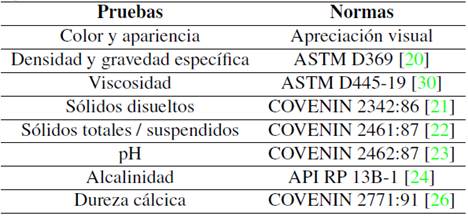
Para el desarrollo de los productos antiincrustantes, se utilizaron tres concentraciones diferentes (3, 5 y 7 g), expresando dicha concentración en g/L y añadiéndole 0,2 g de ácido cítrico (que actuaría como agente preservante) por cada 100 mL de muestra a cada concentración precitada. Posteriormente, se caracterizó el inhibidor formulado mediante pruebas fisicoquímicas que permitieron determinar los siguientes parámetros: pH, densidad y viscosidad, además de cloruros, contenido de solidos totales, disueltos y en suspensión, todos siguiendo los procedimientos establecidos en las normas que se refieren a continuación en la Tabla I.
Tabla I: Pruebas para la caracterización de los extractos de Salvia officinalis y Sambucus peruviana H.B.K.
Evaluación de la eficiencia de los agentes inhibidores de incrustaciones minerales
Los ensayos de evaluación con respecto a la eficiencia de los inhibidores de incrustaciones formulados a escala de laboratorio se realizaron en estado estático en capilares de vidrio, siguiendo el procedimiento especificado en la norma NACE TM0374-2007[19]. La prueba tuvo una duración de veinticuatro horas, a una temperatura de 71 1 C (160 2 F) y a presión atmosférica.
Dicha norma permitió determinar la capacidad de los productos químicos antiincrustantes de mantener soluble las sales presentes en la muestra de agua de producción, evitando su aglomeración/precipitación, el cual estuvo basado en la obtención del porcentaje de eficiencia con dosis aplicadas en microlitros (L), empleando los prospectos experimentales a base de salvia y saúco, además de un producto comercial específico.
Una vez transcurridas las veinticuatro horas de calentamiento, la muestra se dejó en reposo hasta que se enfrió a una temperatura de 25 5 C (77 9 F), luego se extrajo la cantidad de muestra suficiente para determinar las concentraciones disueltas de calcio en forma de dureza cálcica. Se obtuvieron los diferentes grados de eficiencias de los químicos antiincrustantes empleados mediante la siguiente expresión:

Donde Ca es dureza cálcica en ppm de la muestra tratada después de la precipitación, Cb es dureza cálcica en ppm del blanco después de la precipitación (blanco caliente) y Cc es dureza cálcica en ppm del blanco antes de la precipitación (blanco frío).
De igual forma, y subsiguiente a la aplicación de la Norma NACE TM0374-2007[19], se determinó el LSI para apreciar la variación en esta estimación de la capacidad incrustante o no del medio líquido sobre el cual se experimentó la evaluación de los extractos empleados como antiincrustantes.
Posteriormente, se realizó un estudio estadístico de acuerdo con los resultados obtenidos en cada una de las pruebas efectuadas, los cuales se encuentran asociados a la efectividad de las formulaciones realizadas en esta etapa. Este análisis se hizo fundamentado en un ANOVA (análisis de varianza) simple, complementado esto con la prueba de múltiples rangos a través del procedimiento de diferencias mínimas significativas (LSD) de Fisher, con la finalidad de discriminar entre las medias involucradas. Los datos considerados para llevar a cabo este análisis fueron las medias de los valores de eficiencia arrojados por la muestra de agua de producción luego de la aplicación de los tratamientos antiincrustantes.
Conjuntamente se realizó un ANOVA multifactorial para evidenciar el efecto que pudiesen tener tanto la concentración (g/300 mL) de salvia o saúco como las dosis empleadas (5,5; 10 y 50 L) sobre la eficiencia de inhibición de incrustación de cada extracto empleado. Para todo esto se utilizó el programa Statgraphics Centurion XVI.II versión 16.02.0004 con el fin de obtener las tablas correspondientes al procedimiento ANOVA.
Resultados y discusión
Propiedades del agua de producción del Campos Oritupano
En la Tabla II se presentan los resultados de la caracterización fisicoquímica obtenida para una muestra de agua de producción del Campo Oritupano.
Tabla II: Caracterización fisicoquímica del agua de producción del Campo Oritupano
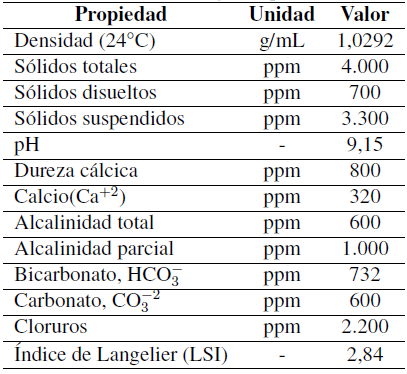
Como propiedades resaltantes de la caracterización de esta muestra de agua del Campo Oritupano se evidencia una densidad (1,0292 g/mL) algo más elevada a la densidad estándar del agua, lo que permite asociarla con la cantidad de sólidos totales presentes en dicha muestra, especialmente al contenido de sales disueltas que presentan las aguas y a la cantidad de sólidos que en general se coligan a materiales que se desintegran por el contacto entre el fluido y las rocas en el subsuelo[13], [31], originando esto un aumento en la masa del agua que afecta su densidad.
En cuanto a los sólidos disueltos (700 ppm), a pesar de que se consideran proporcionalmente menores que los suspendidos y menores a los establecidos en el Decreto 883 de 1995 [32] (Norma para la Clasificación y el Control de Calidad de los Cuerpos de Agua y Vertidos o Efluentes Líquidos) de 1.000 ppm, vale la pena acotar que, de ocurrir algún cambio en las condiciones termodinámicas del fluido (un aumento de temperatura, por ejemplo), se podría llegar a generar la formación y posterior precipitación de las sales minerales originalmente solubles. Para la formación de incrustaciones es necesario que existan sales disueltas en el agua en suficiente proporción para que ocurra la coalescencia de partículas y la formación de depósitos minerales al presentarse un aumento de temperatura[33], [32].
Como parte de los iones que se asocian con los compuestos con cierto grado de solubilidad se encuentran los cloruros, los cuales por lo general aumentan la conductividad del agua debido al incremento de la salinidad de la misma. Estos resultaron en 2.200 ppm, cantidad que se considera alta de acuerdo con lo establecido por la American Public Health Association (APHA) [35], la cual contempla que el contenido de cloruros para un agua de formación sea menor a 250 ppm, y como máximo valor el de 300 ppm; aunque en salmueras naturales que se encuentren próximas a la saturación de cloruro de sodio, la concentración de ion Cl - puede llegar a casi los 200.000 ppm[36].
En alusión al pH, se evidencia el carácter alcalino (Tabla III) y con tendencia a generar incrustaciones de la muestra de agua de producción en estudio. Al presentar un pH de 9,15 le confiere indicios a la misma de tener inclinación incrustante, toda vez que esto es más propenso en aguas básicas ([37], debido a que la mayoría de las sales presentes en el agua disminuyen su solubilidad cuando el pH aumenta; por lo tanto, en medios básicos incrementan su potencial incrustante[31].
Tabla III: Clasificación del agua de acuerdo al pH. Observatorio Nacional Degradación de Tierras y Desertificación (40).
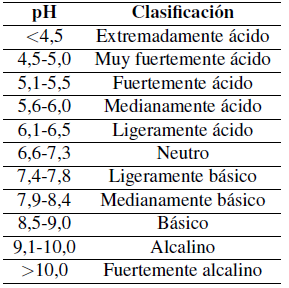
Cabe señalar además que para[38], en la mayoría de los campos petroleros las aguas subterráneas presentan un pH que puede variar entre 6 y 8,5[39].
En el caso particular de la alcalinidad, se exteriorizan valores de alcalinidad parcial (presencia de iones carbonato) de 1.000 ppm y de alcalinidad total (presencia de iones bicarbonato) de 600 ppm, lo cual confirma la presencia de los aniones necesarios para que en conjunto con el catión calcio (Ca+2) que resultó en un valor de 320 ppm, propicien la generación de acumulaciones minerales.
De acuerdo con lo señalado por Kevern, a esta agua de producción se le puede clasificar dentro del rango de alcalinidad alta, toda vez que, de acuerdo con él, se les considera así a todos los valores de esta propiedad mayores a 150 ppm.
Las aguas duras, por lo general, tienden a ser incrustantes, mientras que las blandas suelen ser agresivas o corrosivas[42]. Es por ello que para terminar de corroborar la naturaleza generadora de incrustaciones minerales de la muestra de agua de producción en estudio, la dureza cálcica con una proporción de 800 ppm resulta en términos de relacionarse a un agua muy dura, de acuerdo con lo que se contempla en The NALCO Water Handbook[43]. La dureza de una muestra de agua está definida por la concentración de todos los cationes metálicos no alcalinos presentes en la misma y que es expresada en equivalentes de carbonato de calcio[44]. En cuanto a las aguas, mientras mayor dureza presenten más elevado será su poder incrustante, ya que los compuestos carbonatados se transformarán en cristales del elemento correspondiente, llegando a crear un material resistente que, a nivel operacional, se acumulará en los medios de desplazamiento de los fluidos[11].
Seguidamente, la estimación del LSI, ratifica con su cuantía (2,84) la naturaleza incrustante de la muestra en estudio, lo cual la exhibe como un medio idóneo a través del cual se permitiría evaluar posteriormente los inhibidores orgánicos propuestos en esta disertación.
Generación y caracterización de los inhibidores experimentales
Como paso previo a la obtención y posterior caracterización de los extractos, se les determinaron los tamaños de partículas y la solubilidad al material pulverizado procedente de las hojas de Salvia officinalis y Sambucus peruviana H.B.K. En la Tabla IV se exponen las distribuciones porcentuales de las dos muestras tamizadas en estudio, indicando de manera precedente que el tamaño de las partículas y su clasificación másica correspondiente se vio afectada por el proceso de molienda, pero evidenciando que para ambas muestras la mayor proporción se ubicó en el tamaño de 589 y 250 micrones, obteniendo una relativa mayor proporción para el caso de la Salvia officinalis (2,86% por encima del Sambucus peruviana H.B.K. para los tamaños de 589 y 250 micrones). Además, se manifestó que, teniendo el mismo volumen de salvia y saúco, el primero resultó con menor masa (menos “pesado”), tal como se aprecia en la Tabla IV.
Tabla IV: Tamaño de partículas de las hojas de Salvia officinalis y Sambucus peruviana H.B.K. pulverizadas
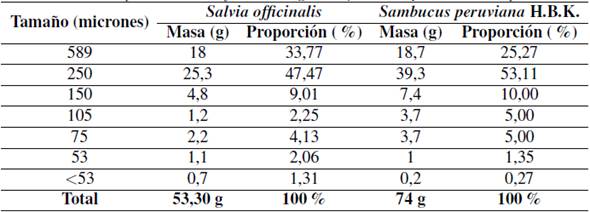
Al resultar menos denso el material pulverizado proveniente de las hojas de la salvia que el de saúco, le confirió al primero un carácter menos soluble, como se aprecia en la Tabla V, de lo que se infiere que emplearlo diluido de manera directa en agua no resultaría efectivo.
Tabla V: Solubilidad de las partículas de las hojas de Salvia officinalis y Sambucus peruviana H.B.K pulverizadas

Por lo anterior, ambas fuentes naturales fueron sometidas a un proceso de extracción sólido-líquido que, como ya se mencionó en el procedimiento metodológico, se llevó a cabo a través de un equipo Soxhlet durante un tiempo aproximado de tres horas, permitiendo así que se produjese un contacto directo entre el material sólido y el solvente empleado (agua), con aumento de temperatura, para que así se extrajeran los principales componentes activos tanto de la salvia como del saúco.
Para[45], y [47], la transferencia de los componentes desde la planta al medio de infusión depende de varios factores, como el tipo de disolvente y su concentración, la relación disolvente/ sólido, el número de etapas de extracción, el pH, el tiempo de contacto, la temperatura y el tamaño de partícula de la matriz sólida.
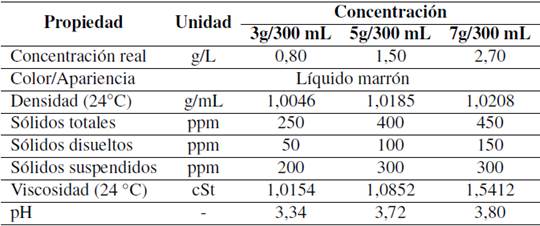
En la Tabla VI y la Tabla VII se muestran los resultados de la caracterización de los extractos empleados posteriormente como inhibidores de incrustación. En ambos casos se manifestó una sustancia de color marrón claro, aumentando la tonalidad dependiendo de la concentración inicial empleada en la extracción. A cada uno se les determinó la concentración real posterior al proceso de filtración para evidenciar la eficiencia de dicho proceso.
Tabla VI: Caracterización del extracto/inhibidor de incrustaciones a base de Salvia officinalis
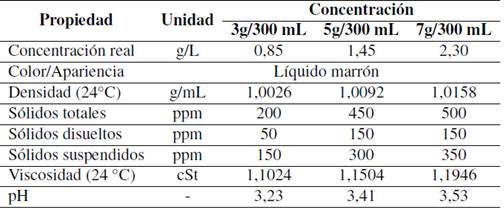
Tabla VII: Caracterización del extracto/inhibidor de incrustaciones a base de Sambucus peruviana H.B.K
Como se aprecia en la Figura 1, estas eficiencias variaron entre 61% y 73% para ambas infusiones, lo cual establece que aún quedaron algunas fracciones sólidas de las fuentes naturales inicialmente sometidas al proceso de extracción sólido-líquido; además, se muestra una disminución de la eficiencia de filtrado a medida que aumentó la cantidad de materia vegetal expuesta, lo que a su vez se tradujo en el aumento progresivo de la cantidad de sólidos totales (disueltos y suspendidos) presentes en los distintos inhibidores registrados (a 3, 5 y 7 g), que de ahora en adelante se mencionarán, para el caso de la Salvia officinalis, como SAL (3,5,7) y, para el Sambucus peruviana H.B.K., como SAU (3, 5, 7).
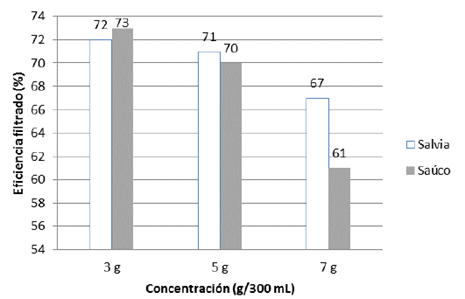
Figura 1: Eficiencias del proceso de filtración de los extractos de Salvia officinalis y Sambucus peruviana H.B.K.
Respecto a la cantidad de sólidos totales ya mencionada, es evidente la relación existente entre estos, que llegan a variar entre 200 y 500 ppm (considerando ambos extractos) y la densidad de cada inhibidor formulado en estudio, esto debido a la correspondencia entre la cantidad de material sólido existente en las muestras y la masa que tendrá cada uno, tal como se aprecia en la Figura 2. Asimismo, se corrobora que, de acuerdo con la estimación inicial de densidad de cada muestra vegetal pulverizada, el saúco (Sambucus peruviana H.B.K.) le confiere a los extractos (SAU 3, 5 y 7) una mayor densidad que en el caso del otro espécimen natural.
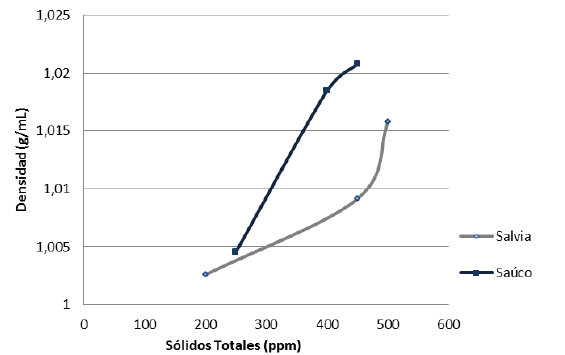
Figura 2: Relación entre densidad y sólidos totales para los extractos de Salvia officinalis y Sambucus peruviana H.B.K.
Cabe resaltar que la cantidad de sólidos (suspendidos y disueltos) resultan sustancialmente más bajos si se comparan con los estudios de[48], los cuales oscilaron entre 5.280 ppm y 26.810 ppm para los inhibidores a base de mucílago de Hibiscus rosa-sinensis de 0,5% hasta 4% m/V respectivamente; también como en el estudio del inhibidor de incrustaciones a base de pectina deshidratada de Passiflora edulis, donde se obtuvieron valores de 1.742, 2.872 y 4.900 ppm para los agentes químicos con concentraciones de 2 %, 4% y 6% m/V respectivamente, con tamaños de partículas mayores o iguales a 841 micrones [16]. En ninguno de los casos los aditivos naturales obtenidos fueron sometidos a proceso alguno de filtración que permitiese la remoción de las partículas sólidas presentes en el medio.
Merece especial mención que desde el punto de vista de la función del inhibidor se busca que el contenido de sólidos totales sea lo más bajo posible, ello a fin de no introducir más coloides en el sistema de producción. Este parámetro no determina directamente la eficiencia del inhibidor, pero sí resulta importante su consideración en tanto se espera una menor cantidad de sólidos involucrados en el sistema para evitar problemas o daños en los equipos[16], [49]. Además de que elevadas concentraciones de sólidos en suspensión son indeseables en el inhibidor de incrustación, ya que este debe ser capaz de disolverse completamente en la muestra de agua para así cumplir eficazmen te su función de impedir la formación de cristales. Al respecto, [50]sugiere que al momento de la aplicación de inhibidores se debe tomar en cuenta la presencia de sólidos en suspensión, ya que estos afectan la eficiencia máxima del producto.
Los valores de viscosidad de los inhibidores aportan una tendencia en ascenso, proporcional a la concentración de cada una de las fuentes naturales empleadas y obtenidas en los extractos, permitiendo una mayor resistencia al flujo para las sustancias obtenidas con concentraciones iniciales de 7 g que con las obtenidas con 3 g. Con valores que oscilan entre 1,1024 y 1,1946 cSt para el inhibidor obtenido de Salvia officinalis y entre 1,0154 y 1,5412 cSt para Sambucus peruviana H.B.K., resulta perentorio acotar que reflejan cantidades bajas si son comparadas con viscosidades obtenidas por inhibidores a base de polisacáridos naturales, como en el caso de los antiincrustantes a base del hidrogel pectínico de Passiflora edulis, donde se obtuvieron valores entre 6,70 y 78 cSt[17], o como para el agente químico formulado con mucílago de la hoja de la planta de Hibiscus rosasinensis, en el cual las viscosidades fluctuaron entre 10,24 y 443,31 cSt[48].
La explicación de lo anterior, en cuanto a la diferencia presentada entre las viscosidades de los inhibidores de incrustación a base de los extractos en estudio respecto a los polisacáridos, radica en el hecho de que los extractos provienen (como ya se ha referido) de un proceso de obtención sólido-líquido en el cual se colocó la materia vegetal pulverizada en contacto con un solvente (agua) y de allí se obtuvo un líquido con bajo contenido de sólidos que en gran medida permitieron conferirle más movilidad. Los polisacáridos, por otro lado, al entrar en contacto con el agua destilada (empleada en la formulación del inhibidor), permiten que se generen redes poliméricas entrelazadas que le conceden a los productos una mayor viscosidad, la cual se incrementa a medida que aumenta la concentración de cada agente químico. Para[50], los espesantes como pectinas y mucílagos, con contenido de polisacáridos en su composición, una vez añadidos al agua aumentan la viscosidad de la solución, toda vez que los polímeros tienen la facultad de alterar la viscosidad de un fluido sin producir cambios importantes en las propiedades de este.
Para completar la caracterización de los extractos empleados como inhibidores de incrustación, se determinó el pH a cada formulación. Los seis inhibidores formulados (SAL 3, 5, 7 y SAU 3, 5, 7) resultaron con un pH característico de soluciones ácidas, variando entre 3,23 y 3,80 y ascendiendo a medida que se incrementó la cantidad tanto de salvia como de saúco empleados en la extracción inicial (Figura 3), lo que implica que el aumento de la cantidad de cada una de las fuentes naturales usadas en la obtención de los extractos aportó componentes que permitieron que se elevara en cierta proporción el pH de las soluciones en estudio, a pesar de que cada uno tenía en su contenido una cantidad constante de 0,20 g/100 mL de ácido cítrico. Tal como se aprecia en la Figura 3, los aumentos de pH con el aumento de la concentración de materia natural usada no son tan pronunciados, lo que hace inferir que las posibles cantidades aportadas de compuestos generadores de alcalinidad al sistema no son tan elevadas.
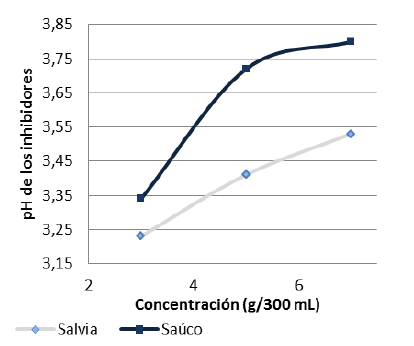
Figura 3: Relación entre el pH y la concentración inicial empleada para los extractos de Salvia officinalis y Sambucus peruviana H.B.K.
De acuerdo con estudios previamente realizados, se ha encontrado que las proporciones de calcio que pueden aportar tanto la salvia como el saúco están en el orden de 1,8% [51] y 1,9% [52] respectivamente.
La cantidad de este elemento (aunque baja) al reaccionar con el dióxido de carbono (CO2) que puede estar presente en el agua destilada usada para la formulación de los inhibidores, estaría generando este ascenso (no tan acentuado) del pH. Asimismo, se tasa en la Figura 4 el carácter relativamente más ácido de los productos a base de salvia, lo que podría conferirle una mejor acción antiincrustante a este que a los agentes a base de saúco. En [53] se evidenció el carácter ácido del extracto de una especie de saúco (Sambucus nigra L.), ubicándolo con un pH de 4,08, que no estaría tan alejado del máximo valor (3,80) obtenido para el caso en estudio, y que estaría justificado por el uso del ácido cítrico como preservante en el caso particular.
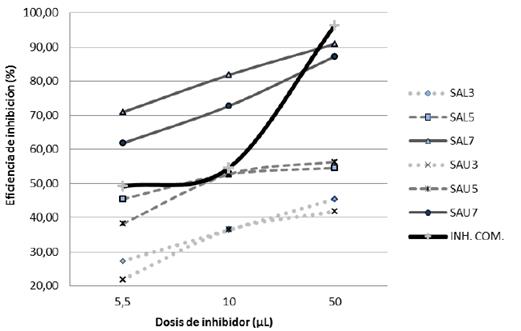
Figura 4: Comparación de las eficiencias de los extractos/inhibidores a base de Salvia officinalis y Sambucus peruviana H.B.K. con el producto comercial.
Eficiencia experimental de los bioinhibidores de incrustación
A continuación, en la Tabla VIII se establecen los porcentajes de inhibición obtenidos, según la Norma NACE TM0374- 2007[19], de las pruebas de eficiencia a las cuales fueron sometidos los inhibidores a base de Salvia officinalis y Sambucus peruviana H.B.K. y el producto comercial en las tres concentraciones y tres dosis que fueron planteadas para ser evaluados cada uno en la muestra de agua de producción del Campo Oritupano. El rendimiento del agente a base de Salvia officinalis osciló entre 27,27% y 90,91 %, y para el extracto de Sambucus peruviana H.B.K. se presentó entre 21,82% y 87,27 %.
Tabla VIII: Eficiencias de los extractos/inhibidores de incrustaciones a base de Salvia officinalis y Sambucus peruviana H.B.K. y del producto comercial.
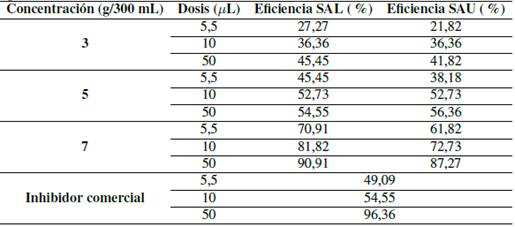
Como se puede visualizar tanto en la Tabla VIII como en la Figura 4, para cada inhibidor sometido a la prueba la eficiencia de inhibición aumentó al incrementar tanto la concentración de cada fuente natural como la dosificación de cada producto agregada en el agua de producción; lo anterior se debe a que al aumentar la cantidad de inhibidor usado se generó un incremento en la cantidad y capacidad de los compuestos mitigadores, disminuyendo así la tendencia de formación y precipitación de las sales minerales disueltas en el agua de producción.
De la Figura 4 se interpreta el hecho de que los inhibidores a base del extracto de las hojas de Salvia officinalis (SAL 3, 5, 7) resultaron con un mejor rendimiento en comparación con el producto originario de la otra materia prima (Sambucus peruviana H.B.K.), asociándose esto al potencial de hidrógeno de carácter más ácido que presentaron los productos de salvia, los cuales permitieron disolver los cristales de carbonato de calcio que se formaron como resultado de la exposición a la elevación de temperatura (71 C) durante las veinticuatro horas de duración de la prueba, evitando alguna probable nucleación de los referidos cristales de las sales minerales disueltas. En cuanto a la conducta del inhibidor comercial, se distingue (a las dosis de 5,5 y 10 L) que presenta igual o semejante eficiencia al inhibidor natural SAL5 (en sus tres dosis), pero a su máxima dosis (50 L), solo se encuentra un aproximado de seis puntos porcentuales por encima del producto SAL7 (a 50 L). Lo anterior le genera buenas expectativas experimentales al agente a base de las hojas de salvia (Salvia officinalis) al ser cotejado con el antiincrustante comercial empleado como patrón.
Los resultados obtenidos demuestran que los distintos inhibidores formulados a base las hojas de salvia y saúco actuaron eficazmente en el agua de producción del Campo Oritupano, pues mantuvieron los valores de dureza cálcica lo más cercano posible al valor correspondiente al blanco frío. Con base en lo anterior se puede ratificar que los extractos evaluados evitarán la precipitación de sales, impidiendo la aparición de las incrustaciones, además de representar una opción viable por su bajo costo, fácil producción y que al ser un producto natural reducirá en gran medida los daños ocasionados al medio ambiente.
Para efectos de ratificar los resultados obtenidos en las pruebas de eficiencia, se realizó la determinación del LSI para la muestra de agua de producción con las dosificaciones de los productos antiincrustantes (naturales y comercial) y los blancos (frío y caliente), revelando la expresión gráfica en la Figura 5.
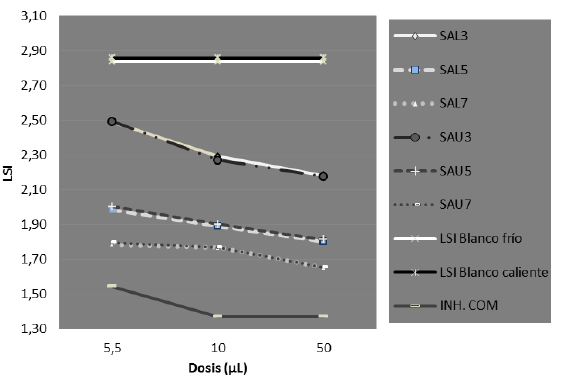
Figura 5: Comparación de los LSI para las muestras de agua con inhibidores experimentales, comercial y blancos (frio y caliente)
La aplicación de los tratamientos antiincrustantes permitió estimar una disminución de los LSI determinados en condición de dosificación, resultando más altos estos decrementos a mayor alícuota agregada para cada uno de los extractos inhibidores. Tal como se expresa en la Figura 6, se alcanza el máximo valor de disminución para SAL7 a 50 L (41,77 %). Además, se percibió que el inhibidor comercial logró obtener el más elevado descenso del índice de saturación (51,72 %), exteriorizando que en el agua de producción donde se llevó a cabo la evaluación se mantuvo mayor contenido de calcio en solución, pero conservando para todos los casos el carácter incrustante (LSI >0).
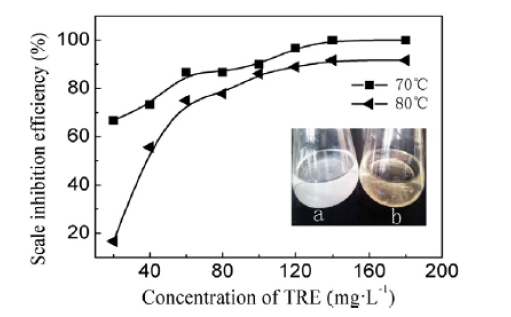
Figura 6: Efecto de la concentración de las hojas de tabaco y temperatura sobre la eficiencia de inhibición de incrustación: (a) depósitos de incrustaciones en blanco, (b) salmuera artificial con 140 ppm de extracto de tabaco. Fuente: (15).
Al comparar los resultados de las valoraciones de eficiencias obtenidos para los antiincrustantes ecológicos respecto a otros estudios previos donde se emplearon extractos como bioinhibidores de incrustaciones, se captó lo que a continuación se evalúa.
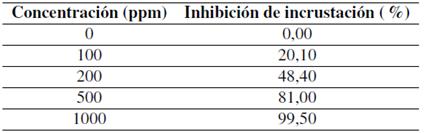
Del estudio basado en el uso del extracto de Bistorta officinalis[12], cuyos resultados relevantes se muestran en la Tabla IX, se aprecia que para las concentraciones de bistorta de 100 y 500 ppm, equivalentes a las dosis de 10 y 50 L de los productos en estudio, existe un grado de superioridad en cuanto a la eficiencia mostrada por los últimos (salvia y saúco) a su concentración más elevada (SAL7 y SAU7), lo cual pondera a los extractos propios como mejores opciones para efectos de la inhibición de incrustaciones de carbonato de calcio a menores dosis que las empleadas por los autores descritos.
Tabla IX: Resultados de las pruebas de eficiencias del extracto de Bistorta officinalis como inhibidor de incrustaciones. Fuente: (12)
Para el caso de la investigación llevada a cabo por[15], relacionada con el uso del extracto de tabaco como antiincrustante, se muestra seguidamente en la Figura 6 el comportamiento del rendimiento encontrado. Se evidencia que con el incremento de la concentración del extracto de tabaco de 20 a 140 ppm, aumentó la eficiencia de inhibición de las incrustaciones de calcio (sulfato y carbonato), obteniendo eficiencias máximas de 100% y 91,7% a las temperaturas de 70 y 80 C, respectivamente, a 140 ppm.
Comparado con los extractos de Salvia officinalis y Sambucus peruviana H.B.K., se aprecia una cercanía en los resultados obtenidos en estos últimos a la dosis de 10 L (para SAL7 y SAU7) y los logrados a 100 ppm (para el extracto de tabaco) de aproximadamente el 80% de eficiencia de inhibición. Por estudios previos se ha encontrado que los inhibidores a base de polifosfonatos disminuye su desempeño a temperaturas por encima de los 70 C[54]; por lo cual, basándose en el estudio de [15] y en el propio, se deduce que las elevadas eficiencias mostradas a las temperaturas de 70 y 80 C (para el extracto de hojas de tabaco) y a 71 C (para los extractos de salvia y saúco), pronostican un buen comportamiento de inhibición a unas temperaturas relativamente altas, comparados con los aditivos de origen polifosfonatados.
Respecto a[9], se manifestó que a la máxima concentración del extracto de oliva empleada en el estudio (50 ppm) obtuvieron un 83%(Figura 7) de inhibición, la cual, comparada con los obtenidos por las soluciones a base de salvia y saúco donde a la concentración superior (7 g/300 mL) para ambas especies, se alcanzaron rendimientos de 90,91% y 87,27 %, respectivamente, para la dosis equivalente de 50 μL.
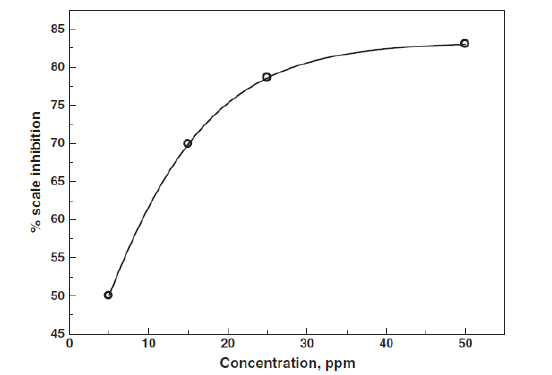
Figura 7: Variación del porcentaje de inhibición de incrustaciones con respecto a la concentración del extracto de hojas de oliva. Fuente: (9).
Lo anterior demuestra que después del contraste de resultados se certifica que la propuesta en estudio albergó resultados aceptables, los cuales derivaron con desempeños de igual calibre o superiores en comparación con las disertaciones tomadas como antecedentes (extractos de bistorta, tabaco y oliva) en la mitigación del fenómeno de incrustaciones minerales en sistemas de producción petrolera.
Análisis estadístico
Los valores tabulados mostrados a continuación corresponden al resultado del análisis de varianza simple. Dicho análisis tiene como objetivo evaluar el comportamiento cuantitativo de las eficiencias obtenidas para cada una de las repeticiones, representadas en este caso por las tres dosificaciones aplicadas para cada concentración de los inhibidores formulados a base de Salvia officinalis y Sambucus peruviana H.B.K., además del inhibidor comercial. Con ello es posible determinar si existen variaciones estadísticamente significativas entre las diferentes conductas encontradas.
Para el caso del ANOVA simple aplicado a la eficiencia del extracto de Salvia officinalis (SAL 3,5, 7) respecto al inhibidor comercial, en la Tabla X se expone que existieron diferencias estadística mente significativas (valor-P menor a 0,05). Se aprecia lo indicado en el componente entre grupos de la Tabla X, adjudicado esto al hecho de que no todas las medias de cada producto son iguales entre sí. El mismo procedimiento se aplicó para el inhibidor a base de Sambucus peruviana H.B.K., obteniéndose que no hay presencia de diferencias significativas entre las medias de los tratamientos en estudio (experimentales y comercial), tal como se comprueba en la Tabla XI, con un valor-P relativamente mayor a 0,05.
Tabla X: Análisis de Varianza simple para las eficiencias del inhibidor a base del extracto de Salvia officinalis y el producto comercial

Tabla XI: Análisis de Varianza simple para las eficiencias del inhibidor a base del extracto de Sambucus peruviana H.B.K. y el producto comercial

Para verificar cuáles medias son significativamente diferentes de otras, en la Tabla XII se muestran los resultados de la prueba de múltiples rangos para los inhibidores a base de Salvia officinalis y Sambucus peruviana H.B.K. respecto al producto comercial.
Tabla XII: Prueba de múltiples rangos para las eficiencias de los dos inhibidores en estudio y el producto comercial
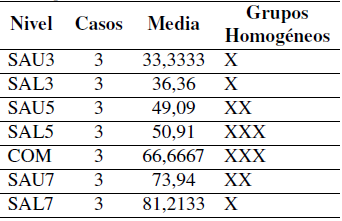
Se exhibe que, al contrastar las medias de cada agente respecto a los otros, los inhibidores a base de salvia y saúco en sus máximas concentraciones presentan diferencias significativas con respecto a sus respectivas bases a menores proporciones, por lo que son estadísticamente similares solo entre ellos mismos (SAL7 y SAU7) y respecto al aditivo comercial.
Una vez obtenidos los resultados, se deduce que los agentes químicos SAL7 y SAU7 (en sus tres dosificaciones) presentaron un comportamiento estadísticamente similar con el agente comercial, lo cual los cataloga como buenos prospectos experimentales a considerar en contextos de la industria petrolera, ello a pesar de que, en cuantía de rendimientos, el producto a base de salvia resultó con mejor desempeño.
Conclusiones
La muestra de agua de producción del Campo Oritupano presentó una dureza elevada característica de aguas subterráneas, además de ostentar las propiedades idóneas para generar incrustaciones como un pH de 9,15 y un LSI positivo. Por otro lado, los extractos de Salvia officinalis y Sambucus peruviana H.B.K. empleados como antiincrustantes exteriorizaron resultados acordes con un bioinhibidor, con potenciales de hidrógeno de carácter ácido, viscosidades por debajo de los 2 cSt, aunque con proporción de sólidos que deberían disminuirse aún más.
De la evaluación del desempeño de los bioinhibidores de incrustación se obtuvieron conductas ascendentes a medida que aumentó la dosificación y la concentración aplicada de materia vegetal incluida en el proceso inicial de extracción.
El extracto de las hojas de Salvia officinalis obtuvo mejor eficiencia (90,91 %) a la concentración y dosis más altas (7 g/300 mL y 50 L), generando una opción viable que debería ser evaluada a nivel de campo. Además, los productos a base de y Sambucus peruviana H.B.K. a la concentración de 7 g/300 mL (en sus tres dosificaciones) presentaron igual comportamiento estadístico que el producto inhibidor comercial empleado como patrón referencial.
Finalmente, como sugerencia a futuras investigaciones, se plantea obtener los terpenos contenidos en las hojas de la planta de Salvia officinalis y estudiar su efecto como dispersantes de asfaltenos.
Referencias
License
Copyright (c) 2023 Luis Antonio Castillo Campos, Steevenson José Barreto

This work is licensed under a Creative Commons Attribution-NonCommercial-ShareAlike 4.0 International License.

From the edition of the V23N3 of year 2018 forward, the Creative Commons License "Attribution-Non-Commercial - No Derivative Works " is changed to the following:
Attribution - Non-Commercial - Share the same: this license allows others to distribute, remix, retouch, and create from your work in a non-commercial way, as long as they give you credit and license their new creations under the same conditions.

2.jpg)