DOI:
https://doi.org/10.14483/23448393.22843Published:
2026-07-25Issue:
Vol. 31 No. 1 (2026): January-AprilSection:
Electrical, Electronic and Telecommunications EngineeringTechnical Feasibility Analysis of DC Microgrids in a Non-Interconnected Area
Análisis de viabilidad técnica de Microrredes DC en una zona no interconectada
Keywords:
DC microgrid, Matlab, Non-interconnected zones, Distributed generation, Incremental conductance (en).Keywords:
Microrred DC, Matlab, Zonas no interconectadas, Generación distribuida, Conductancia incremental (es).Downloads
Abstract (en)
Context: In recent times, access to electricity in non-interconnected areas has been a constant challenge. Therefore, this article evaluates the technical feasibility of implementing direct-current (DC) microgrids in these areas, focusing on food conservation. Our evaluation focuses on the region of Chacón Playa (Timbiquí) in the Cauca Pacific, Colombia.
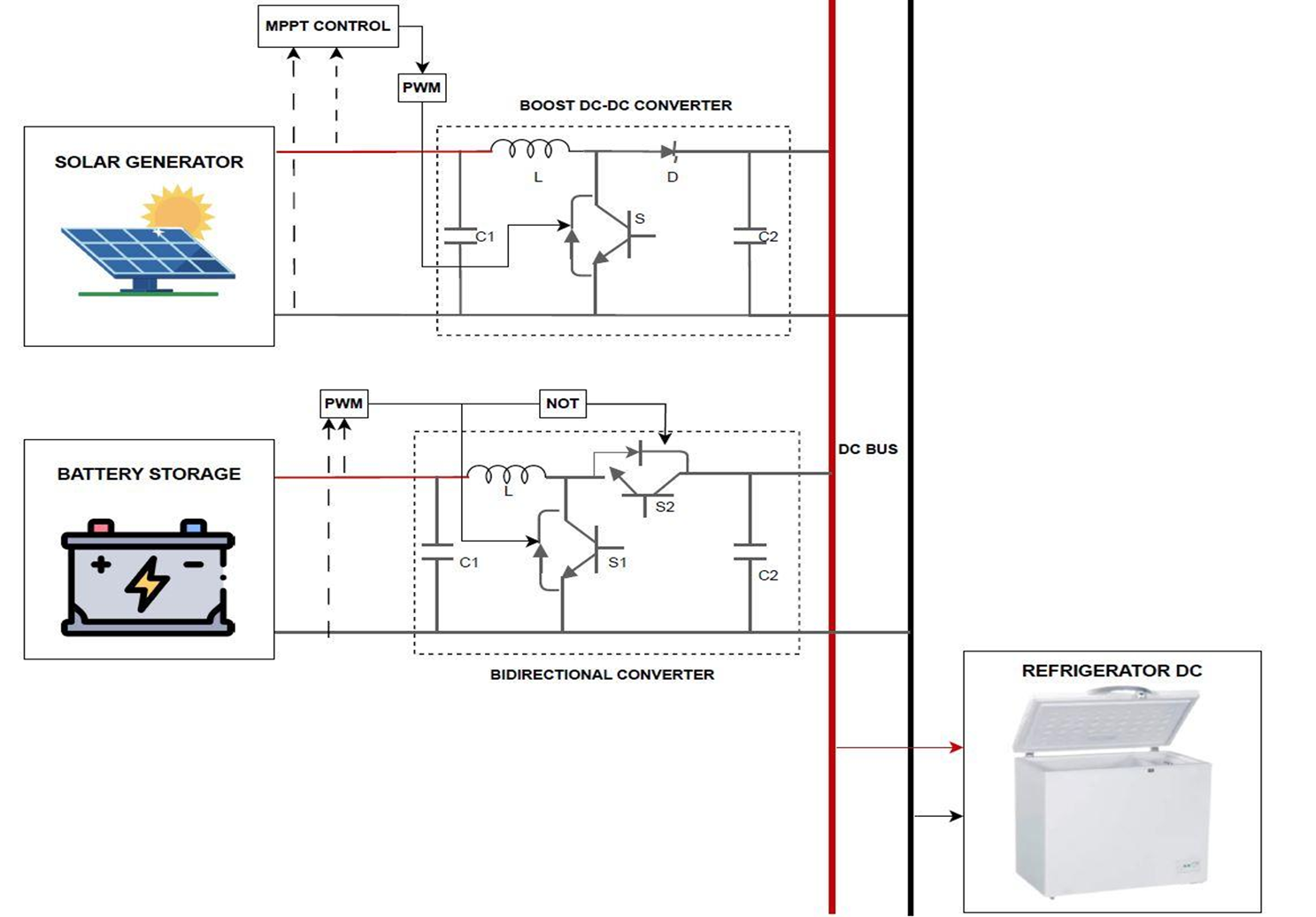
Method: This work analyzes the advantages and disadvantages of DC microgrids vs. alternating-current (AC) systems, selecting a radial topology for its simplicity and expandability. A simulation is performed in MATLAB-Simulink with a control system based on the incremental conductance algorithm, which incorporates solar photovoltaic generation, battery backup, power converters, and a load composed of four DC coolers.
Results: The results and simulations show that DC microgrids are effective in meeting voltage and current demands in response to changes in solar radiation and power demand. Our findings highlight the ability of DC microgrids to provide a stable and efficient power supply suitable for food conservation in non-interconnected areas.
Conclusions: DC microgrids represent a viable solution to cover energy needs in isolated areas. This study supports their implementation as a sustainable and reliable alternative, opening new opportunities for the development of regulatory frameworks that facilitate the expansion of this type of technology in similar regions.
Abstract (es)
Contexto: En los últimos tiempos, el acceso a la electricidad en zonas no interconectadas ha sido un desafío constante. Por ello, este artículo evalúa la viabilidad técnica de implementar microrredes de corriente continua (DC) en estas áreas, centrando su atención en la conservación de alimentos. Nuestra evaluación se enfoca en la región de Chancón Playa (Timbiquí) en el Pacífico del Cauca, Colombia.
Método: Este trabajo analiza las ventajas y desventajas de las microrredes DC frente a los sistemas de corriente alterna (AC), seleccionando una topología radial por su simplicidad y capacidad de expansión. Se desarrolla una simulación en MATLAB-Simulink con un sistema de control basado en el algoritmo de conductancia incremental, la cual incorpora generación solar fotovoltaica, respaldo de baterías, convertidores de potencia y una carga compuesta por cuatro refrigeradores DC.
Resultados: Los resultados y las simulaciones muestran que las microrredes DC son efectivas para satisfacer las demandas de tensión y corriente en respuesta a cambios en la radiación solar y en la demanda de potencia. Nuestros hallazgos destacan la capacidad de las microrredes DC para ofrecer un suministro de energía estable y eficiente, adecuado para la conservación de alimentos en zonas no interconectadas.
Conclusiones: Las microrredes DC representan una solución viable para cubrir las necesidades energéticas en zonas aisladas. Este estudio respalda su implementación como alternativa sostenible y confiable, abriendo nuevas oportunidades para el desarrollo de marcos regulatorios que faciliten la expansión de este tipo de tecnología en regiones similares.
References
[1] F. De La Cruz and C. Avila, “Sistemas fotovoltaicos: solución energética en las comunidades aisladas,” Rev. Cien. Ing., vol. 9, no. 2, 2022.
[2] M. I. Torres Villamizar, “Caracterización de soluciones para comunidades en zonas no interconectadas al sistema eléctrico en Colombia,” Jul. 2022, [Online]. Available: http://hdl.handle.net/1992/59144
[3] M. Castaneda, P. Yanguas, F. Corral, E. Ángel-Sanint, F. Palacios, D. Gómez, R. Ávila, J. D. Cortés, P.-Y. Oei, S. Zapata, and I. Dyner, “Achieving a 100% renewable electricity supply in Colombia by 2030: Dream or feasible possibility?,” Sustain. Futures, vol. 10, Art. no. 101468, 2025. https://doi.org/10.1016/j.sftr.2025.101468
[4] I. Granit, “What makes Colombia’s indigenous peoples adopt microgrids? Social acceptance and financial constraints in renewable energy diffusion,” Energy Res. Soc. Sci., vol. 101, Art. no. 103132, Jul. 2023. https://doi.org/10.1016/j.erss.2023.1031
[5] F. Ojeda Peña, “Revisión de contenido teórico sobre microrredes y estudios previos Colombia,” Universidad Santo Tomas, 2022. [Online]. Available: http://hdl.handle.net/11634/49251
[6] G. Liu, Z. Li, Y. Xue, and K. Tomsovic, “Microgrid assisted design for remote areas,” Energies, vol. 15, no. 10, Art. no. 3725, May 2022. https://doi.org/10.3390/en15103725
[7] UPME, “Plan Indicativo de Expansión de Cobertura de Energía Eléctrica,” 2019. [Online]. Available: https://www1.upme.gov.co/siel/PIEC/2019-23/2019/Informacion_Base_PIEC_Dic302019.pdf
[8] J. A. Cerón, E. Gómez-Luna, and J. C. Vasquez, "Driving the Energy Transition in Colombia for Off-Grid Regions: Microgrids and Non-Conventional Renewable Energy Sources," Energies, vol. 18, no. 4, Art. no. 1010, Feb. 2025. https://doi.org/10.3390/en18041010
[9] T. Mosetlhe, A. Yusuff, T. Ayodele, and A. Ogunjuyigbe, "Sustainable rural electrification through micro-grids in developing nations—A review of recent development," Energy Reports, vol. 13, pp. 1171–1177, 2025. https://doi.org/10.1016/j.egyr.2024.11.040
[10] F. Randibarnas, K. S. Gautama, E. Agustian, T. Ardriani, J. Furqani, and A. Rizqiawan, “A distributed PCS based DC microgrid system for rural electrification,” in Proc. 5th Int. Conf. Power Eng. Renew. Energy (ICPERE), 2022, pp. 1–6. https://doi.org/10.1109/ICPERE56870.2022.10037531
[11] D. Li and C. N. M. Ho, “A module-based plug-n-play DC microgrid with fully decentralized control for IEEE Empower a Billion Lives competition,” IEEE Trans. Power Electron., vol. 36, no. 2, pp. 1764–1776, Feb. 2021. https://doi.org/10.1109/TPEL.2020.3009631
[12] N. Wang, Y. Jiang, Y. Wang, D. Mou, Y. Liu, and W. Hu, “Advanced operation and control schemes of retired batteries in DC microgrid for secondary usage,” IEEE Trans. Smart Grid, vol. 16, no. 4, pp. 3155–3166, Jul. 2025. https://doi.org/10.1109/TSG.2025.3555181
[13] B. Modu, M. P. Abdullah, M. A. Sanusi, and M. F. Hamza, “DC-based microgrid: Topologies, control schemes, and implementations,” Alexandria Eng. J., 2023. https://doi.org/10.1016/j.aej.2023.02.021
[14] A. Bastidas and A. Pantoja, “Análisis técnico-económico de una microrred DC en un edificio universitario,” Sep. 2023, pp. 1–11. https://doi.org/10.26507/paper.3209
[15] A. Valencia-Díaz, E. M. Toro, and R. A. Hincapié, "Optimal planning and management of the energy–water–carbon nexus in hybrid AC/DC microgrids for sustainable development of remote communities," Applied Energy, vol. 377, pt. B, Art. no. 124517, 2025. https://doi.org/10.1016/j.apenergy.2024.124517
[16] K. El Mezdi, A. El Magri, A. Watil, I. El Myasse, N. El Aadouli, and P. Kumar, "Efficient energy management of a low-voltage AC microgrid with renewable and energy storage integration using nonlinear control," Sci. Rep, vol. 15, no. 1, Art. no. 38651, 2025. https://doi.org/10.1038/s41598-025-22473-6
[17] N. Peter, P. Gupta, and N. Goel, "Intelligent strategies for microgrid protection: A comprehensive review," Appl. Energy, vol. 379, Art. no. 124901, 2025. https://doi.org/10.1016/j.apenergy.2024.124901
[18] S. Anbuchandran, M. Arumuga Babu, D. Silas Stephen, and M. Thinakaran, "Dynamic voltage regulation in DC microgrids using super-twisting sliding mode controllers," Electr Eng, vol. 107, no. 11, pp. 14205–14227, 2025. https://doi.org/10.1007/s00202-025-03256-8
[19] M. Fotopoulou, D. Rakopoulos, D. Trigkas, F. Stergiopoulos, O. Blanas, and S. Voutetakis, "State of the art of low and medium voltage direct current (DC) microgrids," Energies, vol. 14, no. 18, Art. no. 5595, Sep. 2021. https://doi.org/10.3390/en14185595
[20] S. Jayaprakash, B. Gopi, M. G. Raj, S. Sujith, S. Deepa, and S. Swapna, “Development of Energy Management System for Micro Grid Operation,” Comp. Syst. Sci. Eng., vol. 45, no. 3, pp. 2537–2551, 2023. https://doi.org/10.32604/csse.2023.032038
[21] S. Coffey, V. Timmers, R. Li, G. Wu, and A. Egea-Àlvarez, "Review of MVDC applications, technologies, and future prospects," Energies, vol. 14, no. 24, Art. no. 8294, Dec. 2021. https://doi.org/10.3390/en14248294
[22] V. F. Pires, A. Pires, and A. Cordeiro, “DC Microgrids: Benefits, Architectures, Perspectives and Challenges,” Energies (Basel), vol. 16, no. 3, Feb. 2023. https://doi.org/10.3390/en16031217
[23] V. Srimathi and D. Vijayakumar, "Design and Implementation of Power Management System in Multi-String Solar-Interfaced DC Microgrid With Energy Storage System," IEEE Access, vol. 13, pp. 140012-140027, 2025. https://doi.org/10.1109/ACCESS.2025.3595594
[24] Z. Ali et al., “Fault Management in DC Microgrids: A Review of Challenges, Countermeasures, and Future Research Trends,” IEEE Access, vol. 9, pp. 128032–128054, 2021. https://doi.org/10.1109/ACCESS.2021.3112383
[25] A. Baqar, M. B. Camara, and B. Dakyo, “Supercapacitors Fast Ageing Control in Residential Microgrid Based Photovoltaic/Fuel Cell/Electric Vehicle Charging Station,” Energies (Basel), vol. 16, no. 13, p. 5084, Jun. 2023. https://doi.org/10.3390/en16135084
[26] S. S. Rangarajan, R. Raman, A. Singh, C. K. Shiva, R. Kumar, P. K. Sadhu, E. R. Collins, and T. Senjyu, "DC Microgrids: A Propitious Smart Grid Paradigm for Smart Cities," Smart Cities, vol. 6, no. 4, pp. 1690–1718, Jul. 2023. https://doi.org/10.3390/smartcities6040079
[27] J. A. G. Archetti et al., “Real time validation of a control system for microgrids with distributed generation and storage resources,” Elec. Power Syst. Res., vol. 223, Oct. 2023, https://doi.org/10.1016/j.epsr.2023.109683
[28] B. Aljafari, S. Vasantharaj, V. Indragandhi, and R. Vaibhav, "Optimization of DC, AC, and Hybrid AC/DC Microgrid-Based IoT Systems: A Review," Energies, vol. 15, no. 18, Art. no. 6813, Sep. 2022. https://doi.org/10.3390/en15186813
[29] J. Kang, B. Hao, Y. Li, H. Lin, and Z. Xue, “The Application and Development of LVDC Buildings in China,” Energies (Basel), vol. 15, no. 19, Art. no. 7045, Oct. 2022, https://doi.org/10.3390/en15197045
[30] M. Nasir, S. Iqbal, H. A. Khan, J. C. Vasquez, and J. M. Guerrero, “Sustainable rural electrification through solar PV DC microgrids—An architecture-based assessment,” Processes, vol. 8, no. 11, pp. 1–23, Nov. 2020, https://doi.org/10.3390/pr8111417
[31] H. M. Mohan and S. K. Dash, “Renewable Energy-Based DC Microgrid with Hybrid Energy Management System Supporting Electric Vehicle Charging System,” Systems, vol. 11, no. 6, p. 273, May 2023, https://doi.org/10.3390/systems11060273
32] S. Azizi, M. H. Asemani, N. Vafamand, S. Mobayen, and A. Fekih, “Adaptive Neural Network Linear Parameter-Varying Control of Shipboard Direct Current Microgrids,” IEEE Access, vol. 10, pp. 75825–75834, 2022, https://doi.org/10.1109/ACCESS.2022.3191385
[33] J. Díaz , “Propuesta metodológica para el análisis integral de la factibilidad de la implementación de microrredes para zonas no interconectadas (ZNI) colombianas,” Universidad de los Andes, 2023. [Online]. Available: http://hdl.handle.net/1992/69629
[34] Y. L. Correa, I. F. Muñoz, F. Franco Obando, and M. Bueno Lopez, "Computational comparison of AC and DC motors to hydrodynamic changes in marine fishing vessels," TecnoL, vol. 26, no. 56, Art. no. e2442, 2023. https://doi.org/10.22430/22565337.2442
[35] M. Bueno Lopez, M. T. Rengifo Ordoñez, D. Chacón Campo, J. Tocancipá-Falla, and A. Osorio Arias, "Energy Transition for rural development: A preliminary case study in Colombia for improving artisanal fishing," Sci. Tech, vol. 29, no. 2, pp. 89–96, 2024. https://doi.org/10.22517/23447214.24944
[36] IPSE, “Informe Mensual de telemetría,” 2023. [Online]. Available: https://ipse.gov.co/cnm/informes-de-operacion/
[37] K. Jithin, P. P. Haridev, N. Mayadevi, R. Hari Kumar, and V. P. Mini, "A Review on Challenges in DC Microgrid Planning and Implementation," J. Mod. Power Syst. Clean Energy, vol. 11, no. 5, pp. 1375–1395, Sep. 2023. https://doi.org/10.35833/MPCE.2022.000053
[38] T. Castillo-Calzadilla, M. A. Cuesta, C. Olivares-Rodriguez, A. M. Macarulla, J. Legarda, and C. E. Borges, "Is it feasible a massive deployment of low voltage direct current microgrids renewable-based? A technical and social sight," Renew. Sustain. Energy Rev., vol. 161, Art. no. 112198, Jun. 2022. https://doi.org/10.1016/j.rser.2022.112198
[39] PVGIS, “Solar radiation,” 2022. [Online]. Available: https://re.jrc.ec.europa.eu/pvg_tools/en/#MR
[40] J. F. Franco Martínez and B. S. Laserna Murcia, “ Diseño y simulación de controladores por aprendizaje reforzado para convertidores de potencia utilizados en micro redes de corriente directa.,” Universidad Antonio Nariño, 2023. [Online]. Available: http://repositorio.uan.edu.co/handle/123456789/8263
[41] H.-Y. Lu, C.-E. Ye, H.-Y. Tsai, and Y.-P. Huang, "Enhanced harmony search for MPPT control in solar systems," Results Eng, vol. 25, Art. no. 104274, 2025. https://doi.org/10.1016/j.rineng.2025.104274
How to Cite
APA
ACM
ACS
ABNT
Chicago
Harvard
IEEE
MLA
Turabian
Vancouver
Download Citation
License
Copyright (c) 2026 Iván Felipe Muñoz Sarria, Maximiliano Bueno López

This work is licensed under a Creative Commons Attribution-NonCommercial-ShareAlike 4.0 International License.

From the edition of the V23N3 of year 2018 forward, the Creative Commons License "Attribution-Non-Commercial - No Derivative Works " is changed to the following:
Attribution - Non-Commercial - Share the same: this license allows others to distribute, remix, retouch, and create from your work in a non-commercial way, as long as they give you credit and license their new creations under the same conditions.

2.jpg)