DOI:
https://doi.org/10.14483/23448393.23151Published:
2025-10-22Issue:
Vol. 31 No. 2 (2026): May-AugustSection:
Mechanical EngineeringCalibration of an External Pressure Cell Coupled to a Digital Densimeter for Measuring Liquid Densities
Calibración de una célula de presión externa acoplada a un densímetro digital para medir densidades de líquidos
Keywords:
density, pressure, temperature, uncertainty (en).Keywords:
densidad, presión, temperatura, incertidumbre (es).Downloads
Abstract (en)
Context: The accurate determination of density is crucial because density is an important property in the custody transfer of fluids and in other applications, such as the characterization of fuels and biofuels.
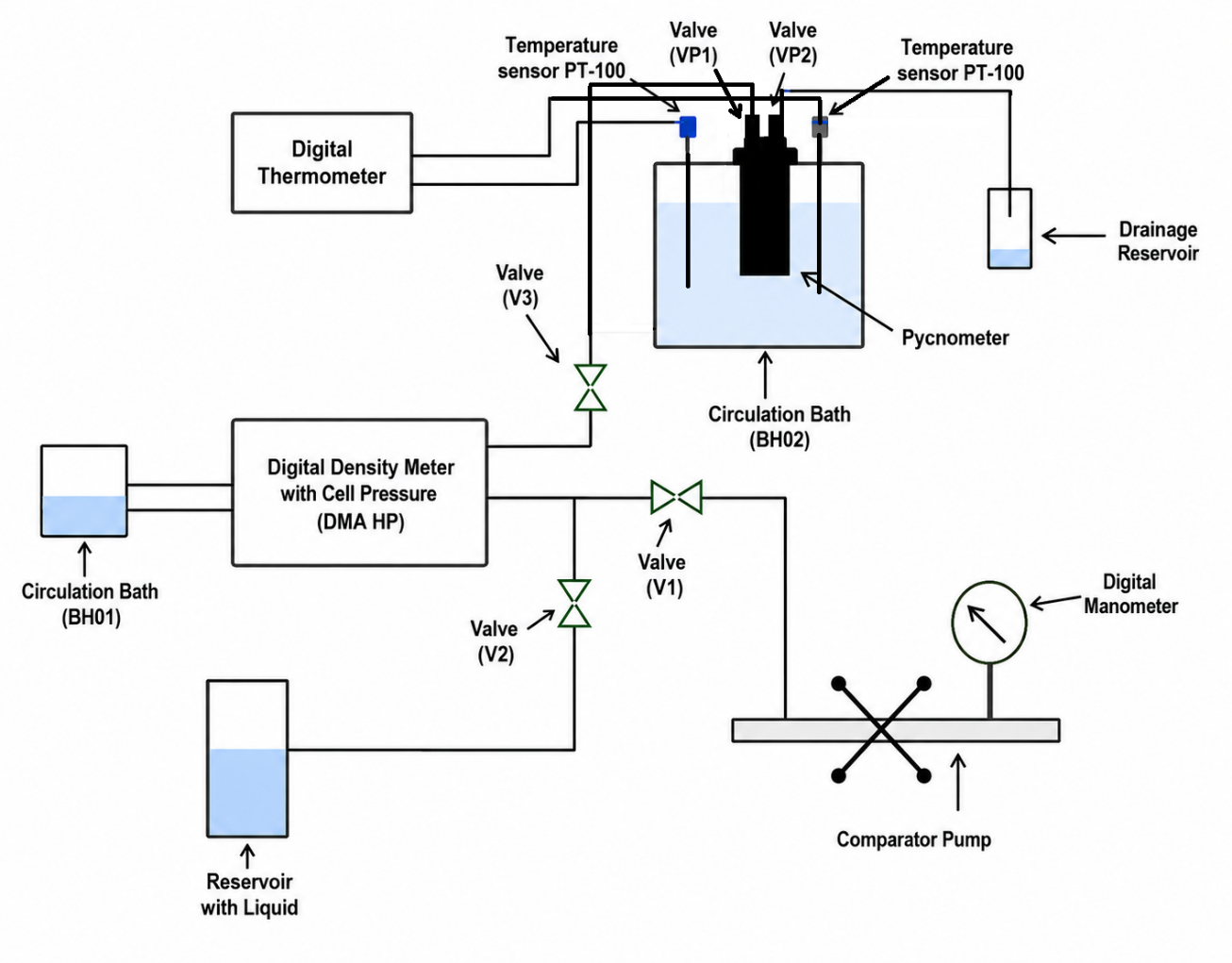
Method: The calibration of the pressure cell, which is connected to the digital densimeter, was performed according to the measurement standards of the Fluids Laboratory of the Instituto Nacional de Metrologia, Qualidade e Tecnologia (Inmetro). This calibration involved determining an internal adjustment factor, which was obtained at each calibration temperature, from 277.15 K to 313.15 K, over a pressure range from 0.1 MPa to 15 MPa. Additionally, reference solutions were used under the same temperature and pressure conditions, as specified by the operational requirements.
Results: The relative expanded uncertainty associated with the calibration curve is 0.00030 g/cm³, for a coverage factor of 2.058 (95% confidence level). It applies to a density range from 0.7033 g/cm³ to 1.0064 g/cm³, a temperature range from 277.15 K to 313.15 K, and a pressure range from 0.1 MPa to 15.0 MPa.
Conclusions: With the pressure cell and all its instruments properly calibrated, this system can be used for a variety of applications within a temperature range from 277.15 K to 313.15 K and a pressure range from 0.1 MPa to 15.0 MPa, including pycnometer calibration, the measurement of liquid densities from 0.7033 g/cm³ to 1.0064 g/cm³, and the calibration of other pressure cells.
Abstract (es)
Contexto: La determinación exacta de la densidad es crucial, ya que la densidad es una propiedad importante en la transferencia de custodia de fluidos y en otras aplicaciones, como la caracterización de combustibles y biocombustibles.
Método: La calibración de la celda de presión, que está conectada al densímetro digital, se realizó de acuerdo con los patrones de trabajo del Laboratorio de Fluidos del Instituto Nacional de Metrologia, Qualidade e Tecnologia (Inmetro). Esta calibración implicó determinar un factor de ajuste interno, que se obtuvo en cada temperatura de calibración, desde 277,15 K hasta 313,15 K, en un rango de presión de 0,1 MPa a 15 MPa. Además, se utilizaron soluciones de referencia en las mismas condiciones de temperatura y presión, tal como lo especifican los requisitos operacionales.
Resultados: La incertidumbre expandida relativa asociada con la curva de calibración es de 0,00030 g/cm³, para un factor de cobertura de 2,058 (nivel de confianza del 95 %). Se aplica a un rango de densidad de 0,7033 g/cm³ a 1,0064 g/cm³, un rango de temperatura de 277,15 K a 313,15 K y un rango de presión de 0,1 MPa a 15,0 MPa.
Conclusiones: Con la celda de presión y todos sus instrumentos debidamente calibrados, este sistema puede utilizarse para diversas aplicaciones dentro de un rango de temperatura de 277,15 K a 313,15 K y un rango de presión de 0,1 MPa a 15,0 MPa, entre ellas la calibración de picnómetros, la medición de la densidad de líquidos de 0,7033 g/cm³ a 1,0064 g/cm³ y la calibración de otras celdas de presión.
References
[1] J. J. P. Santos Junior, Development of a System for Determining the Density of Liquids as a Function of Simultaneous Pressure and Temperature Variation, Ph.D. dissertation, Universidade Federal Fluminense, Niterói, Brazil, 2020 (in Portuguese).
[2] Oscillation-Type Density Meters—Part 1: Laboratory Instruments, ISO 15212-1:1998, International Organization for Standardization, Geneva, Switzerland, 1998.
[3] Oscillation-Type Density Meters—Part 2: Process Instruments for Homogeneous Liquids, ISO 15212-2:2002, International Organization for Standardization, Geneva, Switzerland, 2002.
[4] Guidelines on the Calibration of Oscillation-Type Density Meters, SIM MWG7/cg-02/v.00, Sistema Interamericano de Metrología (SIM), 2016.
[5] S. Lorefice, R. Romeo, M. Santiano, and A. Capelli, “Original Pycnometers for Volatile Liquid Density over Wide Ranges of Temperature and Pressure: Practical Example,” Metrologia, vol. 51, no. 3, pp. 154–250, 2014, https://doi.org/10.1088/0026-1394/51/3/154
[6] J. Díaz, L. Becerra, L. Centeno, F. Castillo, and U. Bravo, “Desarrollo de materiales de referencia certificados en densidad,” in Proc. Simposio de Metrología, Mexico, 2010.
[7] J. J. P. Santos Junior et al., “Measurements and Correlations of Density, Isothermal Compressibility Factor, and Thermal Expansion Coefficient of Anhydrous Ethanol Fuel as a Function of Temperature and Pressure,” Int. J. Thermophys., vol. 42, Art. no. 78, 2021, https://doi.org/10.1007/s10765-021-02825-w
[8] J. J. P. Santos Junior, R. G. Pereira, M. Rosendahl, A. J. S. M. de Mendonça, D. M. do Espirito Santo Filho, and J. M. Gouveia, “Determination of Density, Isobaric Thermal Expansivity Coefficient and Isothermal Compressibility Coefficient Correlations for n-Dodecane and n-Nonane as a Function of Temperature and Pressure,” Int. J. Thermophys., vol. 43, Art. no. 107, 2022, https://doi.org/10.1007/s10765-022-03024-x.
[9] Evaluation of Measurement Data—Guide to the Expression of Uncertainty in Measurement, JCGM 100:2008, Joint Committee for Guides in Metrology, 2008.
[10] Expression of the Uncertainty of Measurement in Calibration, EA-4/02, 1st Brazilian ed. Rio de Janeiro, Brazil: INMETRO, ABNT, and SBM, 1999 (in Portuguese).
[11] G. Schilling, R. Kleinrahm, and W. Wagner, “Measurement and Correlation of the (p, ρ, T) Relation of Liquid n-Heptane, n-Nonane, 2,4-Dichlorotoluene, and Bromobenzene in the Temperature Range from 233.15 K to 473.15 K at Pressures up to 30 MPa for Use as Density Reference Liquids,” J. Chem. Thermodyn., vol. 40, no. 7, pp. 1095–1105, 2008, https://doi.org/10.1016/j.jct.2008.02.020
[12] M. L. Singh, S. C. Tripathi, P. P. K. Venkata, and V. G. Gaikar, “Correlations Among Composition, Temperature, and Density, Viscosity, or Derived Thermodynamic Properties of Binary Mixtures of Tri-n-butyl Phosphate with n-Hexane or n-Dodecane,” Ind. Eng. Chem. Res., vol. 53, pp. 3795–3804, 2014, https://doi.org/10.1021/ie4036912
[13] Y. Takiguchi and M. Uematsu, “Densities for Liquid Ethanol in the Temperature Range from 310 K to 480 K at Pressures up to 200 MPa,” J. Chem. Thermodyn., vol. 28, no. 1, pp. 7–16, 1996, https://doi.org/10.1006/jcht.1996.0003
[14] H. Bettin and F. Spieweck, “A Revised Formula for the Calculation of Alcoholometric Tables,” PTB-Mitteilungen, vol. 100, no. 6, pp. 457–460, 1990
[15] Alcoholometric Tables, ABNT NBR 5992:2008, 2nd ed. Rio de Janeiro, Brazil: Associação Brasileira de Normas Técnicas, 2008 (in Portuguese).
[16] D. Maestre, S. Orjuela, and J. Duarte, “Experimental Assessment of the Emissions Characteristics of Low Displacement Diesel Engines Operating with Biodiesel Blends from Algae Oil,” Ingeniería, vol. 27, no. 2, Art. no. e17539, 2022, https://doi.org/10.14483/23448393.17539
[17] D. Herrera, J. Bermúdez, and C. Castilla, “Análisis del desempeño de la potencia y el torque de un motor diésel operando con mezclas de biodiésel de palma,” Ingeniería, vol. 25, no. 3, pp. 250–263, 2020, https://doi.org/10.14483/23448393.15676.
[18] L. Mónico, J. Sandoval, and A. Rodríguez, “Estudio teórico sobre la influencia del uso de mezclas de biodiésel de aceite de palma con Jet A-1 en motores a reacción,” Ingeniería, vol. 22, no. 1, pp. 140–151, 2017, https://doi.org/10.14483/udistrital.jour.reving.2017.1.a06
[19] E. W. Lemmon and R. Span, “Short Fundamental Equations of State for 20 Industrial Fluids,” J. Chem. Eng. Data, vol. 51, no. 3, pp. 785–850, 2006, https://doi.org/10.1021/je050186n.
[20] E. W. Lemmon and M. L. Huber, “Thermodynamic Properties of n-Dodecane,” Energy Fuels, vol. 18, no. 4, pp. 960–967, 2004, https://doi.org/10.1021/ef0341062.
[21] J. A. Schroeder, S. G. Penoncello, and J. S. Schroeder, “A Fundamental Equation of State for Ethanol,” J. Phys. Chem. Ref. Data, vol. 43, Art. no. 043102, 2014, https://doi.org/10.1063/1.4895394
[22] W. Wagner and A. Pruss, “The IAPWS Formulation 1995 for the Thermodynamic Properties of Ordinary Water Substance for General and Scientific Use,” J. Phys. Chem. Ref. Data, vol. 31, no. 2, pp. 387–535, 2002, https://doi.org/10.1063/1.1461829
[23] M. G. Cox, “The Evaluation of Key Comparison Data: Determining the Largest Consistent Subset,” Metrologia, vol. 44, pp. 187–200, 2007, https://doi.org/10.1088/0026-1394/44/3/005.
[24] J. J. P. Santos Junior et al., “The Use of Ethanol to Determine the Volume of a Pycnometer Used to Measure the Density of Liquids at Different Temperatures and Pressures,” J. Braz. Soc. Mech. Sci. Eng., vol. 42, Art. no. 50, 2020, https://doi.org/10.1007/s40430-019-2107-y
How to Cite
APA
ACM
ACS
ABNT
Chicago
Harvard
IEEE
MLA
Turabian
Vancouver
Download Citation
License
Copyright (c) 2025 José Julio dos Santos Junior, Roberto Pereira, Dalni Espirito Santo Filho, José Mauricio Gouveia, Mila Rosendahl Avelino

This work is licensed under a Creative Commons Attribution-NonCommercial-ShareAlike 4.0 International License.

From the edition of the V23N3 of year 2018 forward, the Creative Commons License "Attribution-Non-Commercial - No Derivative Works " is changed to the following:
Attribution - Non-Commercial - Share the same: this license allows others to distribute, remix, retouch, and create from your work in a non-commercial way, as long as they give you credit and license their new creations under the same conditions.