DOI:
https://doi.org/10.14483/25009311.23722Publicado:
2025-06-12Edição:
v. 11 n. 19 (2025): julio-diciembre 2025Seção:
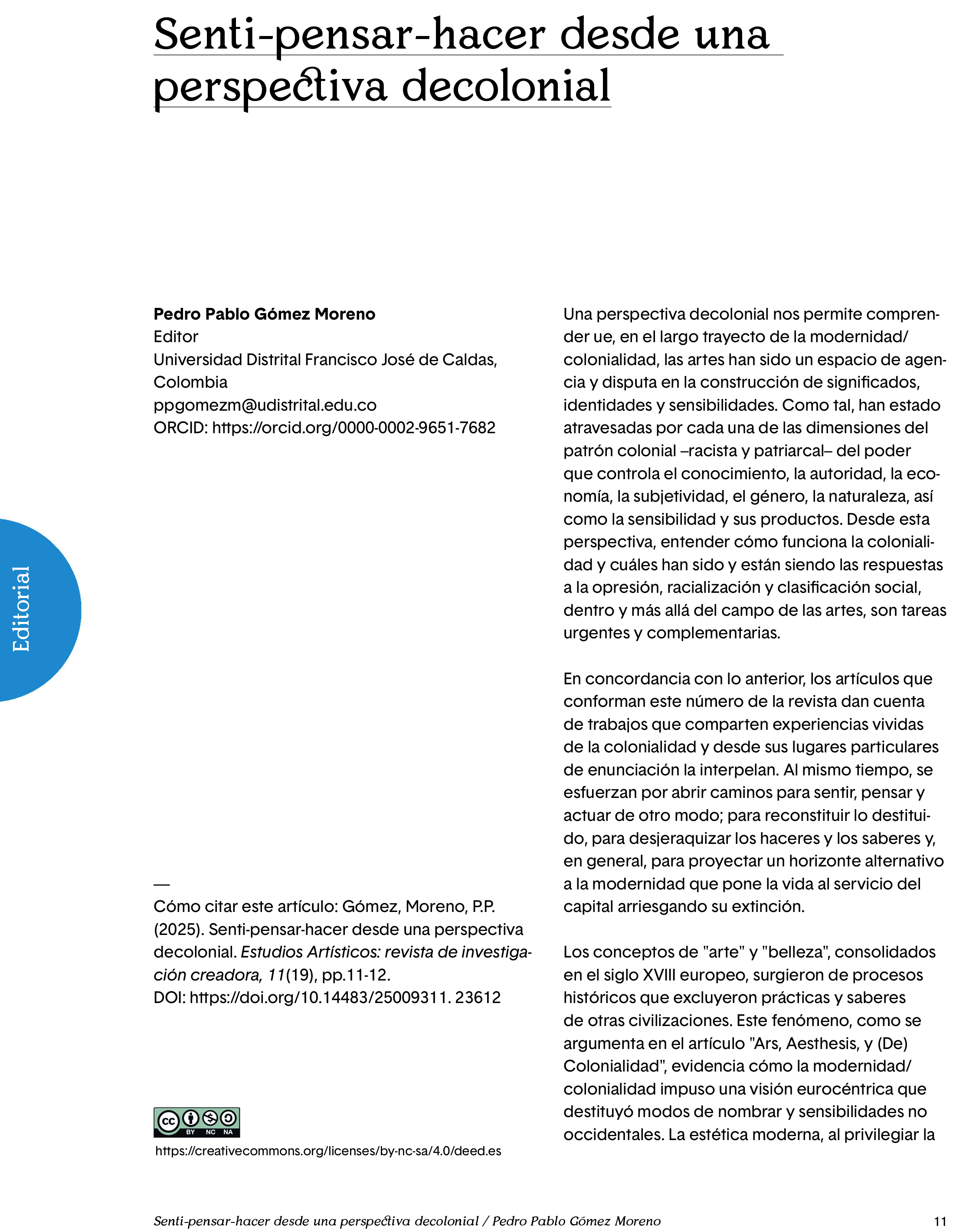
EditorialSenti pensar-hacer desde una perspectiva decolonial
Palavras-chave:
editorial (en).Palavras-chave:
editorial (pt).Downloads
Resumo (es)
Una perspectiva decolonial nos permite comprender ue, en el largo trayecto de la modernidad/colonialidad, las artes han sido un espacio de agencia y disputa en la construcción de significados, identidades y sensibilidades. Como tal, han estado atravesadas por cada una de las dimensiones del patrón colonial –racista y patriarcal– del poder que controla el conocimiento, la autoridad, la economía, la subjetividad, el género, la naturaleza, así como la sensibilidad y sus productos. Desde esta perspectiva, entender cómo funciona la colonialidad y cuáles han sido y están siendo las respuestas a la opresión, racialización y clasificación social, dentro y más allá del campo de las artes, son tareas urgentes y complementarias.
Resumo (en)
A decolonial perspective allows us to understand that, throughout the long history of modernity/coloniality, the arts have been a space of agency and contestation in the construction of meanings, identities, and sensibilities. As such, they have been permeated by each of the dimensions of the colonial pattern—racist and patriarchal—of power that controls knowledge, authority, the economy, subjectivity, gender, nature, as well as sensibility and its products. From this perspective, understanding how coloniality functions and what the responses to oppression, racialization, and social classification have been and are, within and beyond the field of the arts, are urgent and complementary tasks.
Resumo (pt)
Uma perspectiva decolonial nos permite compreender que, ao longo da longa história da modernidade/colonialidade, as artes têm sido um espaço de agência e contestação na construção de significados, identidades e sensibilidades. Como tal, elas têm sido permeadas por cada uma das dimensões do padrão colonial – racista e patriarcal – de poder que controla o conhecimento, a autoridade, a economia, a subjetividade, o gênero, a natureza, bem como a sensibilidade e seus produtos. Nessa perspectiva, compreender como a colonialidade funciona e quais foram e são as respostas à opressão, à racialização e à classificação social, dentro e além do campo das artes, são tarefas urgentes e complementares.
Como Citar
APA
ACM
ACS
ABNT
Chicago
Harvard
IEEE
MLA
Turabian
Vancouver
Baixar Citação
Licença

Este trabalho está licenciado sob uma licença Creative Commons Attribution-NonCommercial-ShareAlike 4.0 International License.
Licencia actual vigente
Creative Commons BY NC SA - Atribución – No comercial – Compartir igual. Vigente a partir del Vol. 8 Núm. 13 (2022)

https://creativecommons.org/licenses/by-nc-sa/4.0/deed.e
POLÍTICA DE PLAGIO
La Revista ESTUDIOS ARTÍSTICOS expone las directrices sobre buenas prácticas en la publicación científica, como marco para el desarrollo y la implementación de sus propias políticas y sistema de ética en la publicación. Los Editores de la Revista ESTUDIOS ARTÍSTICOS , seleccionan los revisores bajo unas directrices de imparcialidad y profesionalidad, a fin de que se puedan asegurar evaluaciones justas, los Editores garantizan a los autores que se seleccionan a los revisores apropiados para las revisiones de sus trabajos, y los lectores puedan confiar en el proceso de revisión por pares.
Los Editores de ESTUDIOS ARTÍSTICOS son conscientes del trabajo necesario para la toma de decisiones firmes y la creación de procesos editoriales sólidos, diseñados para gestionar sus intereses y fomentar un sistema de publicación eficiente y sostenible, que beneficiará a las instituciones académicas, a los editores de revistas, a los autores, a quienes financian la investigación y a los lectores. Las buenas prácticas en la publicación científica, no se desarrollan espontáneamente sino que se establecen conscientemente y se promueven activamente.
Responsabilidades de los autores de los trabajos
Todos los autores que se reflejan en el trabajo deben haber contribuido activamente en el mismo.
ESTUDIOS ARTÍSTICOS proporciona a los autores unas instrucciones claras donde se explican los conceptos de autoría académica, especificando que las contribuciones deben quedar claras. Los editores de ESTUDIOS ARTÍSTICOS piden la declaración a los autores de que cumplen con los criterios de la revista en relación a la autoría. En caso de darse un conflicto en la autoría de un trabajo publicado, los Editores de ESTUDIOS ARTÍSTICOS se pondrán en contacto con el autor que reclama su autoría para establecer la veracidad del caso. Si los Editores lo estiman oportuno, se cerrará el acceso temporalmente al artículo en cuestión, hasta que se tome una decisión final.
Los documentos a publicar, no deben haber sido publicados antes
ESTUDIOS ARTÍSTICOS considerará sólo aquellos trabajos que no hayan sido publicados antes en otra Editorial y en cualquier formato. En este sentido, se considera que la literatura científica puede ser sesgada por una publicación redundante, con consecuencias importantes. ESTUDIOS ARTÍSTICOS pide a los autores que una declaración de que la obra presentada, sobre todo en su comunicación esencial, no ha sido publicada antes, y no está siendo considerada para su publicación en otros envíos
Los Editores de ESTUDIOS ARTÍSTICOS tienen derecho a exigir un trabajo original y cuestionar los autores acerca de si los artículos de opinión (por ejemplo, editoriales, cartas, revisiones no sistemáticas) han sido publicados antes.
Promover la integridad de la investigación
La mala conducta de Investigación
Si los Editores de ESTUDIOS ARTÍSTICOS sospechan de una mala conducta en la investigación llevada a cabo en un trabajo (por ejemplo, la generación de datos, falsificación o plagio), consultarán a los autores del trabajo sobre el procedimiento desarrollado para la investigación y estos deberán proporcionar cuanta información se les solicite.
La revisión por pares a veces puede detectar indicios de mala conducta en la investigación, en estos casos, los revisores plantearán sus dudas y de ser confirmadas, se considerarán como una falta grave (por ejemplo, la fabricación de datos, la falsificación, la manipulación de imágenes inapropiadas o plagio). No obstante, en todo caso los autores tienen derecho a responder a esas denuncias y demostrar que las investigaciones se han llevado a cabo con diligencia y con la velocidad adecuada.
La protección de los derechos de los participantes / sujetos de investigación
Los Editores de ESTUDIOS ARTÍSTICOS trabajan para crear políticas de publicación que promuevan prácticas éticas y responsables de investigación. Se buscarán garantías de que los estudios han sido aprobados por los organismos pertinentes. Si en la investigación se ha trabajado con datos de personas, los trabajos resultantes, deben ir acompañados de una declaración de consentimiento por parte de las mismas. Los Editores se reservan el derecho a rechazar el trabajo si hay dudas acerca de si se han seguido los procedimientos adecuados.
El respeto de las culturas y el patrimonio
Los Editores de ESTUDIOS ARTÍSTICOS expresan su sensibilidad a la hora de publicar imágenes de objetos que podrían tener un significado cultural o ser causa de delito.
Informar a los lectores acerca de la investigación y la publicación de la mala conducta
Los Editores advertirán a los lectores si se han producido violaciones éticas. En estos casos, ESTUDIOS ARTÍSTICOS publicará las oportunas correcciones cuando estos errores puedan afectar a la interpretación de los datos y a la información, cualquiera que sea la causa del error. Del mismo modo, ESTUDIOS ARTÍSTICOS publicará un escrito de rectificación si se ha demostrado que el trabajo puede ser fraudulento, o si los Editores tienen sospechas fundadas de que se ha desarrollado la investigación bajo una mala conducta. En este caso, la revista publicará una corrección como fe de erratas o la rectificación que incluirá las palabras "Fe de erratas" o "Corrección", se publicará en una página numerada y aparecerá en el índice de contenidos de la revista. Esta rectificación permitirá al lector identificar y entender la corrección en el contexto de los errores cometidos, o explicará por qué se corrigió del artículo, o recogerá las preocupaciones del Editor sobre el contenido del artículo. Estará vinculado electrónicamente con la publicación electrónica original.