DOI:
https://doi.org/10.14483/23448393.24027Published:
2026-10-22Issue:
Vol. 31 No. 2 (2026): May-AugustSection:
Computational IntelligenceIntegration of Computer Vision and Robotic Handling for Inventory Management
Integración de visión por computador y manipulación robótica para gestión de inventarios
Keywords:
Artificial Intelligence, Inventory Control, Robotics, Simulation (en).Keywords:
Inteligencia artificial, Control de inventario, Robótica, Simulación (es).Downloads
Abstract (en)
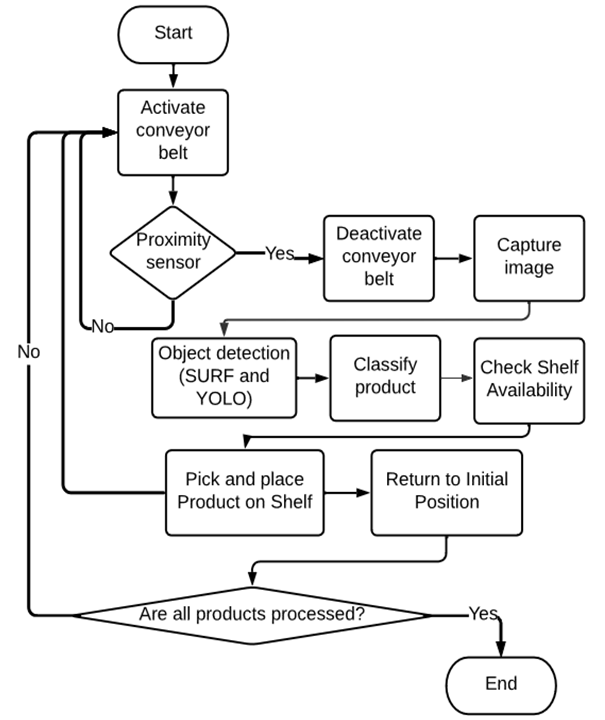
Context: This article presents a development that enables the identification of products on a production line and their subsequent storage using artificial intelligence techniques. This approach facilitates product handling by a robotic arm that picks up the products from the conveyor belt and moves them to a shelf, while controlling the location and inventory level of each product. The system also includes an automatic generator of real-time reports in PDF format.
Method: The design involves five stages: first, the construction of a database of virtual products with different packaging and labels; second, the establishment of the simulation environment, which includes all the components of the work area (robotic arm, conveyor belt, XY platform, and shelf); third, product detection using a You Only Look Once version 2 (YOLO v2) network followed by a Speeded-Up Robust Features (SURF) algorithm; fourth, the integration of the identification algorithms with the robotic arm and an automatic inventory report generator; and fifth, validation.
Results: The simulations showed a classification accuracy of 96.12% and correct placement of the products. The mean detection time with YOLO v2 was 150 ms per object, plus 55 ms for SURF, resulting in an end-to-end cycle time of 32 255 ms, dominated by robot motion in CoppeliaSim. These times confirm the system’s capability to operate in near real time in a virtual industrial environment.
Conclusions: The development was tested in a virtual environment created in the CoppeliaSim software, which made it possible to demonstrate the correct implementation of the classification and distribution algorithm, its ability to classify, locate, and control inventory levels, and its effectiveness in report generation.
Abstract (es)
Contexto: Este artículo presenta un desarrollo que permite la identificación de productos en una línea de producción y su posterior almacenamiento utilizando técnicas de inteligencia artificial. Este enfoque facilita la manipulación de los productos por parte de un brazo robótico que los toma de la banda transportadora y los traslada a una estantería, a la vez que controla la ubicación y el nivel de inventario de cada producto. El sistema también incluye un generador automático de informes en tiempo real en formato PDF.
Método: El diseño consta de cinco etapas: en primer lugar, la construcción de una base de datos de productos virtuales con diferentes envases y etiquetas; en segundo lugar, el establecimiento del entorno de simulación, que incluye todos los componentes del área de trabajo (brazo robótico, banda transportadora, plataforma XY y estantería); en tercer lugar, la detección de productos mediante una red You Only Look Once versión 2 (YOLO v2) seguida de un algoritmo Speeded-Up Robust Features (SURF); en cuarto lugar, la integración de los algoritmos de identificación con el brazo robótico y un generador automático de informes de inventario; y en quinto lugar, la validación.
Resultados: Las simulaciones mostraron una exactitud de clasificación del 96.12% y una ubicación correcta de los productos. El tiempo medio de detección con YOLO v2 fue de 150 ms por objeto, más 55 ms de SURF, lo que da como resultado un tiempo de ciclo completo de 32 255 ms, dominado por el movimiento del robot en CoppeliaSim. Estos tiempos confirman la capacidad del sistema para operar casi en tiempo real en un entorno industrial virtual.
Conclusiones: El desarrollo se probó en un entorno virtual creado en el software CoppeliaSim, lo que permitió demostrar la correcta implementación del algoritmo de clasificación y distribución, su capacidad para clasificar, localizar y controlar los niveles de inventario, y su eficacia en la generación de informes.
References
[1] J.-I. Park and T. Choi, “Regional Factors Associated with Smart Factory Adoption in South Korea,” Technology in Society, vol. 77, Art. no. 102509, 2024, https://doi.org/10.1016/j.techsoc.2024.102509
[2] T. Kanangnanon, C. Fongsamut, and P. Jitngernmadan, “Optimal AI Models for Process Data Analysis in Industry 4.0 Regarding Digital Twin Implementation,” in Proc. 2024 8th International Conference on Information Technology (InCIT), Chonburi, Thailand, 2024, pp. 675–680, https://doi.org/10.1109/InCIT63192.2024.10810585
[3] B. Park, T. Kim, and J. Jong-pil, “AI-Smart Factory: Design and Verification of Korean SME AI Smart Factory Using Level Diagnosis System,” Procedia Computer Science, vol. 24, pp. 169–179, 2023, https://doi.org/10.1016/j.procs.2023.09.025
[4] X. Fang, Q. Song, Z. Li, X. Wang, H. Ma, and Z. Liu, “Intelligent Monitoring System for Production Lines in Smart Factories: A Hybrid Method Integrating Transformer and Kalman Filter,” Journal of Manufacturing Systems, vol. 79, pp. 27–47, 2025, https://doi.org/10.1016/j.jmsy.2024.12.014
[5] S. Hartmann, J. Brock, A. Kühn, and R. Dumitrescu, “Applying Artificial Intelligence in the Smart Factory: Lessons Learned from Real-World Use Cases,” Procedia CIRP, vol. 130, pp. 100–105, 2024, https://doi.org/10.1016/j.procir.2024.10.062
[6] C. Liu, Y. Gao, J. Zhang, J. Liu, and S. Feng, “Research on Industrial Product Quality and Safety Emergency Detection Based on Multifeature Fusion,” in Proc. 2021 IEEE International Conference on Industrial Application of Artificial Intelligence (IAAI), Harbin, China, 2021, https://doi.org/10.1109/IAAI54625.2021.9699941
[7] M. Butolo et al., “Advanced Real-Time Surface Defect Detection in Industrial Products Using Machine Vision,” in Proc. 2024 IEEE SmartBlock4Africa, Accra, Ghana, 2024, https://doi.org/10.1109/SmartBlock4Africa61928.2024.10779491
[8] J. C. Guacheta-Alba, A. A. Espitia-Cubillos, and R. Jiménez-Moreno, “Automated Box Classification in a Virtual Industrial Environment Using Machine Vision Algorithms,” in Proc. 12th International Conference on Control, Mechatronics and Automation (ICCMA), London, UK, 2024, https://doi.org/10.1109/ICCMA63715.2024.10843920
[9] V. Sumathi, R. S, C. C. S. Basavaraddi, V. J, I. M. V., and S. Srinivasan, “Advanced Process Control in Manufacturing Using IoT Devices and Artificial Neural Networks,” in Proc. 4th International Conference on Sustainable Expert Systems (ICSES), Kaski, Nepal, 2024, https://doi.org/10.1109/ICSES63445.2024.10763299
[10] Y. Jiang, W. Wang, and C. Zhao, “A Machine Vision-Based Realtime Anomaly Detection Method for Industrial Products Using Deep Learning,” in Proc. 2019 Chinese Automation Congress (CAC), Hangzhou, China, 2019, https://doi.org/10.1109/CAC48633.2019.8997079
[11] S. Chanda, R. D. Prangon, and K. N. Hoque, “A CNN-Based Approach for Room Number Detection Using Drone in Indoor Environment,” in Proc. 2024 IEEE International Conference on Power, Electrical, Electronics and Industrial Applications (PEEIACON), Rajshahi, Bangladesh, 2024, https://doi.org/10.1109/PEEIACON63629.2024.10800605
[12] R. Hamzah, L. Ang, R. Roslan, N. H. I. Teo, K. A. Samad, and K. A. F. A. Samah, “Comparing Modified YOLO V5 and Faster Regional Convolutional Neural Network Performance for Recycle Waste Classification,” in Proc. 2024 IEEE International Conference on Automatic Control and Intelligent Systems (I2CACIS), Shah Alam, Malaysia, 2024, https://doi.org/10.1109/I2CACIS61270.2024.10649835
[13] Y. Qi and H. Sun, “Defect Detection of Insulator Based on YOLO Network,” in Proc. 9th International Conference on Electronic Technology and Information Science (ICETIS), Hangzhou, China, 2024, https://doi.org/10.1109/ICETIS61828.2024.10593675
[14] H. Zheng, X. Chen, H. Cheng, Y. Du, and Z. Jiang, “MD-YOLO: Surface Defect Detector for Industrial Complex Environments,” Optics and Lasers in Engineering, vol. 178, Art. no. 108170, 2024, https://doi.org/10.1016/j.optlaseng.2024.108170
[15] Y. Ji, A. Zhang, Z. Chen, M. Wei, Z. Yu, and X. Zhang, “Lightweight Road Damage Detection Algorithm Based on the Improved YOLO Model,” in Proc. 5th International Conference on Artificial Intelligence and Electromechanical Automation (AIEA), Shenzhen, China, 2024, https://doi.org/10.1109/AIEA62095.2024.10692408
[16] A. Anish, S. R, A. H. Malini, and T. Archana, “Enhancing Surveillance Systems with YOLO Algorithm for Real-Time Object Detection and Tracking,” in Proc. 2nd International Conference on Automation, Computing and Renewable Systems (ICACRS), Pudukkottai, India, 2023, https://doi.org/10.1109/ICACRS58579.2023.10404710
[17] S. Xu, Y. Ji, G. Wang, L. Jin, and H. Wang, “GFSPP-YOLO: A Light YOLO Model Based on Group Fast Spatial Pyramid Pooling,” in Proc. IEEE 11th International Conference on Information, Communication and Networks (ICICN), Xi’an, China, 2023, pp. [start]–738, https://doi.org/10.1109/ICICN59530.2023.10393445
[18] R. Narwaria, A. Ahirwar, A. K. Prajapati, A. Kumar, and A. Tiwari, “Smart Object Detection Using ESP32-CAM Based on YOLO Algorithm,” in Proc. 2nd International Conference on Intelligent Cyber Physical Systems and Internet of Things (ICoICI), Coimbatore, India, 2024, https://doi.org/10.1109/ICoICI62503.2024.10696374
[19] J. Xu, F. Pan, X. Han, L. Wang, Y. Wang, and W. Li, “EdgeTrim-YOLO: Improved Trim YOLO Framework Tailored for Deployment on Edge Devices,” in Proc. 4th International Conference on Computer Communication and Artificial Intelligence (CCAI), Xi’an, China, 2024, https://doi.org/10.1109/CCAI61966.2024.10602964
[20] R. Bose, H. Mondal, I. Sarkar, and S. Roy, “Design of Smart Inventory Management System for Construction Sector Based on IoT and Cloud Computing,” e-Prime – Advances in Electrical Engineering, Electronics and Energy, vol. 2, Art. no. 100051, 2022, https://doi.org/10.1016/j.prime.2022.100051
[21] S. Weißhuhn and K. Hoberg, “Designing Smart Replenishment Systems: Internet-of-Things Technology for Vendor-Managed Inventory at End Consumers,” European Journal of Operational Research, vol. 295, no. 3, pp. 949–964, 2021, https://doi.org/10.1016/j.ejor.2021.03.042
[22] E. Saha and P. Rathore, “A Smart Inventory Management System with Medication Demand Dependencies in a Hospital Supply Chain: A Multi-Agent Reinforcement Learning Approach,” Computers & Industrial Engineering, vol. 191, Art. no. 110165, 2024, https://doi.org/10.1016/j.cie.2024.110165
[23] Y. D. Pranata et al., “Deep Learning and SURF for Automated Classification and Detection of Calcaneus Fractures in CT Images,” Computer Methods and Programs in Biomedicine, vol. 171, pp. 27–37, 2019, https://doi.org/10.1016/j.cmpb.2019.02.006
[24] M. Z. Chaari and G. P. Pereira, “Powering a Six-Axis Robotic Arm with AI to Collect Plastic Bottles,” in Proc. 2024 International Conference on Microelectronics (ICM), Doha, Qatar, 2024, https://doi.org/10.1109/ICM63406.2024.10815860
[25] F. J. Aguilar and H. Rodríguez, “Open-Source Integration Environment for Industrial Robot Arm NACHI MZ04 with ROS,” in Proc. 9th International Engineering, Sciences and Technology Conference (IESTEC), Panama City, Panama, 2024, https://doi.org/10.1109/IESTEC62784.2024.10820217
[26] J. C. Guacheta-Alba, A. A. Espitia-Cubillos, and R. Jiménez-Moreno, “Robotic Product-Based Manipulation in Simulated Environment,” International Journal of Electrical and Computer Engineering, vol. 15, no. 6, pp. 5894–5903, 2025, https://doi.org/10.11591/ijece.v15i6.pp5894-5903
[27] S. Chakraborty and P. S. Aithal, “A Custom Robotic Arm in CoppeliaSim,” International Journal of Applied Engineering and Management Letters (IJAEML), vol. 5, no. 1, pp. 38–50, 2021.
[28]O. Caixiao, “Research on Object Grasping System Based on YOLO Algorithm,” in Proc. 2024 International Conference on Telecommunications and Power Electronics (TELEPE), Frankfurt, Germany, 2024, https://doi.org/10.1109/TELEPE64216.2024.00048
[29] S. Bakheet, A. Al-Hamadi, and R. Youssef, R. “A fingerprint-based verification framework using Harris and SURF feature detection algorithms,” Applied Sciences, vol. 12, no. 4, p. 2028, 2022, https://doi.org/10.3390/app12042028
[30] L. Fan, Y. Wang, Y. Zhou, J. Zhang, and H. Chen, “YOLO-APGC: A Lightweight Method for BGA Surface Defect Detection Based on Cross-Scale Feature Fusion,” Microelectronics Reliability, vol. 175, Art. no. 115906, 2025, https://doi.org/10.1016/j.microrel.2025.115906
How to Cite
APA
ACM
ACS
ABNT
Chicago
Harvard
IEEE
MLA
Turabian
Vancouver
Download Citation
License
Copyright (c) 2026 Juan C Guachetá-Alba, Anny Astrid Espitia Cubillos, Robinson Jiménez-Moreno

This work is licensed under a Creative Commons Attribution-NonCommercial-ShareAlike 4.0 International License.

From the edition of the V23N3 of year 2018 forward, the Creative Commons License "Attribution-Non-Commercial - No Derivative Works " is changed to the following:
Attribution - Non-Commercial - Share the same: this license allows others to distribute, remix, retouch, and create from your work in a non-commercial way, as long as they give you credit and license their new creations under the same conditions.