
DOI:
https://doi.org/10.14483/23464712.23840Publicado:
2025-12-15Making two squares from six squares: comparing routine creativity of book authors with induced creativity of mathematics students
Hacer dos cuadrados a partir de seis cuadrados: comparación de la creatividad rutinaria de los autores de libros con la creatividad inducida de los estudiantes de matemáticas
Fazer dois quadrados a partir de seis quadrados: comparação entre a criatividade rotineira de autores de livros e a criatividade induzida de estudantes de matemática
Palabras clave:
Geometric matchstick puzzles, Multiple-solution puzzles, Routine creativity, Induced creativity, Relationships between multiple solutions (en).Palabras clave:
acertijos geométricos con cerillos, Soluciones múltiples de acertijos, Creatividad rutinaria, Creatividad inducida, Relaciones entre las soluciones múltiples (es).Palabras clave:
Quebra-cabeças geométricos com palitos, Múltiplas soluções de quebra-cabeças, Criatividade rotineira, Criatividade induzida, Relações entre múltiplas soluções (pt).Descargas
Referencias
Adeoye, M. A. y Jimoh, H. A. (2023). Problem-solving skills among 21st-century learners toward creativity and innovation ideas. Thinking Skills and Creativity Journal, 6(1), 52-58.
Anonymous (1996). Streichholz-Spiele. Tosa Verlag.
Anonymous (2015). Matchstick puzzles. Test your brain-power with these tricks & puzzles. Arcturus.
Bicer, A., Aleksani, H., Butler, C., Jackson, T., Smith, T. D. y Bostick, M. (2024). Mathematical creativity in upper elementary school mathematics curricula. Thinking Skills and Creativity, 51, 101462. https://doi.org/10.1016/j.tsc.2024.101462
Bicer, A., Marquez, A., Colindres, K. V. M., Schanke, A. A., Castellon, L. B., Audette, L. M., Perihan, C., & Lee, Y. (2021). Investigating creativity-directed tasks in middle school mathematics curricula. Thinking Skills and Creativity, 40, 100823. https://doi.org/10.1016/j.tsc.2021.100823
Blyth, W. (1921). Match-stick magic. C. Arthur Pearson.
Boaler, J. (2024). Math-ish. Finding creativity, diversity, and meaning in mathematics. HarperCollins.
Brandreth, G. D. (1982). The complete puzzler. Robert Hale.
Braun, F. (1876). Der junge Mathematiker und Naturforscher. Verlag von Otto Spamer.
Bustos Mora, J. S., y Castiblanco Abril, O. L. (2023). El Desarrollo de la Creatividad en Cuarto de Primaria a partir del Aprendizaje de la Física. Góndola, Enseñanza y Aprendizaje de las Ciencias, 18(Especial), 206–222. https://doi.org/10.14483/23464712.21369
Cook, M. (1981). Think about it! Mathematics problems of the day. Creative Publications.
Downie, D., Slesnick, T. y Stenmark, J. K. (1981). Math for girls and other problem solvers. Lawrence Hall of Science/University of California.
Greens, C. (1977). Successful problem-solving technique. Creative Publications.
Grund-Thorpe, H. (2006). Die schönsten Streichholzspiele. Weltbild Verlag.
Hansell, S. (1981). 109 knifflige Streichholztricks. Otto Maier Verlag.
Hikmah, R. (2023). Validity and practicality of Geogebra application-based mathematics learning tools to train visual-spatial intelligence. JDIME: Journal of Development and Innovation in Mathematics Education, 1(1), 42-53.
http://dx.doi.org/ 10.32939/jdime.v1i1.2336
Hoffman, L. (1893). Puzzles old and new. Frederick Wane and Company.
Jukic-Matic, Lj. & Slisko, J. (2024). An empirical study of mathematical creativity and students’ opinions on multiple solution tasks. International Journal of Mathematics Education in Science and Technology,55(9), 2170-2190. https://doi.org/10.1080/0020739X.2022.2129496
Katona, G. (1940). Organizing and memorizing. Studies in the psychology of learning and teaching. Columbia University Pres.
Koul, R. B., Sheffield, R. y McIlvenny, L. (2021). Teaching 21st Century Skills. Springer Singapore.
Leikin, R. & Sriraman, B. (2022). Empirical research on creativity in mathematics (education): from the wastelands of psychology to the current state of the art. ZDM – Mathematics Education, 54,1–17
https://doi.org/10.1007/s11858-022-01340-y
Levav-Waynberg, A. y Leikin, R. (2012). The role of multiple solution tasks in developing knowledge and creativity in geometry. The Journal of Mathematical Behavior, 31(1), 73-90. https://doi.org/10.1016/j.jmathb.2011.11.001
Levenson, E. (2013). Tasks that may occasion mathematical creativity: Teachers’ choices. Journal of Mathematics Teacher Education, 16(4), 269-291. https://doi.org/10.1007/s10857-012-9229-9
Leeming, J. (1946). Fun with puzzles. J.B. Lippincott Company.
Loom, E. y Abner, P. (1939). Jot ‘em down. Blue Ribbon Books.
Mittenzway, L. (1880). Mathematische Kurzweil. Verlag von Julius Klinkhardt.
Nickerson, R. S. (2010). How to discourage creative thinking in the classroom. In R. A. Beghetto y J. C.
Kaufman (Eds.), Nurturing creativity in the classroom. Cambridge University Press (pp 1 – 5).
Nilimaa, J. (2023). New examination approach for real-world creativity and problem-solving skills in mathematics. Trends in Higher Education, 2(3), 477-495. https://doi.org/10.3390/higheredu2030028
Obermair, G. (1977). Matchstick puzzles, tricks and games. Sterling Publishing Company.
Paraquin, K. H. (1970). Spiel und Spass mit Hölzchen und Köpfchen. Otto Maier Verlag.
Picon, D. (2002). Allumettes. Mango.
Piirto, J. (2011). Creativity for 21st century skills. Springer Science & Business Media.
Schindler, M. y Lilienthal, A. J. (2020). Students’ creative process in mathematics: Insights from eye-tracking-stimulated recall interview on students’ work on multiple solution tasks. International Journal of Science and Mathematics Education, 18(8), 1565-1586.https://doi.org/10.1007/s10763-019-10033-0
Schuyt, M. (1989). Phantastische Zündholzspiele. DuMont Buchverlag.
Sipahi, Y. & Bahar, A. K. (2025). Mathematical Creativity: A Systematic Review of Definitions, Frameworks, and Assessment Practices. Education Sciences, 15(10), 1348 https://doi.org/10.3390/educsci15101348
Slisko, J. (2025). Helping puzzle-solvers find solutions missed by a famous puzzle author: Initial study on stimulated creativity. European Journal of Science and Mathematics Education, 13(4), 385 – 294. https://doi.org/10.30935/scimath/17509
Slocum, J. (1996). The puzzle arcade for people who like lots of hints. Klutz.
Spitzer, H. F. (1956). Practical classroom procedures for enriching arithmetic. Webster Publishing Company.
Stupel, M., y Ben-Chaim, D. (2017). Using multiple solutions to mathematical problems to develop pedagogical and mathematical thinking: A case study in a teacher education program. Investigations in Mathematics Learning, 9(2), 86-108.https://doi.org/10.1080/19477503.2017.1283179
Trilling, B. y Fadel, C. (2009). 21st century skills: Learning for life in our times. John Wiley & Sons.
Townsend, C. B. (2003). The curious book of mind-boggling teasers, tricks, puzzles & games. Sterling Publishing Company.
Tromholt, S. (1889). Streichholzspiele. First edition. Verlag von Otto Spamer.
Tromholt, S. (1890). Streichholzspiele. Fourth edition. Verlag von Otto Spamer.
Tromholt, S. (1889). Streichholzspiele. Fifth edition. Verlag von Otto Spamer.
Wood, C. y Goddard, G. (1938). The complete book of games. Halcyon House.
Cómo citar
APA
ACM
ACS
ABNT
Chicago
Harvard
IEEE
MLA
Turabian
Vancouver
Descargar cita
Recibido: 28 de junio de 2025; Aceptado: 10 de diciembre de 2025
Abstract
Creative thinking is among the most important skills in the XXI century. For promoting creativity in mathematics education, it is very important to reduce the presence of a false belief: Every mathematics problem has only one solution or one solving approach. Many matchstick puzzles have more than one solution. Nevertheless, book authors publish for them only one solution without mentioning that other, visually different solutions are possible, showing low lever of their routine creativity. This phenomenon is illustrated by presenting different published solutions to a popular matchstick puzzle: “17 matchsticks form 6 equal squares. Remove 6 matchsticks to get only 2 squares”. The puzzle with a single solution was published in the Year 1893 by Hoffman and since then 18 book authors presented only one of four possible, visually different solutions. This puzzle was presented to a group 23 undergraduate mathematics students, with added information that it has four, visually different solution, supposing this information might activate students’ induced creativity in solving the puzzle. All four solutions were found by 20 students (more than 85 %). Only one solution was found by two students, while one student was unable to find a single correct solution. These results show that the students involved in the research revealed more creativity than 19 book authors in more than 100 years. In concluding considerations, I present and justify a pedagogical proposal about how to better use matchstick puzzles to induce more mathematical creativity and visual intelligence.
Keywords
Geometric matchstick puzzles, Multiple-solution puzzles, Routine creativity, Induced creativity, Relationships between multiple solutions.Resumen
Pensamiento creativo es una de las habilidades más importantes del siglo XXI. Para promover la creatividad en la educación matemática, es fundamental reducir la falsa creencia de que cada problema matemático tiene una sola solución o un único enfoque de resolverlo. Muchos acertijos con cerillos tienen más de una solución. Sin embargo, los autores publican solo una solución para ellos, sin mencionar que existen otras soluciones visualmente diferentes, lo que demuestra un bajo nivel de su creatividad rutinaria. Este fenómeno se ilustra al presentar diferentes soluciones publicadas para un popular acertijo de cerillos: “17 cerillos forman 6 cuadrados iguales. Retira 6 cerillos para obtener solo 2 cuadrados”. Este acertijo con una sola solución fue publicado en 1893 por Hoffman y, desde entonces, 18 autores han presentado solo una de cuatro posibles soluciones visualmente diferentes. Este rompecabezas se presentó a un grupo de 23 estudiantes de matemáticas de pregrado, con la información adicional de que tiene cuatro soluciones visualmente diferentes, suponiendo que esta información podría activar la creatividad inducida de los estudiantes al resolverlo. Veinte estudiantes (más del 85 %) encontraron las cuatro soluciones. Dos estudiantes solo encontraron una solución, mientras que uno no pudo encontrar ninguna correcta. Estos resultados demuestran que los estudiantes que participaron en la investigación mostraron una creatividad superior a la de 19 autores de libros en más de 100 años. En las conclusiones, presento y justifico una propuesta pedagógica sobre cómo utilizar mejor los acertijos con cerillos para fomentar la creatividad matemática y la inteligencia visual.
Palabras clave
acertijos geométricos con cerillos, Soluciones múltiples de acertijos, Creatividad rutinaria, Creatividad inducida, Relaciones entre las soluciones múltiples.Resumo
O pensamento criativo é uma das habilidades mais importantes do século XXI. Para promover a criatividade no ensino da matemática é fundamental combater a falsa crença de que cada problema matemático tem apenas uma solução ou uma única abordagem para resolvê-lo. Muitos quebra-cabeças com palitos de fósforo têm múltiplas soluções. No entanto, os autores frequentemente publicam apenas uma solução, sem mencionar que existem outras soluções visualmente diferentes, revelando uma falta de criatividade rotineira. Este fenômeno é ilustrado através da análise das soluções publicadas para um popular quebra-cabeça com palitos: “17 palitos formam 6 quadrados iguais. Remova 6 palitos para deixar apenas 2 quadrados”. Esse enigma, originalmente apresentado por Hoffman em 1893 como tendo uma única solução, teve desde então 18 autores reproduzindo apenas uma das quatro soluções visualmente distintas possíveis. O quebra-cabeça foi apresentado a uma turma de 23 estudantes de graduação em matemática, com a informação adicional de que existiam quatro soluções visualmente distintas - um detalhe destinado a ativar a criatividade induzida. Vinte estudantes (mais de 85%) encontraram todas as quatro soluções. Dois encontraram apenas uma solução, e um não conseguiu encontrar nenhuma. Esses resultados demonstram que os estudantes participantes exibiram maior criatividade do que 19 autores de livros didáticos ao longo de mais de 100 anos. Nas conclusões, apresento e justifico uma proposta pedagógica para utilizar os quebra-cabeças com palitos de forma mais eficaz no desenvolvimento da criatividade matemática e da inteligência visual.
Palavras-chave
Quebra-cabeças geométricos com palitos, Múltiplas soluções de quebra-cabeças, Criatividade rotineira, Criatividade induzida, Relações entre múltiplas soluções.1. Introduction
Creative thinking is among the most important 21st century skills (Thrilling y Fadel, 2009; Piirto, 2011) because it is necessary to resolve actual and future complex problems in economic and social life. Being so, educational systems at all levels must find best ways to promote and foster creativity in all school courses (Koul at al, 2021; Adeoye y Jimoh, 2023; Bustos Mora y Castiblanco Abril, 2023). Theoretical frameworks that inform mathematical creativity have a rich spectrum, from cognitive-divergent production models to sociocultural classroom- based perspectives, and from individual problem-solving heuristics to collaborative meaning-making processes (Sipahi & Bahar, 2025). Different elements of this spectrum are visible in mathematics teaching (Levenson, 2013; Bicer at al, 2021; Nilimaa, 2023; Bicer at al, 2024). Open-ended problems, problemposing tasks, and multiple-solution tasks are the pedagogical tools that are most frequently used nowadays in creativity-directed instructional practices in mathematics education (Leikin & Sriraman, 2022). Namely, mathematical creativity can be operationally defined as a set of cognitive skills needed to perform well in open-ended mathematics problems, problem-posing and multiple-solution mathematics tasks.
Mathematics problems with multiple solutions or with single solution to which one comes using different conceptual and representation paths are commonly used to explore and measure students’ creative thinking and performances (Levav-Waynberg y Leikin, 2012; Schindler y Lilienthal, 2020; Jukic-Matic & Slisko, 2024). This type of problems is also present in preparation of prospective mathematics teachers for teaching creativity skills (Stupel y Ben-Chaim, 2017). Specially interesting class of mathematics problems with multiple solutions are geometric matchstick puzzles.
Geometric matchstick puzzles have a simple structure: For an initial matchstick configuration a final matchstick configuration is sought through removing, moving or adding specific number of matchsticks. For their solution, needed mathematical knowledge is minimal (forms of basic geometric figures), but puzzle solvers must have visual-spatial intelligence or the ability to perceive, analyze, and use visual information to understand spatial concepts such as size, shape, orientation, and their relationships (Hikmah, 2023).
Although various examples of matchsticks puzzles appeared in two previous books (Braun, 1876; Mittenzway, 1880), their first big collection was included in the book “Games with matchsticks” written by Danish high-school teacher and polarlight researcher Sophus Tromholt (1889). In later editions (Tromholt, 1890; Tromholt, 1892) the number of matchstick puzzles increased greatly.
Numerous of Tromholt’s matchstick puzzles have been become “classic” because they were repeated by many posterior authors. Nevertheless, the most important contribution of Tromholt was to include in some matchstick puzzles the information about the number of different solutions. For example, the puzzle 136 (Tromholt, 1892) had the following formulation:
Remove 3 matchsticks so that 3 squares are left over. (Two solutions.)
Matchstick configuration for the puzzle and configurations of its two announced solutions are presented in the Figure 1.
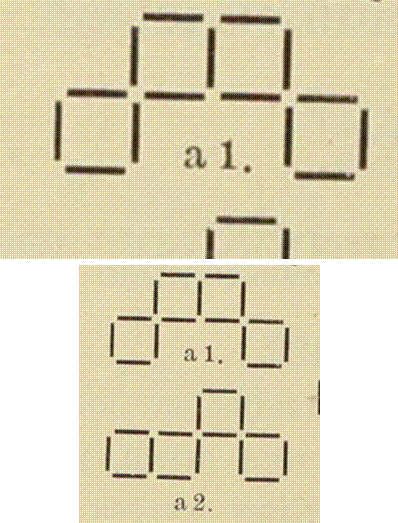
Figure 1.
: Matchstick configuration for the puzzle 136 and configurations of its two announced solutions.
It is important to notice that Tromholt didn’t publish a third visually different solution (Figure 2).
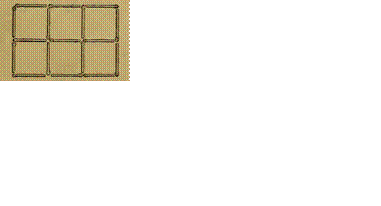
Figure 2.
: Third visually different solution that was not published by Tromholt.
One might think that Tromholt didn’t feel the need to publish the third solution because it is a mirror image of his second solution. Nevertheless, such important decision and information should have been shared with puzzle solvers because some of them can be able to find all three visually different solutions. In addition, they can rightly say that two fundamentally different solutions are the first one and the third one, because the second Tromholt’s solution is a mirror image of the third solution.
The issue of fundamentally different solutions of geometric matchsticks puzzles becomes more complicated when rotational variants of a solution aren’t published by many authors without informing readers about this important criterion for selecting just a particular solution. In fact, only one anonymous author speaks explicitly about it:
“Many of these puzzles may have more than one possible solution, including reflections and rotations of those given at the back of this book; space does not permit us to show more than one solution to each of the puzzle…” (Anonymous, 2015).
Taking into account that matchstick puzzles with visually different solutions can foster mathematical creativity and visual intelligence of puzzle solvers, it is important to show the evidence that book authors destroy that useful creativity-related leaning potential of matchstick puzzles by publishing only one solution, omitting without warning not only rotational and reflection variants of a solution but also those possible, fundamentally different solutions which can’t be obtained by rotation and/ or mirror transformations of the published solution.
It is natural to suppose that serious book authors, knowing that some matchstick puzzles have more than one solution, should have developed some kind of routine creativity. It is habitual inclination to search of possible alternative solutions. This responsible approach is evident in the case of Tromholt, who in the fifth edition of his book (Tromholt, 1892) mentioned and published additional solutions for a few puzzles that previously have been published with only one solution.
2. The puzzle “Making two squares from six squares” and research questions of this two-part investigation
The first books with matchstick puzzles were published in German language (Braun, 1876; Mittenzway, 1880; Tromholt, 1889; Tromholt, 1890; Tromholt, 1892). Hoffman wrote the first book in English language with a section on “Puzzles with lucifer matches” (Hoffman,1893). Although some puzzles were equal to the puzzles in Tromholt’s books, a careful analysis of the solution to one of them shows that Hoffman borrowed puzzles not from Tromholt’s books but from journals published in English.
Hoffman formulated an original puzzle which later became one of the most popular. The puzzle started with initial matchstick configuration presented in the Figure 3.
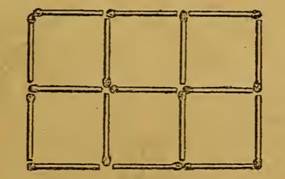
Figure 3.
: Seventeen matchsticks form six equal squares.
The puzzle formulation was:
By taking away six matches leave two squares only (Hoffman, 1893, p. 290).
The single solution given by Hoffman is presented in the Figure 4.
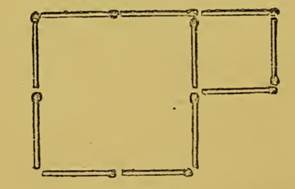
Figure 4.
: The Hoffman’s solution of the puzzle “Make two squares from six squares”.
Considering the popularity of Hoffman’s puzzle and the existence of its four, visually different solutions, it was adequate to find out, through documental research and a paper-and-pencil task given to mathematics, the answers to the following research questions:
1. Which of its possible four solutions did posterior book authors publish?
2. Did any of posterior book authors mention the existence of alternative solutions, showing evidence of routine creativity?
3. Would mathematics students, informed about the existence of four visually different solutions, show induced creativity?
Induced creativity is a creative behavior in puzzle solving stimulated by the knowledge that the puzzle has multiple solution. Such knowledge eliminates cognitive bias “one puzzle – one solution”. It is also known as “stimulated creativity” (Slisko, 2025).
3. Single-solution approach by book authors showing low level of routine creativity
The results of the documental research of the books that presented the Hoffman’s puzzles are the following:
Six posterior book authors repeated Hoffman’s single solution (H-solution) presented above (Blyth, 1921, p. 39; Wood y Goddard, 1938; p. 485; Loom y Abner, 1939, p. 132; Spitzer, 1956,
p. 168; Paraquin, 1970, p. 26; Townsend, 2003, p. 250).
A possible rotational variant of the Hoffman’s solution (A1-solution), rotating it 1800 to the left or to the right, is presented in the Figure 5.
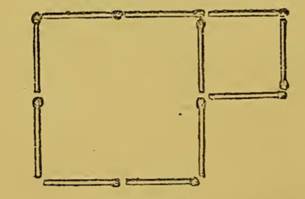
Figure 5.
: Rotational variant of the Hoffman’s solution (A1-solution).
This single solution was presented by two book authors (Leeming, 1946, p. 85; Picon, 2002, p. 121).
The most popular single solution among book authors is the one obtained as the image of the Hoffman’s solution (A2-solution) in the vertical mirror located parallel to the three horizontal matchsticks (Figure 6).
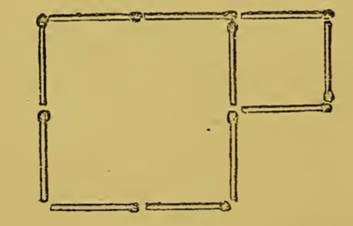
Figure 6.
: The first mirror image of the Hoffman’s solution (A2-solution).
This single solution was presented by nine book authors (Obermair, 1977, p. 99; Greens, 1977, p. 63; Hansel, 1981, p. 82; Downie et al., 1981, p. 68; Brandreth, 1982, p. 155; Shuyt, 1989, p. 143; Anonymous, 1996, p. 154; Slocum, 1996, p. 41; Grund-Thorpe, 2006, p. 74).
The second image of the Hoffman’s solution (A3solution), obtained in the vertical mirror located parallel to right vertical matchsticks, is presented in the Figure 7.
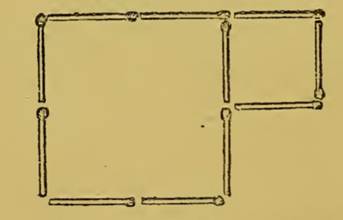
Figure 7.
: The second mirror image of the Hoffman’s solution (A3-solution).
This single A3-solution was presented by only one book author (Cook, 1981, p. 85)!
Being so, the answer to the first research is:
Although, the Hoffman’s puzzle has four visually different solutions presented above, all book authors published only a single solution. Six authors repeated H-solution, two authors published A1-solution, nine authors presented A2-solution and only one author found A3-solution.
The answer to the second research question is:
Nobody of 18 posterior book and textbook authors mentioned to their readers the existence of other three alternative solutions and a possible reason to omit them because they are rotational or mirror images of the selected single solution. In other word, all authors have shown a very low level of routine creativity.
A possible explanation might be that the authors were satisfied with the first solution that came to their mind, believing that every matchstick puzzle has only one solution and that there is no need for activation of creative thinking to look for additional, visually different solutions.
4. Four-solution performance by mathematics students showing high level of induced creativity
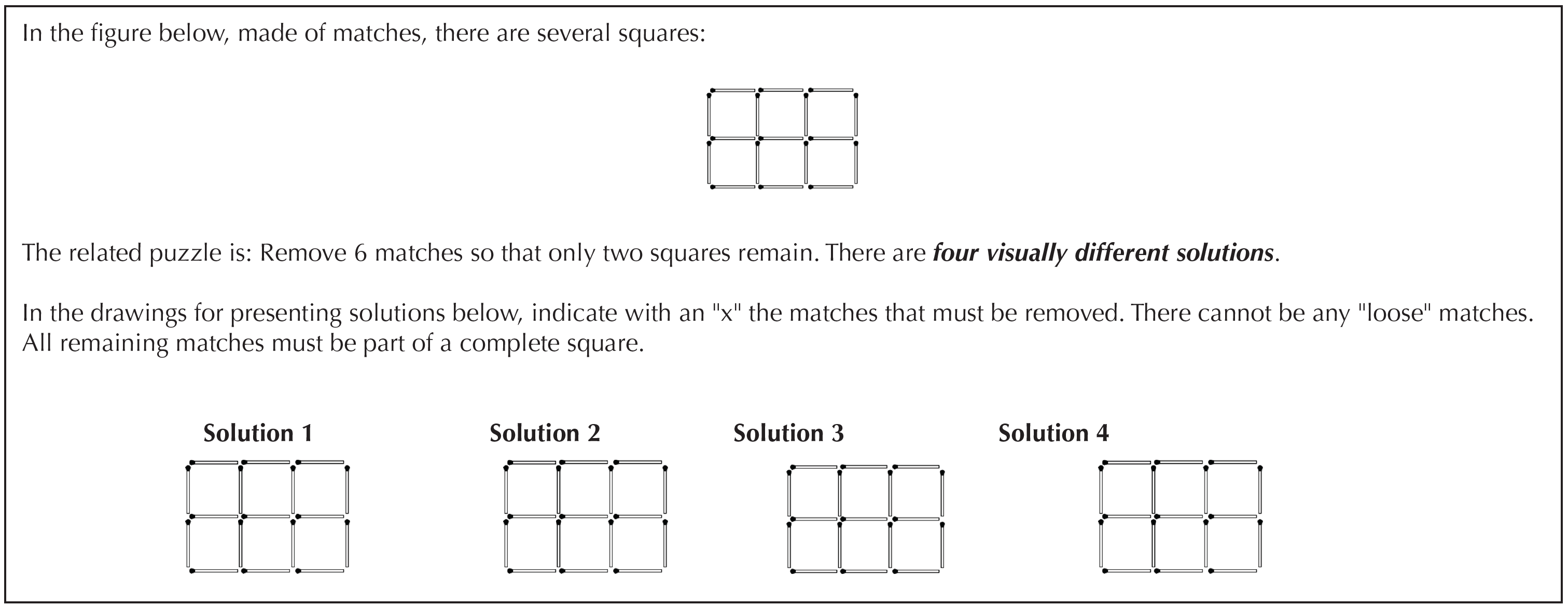
To explore experimentally students’ performances in finding all four visually different solutions of the Hoffman puzzle, a simple structured working sheet was designed (Figure 8).
As it can be seen above, students faced Hoffman’s puzzle with the paper-and-pencil task to find all four visually different solutions. In other words, it was supposed that their induced creativity would be activated by informing them about the existence of four visually different solutions.
Impressed working sheets were given to 23 undergraduate mathematics students who didn’t have previous experiences in solving matchstick puzzle. Students were informed about the objective of the research and participated voluntarily without revealing their names. Students were sitting at such distances that cheating (seeing solutions of neighbors) was excluded. The time for finding four alternative solutions was 15 minutes.
The results of this small-scale research are very encouraging because they give the following answer to the third research question:
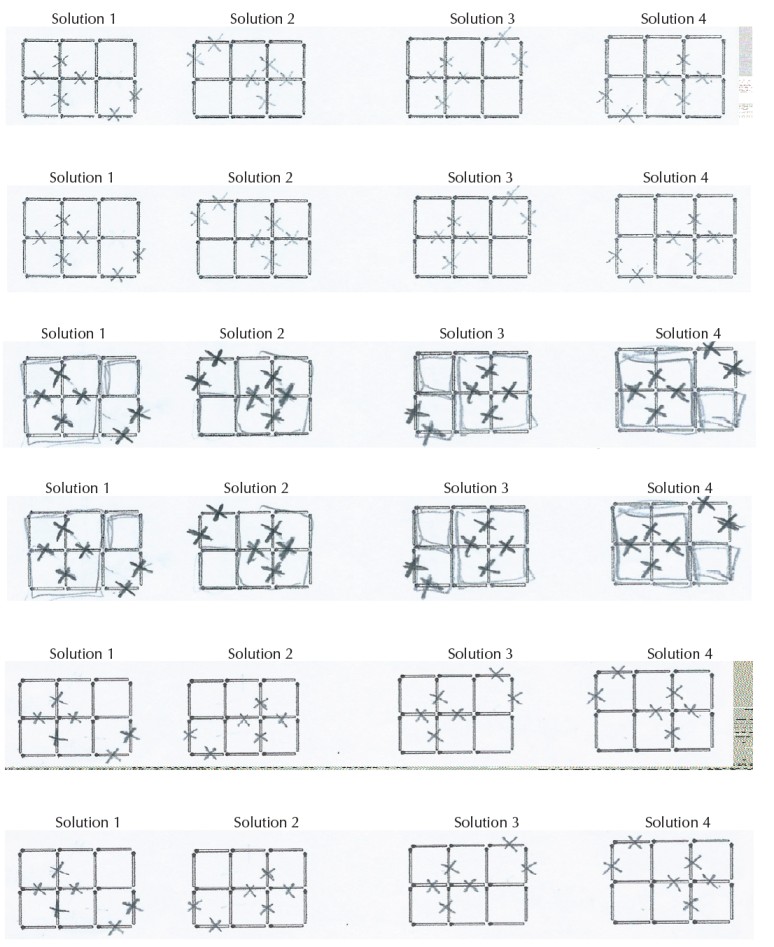
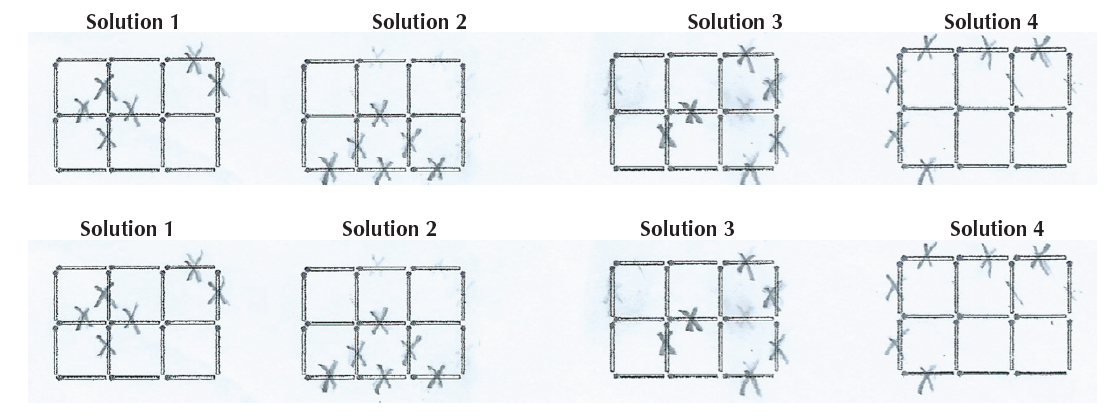
Students, informed about the existence of four visually different solutions, have shown very highlevel of the induced creativity. Twenty students (more than 85 %) were able to find all four visually different solutions.
The details of their solutions are presented in the Appendix 1.
Figure 8.: English translation of working sheet in Spanish for exploring students’ performances in four-solution reformulation of the Hoffman’ puzzle.
It is interesting to look at first solution found by the students, supposing that it was for them the easiest one to find. Eleven of them had as the first solution the H-solution published by Hoffman and six other book authors. Six students found as the first solution the A1-solution that was published by two book authors. Two students started with the A3-solution published by only one author. Only one of twenty students had as the first solution the A-2 solution, the most popular solution published by nine authors.
Not less interesting is to look at the last solution found by students, supposing it was the hardest one for them to find. For seven students the hardest solution was A3-solution found by only one author. For five students, the hardest solution was A-2 solution found by nine authors. For five students the hardest solution was A-2 solution found by two authors. For three students the hardest solution was the H-solution found by Hoffman and six other authors.
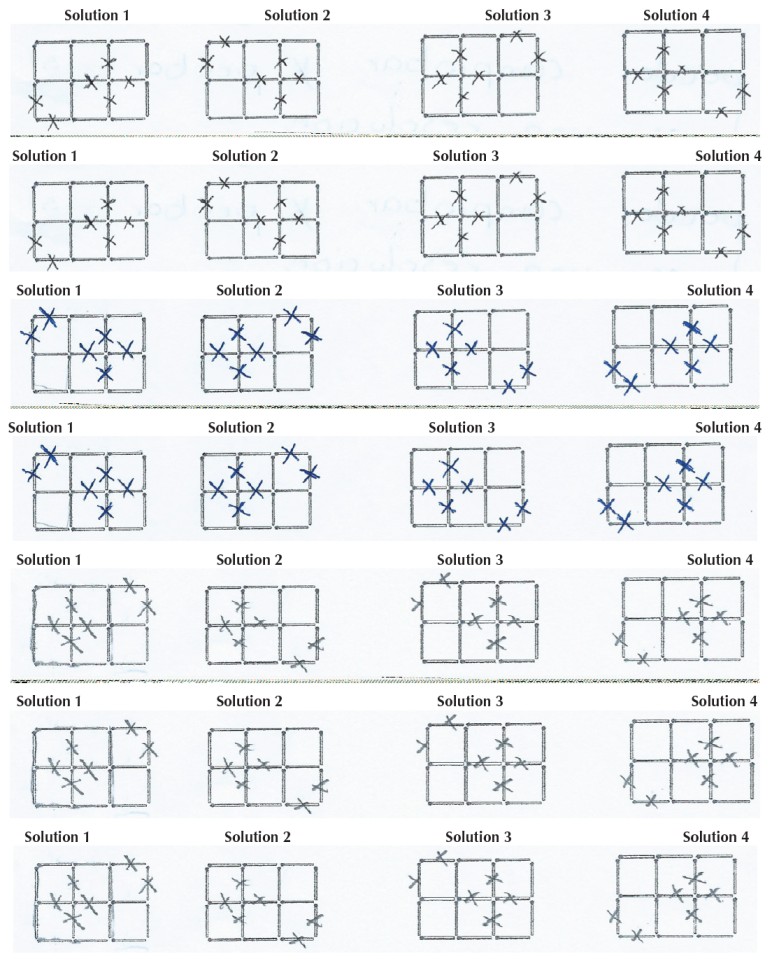
Two students were able to find only one of four visually different solutions (Appendix 2). It is worth mentioning that their single solution is equal to the most popular single solution presented by nine book and textbook authors. Does it mean that those authors were able to find only one solution, too?
Only one student was unable to find a single solution (Appendix 2).
5. Conclusion and implications for mathematics education
Students involved in the second part of the research, informed about the existence of four visually different solutions, have shown high level of induced creativity. Many of them have found all four solutions and outperformed all book authors who, with surpringly low level of routine creativity, published only one solution.
Like Hoffman’s puzzle considered above, many geometric matchstick puzzles have multiple solutions, being ideal multiple-solution tasks (Leikin & Sriraman, 2022). This fact makes them very useful to reduce or eliminate false students’ belief that all mathematics problems have only one solution or only one way of solving. This false belief, fostered by inappropriate teaching of problem solving, is the greatest obstacle to have more creativity in mathematics education (Nickerson, 2010). Such a false belief creates in collective minds an image of “narrow mathematics”. Joe Boaler describes it with the following diagnosis and consequences:
In the world of narrow mathematics, questions have only one valued method, and one answer. They are always numerical, and they do not involve visuals, objects, movements, or creativity. Most people have only ever experienced narrow mathematics, which is why we have a country of widespread mathematics failure and anxiety (Boaler, 2024, p. 9).
In addition, finding multiple solutions to geometrical matchstick puzzles doesn’t imply knowing mathematics formulas but only knowing simple geometric shapes and activation of visual intelligence, mathematical creativity and combinatorial thinking.
Instead of asking or presenting only one solution to geometric matchstick puzzles, a better pedagogical approach would be to have four different but related learning activities.
The first activity would be to strategically predict the basic properties of the sought solutions before removing, moving or adding matchsticks (Braun, 1876; Katona, 1940). In the case of Hoffman’s puzzle, it means that student should be asked to perform the following analysis:
As initial configuration is formed by seventeen matchsticks, after removing six matchsticks, two squares must be formed by eleven matchsticks. This fact eliminates the possibility to form two squares with one-matchstick sides. So, the solution would be to have one square with two-matchstick sides (formed by eight matchsticks) and one square with one-matchstick sides (formed by three matchsticks). It means that the small square will be outside of the big square, sharing with it one matchstick.
The second activity would be to find all visually different solutions. As previous prediction indicates, there are four possible positions of the small square. In two of them, the big square is on its right side, and, in two of them, the big square is on its left side.
The third activity would be to ask students to explore rotational and reflection relationships between four visually different solutions.
The fourth creativity-fostering activity would be a “puzzle-posing” task (Leikin & Sriraman, 2022):
How many matchsticks must be removed to get twosquare solution in which the small square would be inside the big square?
If one small square has to be inside the big square, seven matchsticks should be removed: two from the inside of the big square and five outside of the big square. So, the new original puzzle would be:
Remove seven matchsticks to get two squares. It has eight visually different solutions!
As it was presented above, the results of this pilot research shows that many students can carry out successfully the second learning activity, finding all four visually different solutions of the Hoffman’s puzzle, and outperforming by their induced creativity all book and textbook authors who published only a single possible solution. I hope the future research will show that many students will be able to perform well in other creativityrelated learning activities, too.
References
Appendix
Appendix 1
All four solutions, found by 20 students, are listed below:
Appendix
Appendix 2
The solutions of two students who only found one correct solution are listed below:
The solution tries of one student, who was unable to find a correct solution, are listed below:

Licencia
Derechos de autor 2025 Josip Slisko

Esta obra está bajo una licencia internacional Creative Commons Atribución-NoComercial-CompartirIgual 4.0.
Góndola, Ens Aprend Cienc. es una publicación de acceso abierto, sin cargos económicos para autores ni lectores. La publicación, consulta o descarga de los contenidos de la revista no genera costo alguno para los autores ni los lectores, toda vez que la Universidad Distrital Francisco José de Caldas asume los gastos relacionados con edición, gestión y publicación. Los pares evaluadores no reciben retribución económica alguna por su valiosa contribución. Se entiende el trabajo de todos los actores mencionados anteriormente como un aporte al fortalecimiento y crecimiento de la comunidad investigadora en el campo de la Enseñanza de las Ciencias.
A partir del 01 de diciembre de 2018 los contenidos de la revista se publican bajo los términos de la Licencia Creative Commons Atribución–No comercial–Compartir igual 4.0 Internacional (CC-BY-NC-SA 4.0), bajo la cual otros podrán distribuir, remezclar, retocar, y crear a partir de la obra de modo no comercial, siempre y cuando den crédito y licencien sus nuevas creaciones bajo las mismas condiciones.
Los titulares de los derechos de autor son los autores y la revista Góndola, Ens Aprend Cienc. Los titulares conservan todos los derechos sin restricciones, respetando los términos de la licencia en cuanto a la consulta, descarga y distribución del material.
Cuando la obra o alguno de sus elementos se halle en el dominio público según la ley vigente aplicable, esta situación no quedará afectada por la licencia.
Asimismo, incentivamos a los autores a depositar sus contribuciones en otros repositorios institucionales y temáticos, con la certeza de que la cultura y el conocimiento es un bien de todos y para todos.





.jpg)