DOI:
https://doi.org/10.14483/23464712.22023Publicado:
2025-09-12A proposal to integrate teacher digital competencies and professional knowledge associated with PCK and TPACK
Una propuesta para integrar las competencias digitales docentes y los conocimientos profesionales asociados a PCK y TPACK
Uma proposta para integrar competências digitais docentes e conhecimentos profissionais associados ao PCK e TPACK
Palabras clave:
Teacher Digital Competence, Pedagogical Content Knowledge, Pedagogical and Technological Content Knowledge, Teacher training (en).Palabras clave:
Competência Digital Docente, Conhecimento Pedagógico do Conteúdo, Conhecimento Pedagógico e Tecnológico do Conteúdo, Formação de professores. (pt).Palabras clave:
Competencia Digital Docente, Conocimiento Didáctico del Contenido, Conocimiento Didáctico y Tecnológico del Contenido, Formación de profesores (es).Descargas
Referencias
Araújo, E. D., de Sousa, F. G. A., Ponce, H. H., & Fialho, L. M. F. (2021). Digital skills and difficulties of the students of the Pedagogy course of the State University of Ceara (Brazil) through distance education. Edmetic, 10(1), 40–57. https://doi.org/10.21071/edmetic.v10i1.12950
Barcena-Toyos, P. (2022). Gamification as a tool to dynamize continuous assessment in a Master’s degree. Journal of learning styles, 15(30), 109–118.
Belmonte, J. L., Sánchez, S. P., Cabrera, A. F., & Campoy, N. D. (2020). The level of digital competence in education professionals: The case of Spanish physical education teachers. Zona proxima, 33, 146–164.
Berry, A., Loughran, J., & van Driel, J. H. (2008). Revisiting the Roots of Pedagogical Content Knowledge. International Journal of Science Education, 30(10), 1271–1279.
https://doi.org/10.1080/09500690801998885
Boice, K. L., Jackson, J. R., Alemdar, M., Rao, A. E., Grossman, S., & Usselman, M. (2021). Supporting Teachers on Their STEAM Journey: A Collaborative STEAM Teacher Training Program. Education Sciences, 11(3), 105. https://doi.org/10.3390/educsci11030105
Braslavska, O., Rozhi, I., Novhorodska, Y., Skrypnyk, N., & Pochuieva, V. (2021). Information technologies in the formation of professional competence of future teachers. Ad alta-journal of interdisciplinary research, 11(1), 139–142.
Cabero-Almenara, J., Barroso-Osuna, J., Palacios-Rodríguez, A., & Llorente-Cejudo, C. (2020a). Digital Competency Frames for university teachers: evaluation through the expert competence coefficient. Revista electronica interuniversitaria de formacion del profesorado, 23(2), 1–18.
https://doi.org/10.6018/reifop.413601
Cabero-Almenara, J., Barroso-Osuna, J., Palacios-Rodríguez, A., & Llorente-Cejudo, C. (2020b). Marcos de Competencias Digitales para docentes universitarios: su evaluación a través del coeficiente competencia experta. Revista Electrónica Interuniversitaria de Formación del Profesorado, 23(2).
https://doi.org/10.6018/reifop.413601
Cabero-Almenara, J., Guillén-Gámez, F. D., Ruiz-Palmero, J., & Palacios-Rodríguez, A. (2021). Classification models in the digital competence of higher education teachers based on the DigCompEdu Framework: logistic regression and segment tree. Journal of e-learning and knowledge society, 17(1), 49–61.
https://doi.org/10.20368/1971-8829/1135472
Cabero-Almenara, J., Gutiérrez-Castillo, J. J., Palacios-Rodríguez, A., & Barroso-Osuna, J. (2020). Development of the Teacher Digital Competence Validation of DigCompEdu Check-In Questionnaire in the University Context of Andalusia (Spain). Sustainability, 12(15). https://doi.org/10.3390/su12156094
Cabero-Almenara, J., & Palacios-Rodríguez, A. (2020). Digital Competence Framework for Educators “DigCompEdu”. Translation and adaptation of “DigCompEdu Check-In” questionnaire. Edmetic, 9(1), 213–234.
https://doi.org/10.21071/edmetic.v9i1.12462
Cabero-Almenara, J., & Palacios-Rodríguez, A. (2021). The Evaluation of Virtual Education: e-Activities. Ried-revista iberoamericana de educacion a distancia, 24(2), 169–188.
https://doi.org/10.5944/ried.24.2.28994
Cabero-Almenara, J., Romero-Tena, R., & Palacios-Rodríguez, A. (2020). Evaluation of Teacher Digital Competence Frameworks Through Expert Judgement: the Use of the Expert Competence Coefficient. Journal of new approaches in educational research, 9(2), 275–293. https://doi.org/10.7821/naer.2020.7.578
Cabero-Almenara, J., Valencia-Ortiz, R., & Palacios-Rodríguez, A. (2022). E-learning in times of COVID-19. What have we learned? IJERI-international journal of educational research and innovation, 17, 14–26.
https://doi.org/10.46661/ijeri.6361
Cabero-Almenara, J., Vázquez-Cano, E., Villota-Oyarvide, W. R., & López-Meneses, E. (2021). Innovation in the University Classroom Through Augmented Reality. Analysis From the Perspective of the Spanish and Latin American Students. Revista electronica educare, 25(3). https://doi.org/10.15359/ree.25-3.1
Candela, B. F. (2017). Adaptación del instrumento metodológico de la representación del contenido (ReCo) al marco teórico del CTPC. Góndola, enseñanza y aprendizaje de las ciencias, 12(2), 158.
https://doi.org/10.14483/23464712.11175
Cantabrana, J. L. L., Rodríguez, M. U., & Cervera, M. G. (2019). Assessing Teacher Digital Competence: the Construction of an Instrument for Measuring the Knowledge of Pre-Service Teachers. Journal of new approaches in educational research, 8(1), 73–78.
https://doi.org/10.7821/naer.2019.1.370
Castells, M. (2016). O poder da comunicação (5o ed, Vol. 1). Paz & Terra.
Chan, K. K. H. (2022). A critical review of studies using the pedagogical content knowledge map approach. International Journal of Science Education, 44(3), 487–513.
https://doi.org/10.1080/09500693.2022.2035011
da Silva, W. A., & Costa, F. A. (2023). MITec: a perceptual model to identify the necessary skills in the integration of digital technologies in the teaching-learning process. Educacao, 48, 1–26. https://doi.org/10.5902/1984644471110
Danilaev, D. P., & Malivanov, N. N. (2020). Technological education and engineering pedagogy. Obrazovanie i nauka-education and science, 22(3), 55–82.
https://doi.org/10.17853/1994-5639-2020-3-55-82
de Silva, W. A., & Costa, F. A. (2022). Digital skills in initial teacher training in Portugal. Educacao & formacao, 7(2).
https://doi.org/10.25053/redufor.v7.e8180
Dzhurylo, A. P., & Shparyk, O. M. (2019). ICT competence for secondary school teachers and students in the context of education informatization: global experience and challenges for ukraine. Information technologies and learning tools, 70(2), 43–58.
Economou, A. (2023). SELFIE forteachers Toolkit - Using SELFIE for teachers.
Esteve-Mon, F. M., Cela-Ranilla, J. M., & Gisbert-Cervera, M. (2016). ETeach3D: Designing a 3D Virtual Environment for Evaluating the Digital Competence of Preservice Teachers. Journal of educational computing research, 54(6), 816–839. https://doi.org/10.1177/0735633116637191
Estigarribia, D. L. C., Gastelú, C. A. T., Domínguez, A. L., & García, M. G. (2022). Digital competence of future teachers in a Higher Education Institution in Paraguay. Pixel-bit- revista de medios y educacion, 63, 159–195. https://doi.org/10.12795/pixelbit.91049
Faria, G. (2022). Information and communication technologies in social policies: lack of transparency and democratic illusion. Revista Katálysis, 25(1), 137–146.
https://doi.org/10.1590/1982-0259.2022.e82314
Feo, R. E. L. (2023). Teaching Digital Competence: Training experience for higher education. Revista ciencias pedagogicas e innovacion, 10(2), 74–86.
https://doi.org/10.26423/rcpi.v10i2.626
Fernández-Batanero, J. M., Cabero, J., & López, E. (2019). Knowledge and degree of training of primary education teachers in relation to ICT taught to students with disabilities. British journal of educational technology, 50(4), 1961–1978. https://doi.org/10.1111/bjet.12675
Fernández-Batanero, J. M., Cabero-Almenara, J., Román-Graván, P., & Palacios-Rodríguez, A. (2022). Knowledge of university teachers on the use of digital resources to assist people with disabilities. The case of Spain. Education and information technologies, 27(7), 9015–9029. https://doi.org/10.1007/s10639-022-10965-1
Fernández-Batanero, J. M., Montenegro-Rueda, M., Fernández-Cerero, J., & García-Martínez, I. (2022). Digital competences for teacher professional development. Systematic review. European journal of teacher education, 45(4), 513–531. https://doi.org/10.1080/02619768.2020.1827389
Fernandez-Batanero, J. M., Roman-Gravan, P., Montenegro-Rueda, M., Lopez-Meneses, E., & Fernandez-Cerero, J. (2021). Digital Teaching Competence in Higher Education: A Systematic Review. Education sciences, 11(11).
https://doi.org/10.3390/educsci11110689
Fernández-Márquez, E., Leiva-Olivencia, J. J., & López-Meneses, E. (2018). Digital Competences in Higher Education Professors. Revista digital de investigacion en docencia universitaria-ridu, 12(1), 213–231.
https://doi.org/10.19083/ridu.12.558
Fernández-Morante, C., López, B. C., Casal-Otero, L., & León, F. M. (2023). Teachers’ Digital Competence. The Case of the University System of Galicia. Journal of new approaches in educational research, 12(1), 62–76.
https://doi.org/10.7821/naer.2023.1.1139
Frolova, E. V, Rogach, O. V, & Ryabova, T. M. (2020). Digitalization of Education in Modern Scientific Discourse: New Trends and Risks Analysis. European journal of contemporary education, 9(2), 313–336.
https://doi.org/10.13187/ejced.2020.2.313
Fuentes, A., López, J., & Pozo, S. (2019). Analysis of the Digital Teaching Competence: Key Factor in the Performance of Active Pedagogies with Augmented Reality. Reice-revista iberoamericana sobre calidad eficacia y cambio en educacion, 17(2), 27–42.
https://doi.org/10.15366/reice2019.17.2.002
Gafuanov, Y. Y., & Podnebesova, G. B. (2020). The Formation of Professional ICT-Competence in Teaching Programming to Future Teachers of Informatics and IT-Experts. Tomsk state university journal, 455, 175–182.
https://doi.org/10.17223/15617793/455/24
Galvao, M. C. B., Pluye, P., & Ricarte, I. L. M. (2017). Métodos de pesquisa mistos e revisões de literatura mistas: conceitos, construção e critérios de avaliação. InCID: Revista de Ciência da Informação e Documentação, 8(2), 4. https://doi.org/10.11606/issn.2178-2075.v8i2p4-24
Gisbert-Cervera, M., Usart, M., & Lázaro-Cantabrana, J. L. (2022). Training pre-service teachers to enhanced digital education. European journal of teacher education, 45(4), 532–547. https://doi.org/10.1080/02619768.2022.2098713
González-Martinez, J., Martí, M. C., & Cervera, M. G. (2019). Inside a 3D simulation: Realism, dramatism and challenge in the development of students’ teacher digital competence. Australasian journal of educational technology, 35(5), 1–14. https://doi.org/10.14742/ajet.3885
Graça, V. G., Quadros-Flores, P. M., Raposo-Rivas, M., & Ramos, M. A. (2021). ICT in the initial training of educators and teachers. Revista latinoamericana de tecnologia educativa-relatec, 20(1), 27–37. https://doi.org/10.17398/1695-288X.20.1.27
Grobler, R., & Ankiewicz, P. (2022). The viability of diverting from a linear to a parallel approach to the development of PCK in technology teacher education. International journal of technology and design education, 32(2), 1001–1021. https://doi.org/10.1007/s10798-020-09644-4
Gutiérrez-Castillo, J. J., Palacios-Rodríguez, A., Martín-Párraga, L., & Serrano-Hidalgo, M. (2023). Development of Digital Teaching Competence: Pilot Experience and Validation through Expert Judgment. Education sciences, 13(1). https://doi.org/10.3390/educsci13010052
Harris, J., Mishra, P., & Koehler, M. (2009). Teachers’ Technological Pedagogical Content Knowledge and Learning Activity Types. Journal of Research on Technology in Education, 41(4), 393–416. https://doi.org/10.1080/15391523.2009.10782536
Hidalgo-Cajo, B. G., & Gisbert-Cervera, M. (2022). Determining factors that make it possible to establish typologies of teachers in the context of technological innovation in education. Red-revista de educacion a distancia, 22(69). https://doi.org/10.6018/red.499171
Hidalgo-Durán, G. (2019). Technological competences development: fundamental challenge for Costa Rican university teachers. Revista electronica calidad en la educacion superior, 10(2), 34–52.
https://doi.org/10.22458/caes.v10i2.1924
Horacek, G. E., & de Anso, M. B. (2019). Playful digital abilities and gamification. Reidocrea-revista eectronica de investigacion y docencia creativa, 8, 399–410.
Hume, A., Cooper, R., & Borowski, A. (2020). Correction to: Repositioning Pedagogical Content Knowledge in Teachers’ Knowledge for Teaching Science. Em Repositioning Pedagogical Content Knowledge in Teachers’ Knowledge for Teaching Science (p. C1–C1). Springer Nature Singapore.
https://doi.org/10.1007/978-981-13-5898-2_15
Hung, E. M. S., Sartori, A. S., & Marcano, B. (2019). Factors affecting the use of ict in elementaryu school teachers in colombia. Prisma social, 25, 464–487.
INTEF. (2017). Marco común de competencia digital docente octubre 2017.
Isupova, N. I., Mamaeva, E. A., Bocharov, M. I., & Bocharova, T. I. (2021). Practical Activity on Developing a System of Tasks as a Condition for Training A Future Digital School Teacher. European journal of contemporary education, 10(3), 638–652.
https://doi.org/10.13187/ejced.2021.3.638
Ivaniuk, H. I., Kuzemko, L. V, & Novyk, I. M. (2020). Training program “designing a multimedia environment of general secondary education and preschool education institutions” as an instrument for future educators’ digital skills formation. Information technologies and learning tools, 79(5), 73–89.
https://doi.org/10.33407/itlt.v79i5.3901
John W. Creswell. (2012). Educational Research Planning, Conducting, and Evaluating Quantitative and Qualitative Research (Paul A. Smith, Christina Robb, Matthew Buchholtz, & Karen Mason, Orgs.; 4o ed, Vol. 1). Pearson Education.
Kathe Pelletier, Jenay Robert, Nicole Muscanell, Mark McCormack, Jamie Reeves, Nichole Arbino, & Susan Grajek. (2023). 2023 EDUCAUSE Horizon Report® Teaching and Learning Edition.
Khoruzha, L. L., Proshkin, V. V, & Glushak, O. M. (2020). High school teachers’ competence development by means of digital technologies. Information technologies and learning tools, 78(4), 298–314.
https://doi.org/10.33407/itlt.v78i4.3042
Koehler, M. J., Shin, T. S., & Mishra, P. (2012). How Do We Measure TPACK? Let Me Count the Ways. Em Educational Technology, Teacher Knowledge, and Classroom Impact (p. 16–31). IGI Global. https://doi.org/10.4018/978-1-60960-750-0.ch002
Kostenko, L., Ruda, O., Sofilkanych, M., & Bokshan, A. (2023). Distance learning as an integrative response to contemporary challenges. Futurity Education, 3(1), 151–164.
https://doi.org/10.57125/FED/2022.10.11.12
Lara-Rivera, J. A., & Cabero-Almenara, J. (2021). Digital knowledge in higher education teachers. Study in a Mexican school. Red-revista de educacion a distancia, 21(66).
https://doi.org/10.6018/red.447911
Levy, P. (1999). Cibercultura (P. Levy, Org.; 1o ed, Vol. 1). 34.
Llorente-Cejudo, C., Palacios-Rodríguez, A., & Fernández-Scagliusi, V. (2022). Learning Landscapes and Educational Breakout for the Development of Digital Skills of Teachers in Training. Interaction design and architectures, 53, 176–190.
Loughran, J., Mulhall, P., & Berry, A. (2004). In search of pedagogical content knowledge in science: Developing ways of articulating and documenting professional practice. Journal of Research in Science Teaching, 41(4), 370–391. https://doi.org/10.1002/tea.20007
Malcolm, S. A., Mavhunga, E., & Rollnick, M. (2019). The Validity and Reliability of an Instrument to Measure Physical Science Teachers’ Topic Specific Pedagogical Content Knowledge in Stoichiometry. African journal of research in mathematics science and technology education, 23(2), 181–194.
https://doi.org/10.1080/18117295.2019.1633080
Manzanero, W. G. C., & Gonzalez, A. Z. (2023). The digital literacy of secondary school teachers in the city of Merida, Yucatan, Mexico. CPU-e revista de investigacion educativa, 37, 1–35. https://doi.org/10.25009/cpue.v0i37.2845
Martinez-Perez, S., Cabero-Almenara, J., Barroso-Osuna, J., & Palacios-Rodriguez, A. (2022). T-MOOC for Initial Teacher Training in Digital Competences: Technology and Educational Innovation. Frontiers in Education, 7. https://doi.org/10.3389/feduc.2022.846998
Martín-Párraga, L., Llorente-Cejudo, C., & Cabero-Almenara, J. (2022). Analysis of teachers’ digital competencies from assessment frameworks and instruments. International journal of educational research and innovation, 18, 62–79. https://doi.org/10.46661/ijeri.7444
Martín-Párraga, L., Palacios-Rodríguez, A., & Gallego-Pérez, O. M. (2022). Do we play or gamify? Evaluation of gamification training experience to improve the digital competence of university teaching staff. Alteridad-revista de educacion, 17(1), 36–49.
https://doi.org/10.17163/alt.v17n1.2022.03
Mattar, J., Santos, C. C., & Cuque, L. M. (2022). Analysis and Comparison of International Digital Competence Frameworks for Education. Education sciences, 12(12).
https://doi.org/10.3390/educsci12120932
Mavhunga, E. (2016). Transfer of the pedagogical transformation competence across chemistry topics. Chemistry education research and practice, 17(4), 1081–1097.
https://doi.org/10.1039/c6rp00095a
Meneses, E. L., & Cerero, J. F. (2020). Information and Communication Technologies and functional diversity: knowledge and training of teachers in Navarra. IJERI-international journal of educational research and innovation, 14, 59–75. https://doi.org/10.46661/ijeri.4407
Miguel-Revilla, D., Martínez-Ferreira, J. M., & Sanchez-Agustí, M. (2020). Assessing the digital competence of educators in social studies: An analysis in initial teacher training using the TPACK-21 model. Australasian journal of educational technology, 36(2).
https://doi.org/10.14742/ajet.5281
Mishra, P., & Koehler, M. J. (2006). Technological Pedagogical Content Knowledge: A Framework for Teacher Knowledge. Teachers College Record: The Voice of Scholarship in Education, 108(6), 1017–1054.
https://doi.org/10.1111/j.1467-9620.2006.00684.x
Monteiro, A., Mouraz, A., & Dotta, L. T. (2020). Veteran teachers and digital technologies: myths, beliefs and professional development. Teachers and teaching, 26(7–8), 577–587. https://doi.org/10.1080/13540602.2021.1900809
Morais, C., & Araújo, J. L. (2023). An Alternative Experimental Procedure to Determine the Solubility of Potassium Nitrate in Water with Automatic Data Acquisition Using Arduino for Secondary School: Development and Validation with Pre-Service Chemistry Teachers. Journal of Chemical Education, 100(2), 774–781. https://doi.org/10.1021/acs.jchemed.2c00615
Morales, M. J., Rivoir, A., Lázaro-Cantabrana, J. L., & Gisbert-Cervera, M. (2020). How does the digital teaching competence matter? An analysis of initial teacher training programs in Uruguay. Innoeduca-international journal of technology and educational innovation, 6(2), 128–140. https://doi.org/10.24310/innoeduca.2020.v6i2.5601
Nilsson, P. (2022). From PCK to TPACK-Supporting student teachers’ reflections and use of digital technologies in science teaching. Research in science & technological education. https://doi.org/10.1080/02635143.2022.2131759
Oliveira, T. M. A., & Mozzer, N. B. (2017). Análise dos conhecimentos declarativo e procedimental de futuros professores de química sobre analogias. Ensaio Pesquisa em Educação em Ciências (Belo Horizonte), 19(0). https://doi.org/10.1590/1983-21172017190102
Ortega-Rodríguez, P. J., Gómez-García, M., Boumadan, M., & Soto-Varela, R. (2022). Media literacy of university students for creating digital contents. Innoeduca-international journal of technology and educational innovation, 8(2), 69–82. https://doi.org/10.24310/innoeduca.2022.v8i2.14169
Palacios-Rodríguez, A., Cabero-Almenara, J., & Puentes-Puente, A. (2022). Production of Polimedia by University Professors and Degree of Acceptance in the Dominican Republic. Revista electronica de investigacion educativa, 24. https://doi.org/10.24320/redie.2021.24.e11.4366
Panagiotis Kampylis, Yves Punie, & Jim Devine. (2015). Promoting Effective Digital-Age Learning: A European Framework for Digitally-Competent Educational Organisations.
Pech, S. H. Q., Chi, G. I. C., & Cabrera, W. R. R. (2021). Development of digital competence in university teachers. Etic net-revista cientifica electronica de educacion y comunicacion en la sociedad del conocimiento, 21(1), 83–114. https://doi.org/10.30827/eticanet.v21i1.16005
Pérez, M. E. D., López-Bouzas, N., & Fernández, J. C. (2022). Design of gamified stories with augmented reality in initial teacher training. Redu-revista de docencia universitaria, 20(2), 199–218. https://doi.org/10.4995/redu.2022.18701
Pérez-Sanagustin, M., Kotorov, I., Teixeira, A., Mansilla, F., Broisin, J., Alario-Hoyos, C., Jerez, O., Pinto, M. D. T., García, B., Kloos, C. D., Morales, M., Solarte, M., Oliva-Córdova, L. M., & Lopez, A. H. G. (2022). A Competency Framework for Teaching and Learning Innovation Centers for the 21st Century: Anticipating the Post-COVID-19 Age. Electronics, 11(3).
https://doi.org/10.3390/electronics11030413
Perrenoud, Philippe. (2000). Dez novas competências para ensinar. (Philippe. Perrenoud, Org.). Artmed, 2000.
Pinto-Santos, A. R., & Garcias, A. P. (2022). Curriculum management and development of teaching digital competence in initial teacher training. Red-revista de educacion a distancia, 22(69). https://doi.org/10.6018/red.493551
Pozas, M., & Letzel, V. (2023). “Do You Think You Have What it Takes?” - Exploring Predictors of Pre-Service Teachers’ Prospective ICT Use. Technology knowledge and learning, 28(2), 823–841. https://doi.org/10.1007/s10758-021-09551-0
Putri, A. R. A., Hidayat, T., & Purwianingsih, W. (2020). Analysis of technological pedagogical content knowledge (TPACK) of biology teachers in classification of living things learning. Journal of Physics: Conference Series, 1521(4), 042033. https://doi.org/10.1088/1742-6596/1521/4/042033
Quast, J., Rubach, C., & Porsch, R. (2023). Professional digital competence beliefs of student teachers, pre-service teachers and teachers: Validating an instrument based on the DigCompEdu framework. European journal of teacher education. https://doi.org/10.1080/02619768.2023.2251663
Redecker, C., & Punie, Y. (2017). European Framework for the Digital Competence of Educators: DigCompEdu.
Reinhold, F., Strohmaier, A., Finger-Collazos, Z., & Reiss, K. (2021). Considering Teachers’ Beliefs, Motivation, and Emotions Regarding Teaching Mathematics With Digital Tools: The Effect of an In-Service Teacher Training. Frontiers in education, 6.
https://doi.org/10.3389/feduc.2021.723869
Ricardo-Barreto, C., Molinares, D. J., Llinás, H., Santodomingo, J. P., Acevedo, C. A., Rodríguez, P. A., Navarro, C. B., & Villa, S. V. (2020). Trends in using ict resources by professors in heis (higher education institutions). Journal of information technology education-research, 19, 395–425. https://doi.org/10.28945/4601
Rodríguez-Muñiz, L. J., Burón, D., Aguilar-González, A., & Muñiz-Rodríguez, L. (2021). Secondary Mathematics Teachers’ Perception of Their Readiness for Emergency Remote Teaching during the COVID-19 Pandemic: A Case Study. Education sciences, 11(5).
https://doi.org/10.3390/educsci11050228
Roliak, A. O. (2019). Ict implementation in the system of teacher education: nordic dimension. Information technologies and learning tools, 69(1), 258–267.
https://doi.org/10.33407/itlt.v69i1.2361
Rubio-Gragera, M., Cabero-Almenara, J., & Palacios-Rodriguez, A. (2023). Digital Innovation in Language Teaching-Analysis of the Digital Competence of Teachers according to the DigCompEdu Framework. Education sciences, 13(4). https://doi.org/10.3390/educsci13040336
Sáez-López, J. M., Grimaldo-Santamaría, R. O., Quicios-García, M. P., & Vázquez-Cano, E. (2023). Teaching the Use of Gamification in Elementary School: A Case in Spanish Formal Education. Technology knowledge and learning. https://doi.org/10.1007/s10758-023-09656-8
Sánchez, S. P., Belmonte, J. L., Cruz, M. F., & Núñez, J. A. L. (2020). Correlational analysis of the incident factors in the level of digital competence of teachers. Revista electronica interuniversitaria de formacion del profesorado, 23(1), 143–159.
https://doi.org/10.6018/reifop.396741
Santaella, L. (2023). As linguagens da cibercultura. Em M. dos S. M. Vieira & M. L. Weidemer (Orgs.), Saberes em Sociolinguística: trilhas, demandas e proposições (1o ed, Vol. 1, p. 85–100).
Santos, A. R. P., Pérez-Garcias, A., & Mesquida, A. D. (2023). Training in Teaching Digital Competence: Functional Validation of the TEP Model. Innoeduca-international journal of technology and educational innovation, 9(1), 39–52. https://doi.org/10.24310/innoeduca.2023.v9i1.15191
Santos, D., Lima, L., & Junior, G. (2020). A formação de professores de química, mudanças na regulamentação e os impactos na estrutura em cursos de licenciatura em química. Química Nova. https://doi.org/10.21577/0100-4042.20170567
Semenikhina, O. V, Drushliak, M. G., & Khvorostina, Y. V. (2019). Use of geogebra cloud service in future math teachers’ teaching. Information technologies and learning tools, 73(5), 48–66.
Shulman, L. S. (1986). Those Who Understand: Knowledge Growth in Teaching. Educational Researcher, 15(2), 4.
https://doi.org/10.2307/1175860
Sierra, A. A. J., Iglesias, J. M. O., Cabero-Almenara, J., & Palacios-Rodríguez, A. (2023). Development of the teacher’s technological pedagogical content knowledge (TPACK) from the Lesson Study: A systematic review. Frontiers in education, 8.
https://doi.org/10.3389/feduc.2023.1078913
Tomte, C., Enochsson, A. B., Buskqvist, U., & Kårstein, A. (2015). Educating online student teachers to master professional digital competence: The TPACK-framework goes online. Computers & education, 84, 26–35.
https://doi.org/10.1016/j.compedu.2015.01.005
Torres-Flórez, D., & Pachón-Pérez, Y. (2021). Digital skills in university professors of administrative economic sciences. Revista pensamiento americano, 14(28), 77–93.
https://doi.org/10.21803/penamer.14.28.447
Tsiuniak, O., Galyna, R., Mariana, S., Hvozdyak, O., Hirniak, S., Nevmerzhytska, O., Chubinska, N., & Hevko, V. (2022). The formation of future teachers professional readyness to innovation activity by means of digital technologies. Revista de investigaciones-universidad del quindio, 34, 136–143.
UNESCO. (2008). ICT Competency Standards for Teachers.
Urbina, S., Pérez-Garcias, A., & Ramírez-Mera, U. N. (2022). The digital competence of university lecturers in initial teacher training. Campus virtuales, 11(2), 49–62.
https://doi.org/10.54988/cv.2022.2.1043
Vakaliuk, T. A., Osova, O. O., Chernysh, O. A., & Bashkir, O. I. (2022). Checking digital competence formation of foreign language future teachers using game simulators. Information technologies and learning tools, 90(4), 57–75. https://doi.org/10.33407/itlt.v90i4.4816
Valle, L. A. C., & Girotto, G. (2021). Understanding the Technological and Pedagogical Content Knowledge (TPACK) of mathematics teachers as a possibility for reflection on the use of educational technology. Acta Scientiae, 23(6). https://doi.org/10.17648/acta.scientiae.6695
van Eck, N. J., & Waltman, L. (2018). Manual for VOSviewer version 1.6.8.
Widyasari, F., Masykuri, M., Mahardiani, L., Saputro, S., & Yamtinah, S. (2022). Measuring the Effect of Subject-Specific Pedagogy on TPACK through Flipped Learning in E-Learning Classroom. International journal of instruction, 15(3), 1007–1030. https://doi.org/10.29333/iji.2022.15354a
Willermark, S. (2018). Technological Pedagogical and Content Knowledge: A Review of Empirical Studies Published From 2011 to 2016. Journal of Educational Computing Research, 56(3), 315–343. https://doi.org/10.1177/0735633117713114
Wohlfart, O., & Wagner, I. (2022). The TPACK Model - a promising Approach to Modeling the Digital Competences of (prospective) Teachers? A systematic Umbrella Review. Zeitschrift fur padagogik, 68(6), 846–868.
Zeller, D. (2022). Medialab - A three-stage module for the development of digital competence in chemistry or science teacher education. Chemkon, 29, 287–292.
https://doi.org/10.1002/ckon.202200012
Zhernovnykova, O. A., Peretiaha, L. Y., Kovtun, A. V, Korduban, M. V, Nalyvaiko, O. O., & Nalyvaiko, N. A. (2020). The technology of prospective teachers’ digital competence formation by means of gamification. Information technologies and learning tools, 75(1), 170–185.
Cómo citar
APA
ACM
ACS
ABNT
Chicago
Harvard
IEEE
MLA
Turabian
Vancouver
Descargar cita
Recibido: 2 de abril de 2024; Aceptado: 1 de septiembre de 2025
Abstract
Teacher training for the use of technological resources has been widely researched in educational studies. Situated in the context of such investigations, research on digital competences in education has also gained prominence in the last decade. Considering the breadth of work conducted in these areas and the need for integration between the different theoretical-practical domains that permeate this field of study, the main objective of this research is to develop a theoretical framework to bridge the references of teaching and digital competency within Teaching Professional Knowledge. Methodologically, a systematic literature analysis was conducted, beginning with an initial bibliometric analysis using VOSviewer software tool, followed by the categorization of a selected corpus of works. Subsequently, an analysis of the relationships between the teaching of digital competences and the knowledge domains related to the references of Pedagogical Content Knowledge and Pedagogical and Technological Content Knowledge was carried out. The systematic review allowed us to infer that prevailing trends in research on the teaching of digital competency are related to the assessment of competences in different groups of teachers, to the proposal of training actions, and to theoretical studies. It was evident that the theoretical framework known as DigCompEdu serves as a foundation for various research endeavors. Relations between the domains of teaching professional knowledge and digital competences were identified, and based on this identification, a theoretical framework is discussed and proposed to consider the possibility of articulating actions for the development of teaching digital competences in the context of teacher training oriented towards Pedagogical and Technological Content Knowledge.
Keywords
Teacher Digital Competence, Pedagogical Content Knowledge, Pedagogical and Technological Content Knowledge, Teacher training.Resumen
La formación del profesorado en el empleo de recursos tecnológicos ha sido objeto de extensa investigación en el ámbito de la educación reciente. En el contexto de estas investigaciones, se ha observado un creciente enfoque en las competencias digitales para la educación durante la última década. Dado el amplio espectro de investigaciones desarrolladas en estas áreas y la necesidad de establecer conexiones entre los diversos dominios teórico-prácticos que atraviesan este campo de estudio, nuestro objetivo primordial en esta investigación es la formulación de un marco teórico con la finalidad de integrar los elementos fundamentales de la pedagogía y la competencia digital dentro del conocimiento profesional docente. Desde una perspectiva metodológica, se llevó a cabo un análisis sistemático de la literatura, comenzando con un análisis bibliométrico inicial mediante el empleo del software VOSviewer, seguido por la categorización de un conjunto selecto de obras. Posteriormente, se procedió a examinar las relaciones existentes entre la enseñanza de las competencias digitales y los dominios de conocimiento vinculados a los referentes del Conocimiento Didáctico del Contenido y el Conocimiento Didáctico y Tecnológico del Contenido. El análisis sistemático realizado permitió deducir que las tendencias predominantes en las investigaciones sobre la enseñanza de la competencia digital se centran en la evaluación de las habilidades en diversos grupos de docentes, la propuesta de estrategias formativas y los estudios teóricos. Se destaca que el marco teórico denominado DigCompEdu constituye una base sólida para numerosas investigaciones en esta área. A través de la identificación de similitudes entre los dominios relacionados con la enseñanza de los conocimientos profesionales y las habilidades digitales, se plantea la posibilidad de concebir un marco teórico que permita la articulación de acciones destinadas al desarrollo de la enseñanza de las habilidades digitales en el contexto de la formación orientada al Conocimiento Didáctico y Tecnológico del Contenido.
Palabras clave
Sentido común, APPs, LGBTQI+, Prácticas sexuales, Enfermedades.Resumo
A formação de professores para o uso de recursos tecnológicos tem sido amplamente investigada nas pesquisas educacionais recentes. No contexto dessas investigações, as pesquisas sobre as competências digitais para educação também têm ganhado foco nos últimos dez anos. Considerando a amplitude de trabalhos desenvolvidos nessas áreas e a necessidade de articulação entre os diferentes domínios teóricopráticos que permeiam este campo de estudos, o objetivo principal desta pesquisa é o desenvolvimento de um quadro teórico com a intenção de aproximar os referenciais de competência digital docente e dos conhecimentos profissionais docentes. Metodologicamente, procedeu-se com uma análise sistemática da literatura que partiu de uma análise bibliométrica inicial utilizando-se o software VOSviewer, seguida da categorização de um corpus de trabalhos selecionados. Posteriormente, realizou-se a análise das relações entre as competências digitais docentes e os domínios de conhecimento vinculados aos referenciais do Conhecimento Pedagógico do Conteúdo e do Conhecimento Pedagógico e Tecnológico do Conteúdo. A revisão sistemática permitiu inferir que as tendências nas pesquisas sobre competência digital docente estão relacionadas ao diagnóstico de competências em diferentes grupos de professores, à proposição de ações formativas, e a estudos teóricos. Evidenciou-se que o marco teórico DigCompEdu apresenta-se como base para as diferentes pesquisas realizadas. Foi possível identificar aproximações entre os domínios de conhecimento profissional docente e as competências digitais, e com esta identificação discute-se e propõe-se um quadro teórico no sentido de considerar a possibilidade de se articularem ações para o desenvolvimento das competências digitais docentes na formação para o desenvolvimento de Conhecimento Pedagógico e Tecnológico do Conteúdo.
Palavras-chave
Competência Digital Docente, Conhecimento Pedagógico do Conteúdo, Conhecimento Pedagógico e Tecnológico do Conteúdo, Formação de rofessores.1. Introduction
The study of digital skill development focuses on understanding how to use digital tools and resources discerningly for active citizenship. This focus is intrinsically related to the training of individuals capable of constructing different meanings when faced with the use of diverse resources and information in the digital context (UNESCO, 2008).
Historically, the concept of competence permeated various sectors, primarily linked to vocational preparation in a didactic and technical sense. In the realm of education, this paradigm transformed, aligning itself with constructivism. This evolution has surpassed the purely technical dimensions of competence, evolving into a fusion of knowledge and skills united with decision-making capacity. This amalgamation operates within an intentional, reflective process, tailored to the idiosyncrasies of the specific professional contexts within the realm of education. Perrenoud (2000) proposes the notion of competences, intricately intertwined with the concepts of:
“[…] individualize and diversify training paths, introduce learning cycles, differentiate pedagogy, focus on a more formative rather than normative assessment, conduct development projects, develop teaching teamwork and take collective responsibility for students, place children at the center of pedagogical action, using active methods, project procedures, working with open problems and problem situations, developing skills and transferring knowledge, educating for citizenship” (Perrenoud, 2000) p. 14, translation by the authors).
In the contemporary landscape characterized by the widespread use of technological resources, the notion of digital competences emerges within different areas. This concept finds resonance in the discourse of institutions such as UNESCO (2008) and is examined by authors who seek to understand the use of digital Information and Communication Technologies (ICT) within the fields of politics, economics, and society (Castells, 2016; Faria, 2022; Santaella, 2023; Levy, 1999).
In the educational domain, and particularly in the context of teacher training, the concept of Teaching Digital Competence (TDC) has emerged. This concept proposes that, given the increasing and daily use of ICT, it is necessary to contemplate not only their instrumental training but also their discerning and critical utilization. As emphasized by some authors, digital competence plays a fundamental role as one of the primary skills that citizens in general, and teachers in particular, must master in contemporary society (Cabero-Almenara, Romero-Tena, et al., 2020).
The definitions and conceptualizations associated with TDC have been articulated diversely in the literature. Some authors investigate in detail the notion of TDC as a composite construct encompassing knowledge, skills, and attitudes indispensable for the effective utilization of ICT (Hidalgo-Durán, 2019). This holistic perspective entails various dimensions, including technological, informational, multimedia, communicative, collaborative, and ethical aspects. It anchors itself in didactic and pedagogical criteria, seeking to facilitate the seamless integration of TDC into educational practices.
Pech et al. (2021) propose a transversal competence, one that involves the ability to not only navigate the technology resources, but also to interact effectively with others and demonstrate professionalism. This comprehensive view comprises the integration of technologies while concurrently relating them to the corpus of pedagogical knowledge.
In alignment with this perspective, TDC is conceptualized as multidimensional competence, supported by the central notion of the ability to mobilize capabilities and proficiencies (Graça et al., 2021). These competences empower educators to adeptly search, critically curate, acquire, and process pertinent information through the utilization of ICT.
Research on TDC has gained prominence, accompanied by a series of initiatives focused on diagnosis and the formulation of teacher training strategies. An important document produced by the Joint Research Center (JRC) – associated with the European Commission – takes center stage: the Digital Competence Framework for Education (commonly referred to as DigCompEdu) (Redecker & Punie, 2017). DigCompEdu is designed to support and facilitate national, regional, and local initiatives aimed at enhancing educators’ digital competence. It serves as a unifying reference point replete with a shared lexicon and rationale (p. 7). This European framework has not only been extensively cited in research worldwide but has also laid the foundation for the formulation of various tools and policies regarding teacher training (Cabero-Almenara, Gutiérrez-Castillo, et al., 2020; INTEF, 2017).
Given that different authors conceptualize TDC as comprising knowledge, skills, and attitudes, and recognize that teacher training in technology integration encompasses diverse domains of knowledge, including content, pedagogical, and technological aspects, it is plausible to contemplate how TDC studies can align with the endeavors centered on the development of Teaching Professional Knowledge (TPK).
In this context, two important references in the TPK area are Pedagogical Content Knowledge (PCK) (Shulman, 1986) and Technological Pedagogical Content Knowledge (TPACK) (Mishra & Koehler, 2006). PCK delineates teachers’ knowledge within domains that may not explicitly incorporate technology but are likely to consider technological knowledge integrated into various facets of the knowledge base, covering aspects such as student characteristics, learning context, pedagogical strategies and assessment methods. The most recent model, known as the “Refined Consensus Model”, introduces three distinct realms of PCK: collective PCK (cPCK), personal PCK (pPCK), and enacted PCK (ePCK), marked by interconnections, filters – limiting aspects for development - and amplifying aspects - enhancing aspects for development - across these different domains (Hume et al., 2020). This model acknowledges that a strong foundation in broader professional knowledge, including Content Knowledge (CK), Pedagogical Knowledge (PK), Student Knowledge (SK), Assessment
Knowledge (AK), and Curriculum Knowledge (CuK) is crucial for a teacher’s Pedagogical Content Knowledge (PCK) (Hume et al., 2020).
The TPACK model comprises distinct elements examined separately and altogether. Content Knowledge (CK) and Pedagogical Knowledge (PK) form the base of the PCK model, while Technological Knowledge (TK) integrates the technologies. Through the alignment of these elements, Technological Content Knowledge (TCK) and Technological Pedagogical Knowledge (TcPK) emerge, integrating with PCK and forming TPACK.
Both of these reference models have found utility in research concerning teacher training in technology integration, spanning diverse contexts, including theoretical investigations, the development and deployment of training initiatives, as well as the evaluation and measurement of TPK (Wohlfart & Wagner, 2022).
Notably, scholars have undertaken efforts that seek to interweave discussions about PCK and TPACK with the integration of technological resources (Grobler & Ankiewicz, 2022; Nilsson, 2022) alongside research dedicated to teacher training for TDC (Gafuanov & Podnebesova, 2020; Ivaniuk et al., 2020). However, there remains a gap in terms of the theoretical constructs encompassing these domains.
Thus, it is in a context in which research on TDC and TPK for the use of ICT is undergoing intense development that we consider the possibility of greater integration between the areas to be promising. This study aims to promote alignment between these areas, seeking to identify opportunities and challenges inherent to their integration in the field of teacher education.
We emphasize that the articulation between these frameworks is important, given that there is little overlap between them, but mainly because both focus on teacher professional development for the use of technologies and on areas that can complement each other and strengthen professional development.
Therefore, the general objective of this study is: To propose a theoretical framework that aligns the components of Teaching Digital Competences (TDC) with Teaching Professional Knowledge (TPK) in the context of teacher training. With this central focus, we have delineated specific objectives:
(i) To conduct a literature review in order to identify and characterize the predominant definitions and trends within the realm of research concerning TDC and teacher training.
(ii) To provide a characterization of works related to TDC and teacher training, taking into account different perspectives, research objectives, methodologies and results. This characterization involves the identification of distinct viewpoints in recent research.
(iii) Analyze and describe possible relationships between teaching digital skills and the components of PCK and TPACK.
In our research, we have formulated the following questions:
1. In the corpus of research encompassing TDC and TPK, how do these two conceptual frameworks intersect within the domain of teacher training?
2. Given the definitions of TDC and the fundamental references of Pedagogical Content Knowledge (PCK) and Technological Pedagogical Content Knowledge (TPACK), is it possible to find intersections between the components that structure these constructs?
2. Methodology
Considering our research objectives, the methodological steps described below sought, based on a broad literature review, to identify research trends and key discussions associated with TDC and TPK, and then to further explore reference texts. This analysis would allow us to understand whether there are integrations between digital competencies and professional knowledge, how these are structured, and what the possible paths for integration are.
The research methodology in this study follows the design outlined in Figure 1. The methodology involves three main steps: initially selecting a primary corpus for bibliometric analysis to identify research trends (Steps I to IV). Following this, a more detailed analysis was conducted on a subset of the initial works in a second corpus.

Figure 1:: Structure and stages of the methodology.
A literature review was conducted (Galvao et al., 2017). This review protocol necessitates the specification of search criteria, delimiting the temporal space, identifying key terms and applying filters. The review outcomes were analyzed using the VOSviewer (VOS) software (version 1.6.20) to discern research trends in this domain. To this review, that covered Steps II and III, we explored the Web of Science (WoS) and Scopus databases.
The search was executed employing the following query string: “digital competence” OR “digital competences” AND “teacher training”. The languages considered were English, Spanish, and Portuguese. This comprehensive search strategy was designed to capture a wide spectrum of works, recognizing that some texts may pertain to fields of knowledge beyond education. The temporal scope of the search spanned from 2015 to 2023, with 2015 selected due to the publication of the initial version of the European framework for digital competences in educational organizations (Panagiotis Kampylis et al., 2015). The search was executed in September 2023, and the article selection criteria incorporated the following filters (Step III):
a. Inclusion of works that exclusively pertained to education and teaching, as per the research areas delineated by the respective database platforms: Multidisciplinary Sciences, Interdisciplinary Social Sciences, Scientific Disciplines of Education, Educational Psychology, and Educational Research.
b. Exclusion of works related to the Covid-19 pandemic, as this period represented an exceptional context characterized by emergency training measures, which was beyond the scope of this study. Consequently, articles featuring keywords such as “pandemic,” “COVID-19,” and “SARS-CoV-2” were excluded.
The execution of this search, coupled with the application of the specified filters, yielded a total of 651 works from WoS and 572 from Scopus, encompassing research articles, review articles, books, and book chapters. The research data was exported in text format and subsequently organized in an electronic spreadsheet, facilitating the elimination of duplicates and the elimination of synonymous terms, thus creating a synonym file (referred to as a thesaurus file) intended for utilization in the VOS. The consolidation of files originating from WoS and Scopus into a unified file, amenable to effective analysis by VOS, was facilitated through the use of the R software, leveraging its bibliometrix extension. This process resulted in a total of 512 files intended for analysis, constituting the initial corpus.
Subsequently, a series of maps was generated, illustrating the co-occurrence of keywords, coauthorship relationships between countries, and bibliographic couplings among countries as well as co-citations between authors (Step IV).
Upon scrutinizing and processing this information, we discerned emerging research trends from the maps generated by VOS, prompting the application of additional filters to distill a corpus for a more intricate analysis. Among the initial set of 512 works, inclusion and exclusion criteria were applied, encompassing:
a. Inclusion of works featuring authors with the highest frequency of citations (44 works).
b. Inclusion of works originating from countries exhibiting the highest production (169 works).
c. Exclusion of works not falling within the purview of education and teaching, based on an examination of their abstracts.
The selected works underwent qualitative analysis (John W. Creswell, 2012). This process involves selecting and preparing texts, reading and identifying relevant sections, and categorizing highlighted excerpts into thematic clusters with shared meanings. In this study, our focus was on seeking definitions of Teaching Digital Competences (TDC) as employed by authors and integration and TDC and TPK.
Reading and analysis were carried out, focusing on the objectives, methodologies, and results, considering our second specific objective. Categorization was performed deductively and with emerging categories. This choice was made because we sought to recognize trends in conceptualization and integration without defining specific criteria. The data analyzed by the researcher were discussed and evaluated by peers, a process aimed at inimizing subjectivities and discrepant interpretations. Peer validation consisted of a thorough reading of the categories and units of meaning by two other researchers, followed by a discussion of the different interpretations and the establishment of common criteria. After this process, the final categories were considered valid for discussion. We classified various works to gain insights into the research objectives, methodologies, and outcomes related to TDC and teacher training (Steps V and VI).
3. Results 3.1 Bibliometric analysis
Considering our first specific objective, we carried out Steps I through IV, which allowed us to select the first and second corpora of analysis to proceed with Steps V and VI, focusing on our second specific objective. Based on the analysis of the cooccurrence maps prepared, we selected a set of studies for categorization. The first map produced (co-occurrence of keywords present in the articles) is shown in Figure 2.
In analyzing the co-occurrence of keywords, we created maps considering the link strengths suggested by the software tool as a minimum on a scale of 5 to highlight the absence of correlation between less significant terms, such as “innovation,” “schools,” “internet,” and “child,” which, in general, appear few times or do not present strong correlations. When analyzing the largest clusters generated, seven were presented: digital competence, information and communication technologies, teacher, teacher training, education, models of teaching/learning, and higher education.
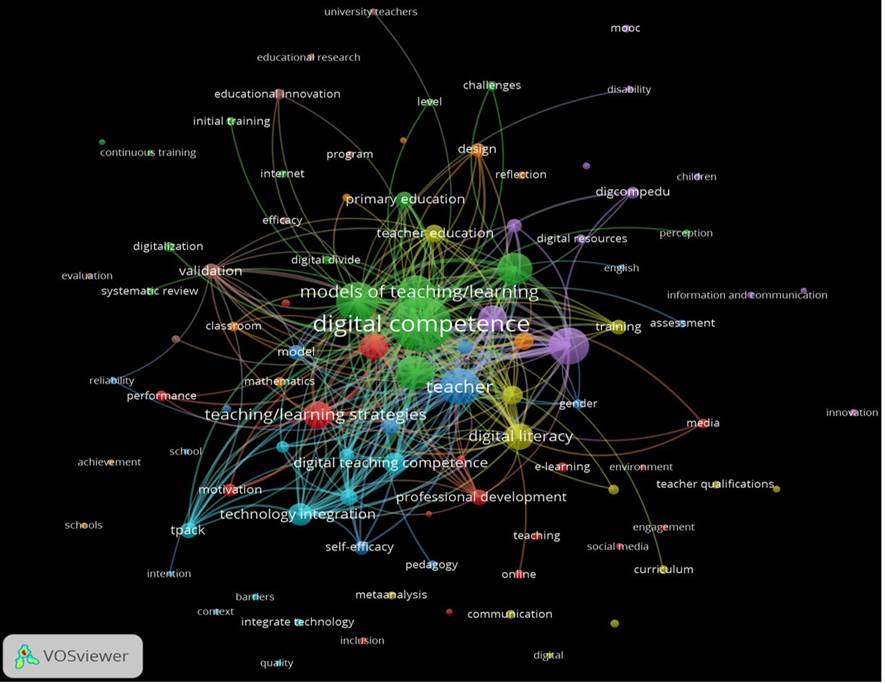
Figure 2:: Keyword co-occurrence map.
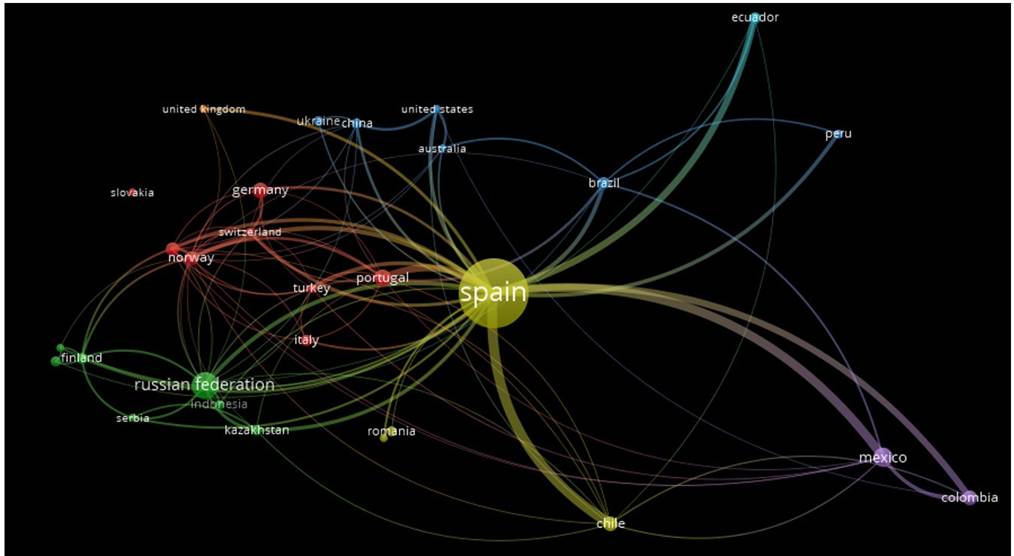
Figure 3:: Bibliographic coupling map by country.
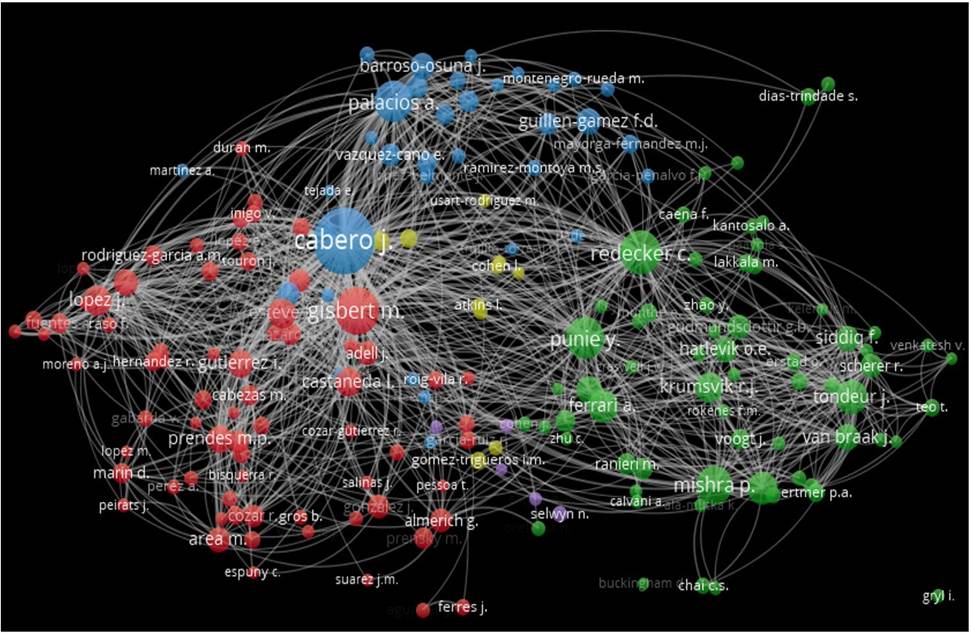
Figure 4:: Co-citation map.
To obtain more information regarding productions by country, we created the bibliographic coupling map by country (Figure 3). Bibliographic coupling occurs when two publications are connected, indicating that both cite a third publication simultaneously (van Eck & Waltman, 2018, p.3). The strongest links occur between Spain-Chile, Spain-Mexico, Spain-Portugal, Spain-Ecuador, Spain-Colombia and Spain-Brazil. However, other connections can be visualized, such as PortugalBrazil and Portugal-Russia.
Based on the acquired information, our efforts sought to identify the fundamental works that support research into digital skills. Thus, we constructed a co-citation a co-citation map among these works, showing references that are cited simultaneously in the selected articles (Figure 4).
Figure 4 reveals the presence of three major clusters, each corresponding to a distinct cohort of authors who hold significant influence in the field. Within this map, we find Cabero and Palácios (blue cluster), Gisbert and Lopez (red cluster), and Redecker, Mishra, Punie, and Tondeur (green cluster), all of whom are highlighted. These authors not only possess their intricate networks of connections but also exhibit interconnections among themselves. In essence, the majority of the works within our corpus cite these authors, thereby underscoring the importance of their writings in the context of this research.
The data can be interpreted by considering that the authors in the highlighted clusters have a history of publishing works about teaching digital skills. Their publications encompass diverse aspects, including the utilization of DigCompEdu’s CheckIn questionnaire, critical examinations of digital milestones, and other relevant facets. Consequently, these authors are references for fellow researchers (Cabero-Almenara, Barroso-Osuna, et al., 2020b,
2020a; Esteve-Mon et al., 2016; Fernández-Batanero et al., 2019). Furthermore, the association of these authors with Spanish institutions may explain Spain’s greater connectivity with other countries, a phenomenon that can be observed in Figures 2 and 3.
For instance, Punya Mishra is recognized for advocating the Technological Pedagogical Content Knowledge framework (TPACK) in collaboration with others. Similarly, Christine Redecker and Yves Punie are proponents of the European Commission’s framework for digital skills for educators, known as DigCompEdu.
This initial bibliometric analysis provided us with valuable insights into the trajectory of research on TDC and teacher education. In addition to the directly investigated terms, the perspectives on teaching and learning models, as well as higher education, appear to be areas of pronounced research interest (Figure 1). Moreover, this research perspective is characterized by a notable concentration of authors from Spain, irrespective of the language of publication. Additionally, the digital competence framework for educators in the European Union serves as a recurring reference point across various works.
Considering this perspective, we proceeded to delineate the works in terms of their objectives, methodologies, and outcomes. Our analysis began focusing on works authored by the most cited authors (Step V).
Among the initial set of 512 papers, the most cited authors (Figure 3) contributed to 42 documents. Notably, some authors did not have papers in this selection, such as Punya Mishra. This observation can be attributed to the nature of these authors’ studies, which involve (TPACK) and (PCK) but not directly TDC. In the case of Christine Redecker and Yves Punie, as previously noted, their works align with the DigCompEdu digital competence framework making them a recurring reference throughout the literature. These 42 selected articles have served as the basis for our exploration of the interplay between TDC and TPK, recognizing that these authors predominantly represent a specific research axis centered around a group of countries.
In order to incorporate work by researchers from other countries who also work in this field, we applied a criterion wherein countries with fewer than 10 publications were considered, since below this value, there were only authors from countries with a maximum of 3 publications. Employing this criterion, an additional 169 works were subjected to preliminary examination through the reading of their abstracts. Those who met the inclusion and exclusion criteria described in the methodology were selected for analysis.
We acknowledge the limitations of our research. Our methodological choice led to texts with more authors from Spain. Although we expanded the search to countries with 10 publications, this factor limits the results. Nevertheless, given the volume of data, we believe our selection should consider the main works in the field, allowing us to gather conceptually relevant data.
3.2 Analysis and characterization of research involving Teaching Digital Competences and Teacher Training
This characterization seeks to incorporate elements that could contribute to the definitions of TDC and identify other research trends in this field. After a detailed analysis of the studies authored by the most frequently cited academics, we note the notion of competence in a broader context before subsequently narrowing their focus on digital skills in the educational domain, specifically, in TDC. The DigCompEdu reference framework emerges as the most prevalent point of reference, and it is directly cited in several instances (Belmonte et al., 2020; Cabero-Almenara, Romero-Tena, et al., 2020;
Cabero-Almenara & Palacios-Rodríguez, 2020; Gutiérrez-Castillo et al., 2023; Martinez-Perez et al., 2022; Martín-Párraga, Llorente-Cejudo, et al., 2022; Rubio-Gragera et al., 2023).
How the DigCompEdu is explored varies depending on the research objectives. Some delve into a detailed analysis of the framework itself, examining its content and suitability as a reference or exploring potential areas for enhancement. On the other hand, other investigations employ it more broadly, utilizing it as a parameter for evaluating courses or proposing assessment tools. In addition to the European DigCompEdu framework, various documents from other institutions are cited either in a complementary fashion or to provide readers with alternative milestones that can serve as reference points about digital competences (Fuentes et al., 2019; Lara-Rivera & CaberoAlmenara, 2021; Pérez-Sanagustin et al., 2022).
Among the documents referenced by the most cited authors, the Common Framework for Teaching Digital Competence, issued by the Instituto Nacional de Tecnologias Educativas y de Formación del Profesorado [National Institute of Educational Technologies and Teacher Training] (INTEF, 2017) under the Ministry of Education, Culture and Sport of the Spanish government, stands out significantly alongside DigCompEdu. Less frequently, references are made to documents from UNESCO (2008) and the International Society for Technology in Education (ISTE), which offer guidelines on general definitions of digital competence and proposals for implementing digital competences assessments for educators and training practices, respectively. Additionally, documents produced by government entities in other countries, such as the Ministeries of Education of Chile and Colombia, receive citations.
In terms of documents emanating from corporate or societal sectors with managerial functions, the Horizon Report for Higher Education, authored by the New Media Consortium in partnership with the EDUCAUSE Learning Initiative (ELI) (Pelletier et al., 2023) merits mention. In summary, it is noteworthy that the DigCompEdu framework plays an important role in shaping the definition of TDC within the body of work reviewed.
DigCompEdu was developed and published in 2017 (Redecker & Punie, 2017) with the main objective of addressing the varied demands of European Member States concerning the perception that educators require a distinct set of digital skills tailored to their profession.
The document highlights that “The framework is intended to support national, regional and local efforts to promote educators’ digital competence by offering a common frame of reference, with a common language and logic” (p. 7). It is, therefore, an instrument that aims to assess and describe the educator’s specific digital competences, proposing 22 elementary competences organized into six areas.
In addition to official documents, definitions of digital skills proposed by different authors emerged, such as the idea of TDC as a transversal and multidimensional skill, as previously mentioned (Graça et al., 2021; Pech et al., 2021). Also considering the use of ICT, there are proposals that TDC be worked as a set of knowledge, skills and attitudes that the teacher must have to use resources effectively and adopt pedagogical criteria (Hidalgo-Durán, 2019).
Note that definitions not associated with these authors are more comprehensive and related to broader professional knowledge contexts (knowing how to do, knowing how to be, knowledge of the context etc). Those proposed by DigCompEdu and INTEF also bring these broader aspects, but direct more detailed perspectives in terms of specific actions.
Other authors present their definitions of TDC based on the European framework DigCompEdu (Fernández-Batanero, Cabero-Almenara, et al., 2022; Fernández-Márquez et al., 2018; HidalgoCajo & Gisbert-Cervera, 2022; Martín-Párraga, Llorente-Cejudo, et al., 2022; Morales et al., 2020), and there are studies that did not define TDC, seeking to analyze a specific technology; or more general aspects of the integration of ICT; or studies with a methodological focus on applying tests and diagnoses (Cabero-Almenara, Vázquez-Cano, et al., 2021; Cabero-Almenara & Palacios-Rodríguez, 2021; Gisbert-Cervera et al., 2022; GonzálezMartinez et al., 2019; Llorente-Cejudo et al., 2022; Miguel-Revilla et al., 2020; Rodríguez-Muñiz et al., 2021).
It is therefore highlighted that the main reference for TDC is the European framework — DigCompEdu, in addition to authors who promote definitions associated more broadly with professional teaching knowledge.
To understand how TDC has been used in teacher training researchs, and what associations and integrations it promotes, we proceed with the characterization of the work focusing on its main objectives, methods and results. Therefore, this more detailed analysis of the works aims to investigate whether the integration between digital competences and professional knowledge occurs, as it does, or whether we can consider possibilities for a discussion about this integration.
We categorized the works developed by the most cited authors together with works from countries with 10 or more articles produced, as highlighted in the methodology. In relation to the set of countries with 10 or more articles produced, the reading of the abstracts was carried out by excluding 95 texts as they were not within the scope of this review. This was done by the exclusion and inclusion criteria proposed in the methodology, resulting in a final analysis of 76 articles and a total of 118 works.
After reading and analyzing focusing at the objectives, methodologies and results, and also considering our second specific objective, five emerging categories were established:
C1. Construction and implementation of an instrument for evaluating TDC — 34 works. It comprises manuscripts dedicated to the implementation of tests already developed for the assessment, such as the DigCompEdu CheckIn questionnarie and research that adapts these instruments.
C2. Use of specific technological resources — 30 works. It comprises manuscripts focused on approaching ICT in different ways.
C3. Evaluation of courses, teacher training courses or curricula — 26 works. It comprises manuscripts that aim to evaluate how training impact training for TDC and how these appear in teacher training curricula.
C4. Investigations into the theoretical frameworks of TDC and theoretical articles — 17 works. They comprise manuscripts that provide analyses of different theoretical frameworks and literature analyses for TDC and TPK topics.
C5. Factors that impact TDC — 11 works. They comprise manuscripts that seek correlations between TDC levels and different professional and personal factors.
In order to systematize such results and refrain from an overextended discussion, we listed, for some articles, units of meaning representing the ideas that led to the allocation in their respective category through tables and discussed the general ideas of the other articles in the subsequent body of text. We chose to translate the units arising from articles in Portuguese and Spanish.
3.3 Construction and implementation of an instrument for evaluating TDC (C1)
Since 2015, of the 34 works under analysis, a large number have been dedicated to the implementation of questionnaires already developed for assessmente of TDC, such as the DigCompEdu Check-In questionnarie. Nevertheless, there is research that assesses the adequacy of these instruments or develops them (for pre-service and in-service teachers), based on the TDC specified in the references of the European Commission (DigCompEdu), INTEF, or others mentioned above. Table 1 illustrates some of the works and units of meaning that take part in our classification.
Adaptations for other contexts or for teachers at different levels are common. The authors CaberoAlmenara and Palacios-Rodríguez present a series of works in the context of countries in Central America, Latin America and regions of Spain (Cabero-Almenara, Barroso-Osuna, et al., 2020b; Cabero-Almenara, Gutiérrez-Castillo, et al., 2020; Cabero-Almenara, Vázquez-Cano, et al., 2021;
Cabero-Almenara & Palacios-Rodríguez, 2020; Palacios-Rodríguez et al., 2022; Rubio-Gragera et al., 2023). Most analyzed works show a clear concern for peer validation and the application of a statistical framework.
A set of works was dedicated to diagnosing TDC for higher education and, to a lesser extent, secondary education. For teachers in training, there are also adjustments to questionnaires, but the body of work is substantially smaller (Cantabrana et al., 2019; Martinez-Perez et al., 2022; Urbina et al., 2022; Vakaliuk et al., 2022). Therefore, the term “higher education”, quite recurrent in keywords, refers to works that aim to recognize TDC for teachers working in higher education.
In addition to TDC, some investigations aim to recognize teachers’ knowledge about digital literacy (Kostenko et al., 2023), and to look at digital skills for the use of a specific resource, such as the case of augmented reality (Fuentes et al., 2019).
Table 1:: Articles and units of meaning associated with Category 1.
Articles
Units of meaning
1. Cantabrana et al. (2019)
- we will describe the structure we used as a guide for creating the TDC (Teacher Digital Competence) test presented in this article. - Based on this content analysis, we believe that the evaluation rubric created by Lázaro and Gisbert (2015) is an appropriate instrument to evaluate TDC, in line with two government proposals: one international (DigCompEdu) and one national.
2. Cabero-Almenara & Palacios-Rodríguez (2020)
- the translation and adaptation into Spanish of the «DigCompEdu Check-In» questionnaire is presented. - this investigation calls for a study of the validity of the questionnaire through solid, stable and quality models such as, for example, the empirical validation of the instrument through exploratory factor analysis and confirmatory factor analysis.
3. Martinez-Perez et al. (2022)
- two online questionnaires were administered at the beginning of the course: the Digital Didactic Skills Questionnaire (DigCompEdu) and the Content Questionnaire: Digital Resources and Digital Pedagogy.
Understanding the level of TDC for pre-service teachers and in-service teachers is extremely important, as such data can support the development of training and courses. In this context, the work of Gisbert-Cervera et al (2022) stands out for carrying
out the diagnosis and, after recognizing the gaps, developed and evaluated a Massive Online Open Course (MOOC) based on the recognized context and emerging demands (Gisbert-Cervera et al., 2022). The course developed involved modules for each of the 22 digital competences reported by DigCompEdu and was evaluated by experts. Most of the manuscripts, such as Article 3, still identify a low level of TDC even in university teachers. Another similar studies were developed in Paraguay, with the evaluation of 330 teachers (Estigarribia et al., 2022) and in Galicia, where was proposed an investigation with 610 professors from public universities(Fernández-Morante et al., 2023). Therefore, these and other studies grouped in this category recommend reflecting upon the development of TDC through training, considering the perspective of training trainers.
The fact that most studies still focus on diagnosing the level of TDC is a consequence of the complexity and contemporary nature of the topic. Although the use of technological resources is not new, TDC can be considered current. Hence, it is estimated that this area is in a phase of understanding and definition, so that training proposals can be concretely implemented.
In the European context, where diagnoses with teachers have been more frequent, training paths or plans have already been designed, such as the Plano de Ação para a Transição Digital [Action Plan for Digital Transition] (PATD) in Portugal, which, after applying the Check-In questionnaire defined training actions for trainers who, in turn, would be replicators of such actions. Currently, a follow-up questionnaire called Self-reflection on Effective Learning by Fostering the use of Innovative Educational Technologies (SELFIE) (Economou, 2023) has been disseminated as a strategy to recognize the development of TDC. However, initial teacher training does not appear to be the scope of the work developed to date, as can be seen in some studies that point to the absence of content focused on TDC in teacher training curricula, despite technological resources being present in some subjects (de Silva & Costa, 2022; Pinto-Santos & Garcias, 2022).
3.4 Use of specific technological resources (C2)
A set of works was identified with a focus on approaching ICT in education. However, there is little integration of the use of ICT associated with TDC. Of the 30 works in this category, only a third associated the use of technological resources with TDC. That is, carrying out an investigation that evaluates the use of a specific resource associated not only with the development of skills in use, but also with an inquiry into the digital competences to which they are directly related (Araújo et al., 2021; Braslavska et al., 2021; Cabero-Almenara et al., 2022; Cabero-Almenara, Vázquez-Cano, et al., 2021; Danilaev & Malivanov, 2020; FernándezBatanero et al., 2019; Isupova et al., 2021; Meneses & Cerero, 2020; Palacios-Rodríguez et al., 2022; Zhernovnykova et al., 2020). Table 2 illustrates some of these works.
It is important to highlight the works that seek to integrate resources considered recent, such as augmented reality, resources involving digital media (transmedia and polymedia), the use of digital games, and even software already consolidated in teaching, such as Geogebra. It is essential to reflect upon the use of these resources and the professional knowledge associated with this use. The idea of using technologies has been present in the educational field for a long time, and references such as TPACK and PCK have already been used in these studies. However, the studies promote a discussion with a greater focus on technology as a resource and do not delve into discussions associated with TDC. Considering that both domains must be explored in training, looking for points of intersection that can be worked on in joint actions takes on an important place for research within this field.
Table 2:: Articles and units of meaning associated with Category 2.
Articles
Units of meaning
Martín-Párraga et al. (2022)
- The aims and objectives pursued with the training action are the following: Know basic concepts related to games, video games, Game-Based Learning (GBL) and gamification. Gamification in Higher Education. Know the different elements of the game relevant to its application in the areas that are required. Develop skills for producing gamification resources using free software or with an educational license.
Pérez et al. (2022)
- 1) evaluate the didactic, digital, socio-collaborative and creative skills of university students based on their Gamified Reports with Augmented Reality; and 2) determine the possible differences between the former undergraduate student and the participating Master’s student. - [...] the Gamified Stories with Augmented Reality created by the students allowed them to infer their skills, observing a high general level. Specifically, the greatest is found in didactic competence, [...].
Semenikhina et al. (2019)
- The article proposes one of the solutions to the problem of computerization of the educational process, introducing the BYOD (Bring Your Own Device) approach into the learning process. - GeoGebra as a cloud environment for placing visualized content; GeoGebra as a cloud environment to organize not only analytical but empirical searches for answers in defining some characteristics of mathematical objects; GeoGebra as a cloud environment for experimentation on home computers.
Table 3:: Articles and units of meaning associated with Category 3.
Articles
Units of meaning
Gutiérrez- Castillo et al. (2023)
- […] carry out an expert evaluation of a training design for the development of digital teacher competence (DTC) using the DigCompEdu reference framework - T-MOOC included tasks of different kinds: creation of concept maps, participation in group forums, design of blogs, construction of personal learning environments (PLE), elaboration of e-activities for students, construction of learning communities, among others.
Morales et al. (2020)
- The objective is how digital competence teaching (TDC) is incorporated into course programs as part of student training [...]. - In the “Informática” [Informatics] program it is verified that the analyzed components have little relationship with the TDC, according to the matrix used for the analysis. - [...] we highlight that the programs analyzed, although they unevenly include most of the components of the TDC, do not respond to current training needs in terms of competence-based training.
de Silva & Costa (2022)
- [...] aims to present an analysis of the curricular matrices of initial teacher training courses at three Portuguese public universities, [...], aiming to understand, in a contextual curricular way, how digital technologies are being approached in order to allow that future teachers develop the skills necessary for their integration into the classroom.
3.5 Evaluation of courses, training actions or curricula (C3)
This category is pertinent because, beyond diagnosing TDC and TPK, contemplating teacher training initiatives and assessing their outcomes is essential for discerning the effectiveness of proposed actions aimed at narrowing the digital gap in the educational landscape. On the other hand, we identified only eight of the 26 works focusing on the evaluation of training actions, which suggests that such proposals still require further development (Gafuanov & Podnebesova, 2020; Ivaniuk et al., 2020; Khoruzha et al., 2020; Ortega-Rodríguez et al., 2022; Pech et al., 2021; Roliak, 2019; A. R. P. Santos et al., 2023; Zeller, 2022). Table 3 illustrates some of the works and units of meaning.
Positively, the evaluations showed, in all cases, that training systems, whether specific or lasting longer, could help teachers advance in TDC levels. When thinking about the perspectives in this field, longitudinal research is still non-existent due to the contemporary nature of the topic.
Other works within this category evaluated the course curricula, as exemplified by Work 9 highlighted in Table 3, and assessed proposals that were developed but not implemented. In Work 7 from Table 9, for instance, experts in the field assessed MOOCs for TDC development without implementing the course itself.
The low frequency of implementation and dissemination of results may be a reflection of the recent nature of the proposals, as already discussed. However, the works already published tend to have the potential to recognize the TDC development. Some evaluations do not appear in the works, such as monitoring the TDC in longitudinal research or observing how teachers who participated in the training implement TDC in their practices.
Other works related to this aspect stand out, which seek to propose a link between TDC and TPK (Feo, 2023). Along the same lines, but based on a more general idea, other authors try to promote the articulation between digital literacy and TPACK components (Wohlfart & Wagner, 2022). Even though there are similarities, the works address more general characteristics, not delving into the knowledge domains established by the construct.
3.6 Investigations on the theoretical frameworks of TDC and theoretical articles (C4)
The works in this category present comparisons between distinct theoretical references and literature analyses for a specific TDC theme permeating different objectives. There are studies that propose sought to carry out an evaluation by experts of the diverse TDC frameworks to adopt the most appropriate one for assessment (CaberoAlmenara, Romero-Tena, et al., 2020). The complexity of meanings reported by theoretical references distinguishes itself despite a common axis linked to digitalization and the capacity for the critical use of different digital resources and services. In this sense, the authors seek an appropriate reference to evaluate the course they propose, considering the specificity of their context. Table 4 illustrates some of the works and units of meaning.
Table 4:: Articles and units of meaning associated with Category 4.
Articles
Units of meaning
Gutiérrez- Castillo et al. (2023)
- […] carry out an expert evaluation of a training design for the development of digital teacher competence (DTC) using the DigCompEdu reference framework - T-MOOC included tasks of different kinds: creation of concept maps, participation in group forums, design of blogs, construction of personal learning environments (PLE), elaboration of e-activities for students, construction of learning communities, among others.
Morales et al. (2020)
- The objective is how digital competence teaching (TDC) is incorporated into course programs as part of student training [...]. - In the “Informática” [Informatics] program it is verified that the analyzed components have little relationship with the TDC, according to the matrix used for the analysis. - [...] we highlight that the programs analyzed, although they unevenly include most of the components of the TDC, do not respond to current training needs in terms of competence-based training.
de Silva & Costa (2022)
- [...] aims to present an analysis of the curricular matrices of initial teacher training courses at three Portuguese public universities, [...], aiming to understand, in a contextual curricular way, how digital technologies are being approached in order to allow that future teachers develop the skills necessary for their integration into the classroom.
It is relevant to highlight that, although DigCompEdu’s Check-In questionnaire is considered a base tool for TDC analysis, it requires adjustments due to local specificities. The conditions of digital access, for example, are different depending on the region of the world and, therefore, understanding existing frameworks as base documents, and not as predefined models for implementation, needs to be considered.
The literature review works present varied proposals, such as a comparative analysis between the different TDC frameworks (work 10 in Table 4) and reviews on TDC for teachers in higher education (work 11 in Table 4). Furthermore, articles reporting trends in the use of technologies and reviews oft TPACK and educational technologies were also found and grouped in this category (Dzhurylo & Shparyk, 2019; Frolova et al., 2020; Mattar et al., 2022; Monteiro et al., 2020; Reinhold et al., 2021; Ricardo-Barreto et al., 2020; Wohlfart & Wagner, 2022). Some of the articles highlight that the production of work in the last year has grown and that aspects related to the use of technologies in the domestic environment have an influence on TDC levels (FernándezBatanero, Montenegro-Rueda, et al., 2022). In other words, there is a correlation between the general digital competences of citizens and the digital competence of teachers.
3.7 Factors that impact TDC (C5)
The last category identified consists of works that sought to create correlations between TDC levels and different professional and personal factors. They aimed, in general, to identify the factors that affect the teaching of digital competences and their development. The manuscripts investigated factors such as gender, age, experience, motivational aspects, and area of activity, among others (da Silva & Costa, 2023; Graça et al., 2021; Hung et al., 2019; Manzanero & Gonzalez, 2023; Pozas & Letzel, 2023; Torres-Flórez & Pachón-Pérez, 2021; Tsiuniak et al., 2022). Table 5 illustrates some of the works and units of meaning.
Table 5:: Articles and units of meaning associated with Category 5.
Articles
Units of meaning
10. Cabero-Almenara et al. (2020)
- After the round carried out by the judges, an excellent TDC framework was obtained, that is, DigCompEdu, followed by INTEF. [...] Such results will be used in the DIPROMOOC research project to address the teacher training plan from the perspective selected by the experts, as well as to provide our institutions with appropriate guidelines to establish teacher training plans in TDC.
11. Fernandez-Batanero et al. (2021)
- [...] identify the most relevant scientific literature on the digital skills of university teachers through the analysis of scientific literature published between 2009-2019. - Digital skills training for university teachers is limited; the analysis revealed that they mainly use ICT for basic activities such as presenting visual resources (35%) or for word processing programs (25%), followed by Internet access (20%). To a lesser extent, they are used for other more advanced applications (10%), such as the creation and editing of digital resources (10%).
12. Sierra et al. (2023)
- Most studies reveal the imperative relationship of TPACK’s three basic bodies of knowledge: technological knowledge (TK), pedagogical knowledge (PK) and content knowledge (CK) - The integrative vision is a consolidated theoretical perspective that has been used for the initial and continuing training of teachers [...]
In this sense, the work of Sánchez-Prieto et al. (2021) identifies that women have a higher level of digital content creation than men, with an emphasis on problem-solving. It also points out that there is an inversely proportional relationship between age, and competence level and that experience in use improves the level of digital security, emphasizing that continuous training is an aspect that directly influences the level of TDC.
The excerpts in Table 5 point to the development of skills (Work 13), relationships between the use of social networks and professional areas (Work 14), and, in the specific case of competences to work with disabled students, factors that influence the level of TDC (Work 15).
Studies of this nature are relevant because, in addition to diagnostic questionnaires, they can support the development of training actions and appropriate guidance for groups with the greatest need for the development of TDC. The data reveal a strong correlation between the low use of technological resources and the low level of TDC (Cabero-Almenara, Guillén-Gámez, et al., 2021). However, other researches indicate that a given teacher can use a kind of technological resource critically and innovatively without having extensive knowledge of other technologies (Valle & Girotto, 2021). In this context, thinking about the association between professional knowledge and TDC could support interpretations of more complex situations.
The focus of the characterization carried out was to identify trends in the research within the scope of TDC associated with teacher training. In addition to the data and interpretations already presented, we understand that there has been a substantial increase in work involving TDC in recent years, as well as those involving the integration of technologies in education. Nevertheless, the review exhibits a gap between the fields of TDC and TPK development. We also highlight that there is a small number of works seeking to articulate these theoretical-practical fields of activity.
We therefore consider that, based on the analysis of the set of productions developed over the last few years, we might be able to respond to objectives (i) and (ii) from this first analysis. In summary, and by integrating the works and categories, it was possible to identify a set of works that carry out diagnoses on competences with a focus on a) identifying factors that impact the level of TDC; b) proposing training actions; c) assessing the level of TDC after training actions; and d) recognizing TDC levels regardless of training actions.
There is also a set of studies regarding the TDC frameworks, studies focusing on specific technologies, and studies evaluating TDC in teacher training curricula.
Considering that, in our analysis so far, it has not been possible to recognize works that, during training, seek to act on both fronts, i.e. integrating TDC directly into Teaching Professional Knowledge, we can delve into our second research question, which is guided by our objective (iii): Build relationships between TDC and TPK, identifying possibilities for teacher training.
In the next section, we propose an integration between these areas, considering the PCK and TPACK references.
3.8 Approximations between TDC and TPK
We adopted some important assumptions that arose from the previous analysis, resulting from bibliometric analysis and the content of the most relevant articles in the field. These assumptions are: i) The DigCompEdu framework is an important reference in this field, and therefore, the twentytwo competencies associated with its six areas are used as the basis for the TDC; ii) The components of PCK and TPACK are the references for the TPK; iii) We consider that there are conceptual domains specific to each field, and therefore, there is no complete integration between TDC and TPK.
In this way, we propose the establishment of relationships between the components of PCK and TPACK, and the competences of DigCompEdu. We understand that PCK and TPACK are powerful tools used in teacher training. Thus, developing proposals to link them to TDC could offer contributions to the area.
Figures 5 and 6 illustrate the correlation between the components of knowledge in different formats as presented in the PCK base of the Refined Consensus Model (Hume et al., 2020), the components of TPACK (Mishra & Koehler, 2006), and the digital competences of DigCompEdu. The diagrams presented in the two figures show components considered by referees as possible for integration. Competences a1, c2, a5, c6, d6, and e6 are not expressed in Figure 5 and Figure 6 because, as we discuss below, they present, according to peer analysis, a more general character and were not specifically associated with TPK.
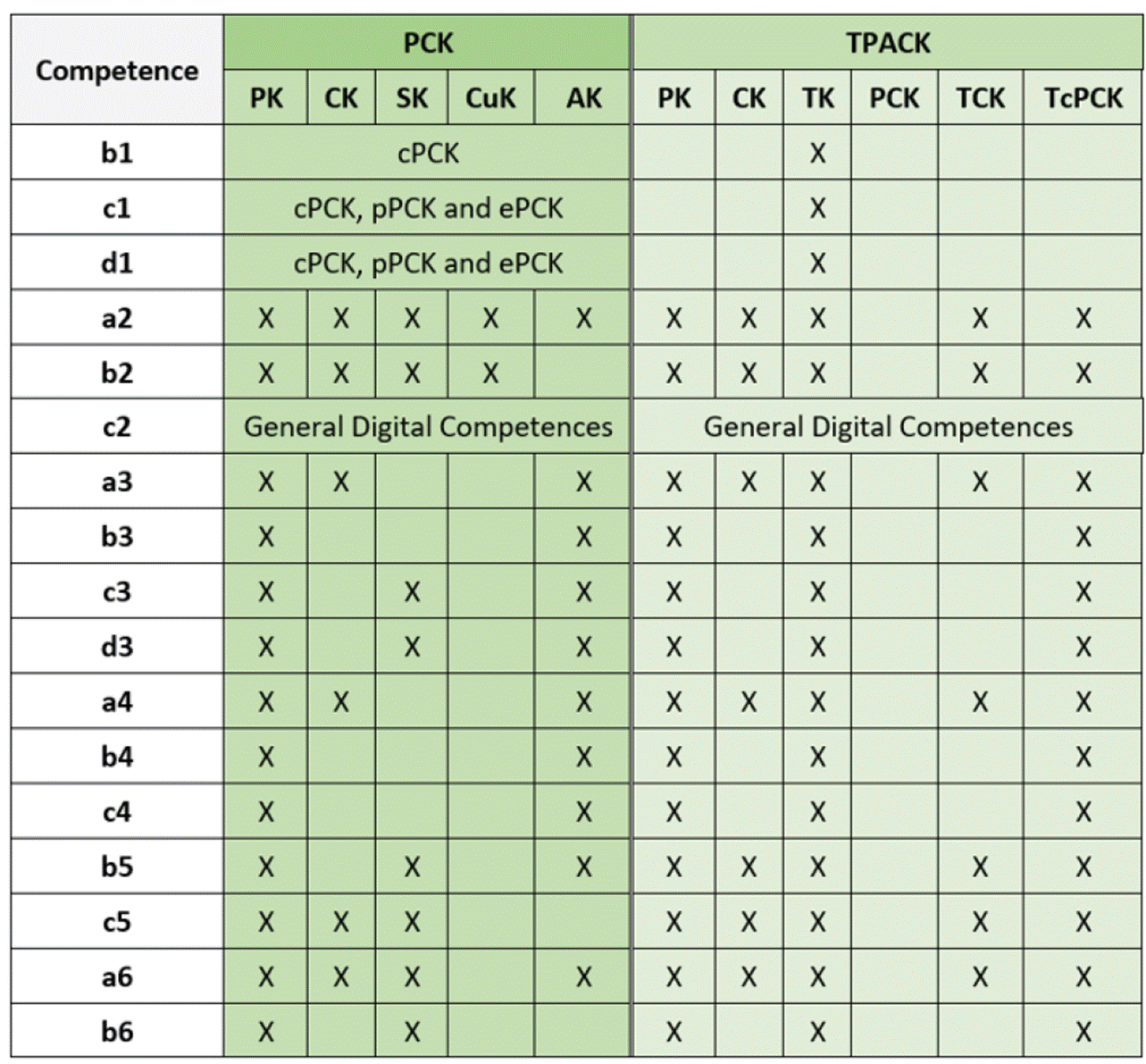
Figure 5:: Relationships between TDC and PCK and TPACK base knowledge.
As previously delineated, competences labeled as a1, c2, a5, c6, d6, and e6 have been categorized as general proficiencies. Notably, upon closer examination, it becomes evident that these competences encompass technological domains that may not inherently align with the concept of amalgamating pedagogical, technological, and content knowledge. It is important to emphasize that this perception does not imply a strict demarcation between TDC and TPK but acknowledges that nuances exist within each field of study.
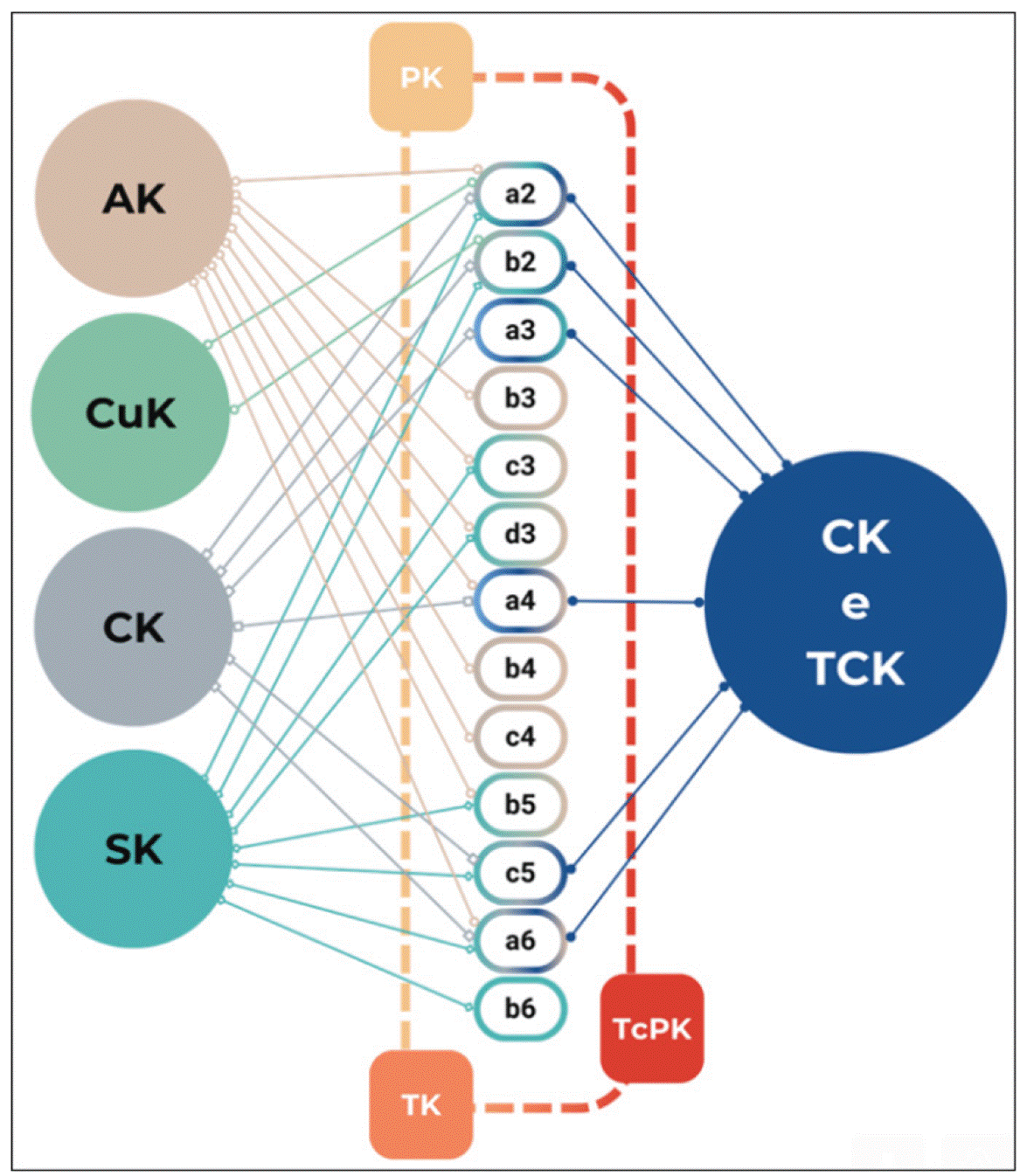
Figure 6:: Diagram of relationships between TDC and knowledge based on PCK and TPACK.
To exemplify this perspective, when we scrutinize competences d6, denoted as ‘Responsible Use’, and e6, referred to as ‘Resolution of Digital Problems’, it becomes apparent that they are linked to aspects of data security, software utilization, open resource adoption, and the resolution of technical issues in websites, software applications, or equipment. While these competences are indeed indispensable for educators, they may not be inherently connected to the educational context. When viewed through the lens of teacher training within the framework of PCK and TPACK, these proficiencies do not exhibit direct correlations with specific subject matter within a domain of knowledge or pedagogical expertise. Concurrently, ‘Organizational Communication’ (a1) is related to the tools by which educators engage professionally with administrators and parents via ICT such as email, messaging platforms, blogs, Virtual Learning Environments (VLEs), and others.
In light of this, we discern that this set of competences aligns closely with the general competences expected of a responsible citizen. The development of these competences can be accomplished through dedicated courses centered on technological proficiency, which may encompass contemporary topics such as the utilization and implications of artificial intelligence technologies.
Within the context of PCK, competences b1, c1, and d1 go beyond the realms of fundamental knowledge, involving reflective practices and ongoing collaboration in the development of collective or individual expertise arising from reflexive pedagogical engagement. Therefore, we posit that these competences need not be exclusively addressed within the ambit of TPK training courses, as they necessitate onsite, individual, or collaborative observation of professional performance. This perspective matches the discussions advanced in the Refined Consensus Model (Hume et al., 2020).
For the remaining competences associated with the PCK/TPACK domains, we underscore an initial argument that guides our exploration. PCK and TPACK undeniably encompass a body of knowledge profoundly influenced by specific content domains (Berry et al., 2008; Chan, 2022; Putri et al., 2020). In essence, the PCK of a chemistry educator differs when addressing topics such as chemical bonding or organic functional groups. In contrast, TDC, by its inherent nature, spans a broader spectrum and is not intrinsically tied to specific content. Nevertheless, our perspective acknowledges the possibility of incorporating actions aimed at fostering both PCK and TPACK in teacher training, while also integrating planned activities that include TDC. Collaborative efforts can engender a more contextually grounded comprehension of a given subject matter within the educator’s domain of expertise.
This is similar to existing practices observed in the context of general and subject-specific didactics, commonly addressed in pedagogical practice courses or subjects with specific content, as already occurs in certain educational programs.
Thus, the exercise undertaken here involves the exploration of relationships and the contemplation of training scenarios that elucidate these possibilities.
The development of the various knowledge domains within the teaching profession occurs through theoretical training and practical experiences, which can be either individualized or integrated. Content knowledge (CK) can be developed through pedagogical actions in a set of disciplines in subject areas such as Chemistry, Physics, History, and others. On the other hand, knowledge related to the assessment process can be developed in specialized disciplines such as Didactics or Curriculum and Assessment. However, the acquisition of subject-specific knowledge and pedagogical knowledge could converge in contexts such as specialized Didactics courses, supervised internships, and other components of initial teacher training (D. Santos et al., 2020). The integration of these knowledge components, including personal knowledge, planning, implementation, and reflection, collectively contributes to the development of TPK.
Considering the intersection with TDC, it becomes apparent that working with pedagogical and assessment knowledge in conjunction with digital skills is a viable approach. This brings us back to our second research question: based on the definitions of TDC and the references of PCK and TPACK, can these frameworks be harmoniously integrated to propose a synthesized framework?
In this regard, we contemplate that, for instance, in a training course focused on specific didactics (e.g., Didactics for Teaching Chemistry), there is potential to incorporate assessment components tailored to specific content while concurrently engaging with various technological tools beyond mere instrumental use. Similar practices have already been demonstrated in teacher training, such as the utilization of quizzes and educational games (Barcena-Toyos, 2022; Horacek & de Anso, 2019; Sáez-López et al., 2023).
When considering a broader perspective on technology, encompassing digital competences, it is plausible to explore competences like a4 (‘Evaluation of strategies’), b4 (‘Analyzing evidence’), and c4 (‘Feedback and planning’) within this training context. In this scenario, beyond discussing assessment attributes, methods, instruments, and pedagogical design, deliberations on the integration of ICT may include aspects such as data management facilitated by digital tools, automated feedback, personalized guidance, and instruction on students’ utilization of data for selfregulated learning, among others.
Once again, we underscore the significance of situating these endeavors within a specific content context, which holds the potential to enhance not only PCK and TPACK but also TDC. This integrated approach addresses knowledge pertinent to specific content, student learning, and the proficient management of technological resources simultaneously.
When considering the integration of components associated with professional knowledge and TDC, it is essential to consider that each component has been addressed, measured, and evaluated independently. Therefore, it is important to recognize specific access and assessment mechanisms. This constitutes a second argument for our proposal, involving the integration of established instruments.
It is noteworthy that considerable emphasis has been placed on the recognition and assessment of TPACK and PCK in the scholarly literature (Malcolm et al., 2019; Mavhunga, 2016; Widyasari et al., 2022) as well as the identification of digital competency levels, as evident in works within Category 1. Given the distinct methodological paths adopted in each of these areas, establishing a direct association (e.g., equating proficiency in PCK and TPACK with an advanced level of TDC) could result in an inaccurate correlation.
Reflecting on the development of content knowledge involves discussions related to specific didactics, encompassing epistemological aspects of scientific knowledge, learning theories, and pedagogical approaches within a context of technological integration. These intricate interconnections contribute to the improvement of PCK and TPACK, but they may not necessarily correlate with DCT, as a teacher may possess a high degree of technological competence in teaching specific content without necessarily incorporating advanced TDC (Valle & Girotto, 2021). In this sense, recognition mechanisms are distinct, and this needs to be specifically addressed in training initiatives, such as specific assessment protocols.
Research with TPK has employed various instruments to assess PCK and TPACK (Candela, 2017; Harris et al., 2009; Koehler et al., 2012; Loughran et al., 2004; Oliveira & Mozzer, 2017). Additionally, our review has exhaustively explored methods for recognizing TDC. In the context of initial teacher education, where classroom practice may not have begun, declarative PCK assessment tools, such as Content Representation (CoRe) and rubrics for teaching sequence planning and analysis, could be employed in conjunction with TDC recognition questionnaires. The literature has already witnessed adaptations to the CheckIn questionnaire for trainee teachers (Quast et al., 2023) based on DigCompEdu.
Moving to in-service teacher training, which affords opportunities for observation and consequently the recognition of procedural PCK PCK through teachers’ actions during practice, when coupled with TDC reflection, holds the potential to facilitate recognition. For example, the combined check-in questionnaire and the reflective approach during practical actions can contribute to the assessment of TPK and TDC.
It is important to emphasize that our proposal, forged through dialogue with existing research, aims to enrich the field of teachers’ professional and technological development. The literature has already noted common aspects between PCK, TPACK and TDC, especially the first two, although in different ways compared to our approach. Wohlfart & Wagner’s work (2022) conducted a review of published texts, highlighting that TPACK has frequently been associated with digital literacy. Nevertheless, there is an understanding that the development of TPACK does not inherently guarantee the development of digital literacy, as discussed earlier. Moreover, digital literacy itself boasts multiple, at times polysemic, definitions, with some works proposing the incorporation of TPACK as a component of digital literacy (Willermark, 2018).
An examination of this group of research allows us to introduce a third argument, suggesting that, although TPK and TDC have been explored in depth, they lack an operational systematization suitable for use in training and for the recognition of knowledge and competence in a less polysemic and integrated way.
In other words, due to the complexity of these fields, some studies have focused more specifically on TDC, while others have adopted a broader perspective on TPK. Consequently, different research efforts have addressed these aspects separately, as exemplified in Category 2. For instance, some authors developed training programs for technology use, evaluating TDC based on TPACK references but without delving into the specific knowledge domains associated with the PCK and TPACK models (Tomte et al., 2015).
The attempt to integrate these domains is not unprecedented, but the association of digital skills related to ICT in the school context tends to focus on general aspects (Dzhurylo & Shparyk, 2019). Our proposal revolves around the notion of directing greater attention to this integration, in order to harmonize the aspects of TDC with those specifically focused on TPK, presenting a complementary approach.
One of the primary challenges of establishing integration is, possibly, that from the point of view of developing training actions and evaluating them integrating both areas, there is a complexity of topics involved. For instance, interpreting TDC from a PCK perspective may necessitate reference to the Refined Consensual Model and its association with other models designed to assess the foundational knowledge that constitutes PCK.
On the other hand, linking TDC with the training practices adopted in these domains requires specialized recognition instruments and adequate preparation of trainers for an effective approach. This network of intricacies represents a critical aspect that demands careful consideration when implementing proposals. This network complexity is, in fact, a necessary issue of consideration for such implementation, which we pose as a challenge that we consider possible to overcome since the areas involved already have mechanisms that are markedly consolidated in the literature.
4. Final considerations
In our quest to establish the connection between teacher training aimed at fostering TDC and TPK, it is essential to recognize the transformation within the educational landscape. This transformation extends beyond the mere integration of isolated TDC knowledge with content or pedagogical practice; it involves a profound understanding of the digitization of society. This digitization entails activities such as information retrieval, data processing, the utilization of monitoring systems, self-regulated learning, and active learner participation.
Our reflective approach, inspired by Shulman’s paradigm (1986), forms the basis for considering the integration of pedagogical, technological knowledge, and TDC. In this context, we underscore that when considering digital competences, both pedagogical and specific content should be intentionally woven into the development of TDC. This transformative process necessitates fresh perspectives on the intricate system of teacher professional development.
Several central aspects of this proposed integration warrant recognition. Firstly, it is essential to recognize the need to integrate specific aspects of TDC into broader training contexts, including, but not limited to, general competences such as a1, c2, a5, c6, d6, and e6.
In addition to these general competences, we recognize the potential for articulation between various facets of TDC and the knowledge derived from PCK and TPACK models. This perspective emerges as we contemplate the intentional inclusion of elements from both references in training courses.
Thus, returning to our research questions, the review data and analysis of the studies point to actions that address TDC and TPK in distinct ways but that can be worked on jointly. We believe that this integration has the potential to benefit teachers’ professional development. The proposal that emerges in Figures 5 and 6 is an attempt to consider this integration, aligning elements that can be worked on jointly and recognizing those that require individualized work.
Subjects within initial teacher training programs can accommodate some practices in this way. As examples, we can cite specific didactic courses (Didacts for Chemistry / Physics; Maths; History, etc.), educational practices in technology courses focusing on collaborative data utilization, and courses centered on active pedagogical methodologies that systematically integrate technology. Additionally, specific disciplines addressing pedagogical topics could explore aspects of assessment alongside digital pedagogical monitoring systems and communication within the educational context. Furthermore, the STEM/ STEAM education, well-documented in the literature across various training paths, could also encompass elements of TDC (Boice et al., 2021; Morais & Araújo, 2023).
It is important to emphasize that TDC and TPK are multifaceted, and we do not posit that all elements must be addressed in a single action. Rather, a gradual incorporation of these elements into various disciplines throughout the training process can lead to the development of a more robust knowledge base and professional competence among educators. Such integration should be achieved by intertwining ICT seamlessly with pedagogical reflection, curriculum development, and the school context.
However, the inclusion of both TDC and TPK in training proposals necessitates the consideration of complex monitoring systems. Consequently, these practices lead us to careful reflection and planning within this complexity. Recognizing professional knowledge via declarative systems and evaluating digital competences through self-perception assessments is important for understanding demands and developing appropriate actions.
Nevertheless, it is crucial to acknowledge that the analysis of how TDC and TPK develop should not be confined to pre and post-tests with uniform standards, but also involving longitudinal studies and observations. An examination of didactic plans and and longitudinal studies could enable on-site monitoring of professional practices, while considering the analysis of knowledge and competences within a procedural context.
Given the foundations we have outlined, we propose future perspectives that involve the development of training initiatives that methodically incorporate TDC and TPK. These initiatives should consider pre-assessments, ongoing follow-ups over time, and participation in more longitudinal programs.
Lastly, it is important to consider forthcoming advancements in this field, especially concerning the potential impact of Artificial Intelligence (AI). AI represents a novel set of technologies with the potential to significantly impact education, generating a wealth of information. This emerging field of knowledge and competences is poised for exploration alongside the integration of established technologies, constituting a topic of ongoing and intensifying discussions.
5. References
Licencia
Derechos de autor 2025 Gildo Girotto Girotto Júnior, Carla Morais, Luciane Fernandes Goes, Guilherme Gonçalves Costa

Esta obra está bajo una licencia internacional Creative Commons Atribución-NoComercial-CompartirIgual 4.0.
Góndola, Ens Aprend Cienc. es una publicación de acceso abierto, sin cargos económicos para autores ni lectores. La publicación, consulta o descarga de los contenidos de la revista no genera costo alguno para los autores ni los lectores, toda vez que la Universidad Distrital Francisco José de Caldas asume los gastos relacionados con edición, gestión y publicación. Los pares evaluadores no reciben retribución económica alguna por su valiosa contribución. Se entiende el trabajo de todos los actores mencionados anteriormente como un aporte al fortalecimiento y crecimiento de la comunidad investigadora en el campo de la Enseñanza de las Ciencias.
A partir del 01 de diciembre de 2018 los contenidos de la revista se publican bajo los términos de la Licencia Creative Commons Atribución–No comercial–Compartir igual 4.0 Internacional (CC-BY-NC-SA 4.0), bajo la cual otros podrán distribuir, remezclar, retocar, y crear a partir de la obra de modo no comercial, siempre y cuando den crédito y licencien sus nuevas creaciones bajo las mismas condiciones.
Los titulares de los derechos de autor son los autores y la revista Góndola, Ens Aprend Cienc. Los titulares conservan todos los derechos sin restricciones, respetando los términos de la licencia en cuanto a la consulta, descarga y distribución del material.
Cuando la obra o alguno de sus elementos se halle en el dominio público según la ley vigente aplicable, esta situación no quedará afectada por la licencia.
Asimismo, incentivamos a los autores a depositar sus contribuciones en otros repositorios institucionales y temáticos, con la certeza de que la cultura y el conocimiento es un bien de todos y para todos.



.jpg)